Mobile Navigation

  • National
    • Policy
      • High Expectations
      • Quality Choices
      • Personalized Pathways
    • Research
    • Commentary
      • Gadfly Newsletter
      • Flypaper Blog
    • Events
    • Scholars Program
  • Ohio
    • Policy
      • Priorities
      • Media & Testimony
    • Research
    • Commentary
      • Ohio Education Gadfly Biweekly
      • Ohio Gadfly Daily
  • Charter Authorizing
    • Application
    • Sponsored Schools
    • Resources
  • About
    • Mission
    • Board
    • Staff
    • Career
Home
Home
Advancing Educational Excellence

Main Navigation

  • National
  • Ohio
  • Charter Authorizing
  • About

National Menu

  • Topics
    • Accountability & Testing
    • Advanced Education
    • Career & Technical Education
    • Charter Schools
    • Curriculum & Instruction
    • ESSA
    • Evidence-Based Learning
    • Facilities
    • Governance
    • Personalized Learning
    • Private School Choice
    • School Finance
    • Standards
    • Teachers & School Leaders
    • Think Again
  • Research
  • Commentary
    • Gadfly Newsletter
    • Flypaper Blog
    • Gadfly Podcast
  • Events
  • Scholars Program

The Education Gadfly Weekly

Sign Up to Receive Fordham Updates

We'll send you quality research, commentary, analysis, and news on the education issues you care about.
Thank you for signing up!
Please check your email to confirm the subscription.

The Education Gadfly Weekly: Give disadvantaged children their pandemic year back

Volume 21, Number 1
1.7.2021
1.7.2021

The Education Gadfly Weekly: Give disadvantaged children their pandemic year back

Volume 21, Number 1
view
High Expectations

Give disadvantaged children their pandemic year back

As the world struggles through some of the darkest days of the pandemic, and more schools shift back to remote learning, we at the Thomas B. Fordham Institute are spending most of our time thinking about what comes next: educational recovery.

Michael J. Petrilli 1.7.2021
NationalFlypaper

Give disadvantaged children their pandemic year back

Michael J. Petrilli
1.7.2021
Flypaper

Miguel Cardona is a blank slate

Dale Chu
1.7.2021
Flypaper

Explicit teaching vs. constructivism: The misadventures of Bean Dad

Robert Pondiscio
1.7.2021
Flypaper

The Education Gadfly Show: What does Miguel Cardona’s time in Connecticut imply about his future in Washington?

1.6.2021
Podcast

2020 Recap: New research from the Thomas B. Fordham Institute

Pedro Enamorado
12.22.2020
Flypaper

Fordham’s ten most-read articles of 2020

Tran Le
12.21.2020
Flypaper

Fordham’s Best of 2020 Flypaper Posts

Pedro Enamorado
12.23.2020
Flypaper
view

Miguel Cardona is a blank slate

Dale Chu 1.7.2021
Flypaper
view

Explicit teaching vs. constructivism: The misadventures of Bean Dad

Robert Pondiscio 1.7.2021
Flypaper
view

The Education Gadfly Show: What does Miguel Cardona’s time in Connecticut imply about his future in Washington?

Michael J. Petrilli, David Griffith, Ph.D., Amber M. Northern, Ph.D., Subira Gordon 1.6.2021
Podcast
view

2020 Recap: New research from the Thomas B. Fordham Institute

Pedro Enamorado 12.22.2020
Flypaper
view

Fordham’s ten most-read articles of 2020

Tran Le 12.21.2020
Flypaper
view

Fordham’s Best of 2020 Flypaper Posts

Pedro Enamorado 12.23.2020
Flypaper
view

Give disadvantaged children their pandemic year back

Michael J. Petrilli
1.7.2021
Flypaper

As the world struggles through some of the darkest days of the pandemic, and more schools shift back to remote learning, we at the Thomas B. Fordham Institute are spending most of our time thinking about what comes next: educational recovery. Next month, we expect to announce a new initiative to crowd-source a set of evidence-based recommendations for addressing learning loss—or what some prefer to call “unfinished learning.” Whatever the label, there’s little doubt that the challenge facing educators, parents and kids, as well as policymakers, will be immense, and take years of smart, dedicated effort to address—especially for our youngest, neediest students, for whom remote learning is particularly ineffective.

The best way to help the students most effected by the disruption, we will argue, is to run fantastic schools. That means equipping talented teachers with high quality instructional materials—materials aligned to rigorous standards and reflecting high expectations—and surrounding those teachers with effective coaching, time for professional learning and collaboration, and systems that help them know whether their efforts are hitting the mark. These practices were tried and true before the pandemic, and will be so long after.

Elementary schools in particular will need to enhance their efforts to accelerate student learning, given all that our children have been through over the past year. That means identifying opportunities for extended learning time and investing in high-dosage tutoring.

To meet the moment, then, we need schools—and especially high-poverty elementary schools—to embrace evidence-based practices, emulate the efforts of the best district and charter schools, plus add a few key elements to their models to help kids make rapid gains. Let’s call that the “traditional schools on steroids” strategy. We want it to take hold, spread, and last long after the pandemic is a distant memory.

Let’s be clear, though: Such a strategy embraces a fairly conservative model. By its nature, any attempt to embrace “evidence-based” practices will be such, since true innovations are by definition untested. Most importantly, it does not seek to disrupt our longstanding practice of assigning students to grade levels based on their age, and moving virtually all kids through the grades in lock-step fashion.

But there is another strategy worth experimenting with, at least in a subset of our schools: seizing this moment to embrace a “move at your own pace” model, one that blows up the standard kindergarten-through-grade-five progression in order to give students who need it significantly more time to get back on track.

This second strategy will be the focus of a series of forthcoming blog posts. In this inaugural discussion, I will (re)state the case for it. Future posts will describe various versions of the idea, and wrestle with the logistical, pedagogical, social, and financial challenges of making them work.

—

Nine months ago, just a few weeks into the national shutdown, I argued in the Washington Post that high-poverty elementary schools should consider keeping all of their students in the same grade when they returned this fall.

The reaction was swift and nearly unanimous: Just about everyone hated the idea. Baltimore’s excellent superintendent, Sonja Sontelises, fired back in her hometown paper with an article declaring that “Baltimore educators won’t be spending one minute of time or one ounce of their brain power exploring this option, for a simple reason: It will not help children.” She pointed to studies showing disappointing results for grade-retention policies, plus the enormous costs of educating students for an additional school year. That’s fair enough, though giving all kids an extra year is a whole lot different from retaining individual students as most of their peers move ahead.

Still, it was clear that I erred in calling for schools to “hold students back.” As I acknowledged in May, that sounds punitive, as well as counterproductive. Plus it felt like overkill. At the time, we assumed that most pupils would return to in-person learning in the fall, though possibly on a part-time schedule, given the need for social distancing. Little did we know that full-time remote learning would continue to be widespread, especially in urban districts serving our most disadvantaged students.

Now it’s clear that many low-income students and students of color will spend at least a year away from school—and possibly longer unless educators are prioritized for vaccines and everyone can return to class this spring. So let me restate the case for a dramatically different approach, this time starting in fall 2021: throwing out the traditional progression through grades K–5 to give kids who need it a lot of extra time—up to a whole extra year of elementary school to make up for the year they lost to the pandemic.

Even before the pandemic, no high-poverty elementary school in the country was getting all of its students to grade level before they left for middle school. Take KIPP-DC, which starts with full-time pre-k at age three, spends over $20,000 per year, has a longer school day and school year than normal, and achieves breakthrough results for its students, yet still doesn’t get all kids to this level by the end of fifth grade.

What this means is that high-poverty middle and high schools must struggle to educate kids who may be three, four, or five years below grade level—an impossible task. In the best systems overseas, as Marc Tucker points out, this simply does not happen.

The answer is not to lower our standards, to declare that our expectations for young children are not “developmentally appropriate.” After all, plenty of kids—especially affluent kids—are meeting grade-level standards. Nor would universal pre-k solve this problem. There are only so many academic skills kids can learn at ages three and four. Rather, we need to give kids who need it the gift of time. More time on task has lots of support in research. And yes, that can mean longer school days, or years, or Saturday school. These are all worth trying, especially if these strategies include high-dosage tutoring. But it could also mean an extra year of schooling.

Affluent parents have long been giving their kids a whole extra year by red-shirting their kindergarteners, especially boys. Data indicate that many more such parents red-shirted their kindergarteners this fall rather than send them to “pandemic school.” Why shouldn’t we consider doing this for poor kids, too?

There are several flavors of what this might look like. A truly individualized approach would allow students to move through the grades—or even key skills or units—at their own pace. A more wholesale approach would rethink the K–5 progression, for example by adding a “second 2nd grade” as the default for high-poverty schools, forever. Yet another model would target the cohort of students most impacted by the pandemic—such as today’s preschoolers and kindergarteners—and give them extra time to catch up—either by providing them more time in elementary school or by rejiggering the curriculum (for example, covering some kindergarten content in first grade).

In future posts, I’ll flesh out these options and think through their pros, cons, and implementation challenges. I hope others might join me—because if we’re going to “build back better,” as President-Elect Biden has called for, we need to be willing to rethink our traditional ways of doing school.

view

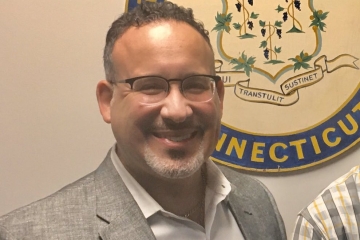
Miguel Cardona is a blank slate

Dale Chu
1.7.2021
Flypaper

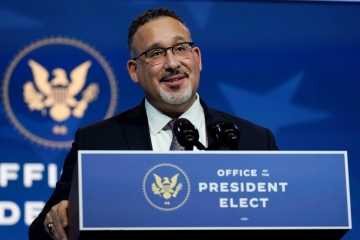
When the news broke last month that Dr. Miguel Cardona had been tapped to be the nation’s next education secretary, a friend of mine texted me asking, “Have you heard of him?” To be honest I hadn’t, but it wasn’t an entirely unreasonable question. Back in the early aughts, I was an elementary school principal in New Haven, twenty miles south of Meriden, where Cardona was plying the same trade over at Hanover Elementary School. While it’s possible our paths may have crossed at any number of state functions, I couldn’t say for certain. What struck me was how reform enthusiasts and union sympathizers alike quickly locked arms around the selection.

Indeed, the gravity defying reception to Cardona was something of a Christmas miracle. The AFT wrote of his potential in leading a “renaissance” following “years and years of the school wars.” Andy Rotherham described the nomination as an offering of a “détente” while Rick Hess called the pick a “clever play.” Democrats for Education Reform declared Cardona a “strong advocate for equity” and, not to be outdone, Diane Ravitch opined that he is “very decent” and not a “fake reformer” (a curious sort of compliment). It was as if Cardona had inoculated the education policy world against the bitterness between pro- and anti-reform camps and the virulent effects of longstanding distrust and animosity.

It’s early to be sure, though it’s difficult to see how any education secretary can be entirely effective in the face of education’s well established divides. Still, at a time when many crave healing and unity, there’s reason for encouragement given Cardona’s personality and personal history. Three things in particular will be worth watching upon his likely confirmation as the twelfth U.S. Secretary of Education.

First and foremost is the question of safely reopening schools. The feds can play a lead role by providing a new coronavirus aid package—on top of the one President Trump just signed—that among other things enables states to invest in the infrastructure required to guard against the virus’ spread. As it stands, schools have taken a scattershot approach, shaped more by politics (including union politics) than by data, that has left many frustrated and confused. Uncle Sam should do more via resources and guidance to bring greater cohesion and improve the likelihood of more schools reopening.

To his credit, Cardona has been an advocate for in-person instruction, but of the myriad challenges involved (e.g., proper ventilation, PPE supplies, ever-evolving health and safety protocols), none may be more daunting than the “last mile problem”: With vaccine distribution now underway, Cardona would do well not to underestimate the formidable step of getting it into the arms of hesitant teachers, administrators, and support staff.

Consider some of the early warning signs. The vaccine rollout has thus far been slow and cumbersome in part because state departments of health were already overextended by the Covid-19 response effort. At the same time, anti-vaccine activists have begun a deliberate campaign to erode public trust by spreading propaganda and preying on fears. Taken together with major media outlets irresponsibly covering every allergic reaction as news, a skewed perception of risk could soon set in. To wit, the president of the Clark County Education Association, representing the fifth largest district in the United States, recently said, “Some don’t want to go back unless there is a vaccine, and others absolutely don’t believe in it.” The head of the California Teachers Association added, “We need to be sure it’s safe and there are no lasting side effects.”

But whether teachers are vaccinated shouldn’t hold up schools from reopening. Ten months into the pandemic, we’ve learned that the initial emphasis on coronavirus transmission in schools was largely misplaced and that the risk of spread is significantly lowered when appropriate mitigation measures are put into place. However, the current predicament for students and families will stretch out indefinitely if too few educators are inoculated. Recognizing this, Cardona could play a significant part in diffusing the anxiety by staying vigilant and pulling out all the stops to inspire schools and systems to get back into buildings. It also wouldn’t hurt for Cardona himself to get vaccinated in public as a way to lead by example.

Next is the contentious issue of annual assessments this year and beyond. To be fair, testing opponents have made some legitimate arguments against testing during Covid-19. Namely, that it’s virtually impossible to do if kids aren’t back in school, and even if they are back, there’s a question as to whether precious time should be spent on testing. Yet the data provided from state assessments are arguably more important than ever in light of what students have been through, especially those living in marginalized communities, which have been deeply affected. Without it, states won’t have a valid way to honestly confront what they’re dealing with.

Cardona’s state department of education defended testing last fall, but it’s anyone’s guess how he might react in the face of the full-court press expected in state legislatures to halt it once again. Cardona should heed these concerns and press ahead with state testing, but consider easing off on accountability requirements for the time being.

Finally, all eyes will be on how Cardona handles the competing interests of charter school supporters and skeptics. Amid the sweltering hothouse of today’s politics, there would appear to be no middle ground between the two, as explained well by Andy Smarick:

Perhaps the most important objection to charters from the educational establishment is that charters embarrass traditional school districts. By proving low-income, inner-city kids can achieve at the highest levels, they pose an uncomfortable question: Why aren’t you accomplishing the same?... Successful charters are a rebuke to teachers’ unions, colleges of education, district leaders, and other institutional defenders of the traditional system—so those interests have declared war on them.

This dynamic is more uneven at the state and local level, where charters and traditional districts sometimes have a less adversarial relationship. Although Cardona has been described as neither a politician nor an ideologue on charters, those sensibilities could be put to the test should the federal Charter Schools Program come under renewed assault.

Largely unknown outside the Nutmeg State, Cardona is like a shapeshifter, in that observers, for better or for worse, are seeing what they want to in the secretary-designate. In one respect, Cardona has nowhere to go but up, being in the fortunate position of following a widely reviled predecessor. Nonetheless, there will be plenty of opportunity for him to disappoint when the honeymoon period wears off. Some are clearly keeping their powder dry for when hard policy questions and unresolvable tensions come to the fore. In the meantime, we should ride the prevailing goodwill to pull for Cardona as he steps into the breach, where millions of students remain disconnected, dispirited, or hanging on by a thread.

view

Explicit teaching vs. constructivism: The misadventures of Bean Dad

Robert Pondiscio
1.7.2021
Flypaper

Nearly every day, social media plucks some poor, anonymous face in the crowd from obscurity and makes him famous. If you’re making New Year’s Resolutions this year, one should be never to be that guy. Over the weekend the unfortunate soul was musician and podcaster John Roderick, doomed to be known henceforth as “Bean Dad,” the trending topic sobriquet earned when he declined to make lunch for his hungry nine-year-old daughter, insisting instead that she make herself some baked beans. The child brought him a can of beans and an opener, which she didn’t know how to use.

“So I said, ‘How do you think this works?’ She studied it and applied it to the top of the can, sideways. She struggled for a while and with a big, dramatic sigh said, ‘Will you please just open the can?’” began Roderick in a since-deleted Twitter thread. “A Teaching Moment just dropped in my lap!” In a series of two dozen tweets he chronicled his daughter’s six-hour struggle to perform a task he might have easily demonstrated and allowed her to try, practice, and master in less a minute, freeing her to focus on higher-order skills, such as following a recipe, or cooking

If Bean Dad thought he deserved an award for Father of the Year, Twitter had other ideas. “Child abuser” and “psycho” were among the milder terms of abuse. “You’re an ass---e, dude,” wrote another dad. “Feed her. Then Teach. Then delete your account.” But the tens of thousands of denizens of that digital hellscape who savaged Roderick’s reputation and drove him off Twitter and into infamy might be surprised to learn that teachers have another name for his child’s mechanical trial by ordeal. We call it “discovery learning.” For over a century we have elevated it as an authentic, hands-on, guide-on-the-side best practice. Indeed, since it was his daughter who decided she wanted lunch—intrinsic motivation!—we’d even recognize it as a “child-centered” approach to learning. Bean Dad was merely being a good constructivist, which requires that teachers facilitate learning and “create a responsive environment” that allows pupils “to achieve autonomous discoveries.”

If this sounds fanciful or like overstatement, pick up a copy of an outstanding new book, The Power of Explicit Teaching and Direct Instruction, by Australian teacher and education blogger Greg Ashman, himself a smart and energetic edu-Tweeter, who notes that the clear message he derived from his teacher prep program was that “explaining concepts directly to students was a last resort.” He describes an exercise he completed during his teacher training that involved questioning a pair of sixteen-year-olds about how satellites orbit the Earth, gently pushing on their misunderstandings until they figured things out on their own. “I now realise that this is an appalling way to try to teach students about satellite motion.” Somewhere Bean Dad nods, grimly.

Ashman’s slim and readable volume is a defense of knowledge-rich curricula, and he notes that “those who want students to gain a specific body of knowledge tend to be drawn, inevitably if sometimes slowly, to explicit forms of teaching.” If constructivists are disciples of Dewey (and Rousseau even further back) rejecting a “banking” theory of learning, Ashman is devoted to the idea most famously made by Newton that we see further when we stand on the shoulders of giants. His book also offers some brisk history of education theory, research in support of his thesis, and a smart takedown of pedagogical fads—the hardy perennials that the field cannot seem to let go of. In sum, there is not much mystery behind the teacher behaviors associated with learning gains, he writes. They include “effective use of time; a coherent curriculum in sequence; active teaching...a balance between conceptual and procedural knowledge; proactive management; teacher clarity, enthusiasm and warmth; pace; teaching to mastery; review and feedback; and teachers’ possession of adequate subject matter knowledge,” Ashman concludes. These also happen to be “the key features of effective explicit instruction.”

If the weight of evidence suggests that explicit instruction is the key to student achievement (and it does) what explains the field’s reluctance to move in the direction that decades of research point? Ashman cites “deep, philosophical reasons” for our reluctance to abandon constructivism and discovery learning. Explicit instruction is “viewed as authoritarian and antidemocratic.” Anticipating pushback, he points out that constructivism is a theory of learning, not a theory of how to teach. But he correctly notes that theory is clearly seen as having implications for the way we teach. “Plucked from its philosophical and scientific roots, constructivism in the classroom usually equates to asking students to find out something for themselves—to ‘construct’ knowledge rather than passively receive it like empty vessels.” In common classroom practice, Ashman quips, “it is as if the giant is there, offering children his shoulders, but instead we are asking them to construct a ladder out of sticky tape and drinking straws.”

It takes a resilient and determined teacher to question and resist education’s dominant models and orthodoxies. Ashman is not the first teacher to begin his career in willing suspension of disbelief only to find (first by failed and frustrating discovery, then in the library) the practical benefits of a knowledge-rich curriculum and direct instruction, nor will he be the last. But to the uninitiated who have never heard of Project Follow Through, Barak Rosenshine’s Principles of Instruction, or who have been acculturated to hear “direct instruction” as an epithet, Ashman offers a strong pair of shoulders to stand upon.

Meanwhile if, after an appropriate period of introspection and abject public apologies, Bean Dad seeks to recover from his cancellation by the Twitter mob and resume a productive career, he may find that his misadventure has left him unwittingly qualified for a surprising new career. He’d be wildly successful as a professor of education.

view

The Education Gadfly Show: What does Miguel Cardona’s time in Connecticut imply about his future in Washington?

1.6.2021
Podcast
 

On this week’s podcast, Subira Gordon, executive director of Connecticut’s ConnCAN, joins Mike Petrilli and David Griffith to discuss President-elect Biden’s education secretary nominee, Miguel Cardona, and his work in the Nutmeg State. On the Research Minute, Amber Northern runs down the best research of 2020.

Amber's Research Minute

5. Harold E. Cuffe, Jan Feld, and Trevor O’Grady, “Returns to Teaching Repetition – The Effect of Short-term Teaching Experience on Student Outcomes,” Education Finance and Policy Journal (February 27, 2020).

4. Jing Liu, Susanna Loeb, and Ying Shi, “More Than Shortages: The Unequal Distribution of Substitute Teaching,” retrieved from Annenberg Institute at Brown University (April 2020).

3. Matthew A. Kraft and Manuel Monti-Nussbaum, “The Big Problem with Little Interruptions to Classroom Learning,” retrieved from Annenberg Institute at Brown University (May 2020).

2. Louise Beuchert, Tine Louise Mundbjerg Eriksen, and Morten Visby Krægpøth, “The impact of standardized test feedback in math: Exploiting a natural experiment in 3rd grade,” Economics of Education Review (June 20, 2020).

1. NaYoung Hwang and Thurston Domina, “Peer Disruption and Learning: Links between Suspensions and the Educational Achievement of Non-Suspended Students,” Education Finance and Policy (February 2020).

If you listen on Apple Podcasts, please leave us a rating and review - we'd love to hear what you think! The Education Gadfly Show is available on all major podcast platforms.

view

2020 Recap: New research from the Thomas B. Fordham Institute

Pedro Enamorado
12.22.2020
Flypaper

As with most years, 2020 has been a busy one for the Fordham research team. We published many groundbreaking studies, adding contributions to the evidence base on literacy, civic education, education funding, school choice, and gifted programs, among others. The pandemic has exacerbated many problems in our education system, including inequities in access to technology, but has also proven the adaptability of many talented and motivated educators and school leaders who responded well. Above all, it has shown how crucial it is to apply research-informed practices to keep kids learning during the Covid-19 crisis and beyond.

Here are the ten research studies, briefs, and books we published in 2020:

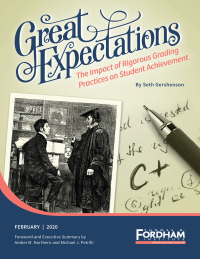
1. Great Expectations: The Impact of Rigorous Grading Practices on Student Achievement, by Seth Gershenson

Grading practices cover

In our first study of the year, Seth Gershenson finds that rigorous graders improve their students’ outcomes in math end-of-course exams—and that effects continue for up to two years. This was true for students of all races, and it reiterates the importance of teachers’ high expectations and transparent grading practices to better serve students.

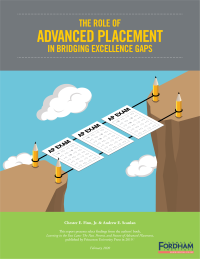
2. The Role of Advanced Placement in Bridging Excellence Gaps, by Chester E. Finn, Jr. and Andrew Scanlan

AP bridging gaps cover

While this year has seen increased hostility towards schools and programs for talented students, Fordham believes in expanding access to challenging courses for all students. Checker Finn and Andrew Scanlan explain how enrollment in AP courses has increased among low-income and minority students, but stress the need to add more supports for disadvantaged students to close the gap in test scores.

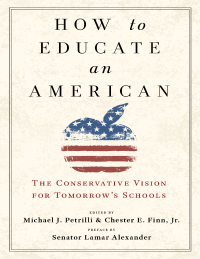
3. How to Educate an American: The Conservative Vision for Tomorrow's Schools, coedited by Michael J. Petrilli and Chester E. Finn, Jr.

how to educate an american cover

In this coedited volume with a preface by Senator Lamar Alexander, twenty leading conservative thinkers lend their thoughts on how schools can cultivate civic virtue and patriotism without glossing over the nation’s checkered past. This year has seen heightened divisions and uncovered many injustices, making this book all the more relevant to educators and district and school leaders.

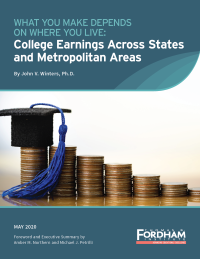
4. What You Make Depends on Where You Live: College Earnings Across States and Metropolitan Areas, by John V. Winters

college earnings cover

This study on college earnings by John V. Winters finds that bachelor’s degree-holders out-earn peers with less education, but there is significant variation between regions. On that note, we hope young Americans begin to consider where they intend to live and work when making their postsecondary education plans.

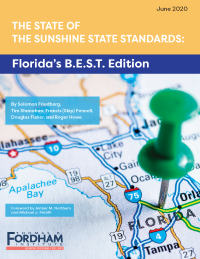
5. The State of the Sunshine State's Standards: The Florida B.E.S.T. Edition, by Solomon Friedberg, Tim Shanahan, Francis Fennell, Douglas Fisher, and Roger Howe

sunshine standards covre

Florida Governor Ron DeSantis promised to replace the state’s Common Core-based math and reading standards with better ones. Unfortunately, our expert reviewers found the new standards lacking, and recommend significant and immediate revisions. This year has forced states everywhere to slow down and rethink how they do education, so we hope Florida takes this opportunity to improve its standards.

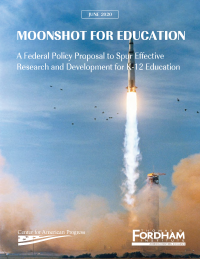
6. Moonshot for Education: A Federal Policy Proposal to Spur Effective Research and Development for K-12 Education, by the Thomas B. Fordham Institute and the Center for American Progress

moonshot cover

Across the nation, federal funds helped schools reopen, close the digital divide, transition to remote learning, and now, distribute a vaccine to end the pandemic. But what if the federal government invested in education-related R & D the way it does in other fields? The Fordham Institute published this bipartisan policy brief in partnership with the Center for American Progress with a vision for a federal program that will develop tools to make schools more adaptable and resilient in the future.

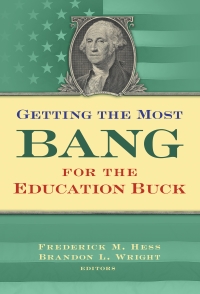
7. Getting the Most Bang for the Education Buck, coedited by Frederick M. Hess and Brandon L. Wright

bang book cover

The Covid pandemic brought unemployment and decreased economic activity in its wake. This coedited volume brings the expertise of a dozen education experts to consider how schools and districts can cope with the coming drop in education revenue, covering topics such as how to leverage technology to improve staff performance, how parent input can inform district spending decisions, and how to get better results for students with disabilities.

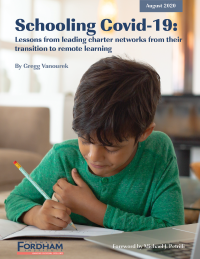
8. Schooling Covid-19: Lessons from leading charter networks from their transition to remote learning, by Greg Vanourek

schooling cov

The transition to remote learning was hard for schools of all kinds—district, charter, and private. But there were some outstanding charter networks with quick and effective transitions that offer lessons for their peers. Greg Vanourek, one of the Fordham Institute’s founders, interviewed parents, teachers, and leaders from eight charter networks to learn about their approaches and see what they had in common.

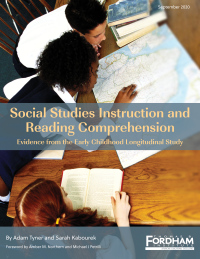
9. Social Studies Instruction and Reading Comprehension: Evidence from the Early Childhood Longitudinal Study, by Adam Tyner and Sarah Kabourek

ss cover

As the wars over literacy instruction rage on, the findings in this report by Adam Tyner and Sarah Kabourek support the importance of building background knowledge. The report finds that students who receive more social studies instruction have better reading outcomes, but finds little improvement for those whose schools spend more time on English language arts.

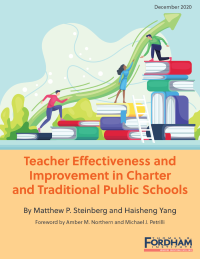
10. Teacher Effectiveness and Improvement in Charter and Traditional Public Schools, by Matthew P. Steinberg and Haisheng Yang

ti cover

Charter networks tend to have more junior staff than district peers, so how is it that they tend to be more effective in boosting student achievement? This study looks at data from Pennsylvania and finds that teachers in charter networks improve on the job at much faster rates than those in standalone charters or traditional public schools, especially in math. Yet again, we see that offering quality education options helps everyone out by encouraging others to learn from their successes.

Stay tuned for another slate of rigorous, relevant studies from the Thomas B. Fordham Institute in 2021!

view

Fordham’s ten most-read articles of 2020

Tran Le
12.21.2020
Flypaper

As with everything else in the world, American K–12 education was rocked back on its heels only three months into 2020. School closures, reopening, and recovery became the focus of teachers and state, district, and school leaders. Remote learning became the bane of students,’ parents’, and teachers’ existence. The year is now coming to an end, and there’s still a long way to go until all students are learning in person and the word “quarantine” is removed from our daily vocabulary.

In looking at Fordham’s top ten most-read posts of the year, it’s easy to see the imprint that the Covid-19 pandemic had. The list, for example, includes three of our compilations of educational resources for youth. But of course, we couldn’t help but continue to write about other longstanding priorities of ours, like high-quality curriculum and classroom instruction. Check out the countdown for yourself below.

10. Training teachers to fail, Jasmine Lane & Jon Gustafson

Speaking from their own experiences at two well-known training programs, teachers Jasmine Lane and Jon Gustafson argue that the current system in place for how we train and place teachers into classrooms is failing. They advocate for preparation programs that provide fundamental training in literacy and research-informed practices to best support student learning.

9. The 1619 Project perpetuates the soft bigotry of low expectations, Ian Rowe

As a former CEO of a charter school network, Ian Rowe condemns The 1619 Project for presenting a notion of America to students and teachers that is inherently hostile towards Black and Brown children. He believes that this narrative develops an “enslavement” mentality, and instead insists that we teach children the power they have in their individual choices in order to develop a mindset of “empowerment.”

8. Great YouTube channels for middle schoolers and high schoolers for learning from home during COVID-19 school closures, Emma Finn

For her middle and high school-aged peers, Emma Finn has plenty of suggestions for educational YouTube channels that have helped her explore new interests. With all the time spent at home during school closures, she thought it the perfect time to find a new passion project, and thankfully, her list—which includes math, science, poetry, and art—has something for everyone.

7. No, this is not the new normal, Robert Pondiscio

After the pandemic closed schools this past spring, Robert Pondiscio cautioned us from throwing all of our Covid-19 recovery efforts into remote learning and instead, encouraged forward-thinking for the resumption of schools. Among other things, he advised planning for school staffing and learning models, meeting students’ social-emotional needs, and combatting learning loss. 

6. Reading comprehension is not a “skill”, Robert Pondiscio

Robert Pondiscio explains why reading comprehension isn’t something that can be taught or trained in the abstract; it requires possessing knowledge about the topic you’re reading about. Using E.D. Hirsch, Jr.’s theory of reading comprehension and citing Fordham’s study as evidence, Robert recommends spending less time teaching this—not-skills—and more time on other subjects that build one’s common knowledge base.

5. Reader’s workshop: The science denial curriculum, Robert Pondiscio

Robert Pondiscio discusses Student Achievement Partners’ evaluation of a widely-used literacy program, the Teachers College’ Units of Study. The report finds that the curriculum fails to promote scientifically-validated practice in reading instruction. 

4. The power of the two-parent home is not a myth, Ian Rowe

In this response to a New York Times op-ed titled “The Myth of the Two-Parent Home,” Ian Rowe argues that we should not dismiss the influence that family structure has on the economic outcomes of children of all races, citing evidence that both Black and White children raised in a two-parent household are less likely to live in poverty than their counterparts in single-parent households.

3. Smiling through: Thirty-two resources for entertaining energetic preschoolers during daycare and preschool closures, Victoria McDougald

In solidarity with all the working parents during daycare and preschool closures, Victoria McDougald made a list of 32 fun yet educational resources for infants and toddlers. Her compilation includes read alouds and book lists, podcasts, YouTube channels and TV shows, and “mixed-bag” resources such as games, activities, and instructional lessons.

2. Pity the history teachers, Michael Petrilli

As if teaching during a pandemic wasn’t hard enough, Michael Petrilli discusses the incredible challenge that lies ahead for history instructors in the new school year: teaching about the origins of America during an all-out culture war. He recommends telling the American story in all its fullness and glory without slipping into politicization or falsehoods. 

1. Resources for learning from home during Covid-19 school closures, by Michael Petrilli

When the pandemic first hit and school buildings shut down, Michael Petrilli sought to help his fellow parents—and newly-minted homeschool teachers—of elementary school-age children. To top the most-read Fordham posts of the year, we have his compilation of top resources for learning from home: the best educational YouTube channels, TV shows and movies, podcasts for kids, and free online instructional materials.

view

Fordham’s Best of 2020 Flypaper Posts

Pedro Enamorado
12.23.2020
Flypaper

We have had a challenging year with news cycles filled with troubling news about the coronavirus, racial injustices, violent rioting, and polarizing elections. But through all this, we have seen people come together and care for one another, such as how teachers drove by in a motorcade to greet their students. Our commentary this year has touched on the heart of many of these topics, reminding Americans to remain hopeful and remain committed to excellence in our schools and to quality education options.

The last two days, we have published a recap of this year’s most popular commentary pieces and of our research. Today, let’s look back at ten of our best blog posts.

1. The chronic condition of American education, by Dale Chu

Although the pandemic exposed weaknesses in our school systems, we would be wise to remember that they have always existed. Dale encourages education reformers not to let the crisis feed into cataclysmic rhetoric that undermines efforts to win people’s hearts, especially when achievement has been stagnant for a while, but reminds us that it’s still important to maintain a proper sense of urgency.

2. David Brooks, please don’t give up on education, by Michael J. Petrilli

In his pessimistic column, Brooks concludes that, because increased college graduation rates are not closing income gaps for Black adults, educational attainment is not the equalizer we hoped it would be. Mike pushes back, however, and argues that controlling for differences in academic skills reveals similar outcomes for Black and White adults. He concludes that “more education might not lead to greater equity, but better education almost certainly will.”

3. How fundamental change happens in America, by Chester E. Finn, Jr.

Everyone hopes that crises will turn into a Sputnik moment that spurs the nation to action to bring transformative change. But for this to happen with our schooling, Checker explains, it requires the combination of successful models, sustained bipartisan leadership, and the most challenging one, a culture shift among parents. When the dust settles on the coronavirus, there will be families who now crave a structural change. Those, he believes, are the ones innovators should focus on.

4. How states can meet the rising demand for school choice, by Dale Chu

With so many parents dissatisfied with the education status quo, what alternatives are or should be available to them? Dale offers his thoughts, including employer-provided early childhood education, letting families enroll children outside their district, and improving access to extracurricular activities for homeschoolers.

5. It’s school culture, stupid, Robert Pondiscio

Wealthier Americans enroll children in private schools on the basis of what values they want their kids to adopt, not their test scores. School culture, Robert explains, is key to student success in the long-run—even reducing criminality rates for at-risk students. While he believes this is a strong argument for giving underserved communities more choice, he also invites reformers to consider how to help schools where poor culture could be worsened if families leave them.

6. Leadership makes a difference: Lamar Alexander and K–12 education, by Chester E. Finn, Jr.

Senator Lamar Alexander will be retiring from his long career of public service. In his honor, Checker writes about his education legacy, from exiting party leadership to focus on passing bipartisan legislation to advancing the Every Student Succeeds Act, and, more recently, a bill to simplify the FAFSA application process. While he will be missed, Checker and other reformers hope he will continue his excellent work from outside Congress.

7. Reopening decisions are mostly a matter of trust, by Michael J. Petrilli

Low-income and parents of color were more afraid than affluent and White peers to send their kids back to schools that tried to reopen. Mike explains that besides being harder hit by the virus, those communities do not trust schools to keep their students safe. He argues that schools should work to do better and build reservoirs of trust to better serve students in the future—and in times of crisis.

8. The lessons that last in the time of pandemic, by Robert Pondiscio

Just as the Depression defined a generation and made it more resilient, writes Robert, the pandemic will define ours. He reflects on the ways in which it has brought people together, such as teachers distributing food or showing up to help a student from outside her porch, and believes children will remember these fondly in their later years.

9. To protect students during the economic downturn, schools need to spend money wisely, by Frederick M. Hess and Brandon L. Wright

The pandemic has heightened the importance of making sound decisions about education finance. Here, the coeditors of Getting the Most Bang for the Education Buck bring together a few lessons from their volume, such as how to use technology smartly, make district budget legislation more flexible, and use parent input to guide decision-making.

10. With his remarks on the murder of George Floyd, Joe Biden showed us how to teach empathy and American history, by Michael J. Petrilli

This has been a challenging year for many Americans, especially for the Black community. Mike, moved by Joe Biden’s words, writes that despite the culture wars and piling injustices, we can still come together as Americans. Mike believes that Biden's speech modeled well how we can teach our history without partisanship and how, through it, we can grieve injustice together and fight for our ideals.

We look forward to 2021, the vaccine, and schools reopening again, and we encourage you to keep following the Flypaper blog for more quality commentary.

Fordham Logo

© 2026 The Thomas B. Fordham Institute
Privacy Policy
Usage Agreement

National

P.O. Box 110
Burke, VA 22009

202.223.5452

[email protected]

Ohio

P.O. Box 82291
Columbus, OH 43202

614.223.1580

[email protected]

Sponsorship

130 West Second Street, Suite 410
Dayton, Ohio 45402

937.227.3368

[email protected]