The quickest way to expand school choice is to fill empty private school seats
Private-school choice advocates, particularly in red states, have a lot to be excited about right now.
For those of us who have long pushed for charter schools to receive fair funding, progress has been slow, uneven, and hard-won. That’s why we at the Thomas B.
Throughout the first quarter of the 21st century, schools built up capacity to accommodate growing student populations, adding classroom space, teacher positions, and the many resources that go into educating a child. The Covid-19 pandemic accelerated the build-up through the injection of giant sums of federal money to supplement state and local budgets.
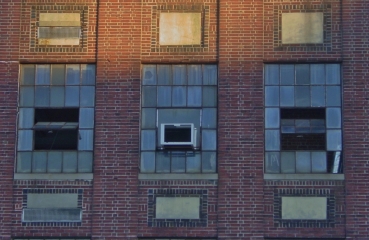
When we talk about achievement and discipline gaps in education, we customarily focus on teaching quality, school funding, and student behavior. But what if some of these disparities have less to do with what teachers or students are doing and more to do with something as basic as air conditioning?
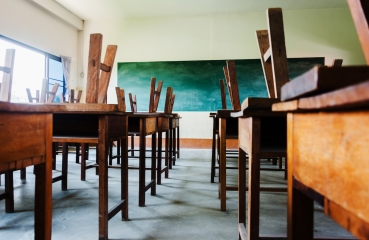
As enrollments drop, city after city is facing pressure to close half-empty schools. Fewer kids means fewer dollars. Consolidating two schools saves money because it means paying for one less principal, librarian, nurse, PE teacher, counselor, reading coach, clerk, custodian… you get the idea.
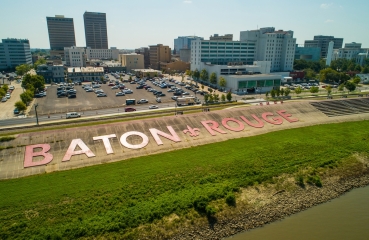
At peak enrollment in Baton Rouge, Louisiana, our local school system educated over 70,000 children. Now, in essentially the same facilities, it serves just over 34,000 children. The district has been experiencing a steady decline in student enrollment since the early 2000s, losing around 2 percent of our student population each year on average.
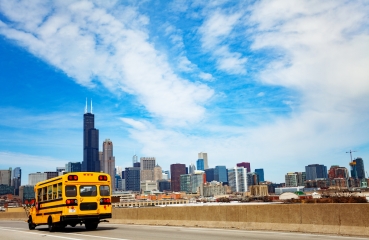
Chicago’s troubled school district has made national headlines recently—from the mass resignation of its appointed school board, which opposed the mayor’s efforts to borrow nearly $300 million at ruinous rates to give the teachers union a sweetheart contract, to the
A 6,000 student Midwestern district recently adopted a budget that would result—if all goes according to plan—in a $13.2 million deficit, or more than $2,000 per student. This follows $10 million shortfalls in each of the previous two years. Cash is dwindling.
Forcing students to switch schools can be traumatic and even harmful. Yet closing an underenrolled school can also be beneficial when displaced students land in better alternatives, and when it ensures that innumerable children in future generations are well-served. But how should policymakers identify which schools should be candidates for closure? Our latest study offers some answers.
Schools across the country spend billions of dollars each year on the construction and renovation of their facilities—everything from roof repairs to new science labs and from classroom expansions to whole new buildings. How do these expenditures impact students and the taxpaying community around schools?
Everyone who cares about racial justice should be focused on doing what’s best for students and their learning—not on school buildings or the employment impact of closing some of them.
The conventional wisdom is that school closures are bad—not the temporary pandemic-era variety, but the permanent shuttering of underenrolled school facilities.
Red-state governors like Ron DeSantis, Brian Kemp, and Greg Abbott deserve credit for taking the political risk to reopen schools quickly during the pandemic, over the objections of officials in Democratic cities. They decided that education was too important to leave to the left. Now the country faces a different wave of school closings, and conservative governors must step up again.
Khaya Njumbe enrolled at GEO Academies’ 21st Century Charter School, in Gary, Indiana, when he was eleven years old. By age thirteen, he’d become the youngest student in state history to earn an associate degree.
Microschools exist as a midpoint between homeschooling and traditional schools. Typically, the entire school will only have twenty-five students and one or two teachers—often parents, sometimes former educators looking for a more personal classroom, and occasionally local community members like doctors who have expertise to share.
School closures are awful. I won’t argue otherwise.
On this week’s podcast, Aaron Daly, COO of Brooklyn Laboratory Chart
On this week’s podcast, Erin Einhorn, a national reporter for NBC News, joins Mike Petrilli and David Griffith to talk about her recent
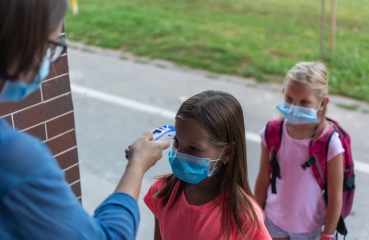
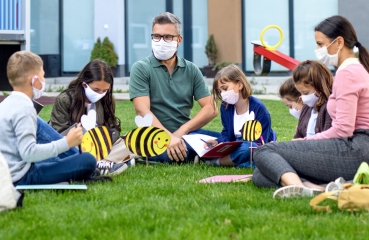
As we prepare to reopen our schools, school administrators must examine our back-to-school rituals and upgrade plans for re-entry to account for the challenges presented by Covid-19. In particular, schools must create and clearly communicate the processes for school drop-off and arrival that support social distancing and wellness measures.
If we are to survive the stress and uncertainty of this year’s school reopenings, we are going to have to learn how to lead from a place of grace and empathy. None of this is easy. There are not any good, let alone perfect, options. The conditions on the ground are changing daily, and the personal circumstances of each family—whether teacher or student—are different.
On this week’s podcast, Mike Petrilli and David Griffith discuss whether and how schools should reopen in the fall.
On this week’s podcast, John Bailey, visiting fellow at AEI, joins Mike Petrilli and David Griffith to discuss AEI’s new
On this week’s podcast, Noelle Ellerson Ng, associate executive director of advocacy and governance at AASA, the School
On this week’s podcast, William Johnston, associate policy researcher at the RAND Corporation, joins Mike Petrilli and David Griffith to