Mobile Navigation

  • National
    • Policy
      • High Expectations
      • Quality Choices
      • Personalized Pathways
    • Research
    • Commentary
      • Gadfly Newsletter
      • Flypaper Blog
    • Events
    • Scholars Program
  • Ohio
    • Policy
      • Priorities
      • Media & Testimony
    • Research
    • Commentary
      • Ohio Education Gadfly Biweekly
      • Ohio Gadfly Daily
  • Charter Authorizing
    • Application
    • Sponsored Schools
    • Resources
  • About
    • Mission
    • Board
    • Staff
    • Career
Home
Home
Advancing Educational Excellence

Main Navigation

  • National
  • Ohio
  • Charter Authorizing
  • About

The Education Gadfly
2.20.2026
Gadfly Guy
Listen to this article
Loading the Elevenlabs Text to Speech AudioNative Player...

CHEERS:

“There are the conventional steps educators in the District of Columbia have taken to boost students’ math achievement—increasing rigor, providing extra supports and undertaking deep data analysis. And then there are the outside-the-box methods. Math field trips. Collaborations among public, charter and private schools. Unapologetic funding increases. Quick pivots when interventions don’t work.” —Kara Arundel, K–12 Dive

—

“The National Labor Relations Board found that a 2024 state law means that Lycee Francais teachers and their union no longer fall under its jurisdiction. The decision could impact all charter schools in New Orleans and across the state.” —Safura Syed, Verite News

JEERS:

“That government unions use their monopoly to hold taxpayers hostage isn’t news. But in California, the teachers union is taking political extortion to a whole new level with a coordinated campaign threatening strikes across the state.” —The Editorial Board, The Wall Street Journal

—

Veteran teachers report disturbing increases in student misbehavior, including among very young children. Despite consensus that the problems are widespread, teachers and school leaders diverge when it comes to solutions, with some focusing on affirmation and restorative practices instead of giving teachers control over their own classrooms. “I’m just one person,” a first-grade teacher tells Jackie Mader. “My real purpose is to teach them content… I’m not trained in psychology. I’m not trained in social work.” —Hechinger Report

Relatedly, in a recent survey, a large share of kindergarten teachers report that today’s young students—babies during the pandemic—are behind in literacy and less socially and emotionally ready for school. Nick Gaehde calls for “a new literacy ecosystem” that prioritizes family and home engagement. —The 74


Editor's note: This was first published on Mike Petrilli's Substack, SCHOOLED, a twice-weekly free Substack and email newsletter restarting the education-reform conversation.

Click here to subscribe for:

  • Sharp analysis of the week’s biggest K–12 debates

  • Curated commentary from across the ed-policy world

  • Lively discussion—including reader reactions and pushback

Jeff Murray
2.20.2026
Gadfly Bites logo
Listen to this article
Loading the Elevenlabs Text to Speech AudioNative Player...

News stories featured in Gadfly Bites may require a paid subscription to read in full. Just sayin’.

  1. Traditional district school enrollment in Ohio has fallen by nearly 2 percent (or 26,900 students) over the last five school years, Eileen McClory tells us in this piece. Charter school enrollment has grown by 4.2 percent and private school enrollment by 11.2 percent over that same period. To our Aaron Churchill, this means that “more Ohio students today are attending schools that fit their needs,” and is happy about that fact. Meanwhile, in Bizarro World, school choice haters bill these numbers as “overwhelming support” for traditional districts. Yep. Just like a leaky set of tires are “mostly supportive” of your car…for now. (Dayton Daily News, 2/19/26)

  2. Here in the Real World, the steady loss of so many students has legitimate consequences—especially when the district in question chooses to ignore reality for years. Facing a humungous budget hole on the horizon, Cleveland Metropolitan School District is closing 18 buildings and consolidating dozens more at the end of this school year, impacting more than 7,000 kids. (The fact that that number is not any higher given the massive number of buildings involved says a lot.) This piece is a look at the status of the enrollment process for these and other CMSD students, the first piece of which ends next week. The numbers so far are pretty interesting. About half of students whose schools are closing have chosen a different district building than the one they were automatically assigned to. About the same amount have made no affirmative choice within the district as yet. (They’ll be automatically assigned somewhere…if they come back at all.) There are also nearly 900 applications for students new to the district for next year, which is notable for several reasons. But the most interesting part of this for me is the interview with the two moms of rising seniors and how they are evaluating all of their options. Interdistrict open enrollment and EdChoice A robust set of choices FTW, I think. (Signal Cleveland, 2/17/26)

  3. Finally this week, in a typical district in a typical small city in north central Ohio: A proposal to expand their STEM education program to middle school students is receiving vociferous and, if I may say so, very thorough pushback from teachers and other staff members in the impacted building. Among the litany of objections: The expense of installing larger toilets and drinking fountains to accommodate older students, as well as purchasing larger furniture. When folks are willing to go that low—literally into the sewers—with their opposition, I figure there’s no middle ground possible and we can safely consider that plan DOA. (Richland Source, 2/18/26)

Did you know you can have every edition of Gadfly Bites sent directly to your Inbox? Subscribe by clicking here.

Policy Priority:
School Funding
Topics:
Governance
Robert Pondiscio
2.19.2026
Teacher in a classroom
Getty Images/Antonio_Diaz
Listen to this article
Loading the Elevenlabs Text to Speech AudioNative Player...

Education writer Holly Korbey recently posed a thoughtful and important question: Why doesn’t education study its successes the way other fields study their masters? Why don’t we linger over high-performing schools, dissect what they do, and deliberately build on their example the way “Kobe did with Jordan, or Dylan did with Woodie Guthrie”? she asked. “Would a culture of studying the greats lead to improvement?”

Holly is a friend and one of our very best education writers and observers. Reading her piece, I found myself wanting not to disagree with her argument but to extend it. The problem, it seems to me, is not that we’re incurious about successful schools—I don’t think that’s quite right—but that we’re insufficiently selective about which models we seek to learn from and the lessons we take from them.

I’ve personally noticed no shortage of interest. No shortage of study tours, fellowships, attention, or inquiries into “what works.” Quite the opposite. When I was researching and reporting my book How the Other Half Learns about New York City’s Success Academy charter school network, I witnessed a steady stream of visitors: district leaders, teachers, policymakers—even international delegations. Professional development sessions routinely included observers from across the country. The network eventually opened its Robertson Center and a K–8 lab school specifically to host trainings and workshops.

And yet, for all that attention, the lessons to be learned from schools like Success Academy either don’t stick or travel very far. This suggests that the challenge is not incuriosity but something else.

The three ways we fail to learn from successful schools

First, we often try to explain away good outcomes, particularly among schools serving low-income families. When schools like Success Academy that serve disadvantaged students produce extraordinary outcomes, even across dozens of campuses, the initial reaction is frequently not “what can we learn?” but “what explains it away?” Surely it must be student selection or deep-pocketed funders—something unique and perhaps even unsavory that either cannot be replicated or that I wouldn’t want to do in my school. We treat good student outcomes as an anomaly to be challenged or rationalized rather than a system to be understood.

Second, even when we accept that success is real, often we adopt only the parts that affirm our existing beliefs. If a high-performing school is succeeding with a strong curriculum but not one we like, we see strong teaching and engaging lessons. If it enforces strict routines and discipline, we talk about “school culture.” If it invests heavily in teacher coaching, we emphasize “professional collaboration.” It’s confirmation bias; we learn the lessons we were predisposed to take away to validate our beliefs and strengthen the case for them. What we tend not to do is interrogate the full system—including the parts that may feel uncomfortable, unfashionable, or difficult to reproduce locally. We harvest the agreeable pieces and quietly ignore or discard the rest.

Worse, even when schools demonstrate sustained success, the field persuades itself that those successes are suspect—or even harmful. Steven Wilson’s devastating recent book The Lost Decade chronicles how a number of high-performing urban charter schools that had delivered measurable gains came under intense criticism and self-scrutiny from within for ideological reasons, shifting the discussion from “How did this work?” to “Should this be allowed at all?”

Third—and perhaps most important—we often study schools at a breakthrough moment of success rather than asking whether their success is likely to endure.

The schools we celebrated—and what became of them

In the early years of education reform, the question “Can this scale?” dominated the conversation. Charter networks were explicitly founded to replicate high-performing schools. Philanthropic funding was often tied to expansion plans. “Proof of concept” quickly became “proof of scalability.” Entire organizations were built around the premise that once we identified a school that worked, the obvious next step was to grow it. In that sense, it isn’t quite right to say educators failed to study successful schools, at least in the charter movement. If anything, we were obsessed with them. Critically, the focus was outward—replication, expansion, growth—rather than inward. We asked how to spread success, not how to sustain it.

Thus, if I may offer a friendly amendment to Holly’s work, it’s not enough merely to study successful schools, districts, and charter management organizations. The ones that deserve our attention are those that have sustained their successes over decades.

In her recent series of blog posts and podcasts, Holly focuses on Karin Chenoweth’s Schools That Succeed (2017). For anyone working in education reform in the early 2000s, her earlier book, “It’s Being Done” (2007), was essential reading. It profiled 15 schools beating the odds through leadership, coherence, and adult responsibility.

I was curious to see what became of those schools roughly two decades later. Sifting through state report card data, the findings are sobering: Only a small number of the schools Chenoweth profiled appear to have remained roughly stable in quality. Many have declined significantly. Several have closed entirely. (Here is a table of those school-by-school results.)

The same pattern holds for the schools profiled in Samuel Casey Carter’s No Excuses (2000), another touchstone of ed reform’s heyday. Many of these were precisely the kinds of schools reformers believed could be replicated at scale—disciplined, high‑expectation models meant to prove that poverty need not determine academic outcomes. Yet decades later, only a minority have clearly sustained their performance. The rest declined or disappeared. One of them, Houston’s Wesley Elementary School, was later swept up in the district’s testing scandals—an important, if uncomfortable, reminder that the urgency to demonstrate that success is possible can make us more eager for proof than careful in verifying it. (Here is a table of those school-by-school results.)

This exercise suggests that while we should study success, we should also be careful in defining it. Let’s be brutally honest: Education is a fad-driven field. We worship at the altar of “innovation.” We celebrate visionary principals, breakthrough models, and dramatic turnarounds. I’ve said for years, “show me a miracle and I’ll show you a scandal.” What we pay far less attention to is sustained excellence.

To my mind, Emily Hanford’s reporting on Steubenville, Ohio, in Sold a Story offers perhaps the most instructive example of educational success in recent years—not because the district discovered something new, but because it didn’t. Hanford went to Steubenville precisely because it is no elite enclave or selective charter network, but a small, economically modest Ohio district serving mostly working-class and low-income students. Its demographics look unremarkable. Its resources are typical. Yet for years, its early reading outcomes stood out against comparable districts, making it an ideal test case for what was actually happening inside classrooms. (Chenoweth profiled Wells Elementary in Steubenville, Ohio in a follow-up 2009 book, How It’s Being Done.)

What Hanford found should give us pause. Steubenville adopted Success for All, a structured, explicit approach to reading instruction, decades ago; it trained teachers carefully in that model; and most strikingly, it has stuck with it for roughly 25 years. While literacy fashions came and went elsewhere—balanced literacy, workshop models, cueing systems, new vendor packages—Steubenville did not cycle through competing philosophies. There is no dramatic breakthrough moment in the story, no charismatic savior, no sweeping reinvention. “Steubenville had no need to pursue the latest trend, to even know what the latest trend was,” Hanford reported, “because what they were doing was working. It’s been working. For 25 years.”

If we are serious about studying successful schools, Steubenville’s example matters enormously. Studying peak performance can teach us what is possible. Studying long-term consistency can teach us what is reliable. And in education, reliable achievement is far more important and far more rare.

The quiet work of maintenance

It’s also pretty boring. Sustained achievement means protecting instructional time, preserving curriculum coherence, and acculturating and training new staff into established routines. It’s resisting the steady pressure of new initiatives, new mandates, and new enthusiasms. All of it is essential and none of it is glamorous.

This invites an interesting thought exercise: If we wanted to predict whether a school’s success will last, what would we actually look for? What conditions would need to be in place—and remain in place—for progress to endure through inevitable leadership turnover, staff churn, political pressures, and the siren song of educational fads?

In my next post, I want to sketch out a speculative answer: what a “built to last” framework for schools might look like and what it might tell us about why some successes persist while others quietly fade.

With reporting and analysis by Annika Hernandez.

Policy Priority:
High Expectations
Topics:
Evidence-Based Learning
Charter Schools
Curriculum & Instruction
Teachers & School Leaders
Miriam Merin
2.19.2026
Business man in a skyscraper
Getty Images/Pinnacle Pictures
Listen to this article
Loading the Elevenlabs Text to Speech AudioNative Player...

“What if the valedictorians in America’s schools were the cool kids?” This is the question Nicholas Kristof posed in his recent column in The New York Times, imagining a culture in the U.S. where academic excellence carries the same social prestige as it does in some East Asian countries.

But in many of the environments I’ve inhabited—elite universities and professional circles in New York, San Francisco, and Washington, D.C.—the valedictorians are already the cool kids. Whether they exhibit genuine academic prowess or have learned to “game the system,” their presumed competence is the ultimate social currency. It grants them not just admiration, but often a kind of anticipatory deference based on the influence they will presumably wield in the future.

Mr. Kristof is not necessarily wrong or alone in feeling envious of the high regard that some prosperous, rapidly developing democracies, particularly in Asia, have for education. Exploring the role cultural values play in shaping national outcomes has preoccupied educators and institutional leaders for decades. And at a time when gifted programs and test-entry schools are falling out of favor in much of the U.S., his point is especially well taken.

But I worry that we have come to conflate intelligence and success with moral authority.

In America’s high-achievement settings, excellence can function as a form of psychological and social insulation: Intelligence is taken as a proxy for virtue; success as evidence of character and wisdom. Over time, this dynamic can make it harder for the most credentialed and celebrated individuals to question their own judgment or remain open to new viewpoints. It can also make it harder for others to question the behavior of those whose accomplishments appear to place them beyond reproach.

The stakes have risen as elite educational institutions have become increasingly efficient at converting academic distinction into access to industries that concentrate economic and cultural power—including technology, finance, consulting, and corporate law. When the most academically accomplished students move, in large numbers, into industries that command extraordinary influence over systems that affect millions, the moral formation they did or did not receive ceases to be a private matter.

Recent corporate scandals illustrate how this concentration of credentialed talent can distort accountability. Theranos, the failed health-technology company, derived credibility from its elite associations, even as doubts circulated internally about its technology. More recently, the collapse of cryptocurrency exchange FTX revealed how technical and quantitative sophistication can coexist with astonishing lapses in judgment.

The point is neither that high achievers are uniquely prone to misconduct, nor that fields like technology and finance are inherently corrosive. These sectors drive innovation, create jobs, and expand opportunity. Rather, my concern is that success, absent formation in judgment, can distort our perceptions and lead us to grant authority where scrutiny is warranted. Academic excellence is indispensable, but it is not, on its own, a safeguard against moral and ethical failure.

American educational and professional institutions are highly effective at identifying talent and accelerating it into status, influence, and financial return. They are less intentional about ensuring that those elevated most quickly are also prepared for the ethical responsibilities that accompany power. This shortfall has become more pronounced in an era of political polarization, when efforts to articulate shared moral commitments are quickly recast as partisan. In a society marked by deep moral pluralism—and, at times, a skepticism that moral truths matter or exist at all—schools retreat to what can be measured, leaving questions of character formation underdeveloped.

In A Nation at Thought: Restoring Wisdom in America’s Schools, David M. Steiner offers a philosophical antidote. He argues that American schools should return their focus not only to academic rigor and excellence, but also to teaching moral reasoning and aesthetic judgement. This tripartite standard, ordered toward human flourishing—what Aristotle called eudaimonia—aims to form not only clever students, but wise ones. It asks students to cultivate judgment: to reason about what is true, to deliberate about what is good, and to discern what is worthy of admiration. Such formation would not compete with excellence. Rather, it would discipline it, ensuring that achievement is exercised in service of a well-lived life rather than merely a successful one.

In practice, this would require more than the occasional advisory period or wallpaper of character-education slogans. It would mean sustained engagement with literature that confronts moral ambiguity and human frailty; history taught not only as a series of dates and figures, but as an inquiry into responsibility and consequence; and explicit instruction in ethical reasoning that invites students to grapple seriously with competing goods.

This is no small task in a society marked by deep moral disagreement. One avenue for counterbalance is increasing institutional diversity by expanding choice for mission-driven schools—whether public charter, secular private, or religious—that can integrate moral formation with academic rigor in ways that align with families’ values. If we are serious about preparing students not only to do well but to live well and to wield influence responsibly, we must create space for schools to pursue intellectual and moral formation with equal seriousness.

So, yes, let’s celebrate academic achievement, expand opportunities for excellence in education, and build a culture where more young people see intellectual work as worth pursuing. But let’s not pretend that making the valedictorians “cool” will solve our problems. In the places where we’ve already done that, we’ve discovered something uncomfortable: Excellence does not guarantee character, but it does enable power. And power, undisciplined, does what power always does. It protects itself.

Policy Priority:
High Expectations
Topics:
Curriculum & Instruction
Teachers & School Leaders
Meredith Coffey, Ph.D.
2.19.2026
Teacher in a classroom
Getty Images/Carlos Barquero Perez
Listen to this article
Loading the Elevenlabs Text to Speech AudioNative Player...

Like many people, when I entered the world of education policy, I encountered a trove of education research that was new to me but that largely tracked with my prior experiences as a teacher.

Working in high schools, for example, I had never heard of “three-cueing,” or the body of evidence against teaching young readers to use “contextual and syntactic clues” instead of phonics. But this research explained why the 17-year-old student who read “indignant” as “indifferent” continued to struggle when I instructed him to look at the letters in the word again.

It also made sense that excessive teacher turnover was harmful and that having a master’s degree in a random subject didn’t necessarily make someone a better teacher. I was glad to learn that researchers cared about these issues and that educational leaders could rely on serious evidence to inform their policies.

I was also open to being persuaded by the evidence. As an English language arts teacher, I’d repeatedly been told that it didn’t really matter what books students were reading as long as they were learning the right skills. Research demonstrating the crucial role of content knowledge, however, cast my classroom experiences in a new light. I don’t regret introducing my students to engaging young adult novels, but I do wish we had spent more time on “classic” texts.

But what never sat right with me was the research community’s prevalent view that a teacher’s experience didn’t make much difference after the first few years. Some decades ago, several empirical studies failed to detect significant gains after three to five years of teaching. What emerged from these findings was an oversimplified narrative that teachers’ abilities simply plateau after the initial learning curve. “Once somebody has taught for three years,” Bill Gates declared in 2009, “their teaching quality does not change thereafter.”

Of course, some teachers stop improving. That’s true of professionals in any field. But the idea that most teachers are as effective after 15 years on the job as they are after three to five is entirely at odds with my experience.

During my six years as a high school teacher—with a backdrop of six years teaching college undergrads—I felt myself improve in myriad ways. Some of the biggest changes were indeed during the first few years. Early feedback from supervisors helped me foster more substantive discussions and better align my end-of-class assessments to the learning objectives.

But other things took more time. I developed organizational systems that worked for me. I continued to refine my approach with students, finding that balance between approachable and serious. I got better at anticipating student misconceptions and knowing which explanations would be most likely to land.

The most experienced teachers whom I observed also did these things—and many more that are tough to reduce to a single sentence. Having been in the classroom longer, they had simply encountered more situations to inform their decision-making in the present.

Students getting heated arguing in class? Based on what had (and hadn’t) worked before, highly experienced teachers smoothly de-escalated. Revisiting related ideas across course units? Years of familiarity with the curriculum helped them notice patterns, understand student perceptions, and weave together content. Possible red flags around new behaviors or trends? These teachers had longstanding relationships with staff and faculty across the school, equipping them to communicate questions and concerns efficiently and often nipping problems in the bud as a result.

Reflecting these realities, recent empirical research complicates the longstanding three-to-five-year-plateau narrative. As detailed in a recent policy brief from the Learning Policy Institute and my own organization, the Thomas B. Fordham Institute, teachers improve most quickly in their first few years, but they continue to improve for up to two decades into their careers.

This doesn’t mean that every experienced teacher will be better than every new-ish colleague, but rather that teachers tend to improve compared to their own prior performance. All this is especially true when teachers work in collaborative environments (can confirm!) and have consistent teaching assignments (sounds dreamy!).

So what does that mean in practical terms?

For administrators and policymakers, the biggest takeaway is that it’s worthwhile to ensure quality mentorships, professional learning, and opportunities for collaboration. Where feasible, it makes sense to keep teachers with the same course assignments. Rotating grade levels might give teachers a breadth of knowledge, for example, but they’re going to be better equipped to educate students if they have a depth of course-specific knowledge.

Perhaps most challenging to address is the unfortunate reality that the highest-need schools tend to have the least-experienced teachers. There’s no silver bullet to address this complex phenomenon, but evidence suggests that improving working conditions, offering significantly higher pay, and creating career ladders can each help.

Schools are complex places, and ultimately, no single study or perspective is adequate to guide policymaking. In the new year, education leaders should use insights from both research and practice to support teacher growth and retention and, in turn, improve student outcomes.

Editor’s note: This was first published by The 74.

Policy Priority:
High Expectations
Topics:
Evidence-Based Learning
Curriculum & Instruction
Teachers & School Leaders
Brian R. Fitzpatrick, Ph.D.
2.19.2026
Piggy bank and chalkboard with question marks
Getty Images/AndreyPopov
Listen to this article
Loading the Elevenlabs Text to Speech AudioNative Player...

The rollout of the Common Core State Standards (CCSS) in 2010 began as a widely applauded, bipartisan policy aimed at providing an accessible curriculum focused on conceptual understanding that could form the foundation for K–12 education content for the next generation. When the rubber hit the road, however, it faced a lot criticism from parents, educators, and policymakers alike—some fair, some not.

A new study by Dong Woo Hahm, professor of Economics at the University of Southern California, sidesteps the question of popularity. Given that enough time has passed for students exposed to CCSS to enter the labor market, he focuses instead on CCSS’s impact on students’ labor market outcomes. The paper examines whether those in their late 20’s and early 30’s at present were better off if their states adopted CCSS in time for them to be exposed to it.

This subset of adults was chosen because their exposure to the Common Core as children depended on if and when their state adopted the standards. So some in this cohort were only exposed to CCSS for their senior year, some were exposed for several years, and some not at all. The key dataset used in this study is the American Community Survey. This is a repeated cross-sectional dataset, with the study designers at the U.S. Census sampling a different nationally representative group of American adults each year.

The main finding is that exposure to just one additional year of CCSS is associated with a $112 increase in annual wages. Mind you, this is using 2010 dollars in a sample of young adults earning an average of $27,000 per year, meaning exposure to CCSS throughout high school would predict a 1.7 percent increase in income a decade later. This is still a small change in one’s income, but the fact that this paper shows any kind of connection between states’ adoption of CCSS and eventual labor market outcomes for students is certainly noteworthy.

A few other noteworthy details about this main finding: First, these earning gains were mostly captured by women rather than men. They are also partially due to workers’ willingness to spend a few more hours on the job throughout the year. These earning gains were also highest in states that formally mandated full K–12 implementation in both math and English language arts. Also of interest is that Hahm broke out his estimates based on how we at the Thomas B. Fordham Institute rated state curriculum quality in the runup to the launch of the CCSS. This revealed that these earning gains were concentrated in states with subpar pre-CCSS curricular standards, presumably because CCSS curriculum represented a more substantial improvement relative to the status quo.

The positive effect on income was not, however, the result of students going to get more education or by steering students towards STEM fields. Instead, the explanation seems to be that CCSS exposure led some to be “less likely to work in sectors characterized by manual, highly routine labor, or basic production, while being more likely to enter [non-STEM] jobs emphasizing non-routine cognitive tasks, communication, and interpersonal coordination.”

This finding may be disheartening for those who extol the value of a career in the trades. But this style of difference-in-difference study is rather convincing. It is not perfect and is far from definitive, but it deserved to be published, and its results should be taken seriously. The author’s key claim is that CCSS nudged some students towards jobs where they use their hands a bit less and their brains a bit more and raised incomes as a result. It is one more piece of evidence that the Common Core should be seen as a success despite its many discontents.

My biggest gripe with the paper is the lack of detail about the variation in this cohort’s exposure to CCSS. Did anyone in the study get the Common Core in middle school, as well as high school? Hahm never says. That aside, this article left me hoping for more: more research on the long-term effects of Common Core and also research on labor market impact of curriculum reforms that have happened since.

SOURCE: Dong Woo Hahm, “From curriculum to career: Early-career labor market effects of the Common Core,” Economics of Education Review, Volume 110, February 2026.

Policy Priority:
High Expectations
Topics:
Evidence-Based Learning
Standards
Jeff Murray
2.18.2026
Gadfly Bites logo
Listen to this article
Loading the Elevenlabs Text to Speech AudioNative Player...

News stories featured in Gadfly Bites may require a paid subscription to read in full. Just sayin’.

  1. We start today with not one but two fantastic profiles of Metro Elementary here in Columbus. The first piece is in honor of The International Day of Women and Girls in STEM, observance of which took place last week, and includes interviews with several smart and sassy young ladies whose parents opted them in to the independent STEM school, which opened its elementary grade program for the first time this past fall. (Spectrum News 1, 2/15/26) Since my kids went to Metro High School, all 7 of my dedicated Gadfly Bites subscribers know I am a) loving any spotlight shone on the awesomeness of Ohio’s independent STEM schools, and b) especially appreciating these looks at the now-complete K-12 pipeline at Metro. Our second piece, along with highlighting ongoing junior awesomeness, also points out that Metro Elementary is planning to double up its enrollment next year. It is not mentioned where those hundreds of new students will materialize from, but they don’t really need to sleuth that out for our benefit, do they now? You know…don’t you? (NBC4 News, Columbus, 2/14/26)

  2. The main reason I’m clipping this story about how some northeast Ohio districts are working to reduce student absenteeism is because Jessica Poiner’s September 2025 blog post is used as a vital data baseline on the topic. But I encourage you to also read and compare the various approaches being tried/fingers being pointed and see if you can guess whether a district is a high-income/high-performing by the type of rhetoric their officials use. It’s a good—and highly educational—game. (Salem News, 2/17/26)

Did you know you can have every edition of Gadfly Bites sent directly to your Inbox? Subscribe by clicking here.

Policy Priority:
School Funding
Topics:
Governance
Aaron Churchill
2.17.2026
Ohio report card - CCWMR blog image
Getty Images/Jupiterimages, Brand X Pictures
Listen to this article
Loading the Elevenlabs Text to Speech AudioNative Player...

State report cards have long provided transparency and accountability for student learning. The current framework has commendable features, yet policymakers should make sure that the system functions well and meets intended goals. This is the third in a series that examines report card elements that could use refinement (previous pieces covered chronic absenteeism and early literacy).

Recognizing that too many students graduate ill-prepared for their next steps, Ohio policymakers have made increased college and career readiness a priority. Within this larger effort, the state introduced a readiness measure on its school report card nearly a decade ago to encourage schools to provide rigorous preparation beyond what is required for high school graduation.

As initially implemented, the measure (then known as “Prepared for Success”) was overly focused on college-ready metrics, such as ACT, SAT, AP, and IB exam scores. In 2021, lawmakers rebooted the component with new indicators added to the mix, including career-tech assessments, work-based learning, and military enlistment. Today, students who meet one of 11 (!) possible indicators are deemed “ready,” and count toward their schools’ “College, Career, Workforce, and Military Readiness” rating.

Revamping the measure was a smart move, but how is the next iteration functioning?

As a starting point, Ohio does a better job differentiating schools than the former model, which flunked nearly everyone. In 2024–25, the first year a star rating was assigned for the measure, 33 percent of districts received 1 or 2 stars and 29 percent 4 or 5 stars, leaving 38 percent at 3 stars.[1]

But a deeper-dive analysis reveals concerns about how accurately Ohio identifies “college and career ready” students, especially along the career-oriented dimension. This in turn raises the question of whether the ratings provide a reliable and honest portrayal of student readiness.

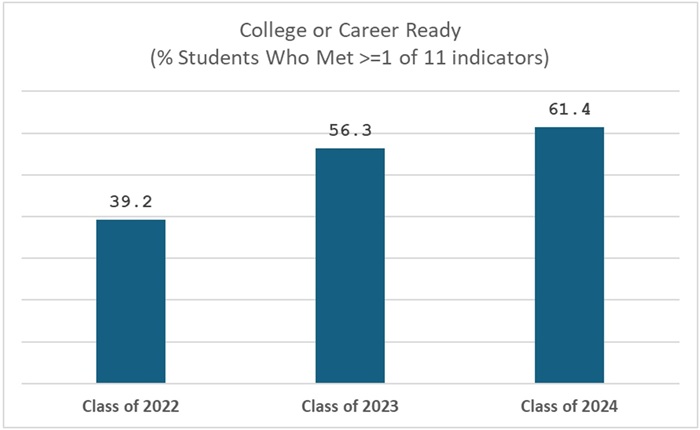
Figure 1 shows the percentage of students deemed “ready” by meeting an indicator listed in Figure 2. The statewide readiness rate jumped from 39 to 56 percent between 2022 and 2023, and increased again to 61 percent for the class of 2024. The current number sits below the state’s 88 percent graduation rate, indicating that the readiness bar is—as it should be—higher than the basic graduation standard. Yet to put the rate into additional context, it’s roughly double Ohio’s longstanding college-completion rate (associate degree or higher) of roughly 30 percent.

Figure 1: Percentage of Ohio students deemed college and career ready, classes of 2022–24

Ohio report card - CCWMR blog figure 1

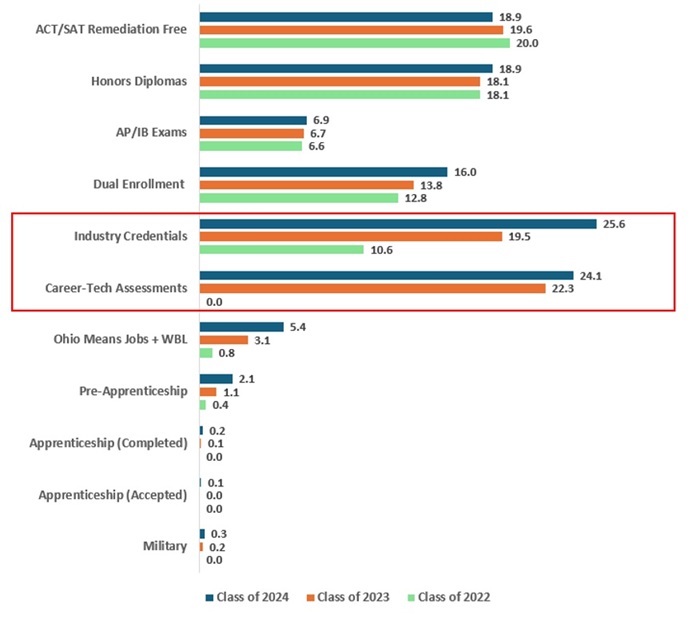
Figure 2 breaks down the overall number by the various indicators, showing that the recent jump is largely attributable to the “career-ready” measures. Among the class of 2024, 26 percent met the industry credentials indicator—more than double the rate from a couple years ago—while 24 percent passed three or more career-technical assessments, whereas no students in the class of 2022 were reported as passing three or more.[2] These two rates have risen not only in response to the report card, but also to the state’s new graduation requirements, which allow low-performing students to receive diplomas through an alternative route that includes credentials and career-tech assessments as options.

Figure 2: Percentage of students meeting various college and career ready indicators

Ohio report card - CCWMR blog figure 2
Notes: For more detail about the indicators, see this document from the Ohio Department of Education and Workforce. Students can meet more than one indicator and, if doing so, are counted more than once; for instance, a student achieving the ACT remediation free score and passing AP exams would be counted in both categories for purposes of Figure 2. WBL = work based learning (250+ hours).

The rise in the career-based numbers could be a positive, except that we know many students have been accumulating credentials of questionable value. The most-earned credentials among the class of 2024 were basic first aid and job safety certificates, as well as a customer service and introductory retail certificate, each of which can be attained relatively easily. Students in urban school districts have been especially apt to collect credentials such as these, likely in an effort to meet alternative graduation requirements. Meanwhile, there are more than 200 career-technical exams, and nothing is known publicly about which exams students are passing or their rigor.

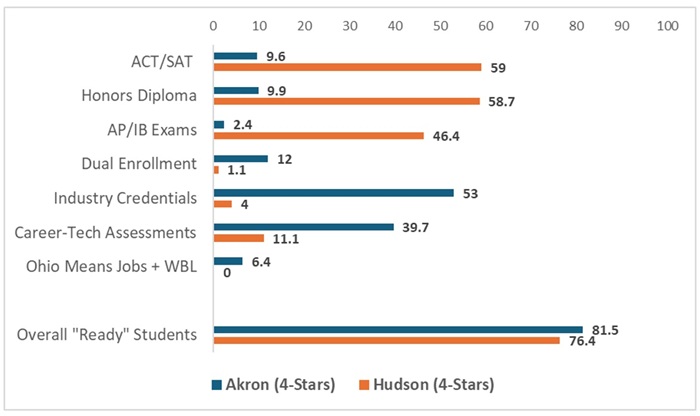
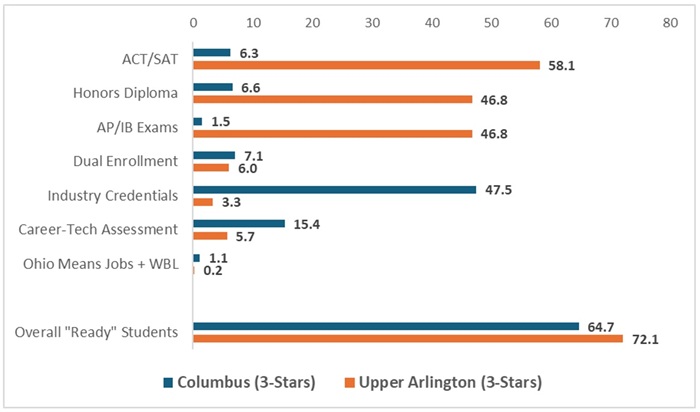
Incorporating the career-ready indicators on an equal basis as ACT or SAT scores has yielded some head-scratching results. The charts below provide illustrations. In Summit County, both Akron and suburban Hudson school district received 4-star college and career readiness ratings. But Hudson earned that rating through the tougher college-ready metrics, while Akron did so through the softer career indicators. In Central Ohio, Columbus and suburban Upper Arlington received 3-star ratings, but Upper Arlington did so through the college-ready metrics and Columbus mostly through credentials.

Figure 3: Percentage of students who meet various indicators, Akron versus Hudson

Ohio report card - CCWMR blog figure 3

Figure 4: Percentage of students who meet various indicators, Columbus versus Upper Arlington

Ohio report card - CCWMR blog figure 4
Note: Less than 1 percent of students in all four districts were reported as meeting the three apprenticeship indicators or enlisted in the military. Schools with low readiness rates receive a three-star rating if their rate improves by 15 or more percentage points relative to the year prior. None of the four districts received this bump.

It’s hard to believe that Columbus—where student proficiency is abysmal—is equally good at preparing students as Upper Arlington, or that Akron does as well as Hudson. But that’s the impression from the report card. The problem, which we’ve warned about before, lies in the uneven rigor between the “career-ready” and “college-ready” measures. Passing three career-tech exams is not nearly as challenging as passing three AP exams. Attaining a retail or job-safety credential is nowhere near as demanding as earning a college-ready score on the ACT or SAT. But under the current structure, they are all are treated equally.

Career-focused measures should continue to be included in the report card, but state lawmakers should take two steps to ensure workforce readiness is accurately measured:

1. Count students as “ready” only if they achieve proficiency on the state Algebra I and English II assessment. Basic academic proficiency is the building block of both college and career readiness. Yet under current policy, students who are not proficient can still be deemed “ready” through the career-based metrics. Rather than ignoring academic deficiencies, Ohio should only count students as “college and career ready” when they achieve proficiency on the two key state high school exams (and meet one of the readiness indicators, as under current policy).[3]

2. Consolidate the credentials and technical-exam indicators, so that students have to meet both (in the same career cluster) to be counted as meeting the indicator. “Career readiness” takes more than just earning a credential. It also requires coursework and demonstrations of technical expertise on an objective exam. Rather than allowing an “either-or” approach, Ohio should require students on career-technical pathways to meet both the credentials and technical exam metrics (or complete one of the other existing career indicators, such as an apprenticeship).

Ohio’s college and career ready measure should challenge schools to equip students with the knowledge and skills needed to succeed after high school. The “college-ready” side of the state’s current measure is sound, but the “career-ready” side still needs work. With strengthening, the state would provide a better gauge of college and career readiness in Ohio schools.


[1] Data for the component were reported for the prior two years, but no ratings were assigned.

[2] It’s possible that some students in the class of 2022 passed assessments, but the data were just not reported by schools (these exams were not used in the state’s former Prepared for Success measure).

[3] Adding this condition is unlikely to impact measures such as ACT/SAT, honors diplomas, and AP/IB exams, as the vast majority of students meeting them are likely to have achieved proficiency on state exams.

Policy Priority:
Standards & Accountability
Topics:
Accountability & Testing
Jeff Murray
2.17.2026
Chronic absenteeism measurement SR image
Getty Images/CHUTIPON LAKKAEW
Listen to this article
Loading the Elevenlabs Text to Speech AudioNative Player...

Researchers, policymakers, educators, and journalists have focused copious amounts of attention on student absenteeism data in the years since a pandemic-era surge that is only now beginning to moderate. Of particular concern is chronic absenteeism, nearly universally defined as missing at least 10 percent of school (generally 18 days) for any reason, and the potential academic harm missing so much school could cause. Research protocols, early warning systems, accountability structures, and considerable resource allocations to identify and reduce chronic absenteeism have all been calibrated with this definition as their guiding principle. However, a trio of researchers from the University of Michigan hypothesize that other measures might be more accurate in predicting negative academic outcomes—and indeed might reset the definition of “chronic absenteeism” in that regard. They set out to test their theory in a new working paper.

The researchers use data on nearly 8,900 students who were enrolled in the Boston Public Schools (BPS) pre-K program starting in the 2007–08 to 2009–10 school years. Students were followed through their eighth grade year (which occurred between 2016–17 and 2018–19). Administrative records from district and state sources include demographics, details of attendance and absences, and English language arts and math standardized test scores. The analytic sample was 48 percent female and racially/ethnically diverse (45 percent Hispanic, 29 percent Black, 15 White, 9 percent Asian, 3 multiracial/other). Roughly half of students spoke English as their home language, 30 percent Spanish, and 21 percent a language other than those. Approximately 58 percent of students were eligible for free or reduced-price lunch.

The researchers used the administrative absences data provided by BPS—total days absent, total unexcused absences (like oversleeping or going to work), and total excused absences (like family vacations or a dental appointment)—as well as calculating a novel student absence rate. That is, dividing each student’s number of total absence days by the total days the student was enrolled during a given year. This helped account for variation in enrollment length for students transferring into the district at different times of the year.

The researchers then evaluated the diagnostic accuracy of six different absenteeism measures over time—total days excused, total days unexcused, total days for all reasons, excused absence rate, unexcused absence rate, total absence rate—in predicting whether a student would score at the lowest category of achievement (“not meeting expectations”) on Massachusetts’ state math and ELA assessments in eighth grade. They found minimal predictive value of absenteeism rates in the early grades, when rates are largely driven by excused absences…and a long way from eighth grade test day! But by the upper elementary grades (when unexcused absences began to predominate), the predictive strength steadily increased. Perhaps not surprisingly, eighth grade absenteeism data was most predictive of eighth grade test performance. Across all years, the researcher-created absence rates and the BPS total-days-absent measures proved the most predictive of academic outcomes.

And what of “chronic” absenteeism? Their analysis found that—rather than the traditional 10 percent of the school year/18-day cutoff that generally denotes chronic absenteeism today—academic harm from absences became highly likely closer to the 7 percent of time enrolled point for most students and ranged from six to 17 days, depending on grade level, test subject, length of time enrolled, and absence measure used. In other words, the default definition of “chronic” absenteeism is likely too generous. More importantly, the warning sign for schools to intervene to mitigate academic harm from chronic absenteeism comes about quite a bit sooner for many students than schools currently believe.

In an interview, research team leader Tiffany Wu says that “no single absence cutoff is likely to serve as a strong standalone predictor of academic risk.” But the team’s report recommends schools track both absence rates and total absences—if staff resources allow—and that leaders and policymakers seriously consider lowering the cutoffs that define “chronic” absenteeism no matter how it is measured. Because data show that early warning systems should be signaling that intervention is needed far sooner than they do now in order to prevent maximum academic harm.

SOURCE: Tiffany Wu, Christina Weiland, and Thomas Staines, “The Chronic(les) of Absenteeism Measurement: Unpacking the Many Measures of Attendance and Evidence for a Lower Chronic Absenteeism Threshold,” Annenberg Institute at Brown University Working Papers (January 2026).

Policy Priority:
Standards & Accountability
Topics:
Governance
Jeff Murray
2.16.2026
Gadfly Bites logo
Listen to this article
Loading the Elevenlabs Text to Speech AudioNative Player...

News stories featured in Gadfly Bites may require a paid subscription to read in full. Just sayin’.

  1. No U.S. presidents have hailed from Lima, Ohio, so I can’t directly connect today’s sole clip to the celebration of Presidents Day. Too bad. (It was originally published on Valentine’s Day but I definitely don’t detect any love in it either.) The Lima News piece looks at what federal moves on education—particularly the dissolution of the U.S. Department of Education, should it come to fruition—will mean for K-12 education locally. (Very locally.) However, some other prominent pols do call Lima home, which might give us a clue as to the local relevance. These include former Ohio House Speaker Bob Cupp (he of the Cupp-Patterson school funding plan, referenced within), U.S. Rep. Jim Jordan (who recently reiterated his support for the dissolution of USDOE), and current Ohio House Speaker Matt Huffman (who is quoted in the piece saying “There doesn’t need to be” a USODE). Fordham’s Aaron Churchill—who has only been to Lima once in his life—is also quoted in this piece, saying that the impact of Dept. of Ed closure “will be fairly minimal” because it is a “minority stakeholder” in K-12 education, contributing roughly 10 cents for each dollar spent on children enrolled in public schools. I assume he’s talking both about Lima and the entire country at the same time. (Lima News, 2/14/26)

Did you know you can have every edition of Gadfly Bites sent directly to your Inbox? Subscribe by clicking here.

Policy Priority:
School Funding
Topics:
Governance

Pagination

  • First page « First
  • Previous page ‹ Previous
  • Page 54
  • Page 55
  • Page 56
  • Page 57
  • Current page 58
  • Page 59
  • Page 60
  • Page 61
  • Page 62
  • Next page Next ›
  • Last page Last »
Fordham Logo

© 2026 The Thomas B. Fordham Institute
Privacy Policy
Usage Agreement

National

P.O. Box 110
Burke, VA 22009

202.223.5452

[email protected]

Ohio

P.O. Box 82291
Columbus, OH 43202

614.223.1580

[email protected]

Sponsorship

130 West Second Street, Suite 410
Dayton, Ohio 45402

937.227.3368

[email protected]