
School report cards have long played a central role in accountability systems. They provide public transparency around student performance and school quality. When results are substandard, state and local are required to take action. Created in 2021, Ohio’s current report card framework is generally solid, featuring user-friendly ratings and measures that incentivize schools to improve. But as report card elements are implemented and new data come in, policymakers may need to make adjustments that preserve the system’s rigor and integrity. In a series of forthcoming pieces, I’ll take a look at areas that could use some careful refinement. This one examines chronic absenteeism, a serious problem statewide, but an indicator that has not been effectively incorporated into the report card.
How chronic absenteeism fits into the report card
Students who miss more than 10 percent of the school year—almost a month’s worth—are deemed “chronically absent.” In an effort to improve attendance, Ohio added chronic absenteeism rates to the report card in 2018. These data initially appeared in the Achievement component alongside student proficiency rates. During the 2021 overhaul, policymakers sensibly moved chronic absenteeism to the Gap Closing component, which focused Achievement on district- and school-wide proficiency.
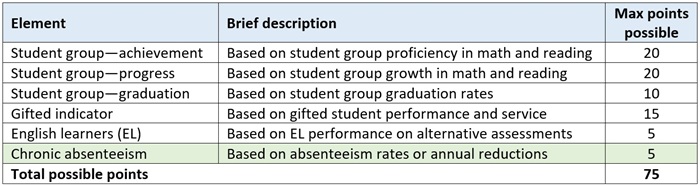
As part of Gap Closing, chronic absenteeism now sits among indicators of various student groups’ performance—e.g., the achievement and growth of low-income pupils. As Table 1 shows, chronic absenteeism is worth five points in the Gap Closing scoring system. The “weight” absenteeism receives varies across districts and depends their demographics and how many student groups they are accountable for. In a district with few student groups, chronic absenteeism carries more weight—it’s worth 10 to 15 percent in many racially homogenous rural districts—while it carries less weight in diverse urban and suburban districts (e.g., 7 percent in Columbus).[1]
Table 1: Structure of Ohio’s Gap Closing component
How high-absenteeism schools get a free pass
Including chronic absenteeism in the report card system highlights the importance of attendance and nudges schools to pay attention to it. But the way the Ohio implements the measure undermines its ability to hold schools accountable and drive significant reductions in chronic absenteeism. The problem boils down to a loose alternative method by which schools can meet the chronic absenteeism indicator and receive the five-point credit.
The first—and non-problematic—way schools can meet the indicator is by meeting a statewide target rate. In 2024–25, the target was 16.4 percent, which roughly two in five districts statewide achieved last year. This is a reasonably strict standard and one that will continue to get tougher each year. By 2029–30, schools will need to register chronic absenteeism rates below 6.9 percent to earn credit through this avenue.
Alternatively, schools can meet the indicator by reducing their chronic absenteeism rates. While the concept is fine, Ohio’s improvement bar is so low that it can present persistent failure as success. For high-absenteeism districts—those with rates above 36.7 percent—all they need to do is reduce chronic absenteeism by 1.1 percentage points versus the year prior.[2] This abysmal standard lets schools off the hook. As Table 2 shows, several districts received full credit even though their chronic absenteeism rates were sky-high and only minimal reductions were made. The full-blown attendance crisis in Columbus was simply ignored just because the district’s absenteeism rate declined by a measly 1.6 percentage points. Note also the satisfactory mark inflated Columbus’ Gap Closing rating. Had it missed the chronic absenteeism indicator, it would have received one star, not two, on this component.
Table 2: Districts meeting the state’s chronic absenteeism indicator despite high rates of absenteeism and minimal reductions

***
To combat the state’s attendance crisis, Ohio must tighten accountability for absenteeism. To this end, the Ohio Department of Education and Workforce should take immediate action to increase the required rate of annual reduction—5 percentage points seems reasonable—to meet the chronic absenteeism indicator.[3] This would raise state expectations for regular attendance, and heighten the urgency to reduce chronic absenteeism rates—something that state leaders have pledged to cut in half over the next few years. If the agency fails to act, state lawmakers should step in to raise the bar through legislation.
The report card remains one of the state’s key levers to drive improvement and align incentives to student learning goals, most notably around math and reading achievement but also, increasingly, attendance. A prolonged absenteeism crisis was not easily foreseeable a few years ago when the current system was being developed. But here we are. It’s time to raise standards for attendance by strengthening implementation of the chronic absenteeism report card indicator.
[1] If a district or school has fewer than 15 students in a particular group, then it is not accountable for its performance as a separate group and the number of points possible is reduced. The actual points possible for districts ranged from 22 to 74 in 2024–25, with the median district having 46 possible points.
[2] For districts with lower rates of chronic absenteeism (below 36.7 percent), the required rate of reduction is 3 percent. The use of a percent change, rather than percentage point change, for lower-absenteeism district appears to address a technical issue when baseline rates are lower (e.g., a 1.1 percentage point decrease is equivalent to a 10 percent decrease versus an 11 percent baseline rate).
[3] Relevant statute (ORC 3302.02 and 3302.03) and administrative rule OAC 3301-28-01/02 do not mention an improvement dimension for the chronic absenteeism indicator, so it appears the agency could change the rate of reduction at its discretion. Of the high-absenteeism districts, two registered declines greater than 5 percentage points last year (East Cleveland and Lockland).