State report cards have long provided essential transparency and accountability for student learning in Ohio schools. The current framework has commendable features, yet policymakers should make sure that the system functions well and meets intended goals. This is the second in a series that examines report card elements that could use refinement (part one covered chronic absenteeism).
With Ohio’s science of reading law on the books, one pressing question is how state policymakers will hold schools accountable for rigorous implementation. In this vein, the Ohio Department of Education and Workforce (DEW) last fall announced it would check whether schools have adopted state-approved reading curricula. That’s a good start, but surely more than compliance reviews will be required. More robust options might include forming an expert state support team—akin to the U.K.’s renowned inspectorate—that conducts site visits, evaluates practices, and recommends improvements. Restoring the state’s third grade retention policy would also heighten accountability for teaching children to read via effective practices.
Though often overlooked in early literacy discussions, another accountability tool is the school report card. To its credit, Ohio has featured an early literacy component on the report card since 2016. But does the measure provide a clear picture of which schools are most effective at teaching reading and which ones need the greatest help? Is the component—as currently designed—up to the task of fairly and rigorously holding schools accountable for literacy outcomes?
Early literacy measure, at a glance
Before diving into policy issues, let us review the mechanics. As Table 1 shows, the early literacy component consists of three underlying elements, which combine and produce an early literacy rating based on a series of weights. The measures include third grade reading proficiency rates, the third-to-fourth grade promotional rate, and an improvement measure for students struggling to read.
Table 1: Structure of Ohio’s early literacy component
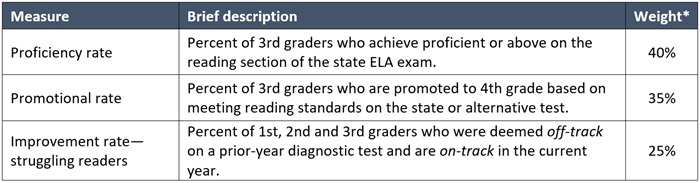
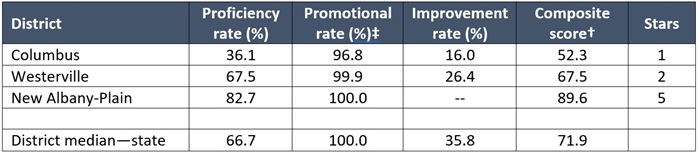
Table 2 illustrates how the measures work using data from three Central Ohio districts of varying levels of student poverty. Starting with Columbus, we see that third grade proficiency lags significantly behind the state’s district median, as well as the rates for Westerville and New Albany-Plain. This reflects, in part, socioeconomically driven achievement gaps (we know those gaps start early), but also—as suggested by its low improvement rate—ineffective reading instruction. Despite the academic challenges, Columbus records a 96.8 percent promotional rate, which mirrors the lofty rates statewide. Still, that’s not enough to help Columbus’s literacy rating, which is a lowly 1 out of 5 stars. As for the suburban districts, Westerville earned 2 stars and New Albany-Plain achieved a 5, though it was exempt from the improvement measure, a loophole discussed later.
Table 2: Ohio’s early literacy measure in action (data from 2024–25)
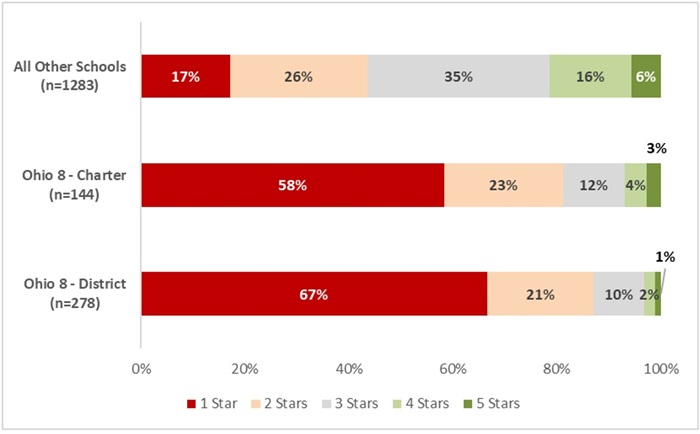
Looking more broadly at the statewide results, Figure 1 shows the early literacy ratings of district and charter schools located in the Ohio Eight cities, as well as all other elementary schools in the state. Very few urban, high-poverty schools fare well on the component: Just 19 out of 422 Ohio Eight schools received 4- or 5-star early literacy ratings (5 percent), while 359 received 1 or 2 stars (85 percent). Schools outside of the large urban areas received higher ratings, though the distribution still leans negative (43 percent 1 or 2 stars versus 22 percent 4 or 5 stars).
Lower early literacy ratings in high-poverty urban areas reflect achievement gaps, as well as the relatively heavy weight proficiency rates receives in the rating calculation. High-poverty urban schools also tend to struggle on the improvement measure, perhaps because they are more likely to enroll students who are furthest from the on-track bar.[1]
Figure 1: Distribution of school-level early literacy ratings, 2024–25
How to strengthen the early literacy measure
The early literacy component serves important purposes and has its strengths. The use of third grade proficiency rates maintains a clear focus on Ohio’s central goal of ensuring that all children are strong readers by the end of third grade. It’s also the data point that parents are likely to best understand and care about when they search for an elementary school. Including an improvement dimension is also critical in the effort to identify effective and ineffective schools. However, the current measure also has limitations. Below are ways that policymakers could improve it.
1. Eliminate the exemption from the improvement measure. Ohio statute exempts schools from the improvement measure when less than 10 percent of kindergartners are deemed off track in literacy. While this seems like a narrow carveout, it actually lets dozens of schools off the hook for helping struggling readers; 67 districts and 145 schools were exempt last year. It’s not like they are lacking students with reading challenges: In 41 exempt districts, more than 20 percent of third graders fell short of proficiency. All this loophole does is relieve—for no justifiable reason—certain (largely wealthy) schools of accountability for all students’ reading success.
2. Recalibrate the grading scale to better identify high- and low-performers. The state’s grading system produces ratings that make it hard to identify superstar elementary schools—the ones we should be learning from—or ones that require the most help. At the top end, just 80 out of 1,705 elementary schools received a 5-star rating last year (and of them, 56 were not subject to the improvement measure). In other words, it’s slim pickings—so far as the early literacy ratings go—in finding exemplars, particularly in urban communities, where fewer than 2 percent of schools earn 5 stars. At the bottom end, nearly 500 elementary schools received 1-star ratings, mainly located in the Ohio Eight. That’s way too many schools for the state to help with additional assistance or training. Reworking the grading scale, which can be done through revisions to administrative rules, would help ensure that the early literacy rating provides better differentiation in school performance.
3. Explore additional options for refining the improvement measure. The current method, which looks at whether off-track students move to on-track status, is a good start. But it could also miss improvements among students who are far below the “on-track” threshold, and it does not consider the continuing progress of on-track students. State policymakers should explore methods that might offer a sharper and more comprehensive picture of schools’ effectiveness in early literacy. For instance, could the state better leverage diagnostic tests to measure growth, perhaps by looking at changes in students’ scaled scores or percentile rankings? Could it implement a “gap-year” value-added measure that captures changes from the fall of kindergarten (KRA) to third grade state tests to supplement the diagnostic test data? A stronger K–3 growth measure would better assist policymakers and educators in nailing down what’s working schoolwide in early literacy—e.g., specific curricula or professional development. It might also encourage policymakers to increase the weight on growth in the early literacy rating, which could yield results that are more neutral to demographics and allow better identification of high- and low-performing schools, particularly in urban areas.
4. Remove the promotional rate from the component. Starting next year, the promotional rate will include only students who move to fourth grade based on the state’s ELA exam or an alternative assessment. This is an improvement relative to the former method used in 2024–25, as it removes a perverse incentive to socially promote students.[2] The shift, however, could produce early literacy ratings that are even more strongly tied to demographics, as promotional rates will more closely mirror proficiency rates. Including the third-to-fourth grade promotional rate was never a good idea to start with, and it’s best to drop an element that either creates bad incentives and astronomical rates or largely duplicates the information provided through proficiency rates.
* * *
Ohio’s science of reading law promises stronger literacy instruction statewide. But whether that promise is fulfilled in the form of increased reading proficiency hinges on rigorous implementation in thousands of elementary classrooms. Accountability for results is one policy tool that helps ensure schools stick with the science, and enables the state to provide effective, well-targeted supports. With some improvements, Ohio will have an early literacy measure that provides clearer information to parents, communities, and educators about the progress children are making in reading.
[1] At a district-level, improvement rates and student poverty (direct certified) are moderately correlated (r = -0.48), while third grade proficiency and poverty rates are strongly correlated (r = -0.73). Direct certification rates are not available at the school-level.
[2] House Bill 455, passed by the House in late 2025 and now pending in the Senate, proposes to reverse the change and revert to a promotional rate that counts in the numerator students promoted via parental exemption.