Mobile Navigation

  • National
    • Policy
      • High Expectations
      • Quality Choices
      • Personalized Pathways
    • Research
    • Commentary
      • Gadfly Newsletter
      • Flypaper Blog
    • Events
    • Scholars Program
  • Ohio
    • Policy
      • Priorities
      • Media & Testimony
    • Research
    • Commentary
      • Ohio Education Gadfly Biweekly
      • Ohio Gadfly Daily
  • Charter Authorizing
    • Application
    • Sponsored Schools
    • Resources
  • About
    • Mission
    • Board
    • Staff
    • Career
Home
Home
Advancing Educational Excellence

Main Navigation

  • National
  • Ohio
  • Charter Authorizing
  • About

Jessica Poiner
2.11.2026
TPPs licensure pass rates blog image
Getty Images/VectorMine
Listen to this article
Loading the Elevenlabs Text to Speech AudioNative Player...

When Ohio lawmakers established a science of reading initiative in 2023, they included two provisions aimed at ensuring that higher education institutions are training teacher candidates in scientifically-based reading instruction. The first focused on inputs. Lawmakers tasked the Ohio Department of Higher Education (ODHE) with conducting audits of teacher preparation programs to determine if their course materials and instruction are aligned with the science of reading. Findings from the first audit were released in December and showed that some programs still have work to do.

The second provision focused on outputs. By requiring ODHE to develop a public dashboard that reports first-time and overall passage rates on the Foundations of Reading licensure exam, policymakers sought to measure how effectively programs are preparing future educators. State law requires most teachers—anyone looking to teach in grades pre-K through eight—to pass the Foundations of Reading exam prior to receiving an Ohio teaching license. The test evaluates a candidate’s knowledge of reading development, comprehension, instruction, and assessment. And by all accounts, it does a good job. NCTQ, which has a long track record of evaluating preparation programs and considerable expertise in reading science, considers it to be a strong exam. If an institution has a high pass rate, then it’s reasonable to assume that the educators it produces are well-prepared to teach reading.

There’s a difference, though, between overall and first-time pass rates. Prior to the early literacy reforms of 2023, Ohio only tracked overall pass rates. Those numbers include any teacher candidate who passes the exam, regardless of how many attempts it took them to do so. First-time pass rates, on the other hand, identify the number of students who passed the test on their first try. Candidates who need more than one attempt to pass the test can still go on to be excellent teachers. But first-time pass rates are an important marker of how rigorously preparation programs are training aspiring educators.

ODHE’s dashboard is now up and running, giving Ohioans their first glimpse at first-time pass rates for 49 preparation programs. The dashboard itself could use some work—more on that later—but the data it contains are a key indicator as to how well programs are training future teachers in reading instruction. Here are the major takeaways.

1. The statewide first-time pass rate ticked up in 2024.

In 2023, the statewide pass rate among first-time test takers was 64.6 percent. In 2024, it rose to 69.2 percent. That’s an increase of nearly 5 percentage points. The number of first-time test takers also climbed, from nearly 2,600 in 2023 to over 3,200 in 2024.

2. More than half of Ohio institutions earned a higher first-time pass rate in 2024 than the year prior.

Twenty-five institutions earned a higher first-time pass rate in 2024 than in 2023. Some of those increases were large—like the University of Mount Union, which jumped a whopping 20 percentage points. Others were much smaller. Twelve institutions registered lower passing rates in 2024, while another two remained flat.[1]

3. Four institutions had first-time pass rates at or above 80 percent in both 2023 and 2024.

The College of Wooster, Cedarville University, John Carroll University, and Baldwin-Wallace University all earned first-time pass rates at or above 80 percent in both years. All four are private universities. They’re also relatively small, with undergraduate enrollment ranging from 1,600 to 4,200 students. (For comparison, Ohio State has nearly 47,000 undergraduates enrolled at the Columbus campus.) Kudos to the College of Wooster, which earned a 100 percent pass rate in 2024 among its 11 first-time test takers. Another four institutions—Indiana Wesleyan University, University of Mount Union, Ohio Dominican University, and Otterbein University—earned pass rates above 80 percent in 2024 but not 2023.

4. Two universities had Ohio’s lowest first-time pass rates in both 2023 and 2024.

In 2023, the University of Rio Grande registered a pass rate of just 35 percent, low enough to earn it last place among the 49 institutions. Heidelberg University clocked in at second-to-last with a pass rate of 45 percent. In 2024, these institutions remained in the bottom two spots but flipped places: Heidelberg University had the lowest pass rate—an abysmal 25 percent—while the University of Rio Grande earned a 45 percent.

5. More than half of Ohio’s institutions had large discrepancies between their first-time and best-attempt pass rates in 2024.

Twenty-seven institutions had best-attempt pass rates that were 10 to 29.9 percentage points higher than their first-time pass rates. Some of the state’s biggest preparation programs were in this group, including Kent State University, Miami University, and Wright State University, all of which had discrepancies of more than 20 percentage points. Another three institutions (Lourdes University, Marietta College, and Ohio Northern University) posted differences of more than 30 percentage points. The largest gap was at Heidelberg University, where the first-time pass rate of 25 percent and the best-attempt pass rate of 87.5 percent produced a whopping 62 percentage point difference.

6. Four of the state’s ten biggest preparation programs—those that account for the largest share of first-time test takers—had first-time pass rates below 70 percent in 2024.

Chart 1 identifies the ten institutions with the most first-time test takers in 2024. Together, they account for a majority (nearly 61 percent). Four of them—Ohio State University, Bowling Green State University, Miami University, and Wright State University—posted pass rates below 70 percent. On a letter grade scale, that would be a D. The remaining six fell between 71 and 79 percent, which would be good enough to earn a C.

Chart 1. Passing rates at the ten institutions with the most first-time test takers in 2024

TPPs licensure pass rates blog chart 1

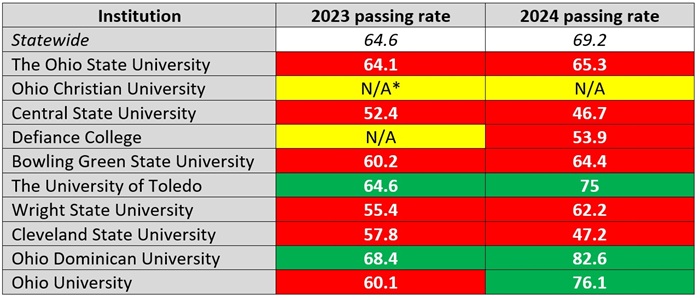
7. Most of the institutions that were identified as “Not In Alignment” on the state’s science of reading audit fell below the statewide average first-time pass rate in one of the last two years.

Chart 2 identifies 2023 and 2024 first-time pass rates at the ten institutions that earned a designation of Not In Alignment on ODHE’s science of reading audit. Institutions shaded in red failed to meet the state average, while those in green met or surpassed it. The University of Toledo, Ohio Dominican University, and Ohio University are the only ones that performed better than the state average in 2024.

Chart 2. First-time pass rates at institutions identified as out of alignment on Ohio’s science of reading audit
TPPs licensure pass rates blog chart 2

*Institutions marked N/A did not have enough information available to determine a pass rate.

***

Overall, the data on reading licensure test pass rates are a mixed bag. Some institutions are doing a solid job of ensuring that their teacher candidates have a strong foundation in reading instruction. Others, not so much. The big question now is where Ohio should go from here.

First, state officials should work on improving the dashboard. The current version has limited capabilities to sort and analyze data, which makes it difficult to compare results for a single institution over time or to compare individual institutions or groups. Making the database more interactive and user-friendly—and allowing users to download the data to sort on their own—would be a good step forward.

Second, state officials should consider keeping all of Ohio’s early literacy data in one place. Right now, audit results and the pass rate dashboard can be found on ODHE’s website. Everything else that’s science-of-reading related is housed on the Department of Education and Workforce’s website or the state’s report card page. Creating an annually-updated site that tracks all of Ohio’s early literacy reform data in one easily-accessible place would give policymakers and the public a much simpler way to track progress.

Third—and most importantly—policymakers should discuss how to support institutions with abysmally low first-time pass rates. The Foundations of Reading exam is a critical part of ensuring that teachers are well-prepared to teach reading when they enter the classroom. And yet, according to ODHE’s new dashboard, there are at least seven institutions where fewer than 60 percent of first-time test takers passed the exam in 2024. On a letter-grade scale, that’s an F.

Prospective teachers—many of whom have taken out student loans to pay for their education—deserve better from their training programs. So do the students these educators will one day teach.


[1] Ten institutions didn’t have enough data to calculate a passing rate in either 2023 or 2024.
Policy Priority:
Standards & Accountability
Topics:
Teachers & School Leaders
Jeff Murray
2.11.2026
Gadfly Bites 2026
Listen to this article
Loading the Elevenlabs Text to Speech AudioNative Player...

News stories featured in Gadfly Bites may require a paid subscription to read in full. Just sayin’.

  1. While this op-ed from the superintendent of the Montgomery County Education Services Center is advertised as an offensive move to “make clear that public schools truly are the heartbeat of our community” (as if that statement would be of any substantive value by itself even if it were true), it only takes a couple of sentences before the whole thing becomes a transparently defensive effort to guilt families away from choosing private school options. The headline asks “why is this the moment for a pro-public schools community campaign?” The answer is: Because EdChoice ain’t going away. (Dayton Daily News, 2/9/26)

  2. The thrust of this story is that Akron City Schools has, by the skin of its teeth, managed to evade the unholy threat of financial oversight by the Empire State of Ohio. (Oh no! They might make us stop blaming everyone else for our woes, help us live within our means, and avoid running out of cash, the beasts!) The Akronites have done so by cutting expenditures for this school year by an impressive $6.6 million and by finding in the metaphorical couch cushions booking an unexpected tax windfall of $477K. Put the proper another way: Ohio’s process of escalating fiscal oversight of traditional school district budgets WORKED EXACTLY LIKE IT’S SUPPOSED TO—AGAIN. (Akron Beacon Journal, 2/10/26) Meanwhile, among the many trial balloons being floated to avoid state fiscal oversight in Lorain City Schools—man would that generate some unpleasant flashbacks up there—is creation of a new district-run virtual school “in hopes of increasing or maintaining enrollment rather than seeing students leave for online schools.” The a$$t $upe is even kind enough to price it all out for us so we don’t even have to speculate on their motives: It will cost the district $23 per month per student to provide internet access to everyone who enrolls in Titan Virtual Academy (that’s nice of them I guess, but I do wonder what the quality of $23 internet service is) as well as $26,000 in startup expenses (no idea what those might be for), but for every child who “returns” to the district from an online charter school, or who doesn’t leave the district because of TVA, Lorain will receive $8,100 in state and federal funding. It’s $o $imple, right? Sure sounds like an offensive strategy to me. (The Chronicle-Telegram, 2/10/26)

  3. Switching gears with a sigh of relief, here’s a look at a recent op-ed by State Senator Mark Romanchuk in his hometown paper extolling the virtue of Ohio’s private schools. “Receiving an education in a safe, disciplined and welcoming classroom environment matters. In a world that is constantly changing, receiving instruction that includes the bedrock teachings of the Western world gives students a foundation to stand on as they face the issues that will arise in their day and age.” (Tribune-Courier, 2/5/26) Relatedly, here’s a different take on Ohio’s Tax Credit Scholarship Program than the one we talked about on Monday. Instead of haters hating (and the Cleveland haters still haven’t stopped hating!), we get an inside look at how the program has helped families attending a pair of Jewish schools in Columbus. Those pieces are like night and day, right? (Columbus Jewish News, 2/10/26) Finally today, just to ram home my point with the minimum amount of subtlety it is rhetorically possible to utilize: While high-spending and low-performing school districts and their head-in-the-sand apologists are busy pointing fingers for their own failings, guilt-tripping parents who dare to want something better for their kids, and transparently scheming to offer students dollar-store education plans in exchange for thousands in taxpayer money, here’s a look at Hawken School’s Medical Science Semester, an intensive academic and residential program for high school students interested in becoming medical practitioners, launching in spring 2027. It sounds like a dream, and anything we can do to open the door to more of that kind of educational awesomeness for as many kids who want it is a good thing. It seems easy enough to me to ignore the flailing haters and to embrace those who demonstrate they truly care about—and will do the work—to boost kids’ academic achievement. How’s that for an offensive strategy? (Cleveland Jewish News, 2/9/26)

Did you know you can have every edition of Gadfly Bites sent directly to your Inbox? Subscribe by clicking here.

Policy Priority:
School Funding
Topics:
Governance

The science of reading has sparked sweeping policy change—but results are not guaranteed. In Fordham’s 2025 Wonkathon, 48 submissions explored how states, districts, and schools can move from laws on the books to real literacy gains in classrooms. The topic is so important and the response was so great, that we created an anthology of all the essays, organized across ten key themes. Click through the topics below or download a PDF of the full collection.


For eleven years now, we at the Thomas B. Fordham Institute have hosted an annual Wonkathon on our Flypaper blog. Designed to generate substantive conversation around key issues in education reform, we invite policy “wonks” to submit responses to a question. 2025’s Wonkathon asked: What needs to happen next—at the state, district, and school levels—for the science of reading revolution to fulfill its promise and ensure that far more children learn to read well?

We decided to focus on the reading crisis, as it has drawn new urgency and spurred a wave of reform. Today, just one-third of American fourth graders read at or above the “proficient” level on the National Assessment of Educational Progress—the lowest rate since 2005. The pandemic worsened matters, erasing years of progress and leaving millions of students further behind. In response, more than 40 states have enacted “science of reading“ laws intended to overhaul how children are taught to read—mandating changes in curricula, teacher training, intervention, and accountability.

The laws vary in their particulars. Almost all invest in professional development for current educators. Most require the adoption of approved curricula, including materials and assessments, as well as tutoring or intensive interventions for struggling readers. And about half include teacher certification or licenses in science of reading instruction and/or mandate that teacher preparation programs incorporate it into their courses.

However, the rollout of these new policies has come with a range of difficulties. In some places, the “science of reading” has become more slogan than substance, with laws passed but not fully funded, faithfully implemented, or closely monitored. Consequently, it’s hard to know whether all this activity will yield significant and lasting improvements in literacy achievement.

These uncertainties make the insights from this year’s unprecedented number of Wonkathon submissions (48 total!) all the more valuable. Together, they paint a picture of a movement with real momentum—but also with substantial work ahead if the science of reading is to fully deliver on its promise.

To help readers explore these ideas, the sections below highlight ten key themes, each with links to the essays in that theme and brief descriptions of the insights they offer. (Topics and essays are listed in alphabetical order.)

1. Building systems for effective implementation

These authors argue that laws and legislation matter, but without strong implementation, they fall short of creating real change. The submissions assert that achieving the goals of SoR policies requires moving beyond a checklist of laws passed and instead creating systems that aid in implementation.

For example, Kunjan Narechania and Jessica Baghian argue that the “miracle” of literacy gains—like those seen in Louisiana, Tennessee, Mississippi, and D.C.—isn’t due to the laws themselves, but to the relentless focus on implementing those laws and how those laws are executed. Kymyona Burk, who led the implementation of Mississippi’s law, adds that passing a bill is only the first step of the work and that true success requires policy implementers to have their boots on the ground.

  • Beyond a science of reading policy checklist, by Kymyona Burk
  • Don’t just pass reading laws—build sustainable literacy systems, by Annie Morrison and Kathy Kelly
  • From laws to literacy: The science of reading needs more than statutes to succeed, by Kristen McQuillan and Robert Pondiscio
  • From slogans to scores: What has to happen next for the science of reading to actually work, by Daniel Whitlock
  • Look at the children: What we miss when we talk about the science of reading, by Julie Wible and Maureen Mirabito
  • Systems, not slogans: Real change requires relentless implementation, by Kunjan Narechania and Jessica Baghian
  • Unlocking the science of reading, by David Steiner

2. Coherence and strategies matter

While still focusing on implementation, other submissions note the importance of coherent systems and structures. Instructional materials, class time, teacher practices, and assessments must all be moving in the same direction to see real policy change. When practices are misaligned, even the best policies might not come to fruition.

For instance, Sarina Sande notes the importance of culture within a school and how teachers, administrators, and literacy coaches being “on the same page” is key to improvement. Louise Baigelman and Shira Engel examine how misaligned student interventions can hinder growth, and Megan Reder-Schopp contends that even the strongest curriculum can fall short if schools fail to prioritize scheduling and sufficient time for implementation.

  • Connecting intervention and core curriculum: Why coherence matters and how to achieve it, by Louise Baigelman and Shira Engel
  • Knowing what to do isn’t knowing how to do it: The missing discipline of systemic strategy, by Jamila Newman
  • The 90-minute solution: How states, districts, and schools can make reading science stick, by Megan Reder-Schopp
  • What happens when everyone reads from the same page: The collaboration the science of reading still needs, by Sarina Sande

3. Family and school–home partnerships

Three essays discussed how parent involvement is essential to effective SoR reforms. This includes communicating screener results and timely reading data with families in a way they can understand, as well as providing parents or caregivers with structured guides and parent-facing tools.

For instance, Windy Lopez-Aflitto asserts that parent engagement should be an intentional part of reforms. Bridget Cherry focuses on the untapped potential of parents to accelerate student progress, especially, by providing parents with simple, actionable tips. And Joan Kelley emphasizes the importance of helping parents understand the SoR so that the support students receive at home aligns with their classroom instruction.

  • Harness parent power to boost literacy gains, by Bridget K. Cherry
  • Strengthening literacy systems: Embedding school–home partnerships to improve outcomes for all kids, by Windy Lopez-Aflitto  
  • Using family partnerships to help fulfil the science-of-reading promise, by Joan Kelley

4. Guardrails, assessments, and accountability

Two submissions highlighted the importance of balanced testing and accountability measures. They argued that clear guardrails and well-designed assessments are necessary to ensure science of reading policies are implemented with fidelity.

Specifically, Edmund Gordon and Eric Tucker emphasize that high quality instructional materials are only effective if paired with frequent, actionable assessments, and Charles Barone suggests that instead of relying on traditional test scores, we should move toward a model of accountability that prioritizes growth.

  • Science of reading 2.0: Assessment in the service of learning as the backbone of science-powered reading improvement, by Edmund W. Gordon and Eric Tucker
  • Seizing opportunity at a time of risk: Toward a new model of accountability to advance student literacy, by Charles Barone 

5. Looking beyond K–3

Other submissions focus on the importance of widening the scope of policies as most current SoR policies focus exclusively on K–3 instruction. Several essays argue that the science of reading should begin much earlier, while others say more attention should be given to policies that reach older students as well.

For example, Elliot Regenstein argues that the foundation of literacy begins long before a child enters a classroom. Conversely, Melinda Cameron notes that the focus on reforms on the early grades has excluded middle and high school students who still struggle to read.

  • If we want the science of reading to work, we have to start before Kindergarten, by Amanda Rutter
  • Read, by grade three? How about reading (and writing) beyond it, by Miah Daughtery
  • The science of reading revolution must reach older readers, by Melinda Cameron
  • The science of reading starts at birth, by Elliot Regenstein

6. Staying the course

Several entries stressed that lasting change requires long-term vision, continued funding, steady improvement, and ambitious and clear goals. Progress takes years of iterative work, not quick wins, and states and districts must keep aiming high to move the needle.

For instance, Jenn Vranek and Ila Deshmukh Towery’s submission cautions against expecting overnight success and promotes endurance rather than a quick fix. Amy Rhyme adds to the discussion by asserting that continuous improvement is necessary and that states must avoid complacency after initial policy wins.

  • Continued literacy growth requires an ongoing commitment to continuous improvement, by Amy Rhyme
  • It’s not a miracle, it’s a marathon, by Jenn Vranek and Ila Deshmukh Towery
  • New Year’s resolutions and the Mississippi Marathon: How states can make reading policy stick, by Todd Collins
  • Reading improvement will require bigger goals and more learning spirit, by Emily Freitag
  • Science of reading, meet evidence-based spending, by Sara Kerr and Heather Boughton
  • Why science of reading reforms need definable goals, by Caitlin Peartree

7. Student engagement

Two additional essays discuss the student reading experience, noting the importance of children experiencing reading as meaningful, joyful, and engaging. Notably, Emily Shisler discusses how the narrow focus on mechanical skills neglects comprehension and a love for books and reading. Similarly, Stephanie Dowlearn notes that teachers should make reading instruction joyful so that children are more engaged.    

  • Spark engagement, reimagine early literacy: An educator’s perspective on bringing joy back into the classroom, by Stephanie Dowlearn
  • We have lost the plot on the science of reading, by Emily Shisler

8. Taking a comprehensive approach

While many submissions chose to highlight individual aspects of SoR that would enact big change, these authors detailed a comprehensive approach that included several key levers of change. These include collaboration across state and district levels, use of external partners and resources, appropriate student supports, parent involvement, and setting the right goals.

For example, David Wakelyn discusses how multiple components like teacher training, curriculum, and consistent data monitoring are all needed to affect change. And Peter Greer offers a similar perspective, noting how instructional materials and long-term feedback loops should be used together to ensure success. 

  • Lightbulb moments and the science of reading, by Victoria R. Haberman
  • Reading laws aren’t enough: How states can turn policy into progress, by David Wakelyn
  • The science of reading is not about policies, it’s about practices, by Jason Kamras, Taikein Cooper, and Alyssa Schwenk
  • Smarter ways to fortify the reading revolution, by Peter Greer

9. Teacher knowledge and effective leadership

A large number of submissions emphasize that policies can only succeed if teachers receive the support they need to develop a deep understanding of SoR. This includes things such as developing educators’ knowledge of language, strengthening pre-service programs, improving professional development, and creating long-term systems for ongoing support for teachers. Moreover, several essays note that effective leadership is a critical component to success.

Examples include Michael Kirst’s essay, which argues that we must rethink the role of the state in supporting educators in every grade throughout their entire careers, not just new teachers entering the profession. Emilie Raczek discusses how most teachers did not learn to teach reading using a SoR approach, and they can’t be expected to make the shift on their own; educators need to be given the opportunity to deepen their expertise. And Lisa Coons asserts the need for strong leaders to guide the implementation of laws across all levels.

  • Dead LETRS: What good is a mandate without great PD?, by Kata Solow
  • Give reading teachers better systems, by Ed Jones
  • How young is a young developing reader?, by Pamela Nevills
  • Improving science of reading implementation through career-long educator support, by Michael W. Kirst
  • Next steps to sustain effective science of reading instruction for all students, by Linda Diamond, Kelly Staurt, and Dale Webster
  • Reform teacher education. Improve student literacy proficiency, by Patrick Riccards
  • Still missing: Educators’ knowledge of language, by Louisa Moats
  • To make science of reading laws work, invest in educators, by Emilie Raczek
  • What’s next for the science of reading movement? Leadership., by Lisa Coons

10. What’s still missing

Lastly, several essays highlighted areas where SoR efforts could focus on or experiment with new approaches. Suggestions ranged from team-teaching models and ability grouping to rethinking how technology and data are used. Others called for a renewed emphasis on writing, a reconsideration of the federal government’s role, and a reprioritization of key skills.

  • Don’t forget to write, by Charles Sahm
  • How researchers and technology are accelerating the science of reading movement, by Dan Lips
  • Literacy or nothing, by Thomas F. Kelly
  • Redefining the federal role in literacy: Strengthening grants to drive statewide reform, by Rianna Saslow
  • Rising with reading: A Lexile-based path to literacy for every student, by Clifford Jones and Lee James
  • The science of reading revolution has the right science—but the wrong system, by Lisa Wyatt and Kelsey Hendricks
  • Why a focus on skill type is necessary to help more children learn to read, by Munro Richardson

Wonkathon Webinar

Following the competition, we hosted a webinar exploring the same question. A recording is available on YouTube. Meredith Coffey, Fordham’s Senior Policy and Operations Associate, also wrote a recap, “For the science of reading, the ‘big work’ is yet to come.” The webinar featured Kymyona Burk (Senior Policy Fellow, Literacy, ExcelinEd), Emily Freitag (Co-Founder and CEO, Instruction Partners), Louisa Moats (President, Moats Language Essentials), David Steiner (Executive Director, Johns Hopkins Institute for Education Policy), and Eric Tucker (CEO and President, The Study Group).

2025 Winners

Although all submissions offered great insights, Wonkathon is a competition. And here are the three essays voters liked most.

First place: Science of reading 2.0: Assessment in the service of learning as the backbone of science-powered reading improvement, by Edmund W. Gordon and Eric Tucker

A balanced assessment system—whereby each quiz, screening, and exam is used to improve instruction, not just audit status—will help ensure reforms related to the science of reading translate into real reading gains, argues the winning entry. The approach builds upon existing commitments to instructional excellence and high expectations for every learner, and is based on rigorous research.

Second place: Read, by grade three? How about reading (and writing) beyond it, by Miah Daughtery

The most significant omission of the science of reading movement was its limited consideration of students in grades six and above, says the runner-up. Many students—particularly those from low-income, multilingual, and historically marginalized communities—struggle to read in middle school and graduate high school nonproficient. Here’s how the movement’s next phase can correct that with better data, literacy instruction, and investment.

Third place: Systems, not slogans: Real change requires relentless implementation, by Kunjan Narechania and Jessica Baghian

For more states to get literacy right, they need to restructure their education agencies around a limited set of goals and reorient their entire system to drive toward those goals. The bronze-winning submission says this will require four core components: a coherent vision, an implementation chain, a plan for using the state’s most important levers, and implementation data that drive improvement.

Policy Priority:
Standards & Accountability
DOWNLOAD PDF
Jeff Murray
2.9.2026
Gadfly Bites logo
Listen to this article
Loading the Elevenlabs Text to Speech AudioNative Player...

News stories featured in Gadfly Bites may require a paid subscription to read in full. Just sayin’.

  1. Somehow, Ohio’s new-ish Tax Credit Scholarship program—which allows individuals to donate to support private school scholarships and get a tax deduction for it—is simultaneously so unknown it must be explained like it’s an alien artefact found in a swamp and yet so popular it’s been “deducting” $25 million per year from state coffers since day one. You can read all the other limp exasperation-mongering for yourself, but I couldn’t help wondering what these haters would say about the non-profit support foundations for school districts around the state doing the exact same thing for decades…if they are ever asked. (Cleveland.com, 2/8/26)

  2. As we briefly discussed during the height of weather-related school closures a couple weeks ago, your humble clips compiler is bothered by the endless focus of district leaders on how much “not school” they can get away with before being “punished” by “having to” make up lost time. They think about it and talk about it too dang much. Here we have another irritating case in point in Cleveland Height-University Heights City Schools (ranked 540 out of 607 districts on performance index score last year), whose leaders are laying plans to make up time for middle and high schoolers this year once they reach 8 full days of “mostly weather-related” closure…which they are sure will happen. And, in a phrase guaranteed to chill the blood faster than a lake effect snow squall, they say they are going to “go back and pull out all of the COVID protocols” to do it. Talk about a sterling example of “not school”. Not only that, but the elected school board of CH-UH is working to shorten up next year’s fall semester because parents would rather “unplug” over the holiday break than have a handful of additional days left in the semester after Christmas/New Year. Rather than turning in final projects and assignments or otherwise tying up loose ends from the fall semester, says the elected board vice president by way of explanation, “we can just spend time with the family and recharge.” What exactly do y’all need to recharge from? All that “not learning”, or the rhetorical knot-twisting you need to do to justify all that “not learning”? (Cleveland.com, 2/7/26)

Did you know you can have every edition of Gadfly Bites sent directly to your Inbox? Subscribe by clicking here.

Policy Priority:
School Funding
Topics:
Governance
Jeff Murray
2.6.2026
Ohio charter news logo
Listen to this article
Loading the Elevenlabs Text to Speech AudioNative Player...

Stories featured in Ohio Charter News Weekly may require a paid subscription to read in full.

Building a brighter Cleveland

Cleveland Metropolitan School District’s plan to close and consolidate dozens of underutilized school buildings—dubbed Building Brighter Futures—is moving full speed ahead. Discussions are already underway around the community about what to do with the many school facilities that will be vacant starting this July. Those discussions, unfortunately, don’t seem to include charter and private school operators, who should—by letter and spirit of Ohio law—have first pick. Fordham’s Chad Aldis is quoted and linked in this coverage, via a blog post from back in May. And just so we don’t forget the great things that can happen when a charter school does locate in a closed district building, here’s some timely coverage of Breakthrough Schools’ brand new gymnasium space added on to its Woodland Hills campus on Cleveland’s east side and dedicated with a big neighborhood celebration last week. Woodland Hills was, as you might have guessed, a former CMSD building that is still serving its community—bigger and better than ever—today.

Living up to the promise

Wall Street Journal columnist Jason Riley extols the virtues of Success Academy and other New York City charter schools this week; schools whose low-income pupils are defying the odds and showing huge academic successes, just as their founders promised. Riley says that these high-performing schools should be expanded immediately to clear their enormous waiting lists and their methods studied and replicated by other schools to help even more students across the country.

The view from Idaho

Bluum CEO Terry Ryan and ExcelinEd Senior Policy Adviser Matthew Joseph expressed similar thoughts in an Idaho Ed News piece recently. “Idaho’s charter sector is growing, in demand, and relatively high-performing,” they write, largely fulfilling the promise of education innovation and success. However, Idaho is the only state that subjects charter schools to both strict compensation controls and restrictive staffing rules, which serves to stifle specific innovations in terms of staffing, schedules, instructional models, and the use of technology. Charters schools have earned the right to “fully align their resources with their educational vision,” Ryan and Joseph conclude. It is past time for Idaho to “let its strongest charter schools show what real autonomy can achieve.”

Even more innovation

Speaking of innovation, here’s a look at Strive charter school, coming soon to the South Bronx. Strive will be “a one-stop shop” for working families, said school founder Eric Grannis (husband of Success Academy CEO Eva Moskowitz). The school will be open twelve hours a day, seven days a week, for 50 weeks of the year. This includes a regular school day, before- and after-school programming, and three meals a day. The K-5 school is scheduled to open late this summer.

A quirky tale

Skillern Elementary, a popular charter school in Hamilton County, Tennessee, will be expanding to 72 kindergarten seats this fall. But it shouldn’t be. The school district that oversees Skillern mistakenly advertised to fill 72 seats—and filled every one—before leaders realized that they had only been approved by the state for 40 seats! After much hand-wringing, some debate, and several emergency votes, the district and the state agreed to allow all 72 students to start. But they are requiring detailed transition planning from staffers to make sure that they can all be accommodated in higher grades at Skillern and on into the Ivy Academy middle and high schools to which Skillern grads traditionally matriculate.

*****

Did you know you can have every edition of the Ohio Charter News Weekly sent directly to your Inbox? Subscribe by clicking here.

Policy Priority:
School Choice
Topics:
Charter Schools
Jeff Murray
2.6.2026
Gadfly Bites logo
Listen to this article
Loading the Elevenlabs Text to Speech AudioNative Player...

News stories featured in Gadfly Bites may require a paid subscription to read in full. Just sayin’.

  1. For our second edition in a row, we start by talking about the poor state of math education in Ohio’s schools, and the commentary again comes in the form of a newspaper op-ed from our friends at Ohio Excels. This time, it’s org president Lisa Gray reminding us of the dire state of student math achievement across the state, the fact that math teachers can be certified even if they fail the math portion of their licensure exam, and that there is a bill under debate in the legislature that proposes fixes for all this and more. (Logan Daily, 2/6/26)

  2. This week’s math talk seems highly relevant because we’ve also been getting increasingly shrill coverage of the fact that districts like Columbus City Schools are facing huge deficits and are required to cut their budgets like never before. The primary reason for these budget holes, as I know you know, is their years-long failure to reckon with shrinking student populations and to right-size their operations to match that reality. Especially in Columbus. (Columbus Dispatch, 2/4/26) Elyria City Schools’ enrollment losses have been less severe than many big-city districts, but they also have been ongoing for years now. However, you will see no discussion of that issue in this piece telling the district’s version of claiming to explain how Elyria arrived at the urgent need to cut $9 million from their budget. It is everyone else’s fault, as you might have guessed, from state legislators to county commissioners to local voters. And, they argue, it’s someone else’s job to just send more money to fix it. (Chronicle-Telegram, 2/5/26) Despite all the coverage of budget reduction votes, I’m not sure if we can really count on the cuts actually happening. As we have noted here several times, Columbus City Schools voted in November of 2024 to close, empty, and sell their downtown headquarters property “immediately”. None of that happened, although this piece indicates that some “shifting” of HQ workers is just now beginning to occur, only 16 months late. “No deadline exists yet for a full move,” said a district spokesperson with no discernable trace of irony, “but I think it is inevitable that we will eventually sell this and move everyone.” How very underwhelming, sir. Also underwhelming: that measly $4 million appraisal value quoted for the buildings and prime downtown land. Surely a lowball figure given the ongoing development all around it. (Columbus Underground, 2/5/26) But outside help is trying to come to the rescue of Columbus City Schools at least. And it may even get there…eventually. The state’s largest school district is finally getting itself one of those slush-fundy-sounding support foundations we were talking about a few weeks ago—ubiquitous in the suburbs and smaller rural districts. The Columbus City Education Foundation will be led by former elected school board member Christina Vera and it will be able to raise unlimited funds to pour into the district which is having so very much trouble living within its budget of hundreds of millions of dollars per year despite serving hundreds fewer students every year. But none of this largesse will be sloshing into the district’s coffers right away. We learn in the final line of this coverage that the foundation must “fundraise for operational costs before it can launch in earnest.” (Columbus Dispatch, 2/4/26)

  3. Finally today, this seems like a really good story overall. But even though I’m not a teacher and thus am probably missing something obvious, I still have questions about the facts underlying the good news. At Akron City Schools’ Jennings Community Learning Center, the passing rate on Ohio’s English proficiency test for students who speak English as a second language (ESL) has recently skyrocketed—from 20 percent in 2024 to 53 percent last year. Credit for that laudable boost is wholeheartedly given to mentor/tutor/cheerleader/“cool friend” Rafa Hernández-Brito, a Cleveland Cavaliers radio announcer who is a native Spanish speaker originally from El Salvador and who has been helping out in the classroom since 2025. This is all good news for the kids, but I found myself wondering what specifically he was doing to help more kids reach a passing grade. One ESL teacher says it’s because, “The kids get to see a real-world example, they get to see someone that’s engaged with them, someone who is successful, charismatic and someone who shows an interest in some time with them.” But why, I ask myself, aren’t the teachers doing all that? Especially if it's going to make so huge an improvement. Why is this untrained, unlicensed volunteer from outside the school able to be that “engaged someone”—and to do it so successfully—while the degreed, licensed, and highly-paid teachers are, by the data and information we get in the piece, not able to do that? If Rafa more than doubled the passing score with however much time he contributed—surely a fraction of time spent by the teachers—what exactly were the teachers doing both before and after he arrived? Even the principal’s comments—which sound good at first blush—end up raising the same concerns for me. “We are very intentional to make sure our students are successful to get them prepared for high school and beyond,” says principal Dawn Harper. But before Rafa came along, all that “intentionality” resulted in a 20 percent pass rate, leaving the vast majority of kids not prepared to move on. And even with Rafa’s clearly vital contribution, Harper says she’s “hoping for at least 75 percent” of students to pass the test this year. Rafa? He’s confident he’s going to get 100 percent. I mean—go Rafa!—that’s obviously what is supposed to happen and I actually think he could get there. But why does it always have to be someone else to the rescue? (Akron Beacon Journal, 2/6/26)

Did you know you can have every edition of Gadfly Bites sent directly to your Inbox? Subscribe by clicking here.

Policy Priority:
School Funding
Topics:
Governance
The Education Gadfly
2.6.2026
Gadfly Guy
Listen to this article
Loading the Elevenlabs Text to Speech AudioNative Player...

WHAT WE’RE READING

Linda Jacobson looks back at former LAUSD superintendent Roy Romer’s efforts to boost student reading through phonics-based instruction nearly two decades before the current science of reading push. —The 74

—

“Some microschools are optimistic Texas’s voucher-style school choice program will expand their reach and help them secure more stable funding. But for others, the funding comes at a steep price—the loss of autonomy in the form of accreditation and the need to adopt standardized testing. It’s an inflection point for a movement that serves about 1.5 million students across the country and includes at least 100 microschools in Texas.” —Jessica Ma, The Dallas Morning News


Editor's note: This was first published on Mike Petrilli's Substack, SCHOOLED, a twice-weekly free Substack and email newsletter restarting the education-reform conversation.

Click here to subscribe for:

  • Sharp analysis of the week’s biggest K–12 debates

  • Curated commentary from across the ed-policy world

  • Lively discussion—including reader reactions and pushback

The Education Gadfly
2.6.2026
Gadfly Guy
Listen to this article
Loading the Elevenlabs Text to Speech AudioNative Player...

CHEERS:

Add another name to the content-knowledge-lovers club. “It is very, very important that kids learn the skill of sounding things out, of converting letters on the page into spoken words. But it’s also critical that in the early elementary years, we are growing their vocabulary, growing their general knowledge of the world, and growing their familiarity with books and stories. When they read something, they should have good odds of being familiar with most of the words in it and have enough background on the world to figure out the rest.” —Kelsey Piper, The Argument

—

Jason Riley praises New York’s successful charter schools, which—as Chad Aldeman reports—are much more likely to boost the reading achievement of low-income students than their traditional public peers. As Karin Chenoweth discussed on this week’s Education Gadfly Show podcast, it’s important to identify and learn from success, not just call out where schools are falling short. —The Wall Street Journal

JEERS:

Ed tech’s aggressive marketing leads to profits—it’s a $165 billion dollar industry worldwide—but it has little to no effect on student learning, and it may contribute to the long-term declines in student achievement. —The Economist

—

“According to data released in December from the National Center for Education Statistics, public schools added 118,000 employees last year even as they served 135,000 fewer students. You may have heard this story before. In fact, I wrote a nearly identicalsentence around this time last year. But enrollment keeps falling as staffing levels rise. Since 2018-19, the last year before the pandemic, student enrollment is down 1.4 million (a 2.8 percent decrease) while employment is up by 479,000 (a gain of 7.3 percent).” —Chad Aldeman, The 74


Editor's note: This was first published on Mike Petrilli's Substack, SCHOOLED, a twice-weekly free Substack and email newsletter restarting the education-reform conversation.

Click here to subscribe for:

  • Sharp analysis of the week’s biggest K–12 debates

  • Curated commentary from across the ed-policy world

  • Lively discussion—including reader reactions and pushback

Michael J. Petrilli
2.5.2026
Football goalposts
Getty Images/33ft
Listen to this article
Loading the Elevenlabs Text to Speech AudioNative Player...

Over the past decade or so, as the education reform movement has increasingly splintered along partisan lines, the number of people who support both charter schools and private school choice has shrunk to almost nothing. I think there might be a dozen of us left. (Wait, Jorge Elorza makes thirteen.) One cause of the growing divide, I believe, is that private school choice advocates are making demands that are increasingly outlandish.

It’s not just the push for universal access or for education savings accounts, though that’s part of it. As Nicole Stelle Garnett acknowledges in City Journal, these are big shifts from where the school choice movement started out three decades ago.

As a young attorney, in the mid-1990s, I helped defend the constitutionality of the nation’s first modern voucher programs. Back then, we were fighting to preserve two programs that served a few thousand kids in Milwaukee and Cleveland. Both were means-tested, limited to the poorest students, and animated by what Howard Fuller called the “rescue mission” justification for parental choice in education—that is, the imperative of empowering disadvantaged kids to exit failing public schools—rather than by what he deemed “a fight for broad societal change.”

Nicole still embraces the rescue mission as a “moral imperative,” even as she’s now excited about a more expansive approach, but it seems to me that said mission has dropped to a bottom-tier priority for many in the choice movement.

Consider the policy wish list of the main school choice organizations today. Not only do they want to give parents, including affluent ones, debit cards loaded with taxpayer dollars to be spent on all manner of products and services—they also want private schools to get public funding and still be able to:

✓ Cherry pick their students

✓ Exclude students from religious faiths other than their own

✓ Exclude gay students or students with gay parents

✓ Exclude students with disabilities

✓ Exclude English learners

✓ Charge tuition above whatever public subsidies they receive, potentially excluding poor and working-class families

✓ Refuse to report test scores for participating students (as in Arizona), or refuse to take the state tests (as in all other school choice states save for Indiana and Wisconsin)

That a lot of demands. And note that not a single one applies to charter schools. This is a big reason why center-left folks like Chad Aldeman strongly prefer the charter model:

Some people argue that private school students shouldn’t have to take state tests. After all, private schools don’t have to follow state standards or regulations in other ways, and they face accountability through parental choice.

But policymakers should be clear about the trade-offs they’re making. The research literature from recent large-scale voucher programs finds negative effects on achievement scores, even while showing more positive impacts on longer-term outcomes like attainment.

Would you accept that deal? Public investment, lower math scores?

I wouldn’t. I would want to know how my investments are working. Most states can’t do that right now. But if states aren’t collecting achievement data, all they have to judge their private school choice programs by is enrollment growth. And if that’s the only metric that matters, then sure, everything looks like sunshine and rainbows.

Yet the private school choice folks are asking for even more. Because now Marty Lueken has declared that funding parity is “the next frontier for school choice”:

Over the past decade, choice policies have expanded rapidly. More families than ever can choose schools outside their assigned district. But while access has grown, funding systems have largely stayed the same. And those systems quietly signal that some students are worth less than others.

Furthermore:

In most states with private school choice programs, students who use those programs receive substantially less funding per pupil (around two-thirds less on average) compared to what their residentially assigned public schools receive in total funding from all sources.

To be clear, I support private school choice, and I like the idea of money following the child. I certainly agree that it’s well and proper to debate the appropriate level of funding for private school choice programs. Even Charlie Barone—who opposes vouchers and the like—admits that private school choice is underfunded:

Tennessee’s newly enacted Education Freedom Act provides families with about $7,300 per student through its universal ESA program. Texas offers about $10,800 annually. Florida’s Family Empowerment Scholarship delivers approximately $8,000 as does Iowa’s Students First program. These figures sound substantial until confronted with an inconvenient truth: the national average private school tuition for 2025-26 stands at approximately $15,000 per year.

This gap, between $5,000 and $8,000 annually per child, fundamentally undermines both the abundance and affordability narratives.

Back to Marty’s argument: Is it unfair that private schools receive two-thirds of what public schools get? Well, in part it depends on the kinds of kids that private schools are serving. Marty laudably supports sending extra dollars to schools with more kids with greater needs; it’s a fact that private schools tend to serve fewer such children—in part because they are allowed to exclude them. So it’s possible that student composition explains much of the funding gap. (That’s not true for charter schools, which generally serve similar students as traditional public schools do, but still aren’t close to funding parity.)

But what if a sizable public/private funding gap remains, even after adjusting for pupil composition? Do we really think that private schools deserve parity with traditional public schools and charter schools, given private schools’ ability to exclude students and their unwillingness to be held accountable for academic results? Life is full of trade-offs, and if private schools want to protect their admissions policies and lack of public accountability, they should accept fewer public dollars in return.

I would also be happy for states to provide incentives such that private schools to receive more public funding if they agree to accept all comers and/or participate in state accountability systems. I bet a bunch of urban Catholic schools would take that deal.

That would be a great way to re-prioritize the “rescue mission” that Dr. Fuller advocated, with a particular focus on getting poor and working-class kids into Catholic schools and other high-quality institutions with a history of boosting upward mobility.

Policy Priority:
Quality Choices
Topics:
Accountability & Testing
Evidence-Based Learning
Curriculum & Instruction
Governance
Private School Choice
Dale Chu
2.5.2026
Mississippi river bridge
Anthony George/Flickr
Listen to this article
Loading the Elevenlabs Text to Speech AudioNative Player...

Mississippi has earned well-deserved plaudits for its outsized literacy gains in recent years, ranking first in the nation in fourth grade reading and near the top in eighth grade, when adjusted for poverty and demographics. Its advances reflect a commitment to the science of reading and strong accountability systems—delivered at a fraction of the cost of many states. But school choice is confined to just ten charter schools and a handful of targeted private programs. That paradox—strong results alongside sparse alternatives—lands at a moment when private school choice is ascendant, even as accountability struggles to keep pace, illustrating the widening view among Republicans today that choice alone drives improvement.

Into this mix comes House Bill 2, a 446-page omnibus measure that narrowly passed Mississippi’s House before stalling in the Senate. Much of the attention has focused on its expansive school choice provisions, but also buried within are directives with far-reaching implications for accountability. The bill instructs the state department of education to seek a federal waiver that would eliminate statewide assessments in grades 3–8 while consolidating multiple federal funding streams into a single block grant. U.S. education secretary Linda McMahon’s team already forced Iowa to walk back a similarly ambitious attempt to merge funds, suggesting that Mississippi’s block grant ambitions would face steep federal headwinds—leaving the push to escape annual assessments as the bill’s more salient feature.

On the surface, that provision may seem harmless and largely symbolic, since federal approval is required—and unlikely. But it puts some state leaders on record as wanting to weaken key elements of what made Mississippi’s literacy gains possible. State assessments aren’t just bureaucratic checkboxes. They provide critical data on student progress and anchor the state’s A–F accountability system. Bypassing those exams risks eroding transparency, leaving policymakers and parents with less actionable information, and signaling that results-driven accountability is optional rather than central. In a state that has seen sustained success without broad-based choice, the push to expand parental options while trimming oversight makes clear that freedom is asserting itself over evidence in education policy and politics.

It’s no secret that today’s private school choice advocates argue that parental satisfaction is the best proxy for accountability. Many private school leaders reject state testing outright, seeing it as incompatible with the flexibility and distinctiveness that define private education—a stance that underscores both the promise and trade-offs of choice. Evidence from some private choice programs suggests that, while students may fall behind on standardized exams, they can still benefit in ways that matter for long-term outcomes like college attendance and completion.

On the other hand, test-based accountability during the Bush-Obama era underpinned a period of steady gains, particularly in math, even if it brought its own set of challenges. Part of what made this approach effective was the comparability of data across schools and districts. Without standardized testing, it is far more difficult for parents to evaluate schools across sectors. This is why, while I was in Indiana, we set a high bar for quality assurance by holding all schools receiving public dollars accountable to the same yardstick. Test scores are not the end all and be all, but they provide a consistent, objective measure that allows parents, policymakers, and educators to evaluate schools and track progress over time.

The drive for unfettered choice in Mississippi carries broader implications, too. If private schools funded with public dollars are ultimately held accountable only to the families who choose them, it becomes difficult to justify expecting a fundamentally different standard for public schools—which are, increasingly, schools of choice themselves. This logic is already emerging in other states. In Texas, lawmakers recently flirted with proposals to weaken statewide assessments even as they expanded choice options, reflecting the argument that public accountability should bend in step with private autonomy. And in Idaho, state leaders are signaling a desire to scale back state testing in favor of alternate measures that are less tightly aligned to state standards, citing flexibility and easing compliance burdens on districts and schools.

Magnolia State lawmakers may not realize the consequences of directing the state education agency to seek a testing waiver. They may see state assessments as an obstacle to private school operators or a barrier to expanding choice, but in pursuing what seems like a simple solution, they risk weakening the very system that has underwritten Mississippi’s recent gains. Without statewide assessments, the state’s A–F grades might technically remain in place, but they would convey far less reliable information about student achievement.

With the legislative session still underway in Jackson, Mississippi’s senate education chair has raised concerns about the bill arising from the state’s Blaine Amendment and the measure’s cost, as well as its lack of accountability. The state senate has also been reluctant to expand charter schools, citing weak performance in existing charters. Taken together, they underscore the tension between expanding choice and preserving accountability: The House risks weakening the system that drives student success, while the Senate, though defending accountability, may be overly cautious in expanding options.

Mississippi is trying to find a sweet spot between test-based accountability and accountability entrusted to the parental marketplace. There’s surely room to expand parent power, but more options won’t help if families don’t have reliable information on school quality. Put simply, allowing parental choice to replace systematic assessment erodes the very data that enables comparisons, weakens incentives for schools of all types to focus on measurable outcomes, and risks widening information gaps that already disadvantage historically underserved populations. Choice is a means, not the end.

Policy Priority:
High Expectations
Topics:
Accountability & Testing
Charter Schools
Governance
Private School Choice

Pagination

  • First page « First
  • Previous page ‹ Previous
  • Page 56
  • Page 57
  • Page 58
  • Page 59
  • Current page 60
  • Page 61
  • Page 62
  • Page 63
  • Page 64
  • Next page Next ›
  • Last page Last »
Fordham Logo

© 2026 The Thomas B. Fordham Institute
Privacy Policy
Usage Agreement

National

P.O. Box 110
Burke, VA 22009

202.223.5452

[email protected]

Ohio

P.O. Box 82291
Columbus, OH 43202

614.223.1580

[email protected]

Sponsorship

130 West Second Street, Suite 410
Dayton, Ohio 45402

937.227.3368

[email protected]