For many years, the conventional wisdom in education reform circles was that teachers stopped improving after a few years on the job. This brief challenges that notion based on recent research, summarizes the conditions that foster ongoing teacher improvement, and explores potential implications of this work for federal, state, and local policy.
Download the full brief or read it below.
Executive Summary
For many years, the conventional wisdom was that teachers’ experience had little bearing on their effectiveness after a few years on the job. This perception has sometimes been used to justify underinvestment in policies aimed at retaining teachers. Yet most rigorous studies over the past two decades have found that, on average, teachers continue to improve as they accumulate additional experience, especially in environments that support professional learning and collaboration.
Key Questions
In this brief, we address three key questions about the value of teaching experience:
Question 1: Do teachers keep improving after their first few years on the job?
Answer: Yes, though generally not as quickly as they do in the first few years.
Question 2: Under what conditions are teachers most likely to improve?
Answer: Teachers are most likely to improve when they work in supportive schools where they can collaborate with experienced colleagues and have stable teaching assignments.
Question 3: How can we retain experienced and effective teachers, especially in our highest-poverty schools?
Answer: By creating high-retention pathways into the teaching profession, cultivating supportive and collegial work environments, and paying teachers in these schools well.
The Bottom Line
The common refrain that teaching experience doesn’t matter after the first few years in the classroom is not supported by the evidence. Rather, it has become increasingly clear that teachers continue to improve well into the second decade of teaching, albeit more gradually than they do initially.
Recommendations
1. Make high-quality preparation and mentoring affordable and accessible, especially for teachers in high-need schools.
2. Provide quality professional learning opportunities to support teachers’ continued growth.
3. Prepare school administrators for the task of creating positive, professional, and collaborative working environments.
4. Strengthen policies that encourage a more equitable distribution of experienced teachers.
Introduction
Much research and policymaking in the United States has been guided by an assumption that teachers’ experience has little bearing on their effectiveness after a few years on the job.[1] However, while nearly every study that has examined the question has concluded that teachers improve quickly early in their careers, there has been debate about the extent to which teachers continue to learn as they gain additional experience in the classroom.
In hindsight, some of this debate may have been attributable to the fact that early analyses were “cross-sectional,” meaning they compared distinct cohorts of teachers with different experience levels in a particular school year (see the left panel in Figure 1).[2] In addition to whatever gains are associated with experience, differences in cohorts’ average effectiveness can be a function of other factors. For example, if more effective teachers leave teaching sooner, more experienced cohorts may appear to be less effective than later cohorts. In contrast, the construction of data systems that track individual teachers longitudinally has enabled analyses that include “teacher fixed effects” and thus effectively compare teachers to themselves over time (see the right panel in Figure 1).
Figure 1: Teacher fixed effects analyses provide more accurate evidence about the effects of teaching experience.
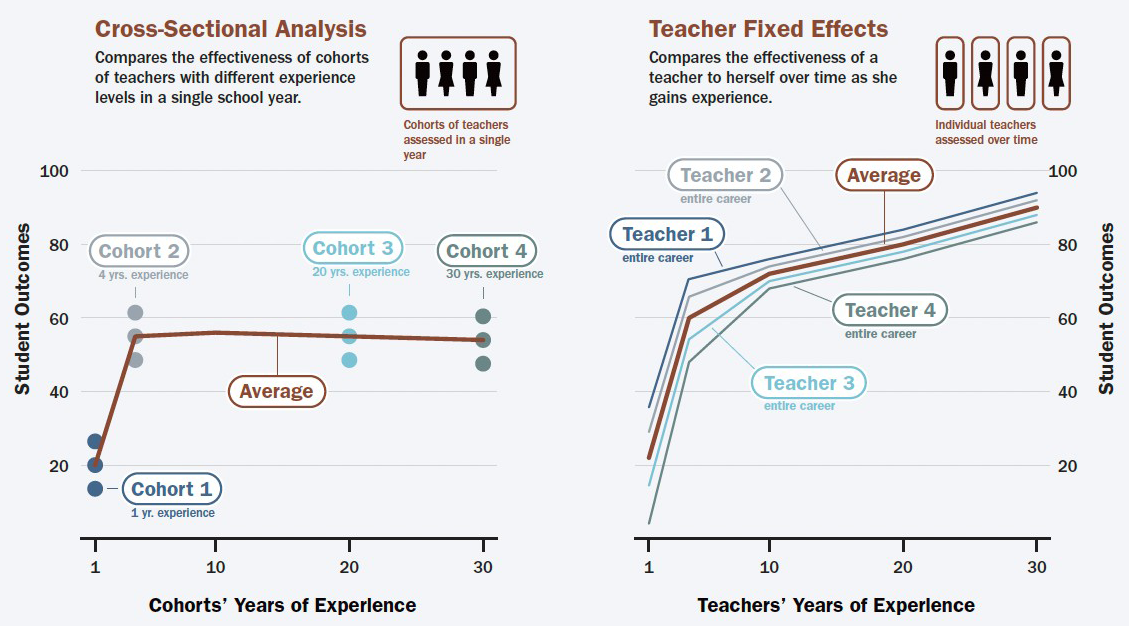
Note: This figure has been reproduced with permission from Kini, Tara, and Anne Podolsky. "Does Teaching Experience Increase Teacher Effectiveness? A Review of the Research." Learning Policy Institute (2016). https://doi.org/10.54300/625.642.
Still, even some comparatively recent studies have taken suboptimal approaches to modeling experience. For example, some studies only examine the benefits of teaching experience for the first few years of a teacher’s career (e.g., years 0-5) and thus fail to capture subsequent improvement.[3] Consequently, it has taken some time for a new consensus on the subject to emerge.
A deeper understanding of when and by how much teachers typically improve is potentially relevant to any number of policy questions. For example, how much weight should principals and policymakers give to experience as opposed to other attributes? How much does it matter that inexperienced teachers are concentrated in schools that serve higher proportions of lower-income students and students of color?[4] And in what ways might policy and resources be focused on building the effectiveness of both novice and veteran teachers?
To better inform policymakers on these and other questions, this brief summarizes the latest research on the returns to teaching experience. As discussed in the sections that follow, the bottom line is that most teachers continue to improve after their first few years on the job, albeit more gradually, and that supportive and collaborative teaching conditions can facilitate that improvement.
Question 1: Do teachers keep improving after their first few years on the job?
Answer: Yes, though generally not as quickly as they do in the first few years.
Table 1 summarizes the findings of 23 studies that have examined the relationship between teacher experience and teacher performance with longitudinal datasets that allowed the researchers to explore whether a given teacher became more effective at boosting student achievement over time. Of these studies, the overwhelming majority found a positive and statistically significant relationship between experience and student achievement in a teacher’s first five years.[5] Moreover, 15 of the 22 studies that examined this relationship in the next decade of a teachers’ career found evidence of further improvement, as did six of the eleven studies that considered the returns to experience between 16 and 25 years. In contrast, two of the nine studies found evidence of improvement beyond 25 years.
Table 1: Summary of analyses of teaching experience and student achievement
|
Years of experience |
# of studies that provide information for these years |
# of studies that suggest improvement in these years |
# of studies with mixed, neutral, or negative estimates |
% of studies that suggest improvement in these years |
|
0-5 |
23 |
22 |
1 |
96% |
|
6-15 |
22 |
15 |
7 |
68% |
|
16-25 |
11 |
6 |
5 |
55% |
|
>25 |
9 |
2 |
7 |
22% |
Importantly, almost every study that has examined the issue has found that the average teacher seems to improve more quickly at the start of his or her career and more slowly later on. For example, a 2017 study of teachers in North Carolina found that they improved about two to four times faster in their first five years than they did in the next five years, depending on the model and the subject.[7] Moreover, both this study and an earlier study of teachers in North Carolina and Florida found that teachers’ effectiveness began to decline after 28 years on the job.[8]
Still, the preponderance of the test-based evidence suggests that, in addition to improving rapidly in their first five years on the job, the average teacher also improves more gradually for at least the next decade. Moreover, this conclusion becomes harder to dispute when publication date and methods of the studies are taken into account. For example, eight of the 10 studies that have been published in the last decade—which tend to have more rigorous methods than earlier efforts—suggest that teachers continue to improve.
For more information on how specific studies were coded, see the Appendix.
Other measures of student success
In addition to boosting test scores, a growing body of research suggests that more experienced teachers produce other academic benefits.[9] For example, one North Carolina study found that middle school students with more experienced English Language Arts teachers spent more time reading for pleasure.[10] Similarly, at least two studies have found that students with more experienced teachers have fewer disciplinary offenses.[11] And two recent studies find that students with more experienced mathematics teachers are more likely to complete college and pursue higher levels of postsecondary education.[12]
Perhaps most strikingly, students with more experienced teachers are less likely to miss school.[13] For example, the North Carolina study found that a typical English teacher with 21 years of experience reduced student absenteeism by 14.5 percentage points compared to a typical teacher with one year of experience.[14] Importantly, highly experienced teachers provided the largest benefits to higher risk, chronically absent students.
Question 2: Under what conditions are teachers most likely to improve?
Answer: Teachers are most likely to improve when they work in supportive schools where they can collaborate with experienced colleagues and have stable teaching assignments.
A growing body of research suggests that teachers exhibit more improvement in some circumstances than they do in others. Specifically, research suggests that at least three conditions are associated with comparatively rapid improvement.
First, several studies have found that teachers who teach the same grade level and subject area for multiple years improve more quickly than those with less relevant prior experience.[15] For example, a study of a large urban school district in California found that elementary teachers were frequently required to switch grades, particularly in low-achieving schools with high proportions of students of color, and that this grade switching was associated with smaller returns to experience and higher rates of turnover among teachers.[16] Similarly, a study of North Carolina high school students found that “about a quarter to a third of the returns to years of experience are actually specific to the subject that the teacher taught.”[17]
In addition to this finding, research indicates that teachers whose colleagues are more experienced are more effective than those whose colleagues are less experienced, suggesting that more experienced teachers provide important benefits to their school community beyond increased learning for the students they teach.[18] For example, one study of 3rd to 5th grade teachers in North Carolina found that those whose peer teachers had more experience improved more quickly, with novice teachers seeing the biggest benefits.[19] In fact, the study found that the quality of a teacher’s peers in the previous two school years affected his or her current students’ achievement.
Finally, some research suggests that teachers’ rates of improvement depend on the supportiveness of their professional working environment. For example, one study of the Charlotte-Mecklenberg School District found that by their 10th year on the job, teachers in more supportive schools—characterized by a trusting and orderly environment, with collaboration among teachers, school leaders who support teachers, and time and resources for teachers to receive meaningful feedback and improve their instruction—had become substantially more effective than teachers in schools that had few of the above characteristics (see Figure 2).
Figure 2: Teachers improve more quickly in more supportive schools.
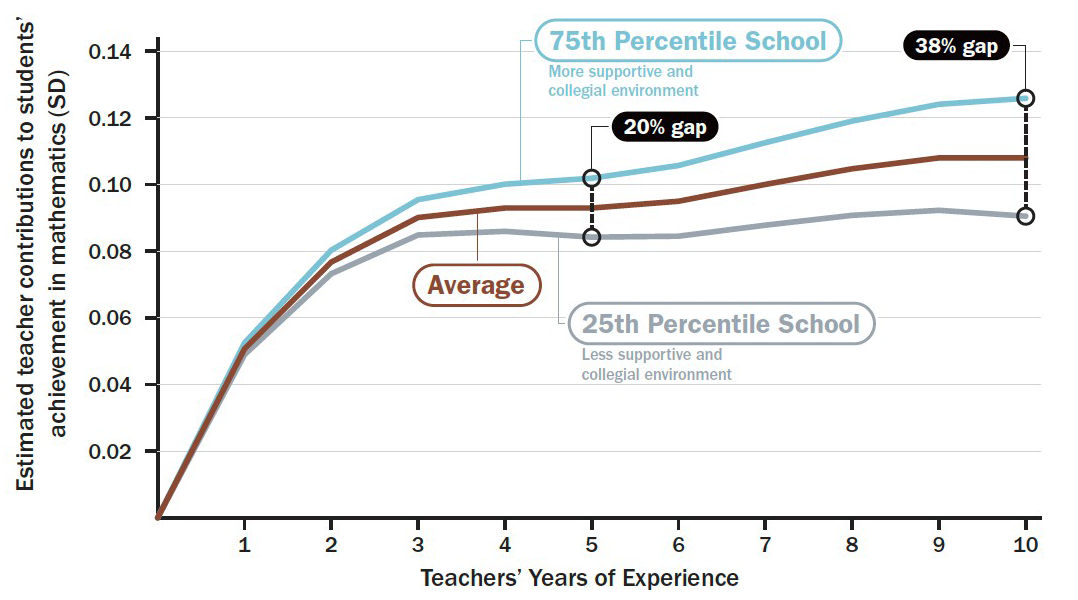
Note: On average, teachers working in schools at the 75th percentile of professional environment ratings improved their effectiveness in teaching mathematics 20% more than teachers in schools at the 25th percentile after five years. This gap almost doubles after 10 years. This figure is adapted from Kraft and Papay (2014) and has been reproduced with permission from Kini, Tara, and Anne Podolsky. "Does Teaching Experience Increase Teacher Effectiveness? A Review of the Research." Learning Policy Institute (2016). https://doi.org/10.54300/625.642.
Question 3: How can we retain experienced and effective teachers, especially in our highest-poverty schools?
Answer: By creating high-retention pathways into the teaching profession, cultivating supportive and collegial work environments, and paying teachers in these schools well.
Creating high-retention pathways into the teaching profession
Research suggests that strong preparation increases the likelihood that teachers will remain in the profession.[20] In addition to courses in teaching methods, learning theory, and the selection of instructional materials, a comprehensive preparation program typically includes opportunities to observe others teaching, at least a semester of student teaching, and individualized feedback from experienced professionals.[21] Teachers who enter the profession without such preparation are two to three times more likely to leave the profession after the first year than those who are comprehensively prepared.[22] They are also disproportionately concentrated in low-performing schools that serve large proportions of low-income students and students of color.[23]
With fewer experienced teachers in these schools, novices are less likely to receive strong mentoring in their initial years. According to one study, teachers who don’t receive high-quality mentoring and induction supports are twice as likely to leave the profession early as those who do.[24] Meanwhile, teachers who have the opportunity to participate in high-quality induction programs seem to improve more quickly.[25]
Notably, some recent research suggests that preparation programs that include an “internship” clinical placement, defined as a full year of co-teaching with the same mentor teacher, may be better at training teachers to be continuous learners.[26] This approach, which is common in newer residency models that seem to boost teacher retention,[27] also typically includes the application of curriculum and teaching methods learned during coursework, as well as additional mentoring.
Cultivating supportive and collegial work environments
Teaching conditions—which also define learning conditions for students—are a strong predictor of teachers’ decisions about where to teach and whether to stay.[28] And unfortunately, many studies have found that working conditions are worse in high-poverty schools and likely contribute to high rates of teacher turnover in these schools.[29]
When prompted, teachers consistently cite two factors related to working conditions as key to their career decisions: First, many teachers cite administrative support as the top reason for leaving or staying in the profession or in a given school.[30] For example, a recent study in Tennessee found that the schools where teachers improve fastest are led by stronger principals, as measured by their administrator observation ratings.[31] Second, many teachers report that their career decisions are shaped by their sense of connectedness to a team with a common purpose.[32] Providing opportunities for teacher collaboration and input into decision-making is one way to encourage such collegiality.
Improving compensation for teachers in high-need schools
Teachers’ salaries affect the quantity and quality of individuals preparing to be teachers and the rates at which teachers quit.[33] Furthermore, inequities in teacher salaries among districts within the same labor market leave some high-need, under-resourced districts at a strong disadvantage in hiring and retention.[34]
Funding reforms that bring additional resources to under-resourced districts can improve teacher experience and qualifications by raising salaries and reducing class sizes.[35] Similarly, additional stipends for teachers in high-poverty schools have succeeded in recruiting and at least temporarily retaining teachers,[36] and in some cases boosting student achievement.[37]
Still, such strategies—which have often been short-lived—must be continued for their effects to endure. For example, a 2013 study of the Talent Transfer Initiative, which paid a $20,000 bonus over two years to highly effective teachers to teach in schools with low average test scores, found increased retention rates during the 2-year period that teachers received the bonus. However, after the program ended, there was no difference between the retention rates of bonus recipients and other teachers.[38]
In practice, research suggests that working conditions may trump the sort of pay increases that teachers in high-poverty schools are likely to receive.[39] For example, Massachusetts teachers who received a $20,000 signing bonus that was paid out over 4 years reported that working conditions played a larger role in their mobility decisions than financial incentives.[40]
Recommendations
1. Make high-quality preparation and mentoring affordable and accessible, especially for teachers in high-need schools.
To attract prospective teachers to the fields and locations where they are needed most and ensure that they are fully prepared, governments should expand their existing investments in service scholarships, loan forgiveness programs, and urban and rural teacher residencies, all of which can boost retention and performance.[41]
2. Provide quality professional learning opportunities to support teachers’ continued growth.
While professional learning opportunities can take many forms, research suggests they are most likely to improve teachers’ practice when they (1) focus on specific curriculum content, (2) actively engage teachers, (3) are collaborative, (4) provide models of effective practices, (5) offer coaching and support from experts, (6) incorporate time for teachers to receive feedback and reflect, and (7) occur over a sustained period of time.[42]
States, districts, and schools can support quality professional learning by implementing standards that guide the design and funding for teachers’ professional development, and by providing the requisite financial and human resources including expert teachers who can serve as mentors and coaches.[43]
3. Prepare school administrators for the task of creating positive, professional, and collaborative working environments.
Increasing opportunities for collaboration and for a more productive working environment is smart policy for two reasons. First, these opportunities support increased teacher retention. Second, the benefits of experience to effectiveness are greater for teachers in strong professional working environments.[44]
Collegiality is hard to legislate, but there are nonetheless concrete steps that policymakers can take. For example, district and school leaders can facilitate scheduling changes to allow for regular blocks of time during which teachers who teach the same grade level or subject area can collaborate and benefit from each other’s expertise, which research finds can enhance effectiveness.[45] In addition, for beginning teachers especially, these opportunities are strengthened when teachers have the opportunity to teach the same grade level or subject area for several years.[46]
Ultimately, implementing these steps effectively requires strong leadership. And in fact, several studies have found that support from principals and other school leaders is one of the best predictors of teacher retention[47] and that better-prepared principals have lower rates of teacher turnover in their schools.[48] Accordingly, federal and state policymakers should promote quality school leadership through the development of strong principal preparation programs that equip administrators with the tools they need to create supportive learning environments.
4. Strengthen policies that encourage a more equitable distribution of experienced teachers.
As described above, states and districts can improve the distribution of more experienced teachers with policies that make resources more equitable across districts and schools in ways that attend to student needs. For example, retention bonuses and stipends for effective teachers in high-poverty schools can make a difference so long as the payments last, as can targeted investments in housing, childcare, and tax incentives for teachers in these communities.
In addition to such investments, states and districts can also support retention through career ladders, which boost compensation for accomplishments like National Board Certification, gaining additional skills and credentials, mentoring other teachers, and providing various kinds of school leadership.
 Appendix
Table A: Summary of the evidence on teaching experience and student achievement
|
Study |
Evidence of improvement in years 0-5? |
Evidence of improvement in years 6-15? |
Evidence of improvement in years 16-25? |
Evidence of improvement after 25 years? |
|
|
1 |
Rockoff (2004) |
Yes |
Mixed |
-- |
-- |
|
2 |
Hanushek, Kain, O’Brien, & Rivkin (2005) |
Yes |
No |
-- |
-- |
|
3 |
Koedel & Betts (2007) |
Yes |
Yes |
-- |
-- |
|
4 |
Boyd, Lankford, Loeb, Rockoff, & Wyckoff (2008) |
Yes |
Mixed |
No |
-- |
|
5 |
Kane, Rockoff, & Staiger (2008) |
Yes |
-- |
-- |
-- |
|
6 |
Jackson & Bruegmann (2009) |
Yes |
Yes |
Yes |
Mixed |
|
7 |
Clotfelter, Ladd, & Vigdor (2010) |
Yes |
Yes |
Yes |
Yes |
|
8 |
Chingos & Peterson (2011) |
Yes |
Mixed |
Mixed |
Mixed |
|
9 |
Harris & Sass (2011) |
Yes |
Mixed |
Mixed |
Mixed |
|
10 |
Sass, Hannaway, Xu, Figlio, & Feng (2012) |
Yes |
Yes |
Yes |
Mixed |
|
11 |
Wiswall (2013) |
Yes |
Yes |
Yes |
Yes |
|
12 |
Kraft & Papay (2014) |
Yes |
Yes |
-- |
-- |
|
13 |
Ost (2014) |
Yes |
Yes |
-- |
-- |
|
14 |
Blazar (2015) |
Yes |
Yes |
-- |
-- |
|
15 |
Atteberry, Loeb, & Wyckoff (2015) |
Yes |
Yes |
-- |
-- |
|
16 |
Papay & Kraft (2015) |
Yes |
Yes |
Mixed |
Mixed |
|
17 |
Cook, & Mansfield (2016) |
Yes |
Yes |
-- |
-- |
|
18 |
Gershenson (2016) |
Yes |
Yes |
Yes |
Mixed |
|
19 |
Ladd & Sorensen (2017) |
Yes |
Yes |
Yes |
Mixed |
|
20 |
Swinton & Clark (2021) |
No |
No |
No |
-- |
|
21 |
Lovison (2024) |
Yes |
Nonsignificant |
-- |
-- |
|
22 |
Ng (2024) |
Yes |
Yes |
-- |
-- |
|
23 |
Bell, James, Taylor, & Wyckoff (2025) |
Yes |
Yes |
-- |
-- |
|
22/23 96% of studies find positive relationship between experience and achievement |
15/22 68% of studies find positive relationship between experience and achievement |
6/11 55% of studies find positive relationship between experience and achievement |
2/9 22% of studies find positive relationship between experience and achievement |
Endnotes
[1] Gates, B. (2013). Mosquitos, malaria and education [Video]. TED. https://www.youtube.com/watch?
[2] Aaronson, D., Barrow, L., and Sander, W. (2007). “Teachers and Student Achievement in the Chicago Public High Schools.” Journal of Labor Economics 25(1): 95–135. https://doi.org/10.1086/508733; Betts, J. R., Zau, A. C., and Rice, L. A. (2003). Determinants of Student Achievement: New Evidence from San Diego. San Francisco, CA: Public Policy Institute of California https://eric.ed.gov/?id=ED497299; Rivkin et al., “Teachers, Schools, and Academic Achievement.”
[3] Wiswall, M. (2013). “The Dynamics of Teacher Quality.” Journal of Public Economics 100: 61–78. https://doi.org/10.1016/j.jpubeco.2013.01.006.
[4] Redding, C., & Nguyen, T. D. (2020). “Recent Trends in the Characteristics of New Teachers, the Schools in Which They Teach, and Their Turnover Rates.” Teachers College Record 122(7): 1–36. https://eric.ed.gov/?id=
[5] In addition to the studies included in Table 1, two fixed effects studies using continuous variables to measure experience found positive returns to experience (Buddin & Zamarro, 2009 and Kukla-Acevedo, 2009). These studies also found a negative squared experience term, suggesting a decline in teachers’ improvement in later years. Importantly, the more experienced teachers in these studies may still have performed at a level significantly above that of an early career teacher. In addition, two studies using an outcome other than student test scores (but associated with student test scores) to measure the returns to experience (i.e., principal evaluations) found positive returns through 6-15 years of experience (Kraft, M. A., Papay, J. P., & Chi, O. L., 2020 and Jacob, B. A., & Walsh, E., 2011).
[6] All the studies included in this table use “teacher fixed effects,” which is a method that allows researchers to compare a teacher to herself over time. We excluded studies that modeled experience with a continuous variable that does not fit neatly into these range categories. A “Yes,” “No,” or “Mixed” in a given experience category indicates that the study examined at least a subset of the years of experience in the category.
[7] Ladd, H. F., and Sorensen, L. C. (2017). “Returns to Teacher Experience: Student Achievement and Motivation in Middle School.” Education Finance and Policy 12(2): 241–279. https://doi.org/10.1162/EDFP_a_00194.
[8] Ladd and Sorensen, “Returns to Teacher Experience”; Sass, T. R., Hannaway, J., Xu, Z., Figlio, D. N., and Feng, L. (2012). “Value Added of Teachers in High-Poverty Schools and Lower Poverty Schools.” Journal of Urban Economics 72(2): 104–122. https://doi.org/10.1016/j.jue.2012.04.004.
[9] Gershenson, S. (2016). “Linking Teacher Quality, Student Attendance, and Student Achievement.” Education Finance and Policy 11(2): 125–149. https://doi.org/10.1162/EDFP_a_00180; Ladd and Sorensen, “Returns to Teacher Experience”; Lee, S. W. (2018). “Pulling Back the Curtain: Revealing the Cumulative Importance of High-Performing, Highly Qualified Teachers on Students’ Educational Outcome.” Educational Evaluation and Policy Analysis 40(3): 359–381. https://doi.org/10.3102/0162373718769379; Lee, S. W., and Lee, E. A. (2020). “Teacher Qualification Matters.” International Journal of Educational Development 77. https://doi.org/10.1016/j.ijedudev.2020.102218.
[10] Ladd and Sorensen, “Returns to Teacher Experience.”
[11] Ladd and Sorensen, “Returns to Teacher Experience”; Hayes, K. N., Preminger, L., and Bae, C. L. (2024). “Why Does Teacher Learning Vary in Professional Development?” Professional Development in Education 50(1): 108–128. https://doi.org/10.1080/
[12] Lee, S. W. (2018). “Pulling Back the Curtain: Revealing the Cumulative Importance of High-Performing, Highly Qualified Teachers on Students’ Educational Outcome.” Educational Evaluation and Policy Analysis 40(3): 359–381. https://doi.org/10.3102/0162373718769379; Lee, S. W., and Lee, E. A. (2020). “Teacher Qualification Matters: The Association Between Cumulative Teacher Qualification and Students’ Educational Attainment.” International Journal of Educational Development 77 (April). https://doi.org/10.1016/j.ijedudev.2020.102218.
[13] Gershenson, S. (2016). “Linking Teacher Quality, Student Attendance, and Student Achievement.” Education Finance and Policy 11(2): 125–149. https://doi.org/10.1162/EDFP_a_00180;
Ladd and Sorensen, “Returns to Teacher Experience.”
[14] Ladd and Sorensen, “Returns to Teacher Experience.”
[15] Blazar, D. (2015). “Grade Assignments and the Teacher Pipeline: A Low-Cost Lever to Improve Student Achievement.” Educational Researcher 44(4): 213–227. https://doi.org/10.3102/0013189X15580944; Cook, J. B., and Mansfield, R. K. (2016). “Task-Specific Experience and Task-Specific Talent: Decomposing the Productivity of High School Teachers.” Journal of Public Economics 140: 51–72. https://doi.org/10.1016/j.jpubeco.2016.04.001; Ost, B. (2014). “How Do Teachers Improve? The Relative Importance of Specific and General Human Capital.” American Economic Journal: Applied Economics 6(2): 127–151. https://doi.org/10.1257/app.6.2.127.
[16] Blazar, “Grade Assignments and the Teacher Pipeline.”
[17] Cook and Mansfield, “Task-Specific Experience and Talent.”
[18] Harris, D. N., and Sass, T. R. (2011). “Teacher Training, Teacher Quality and Student Achievement.” Journal of Public Economics 95(7–8): 798–812. https://doi.org/10.1016/j.jpubeco.2010.11.009; Jackson, C. K., and Bruegmann, E. (2009). “Teaching Students and Teaching Each Other: The Importance of Peer Learning for Teachers.” American Economic Journal: Applied Economics 1(4): 85–108. https://www.aeaweb.org/articles?id=10.1257/app.1.4.85.
[19] Jackson and Bruegmann, “Teaching Students and Each Other.”
[20] Guthery, S., and Bailes, L. P. (2022). “Patterns of Teacher Attrition by Preparation Pathway and Initial School Type.” Educational Policy 36(2): 223–246 https://doi.org/10.1177/0895904819874754; Ingersoll, R. M., Merrill, L., and May, H. (2014). What Are the Effects of Teacher Education and Preparation on Beginning Teacher Attrition? Consortium for Policy Research in Education, Philadelphia, PA. https://cpre.org/sites/default/files/researchreport/2018_prepeffects2014.pdf; Ronfeldt, M., and McQueen, K. (2017). “Does New Teacher Induction Really Improve Retention?” Journal of Teacher Education 68(4): 394–410. https://doi.org/10.1177/0022487117702583.
[21] Ingersoll, R. M., Merrill, L., and May, H. (2014). What Are the Effects of Teacher Education and Preparation on Beginning Teacher Attrition?
[22] Ibid.
[23] Goldhaber, D., Quince, V., and Theobald, R. (2018). “Has It Always Been This Way? Tracing the Evolution of Teacher Quality Gaps in U.S. Public Schools.” American Educational Research Journal 55(1): 171–201. https://doi.org/10.3102/0002831217733445; Redding, C., and Nguyen, T. D. (2020). “Recent Trends in the Characteristics of New Teachers, the Schools in Which They Teach, and Their Turnover Rates.”
[24] Smith, T. M., and Ingersoll, R. M. (2004). “What Are the Effects of Induction and Mentoring on Beginning Teacher Turnover?” American Educational Research Journal 41(3): 681–714. https://doi.org/10.3102/00028312041003681.
[25] Ingersoll, R. M., and Strong, M. (2011). “The Impact of Induction and Mentoring Programs for Beginning Teachers: A Critical Review of the Research.” Review of Educational Research 81(2): 201–233. https://psycnet.apa.org/doi/10.3102/0034654311403323.
[26] Bardelli, E., Ronfeldt, M., and Papay, J. P. (2023). “Teacher Preparation Programs and Graduates’ Growth in Instructional Effectiveness.” American Educational Research Journal 60(1): 183–216. https://doi.org/10.3102/00028312221137798.
[27] Saunders, R., Fitz, J., DiNapoli, M. A., Jr., and Kini, T. (2024). Teacher Residencies: State and Federal Policy to Support Comprehensive Teacher Preparation. Learning Policy Institute & EdPrepLab. https://doi.org/10.54300/358.825.
[28] Simon, N. S., and Johnson, S. M. (2015). “Teacher Turnover in High-Poverty Schools: What We Know and Can Do.” Teachers College Record 117(3): 1–36. https://doi.org/10.1177/016146811511700305.
[29] Evans, G. W. (2004). “The Environment of Childhood Poverty.” American Psychologist 59(2): 77 https://doi.org/10.1037/0003-066x.59.2.77; Loeb, S., Darling-Hammond, L., and Luczak, J. (2005). “How Teaching Conditions Predict Teacher Turnover in California Schools.” Peabody Journal of Education 80(3): 44–70. http://www.jstor.org/stable/3497042; Redding, C., and Nguyen, T. D. (2020). “Recent Trends in the Characteristics of New Teachers, the Schools in Which They Teach, and Their Turnover Rates.” Teachers College Record 122(7): 1–36. https://eric.ed.gov/?id=EJ1271626; Simon, N. S., and Evans, G. W. (2014). “Poverty and Child Development: Beyond the Schoolyard Gate.” In J. Hall (Ed.), Underprivileged School Children & the Assault on Dignity: Policy Challenges and Resistance. Routledge Press.
[30] Boyd, D., Grossman, P., Ing, M., Lankford, H., Loeb, S., and Wyckoff, J. (2011). “The Influence of School Administrators on Teacher Retention Decisions.” American Educational Research Journal 48(2): 303–333. https://doi.org/10.3102/0002831210380788; Simon, N. S., and Johnson, S. M. (2015). “Teacher Turnover in High-Poverty Schools: What We Know and Can Do.” Teachers College Record 117(3): 1–36. https://doi.org/10.1177/016146811511700305.
[31] Papay, J., and Laski, M. (2020, November). “Understanding the Dynamics of Teacher Productivity Development: Evidence on Teacher Improvement in Tennessee.” Presented at the 2020 APPAM Fall Research Conference. APPAM.
[32] García, E., Han, E., and Weiss, E. (2022). “Determinants of Teacher Attrition: Evidence from District-Teacher Matched Data.” Education Policy Analysis Archives 30(25): n25. https://doi.org/10.14507/epaa.30.6642; Kraft, M. A., and Papay, J. P. (2014). “Can Professional Environments in Schools Promote Teacher Development? Explaining Heterogeneity in Returns to Teaching Experience.” Educational Evaluation and Policy Analysis 36(4): 476–500. https://doi.org/10.3102/0162373713519496.
[33] Biasi, B. (2021). “The Labor Market for Teachers under Different Pay Schemes.” American Economic Journal: Economic Policy 13(3): 63–102. https://www.aeaweb.org/articles?id=10.1257/pol.20200295; Carver-Thomas, D., and Darling-Hammond, L. (2019). “The Trouble with Teacher Turnover: How Teacher Attrition Affects Students and Schools.” Education Policy Analysis Archives 27(36). https://doi.org/10.14507/epaa.27.3699; Hendricks, M. D. (2014). “Does It Pay to Pay Teachers More? Evidence from Texas.” Journal of Public Economics 109: 50–63. https://dx.doi.org/10.2139/ssrn.2252576; Loeb, S., Darling-Hammond, L., and Luczak, J. (2005). “How Teaching Conditions Predict Teacher Turnover in California Schools.” Peabody Journal of Education 80(3): 44–70. http://www.jstor.org/stable/3497042.
[34] Adamson, F., and Darling-Hammond, L. (2012, November). “Funding Disparities and the Inequitable Distribution of Teachers: Evaluating Sources and Solutions.” Education Policy Analysis Archives 20(37). http://epaa.asu.edu/ojs/article/view/1053; Farrie, D., and Kim, R. (2023). Making the Grade 2023: How Fair Is School Funding in Your State? Education Law Center. https://files.eric.ed.
[35] Jackson, C. K., Johnson, R., and Persico, C. (2014). The Effect of School Finance Reforms on the Distribution of Spending, Academic Achievement, and Adult Outcomes (No. w20118). National Bureau of Economic Research. http://www.nber.org/papers/w20118; Johnson, R. C. (2023). School Funding Effectiveness: Evidence from California’s Local Control Funding Formula. Learning Policy Institute. https://doi.org/10.54300/529.194.
[36] Clotfelter, C., Glennie, E., Ladd, H., and Vigdor, J. (2008). “Would Higher Salaries Keep Teachers in High-Poverty Schools? Evidence from a Policy Intervention in North Carolina.” Journal of Public Economics 92(5–6): 1352–1370. http://dx.doi.org/10.1016/j.jpubeco.2007.07.003; Springer, M. G., Swain, W. A., and Rodriguez, L. A. (2016). “Effective Teacher Retention Bonuses: Evidence from Tennessee.” Educational Evaluation and Policy Analysis 38(2): 199–221. https://eric.ed.gov/?id=EJ1100444.
[37] Morgan, A. J., Nguyen, M., Hanushek, E. A., Ost, B., and Rivkin, S. G. (2023). Attracting and Retaining Highly Effective Educators in Hard-to-Staff Schools (No. w31051). National Bureau of Economic Research. http://www.nber.org/papers/w31051; Swain, W. A., Rodriguez, L. A., and Springer, M. G. (2019). “Selective Retention Bonuses for Highly Effective Teachers in High-Poverty Schools: Evidence from Tennessee.” Economics of Education Review 68(C): 148–160. https://doi.org/10.1016/J.ECONEDUREV.2018.12.008.
[38] Glazerman, S., Protik, A., Teh, B., Bruch, J., and Max, J. (2013). Transfer Incentives for High-Performing Teachers: Final Results from a Multisite Randomized Experiment. National Center for Education Evaluation and Regional Assistance, Institute of Education Sciences, U.S. Department of Education. https://files.eric.ed.gov/fulltext/ED544269.pdf.
[39] Johnson, R. (2019). Children of the Dream: Why School Integration Works. Basic Books; Loeb, S., and Myung, J. (2010). “Economic Approaches to Teacher Recruitment and Retention.” In B. McGaw, P. Peterson, and E. Baker (Eds.), International Encyclopedia of Education, 3rd ed., Vol. 8, 473–480. Elsevier. http://dx.doi.org/10.1016/
[40] Liu, E., Johnson, S. M., and Peske, H. G. (2004). “New Teachers and the Massachusetts Signing Bonus: The Limits of Inducements.” Educational Evaluation and Policy Analysis 26(3): 217–236.
[41] Saunders, R., Fitz, J., DiNapoli, M. A., Jr., and Kini, T. (2024). Teacher Residencies: State and Federal Policy to Support Comprehensive Teacher Preparation; Fitz, J., and Yun, C. (2024). Successful Teacher Residencies: What Matters and What Works [Brief]. Learning Policy Institute https://learningpolicyinstitute.org/product/successful-teacher-residencies-brief; Papay, J. P., West, M. R., Fullerton, J. B., and Kane, T. J. (2012). “Does an Urban Teacher Residency Increase Student Achievement? Early Evidence from Boston.” Educational Evaluation and Policy Analysis 34(4): 413–434. https://eric.ed.gov/?id=EJ985263.
[42] Darling-Hammond, L., Hyler, M. E., and Gardner, M. (2017). Effective Teacher Professional Development. Palo Alto, CA: Learning Policy Institute. https://doi.org/10.54300/122.311.
[43] Ibid.
[44] Kraft and Papay, “Can Professional Environments in Schools Promote Teacher Development?”
[45] Darling-Hammond, L., Alexander, M., and Hernández, L. E. (2024). Redesigning High Schools: 10 Features for Success. Learning Policy Institute. https://doi.org/10.54300/533.285.
[46] Blazar, “Grade Assignments and the Teacher Pipeline”; Cook and Mansfield, “Task-Specific Experience and Talent”; Ost, “How Do Teachers Improve?”
[47] Grissom, J. A. (2011). “Can Good Principals Keep Teachers in Disadvantaged Schools? Linking Principal Effectiveness to Teacher Satisfaction and Turnover in Hard-to-Staff Environments.” Teachers College Record 113(11): 2552–2585. https://eric.ed.gov/?id=EJ951114; Hughes, A. L., Matt, J. J., and O’Reilly, F. L. (2015). “Principal Support Is Imperative to the Retention of Teachers in Hard-to-Staff Schools.” Journal of Education and Training Studies 3(1): 129–134. https://eric.ed.gov/?id=EJ1054905; Torres, A. C. (2014). “Is This Work Sustainable? Teacher Turnover and Perceptions of Workload in Charter Management Organizations.” Urban Education (2014): 1–24. http://dx.doi.org/10.1177/0042085914549367.
[48] Darling-Hammond, L., Wechsler, M. E., Levin, S., Leung-Gagné, M., Tozer, S., and Campoli, A. K. (2023). Developing Expert Principals: Professional Learning That Matters. Routledge; Grissom, J. A., and Bartanen, B. (2019). “Strategic Retention: Principal Effectiveness and Teacher Turnover in Multiple-Measure Teacher Evaluation Systems.” American Educational Research Journal 56(2): 514–555. https://doi.org/10.3102/0002831218797931.
About this Study
This brief was made possible through the generous support of our sister organization, the Thomas B. Fordham Foundation. We are deeply grateful to the authors, Anne Podolsky and Linda Darling-Hammond, for their diligence and their willingness to share their expertise on this important topic. We also extend our gratitude to external reviewer John Papay for his thoughtful feedback on an early draft. At Fordham, we would like to thank Michael J. Petrilli, Amber M. Northern, and David Griffith (who managed the project) for reviewing drafts; Victoria McDougald for her role in dissemination; Stephanie Distler for developing the cover art and coordinating production; and our research assistants, Heena Kuwuyama, Ali Schalop, and Jill Hoppe.
At LPI, Anne and Linda would like to thank their colleague Tara Kini, who was part of the research team that conducted the original research published in the Journal of Professional Capital and Community.