Mobile Navigation

  • National
    • Policy
      • High Expectations
      • Quality Choices
      • Personalized Pathways
    • Research
    • Commentary
      • Gadfly Newsletter
      • Flypaper Blog
    • Events
    • Scholars Program
  • Ohio
    • Policy
      • Priorities
      • Media & Testimony
    • Research
    • Commentary
      • Ohio Education Gadfly Biweekly
      • Ohio Gadfly Daily
  • Charter Authorizing
    • Application
    • Sponsored Schools
    • Resources
  • About
    • Mission
    • Board
    • Staff
    • Career
Home
Home
Advancing Educational Excellence

Main Navigation

  • National
  • Ohio
  • Charter Authorizing
  • About

National Menu

  • Topics
    • Accountability & Testing
    • Advanced Education
    • Career & Technical Education
    • Charter Schools
    • Curriculum & Instruction
    • ESSA
    • Evidence-Based Learning
    • Facilities
    • Governance
    • Personalized Learning
    • Private School Choice
    • School Finance
    • Standards
    • Teachers & School Leaders
    • Think Again
  • Research
  • Commentary
    • Gadfly Newsletter
    • Flypaper Blog
    • Gadfly Podcast
  • Events
  • Scholars Program

Teachers & School Leaders

Displaying 1111-1140 of 1450 results
Commentary
1.21.2021
Curriculum & Instruction, Governance, Teachers & School Leaders

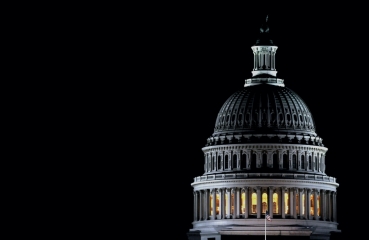
What the Capitol riot means for civics education

Dale Chu

Still reeling from the assault on the Capitol and the subsequent impeachment effort against Former President Trump, the education sphere’s attention has understandably returned to the need to resuscitate the teaching of civics and history. If schools did a better job of grounding our students in the principles of a free society and a basic understanding of U.S.


Commentary
1.21.2021
Accountability & Testing, Curriculum & Instruction, Governance, Teachers & School Leaders

One option for giving children their pandemic year back: Add an extra year to elementary school, forever

Michael J. Petrilli

Editor’s note: This is the second in a series of posts about envelope-pushing strategies schools might embrace to address students’ learning loss in the wake of the pandemic.

Commentary
1.20.2021
Evidence-Based Learning, Governance, Teachers & School Leaders

The pandemic dims a beacon of school improvement

Josh Boots

For the past decade, Washington, D.C., schools have shone as a success story, with achievement for all students rising steadily in elementary and middle schools and more quickly than the national average.

Commentary
1.14.2021
Curriculum & Instruction, Governance, Teachers & School Leaders

The civics and history lesson our children need right now

Robert Pondiscio

History, well taught, equips students with the ability to see through current crises. Civics, well taught, fosters in every heart an investment in democratic processes and a respect bordering on reverence for the rule of law.

Commentary
1.14.2021
Accountability & Testing, Evidence-Based Learning, Governance, Teachers & School Leaders

Without tests in 2021, we’ll never know which schools met the Covid-19 challenge

Michael J. Petrilli

The Covid-19 pandemic has run roughshod over so much of our education system, closing schools, sending students home to try to learn remotely, and obliterating last year’s summative state tests.

Commentary
1.14.2021
Charter Schools, Governance, Teachers & School Leaders

Charter schools are a Band-Aid when a heart transplant is needed

Marc Tucker

This post is adapted from an email conversation between Marc Tucker and Fordham’s Michael J. Petrilli, in which Marc was responding to Mike’s recent article, “The case for urban charter schools.” It also appeared in Fordham’s Flypaper newsletter.

Commentary
1.14.2021
Governance, Teachers & School Leaders

Eyes on the street: Reducing crime and boosting school attendance

Amber M. Northern, Ph.D.

Reducing student absenteeism is a key goal in many schools’ efforts to improve academic outcomes. The reasons that students skip are myriad—indifference to school, illness, jobs, caring for siblings, and more—which means that there is no one solution.

Commentary
1.13.2021
Charter Schools, Governance, Teachers & School Leaders

Dan McKee, poised to be Rhode Island’s next governor, is a model of how to improve schools for all children

Erika Sanzi

Rhode Islanders just saw their governor, Gina Raimondo, tapped to become President-elect Biden’s Secretary of Commerce.

Commentary
1.7.2021
Curriculum & Instruction, Governance, Teachers & School Leaders

Give disadvantaged children their pandemic year back

Michael J. Petrilli

As the world struggles through some of the darkest days of the pandemic, and more schools shift back to remote learning, we at the Thomas B. Fordham Institute are spending most of our time thinking about what comes next: educational recovery.

Commentary
1.7.2021
Curriculum & Instruction, Teachers & School Leaders

Explicit teaching vs. constructivism: The misadventures of Bean Dad

Robert Pondiscio

Nearly every day, social media plucks some poor, anonymous face in the crowd from obscurity and makes him famous. If you’re making New Year’s Resolutions this year, one should be never to be that guy.

Commentary
1.4.2021
Governance, Teachers & School Leaders

Covid-19 facts and figures will not build trust with terrified parents

Erika Sanzi

It is becoming increasingly clear that pundits and well-meaning education advocates fail to fully grasp the deep distrust that some parents have long had for their children’s schools.

Commentary
12.23.2020
Charter Schools, Governance, Teachers & School Leaders

It’s not news that Miguel Cardona is a charter school authorizer—and that’s worth celebrating

Alex Medler

President-Elect Biden has confirmed that he will nominate Dr. Miguel A. Cardona to serve as the next U.S. Secretary of Education. He appears to be a prudent choice for Biden, earning support from teachers unions and education reform groups, including charter operators. Cardona is the current Connecticut Commissioner of Education.

Commentary
12.21.2020
Governance, Teachers & School Leaders

What if everything we believe about education is a lie?

Robert Pondiscio

What if we can’t change at scale the distribution of academic outcomes among disparate groups of students? What if our hope that public education can erase inequality is in vain? If these things were true, how would what we ask of schools—and how we measure their success—change?

Commentary
12.21.2020
Governance, Teachers & School Leaders

Five critical priorities to transform education in response to Covid-19

Lance Hostetter

Long before Covid-19 hit, far too many students were struggling to stay engaged, experiencing the effects of learning loss, and had inequitable access to high quality educational opportunities.

Commentary
12.17.2020
Curriculum & Instruction, Teachers & School Leaders

The effects of social-emotional development on academic achievement

Olivia Piontek

Despite a stampede of interest in students’ social-emotional development (SED), gathering data on—and measuring the success of—such initiatives remain

Commentary
12.17.2020
School Finance, Charter Schools, Governance, Teachers & School Leaders

Mind the gap: Persistent and growing inequities in charter school funding

Victoria McDougald

Like traditional public schools, charter schools are publicly funded according to student enrollment. But compared to their district counterparts, charters have long received far less per-pupil funding.

Commentary
12.17.2020
Governance, Teachers & School Leaders

Ending a tough semester on a positive note

Dale Chu

“In the midst of winter, I found there was, within me, an invincible summer.” —Albert Camus

Commentary
12.14.2020
Curriculum & Instruction, Teachers & School Leaders

Vaccine-making’s lessons for high-dosage tutoring: How to move forward

Mike Goldstein, Bowen Paulle

Editor’s note: This is the final post in a five-part series about how to effectively scale-up high-dosage tutoring.

Commentary
12.14.2020
Charter Schools, Curriculum & Instruction, Teachers & School Leaders

Do charter schools help new teachers get better faster?

Amber M. Northern, Ph.D., Michael J. Petrilli

Study after study has found that urban charter schools, and non-profit charter networks in particular, tend to be more successful at boosting student achievement than traditional public schools in similar settings. But why?

Report
12.14.2020
Charter Schools, Teachers & School Leaders

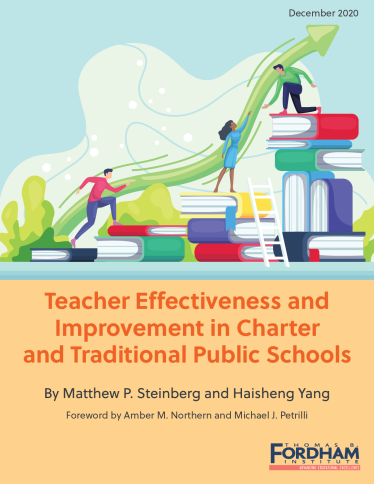
Teacher Effectiveness and Improvement in Charter and Traditional Public Schools

Matthew P. Steinberg

Study after study has found that new teachers tend to be less effective than educators with more experience. But despite having more junior staff, charter networks (referred to as CMOs) often outperform their district peers. So what’s their secret? To find out, this study explores how teacher effectiveness varies and evolves across traditional and charter public schools, as well as within the sector’s CMOs and standalone schools.

Commentary
12.11.2020
Curriculum & Instruction, Teachers & School Leaders

Vaccine-making’s lessons for high-dosage tutoring: A respectful disagreement about research

Mike Goldstein, Bowen Paulle

Editor’s note: This is the fourth post in a five-part series about how to effectively scale-up high-dosage tutoring.

Commentary
12.10.2020
Curriculum & Instruction, Teachers & School Leaders

Vaccine-making’s lessons for high-dosage tutoring: Cells constantly create “new problems”

Mike Goldstein, Bowen Paulle

Editor’s note: This is the third post in a five-part series about how to effectively scale-up high-dosage tutoring.

Commentary
12.10.2020
Curriculum & Instruction, Teachers & School Leaders

Reading comprehension is not a “skill”

Robert Pondiscio

I became a disciple of E.D. Hirsch, Jr. early in my teaching career for one simple reason. His theories about reading comprehension—and his alone—described precisely what I witnessed every day in my South Bronx fifth grade classroom: children who could “decode” (read the words on the page) but struggled to comprehend the words they read.

Commentary
12.3.2020
Governance, Teachers & School Leaders

Suing for peace in education’s culture wars

Michael J. Petrilli

Editor’s note: This is the second article in a two-part series. Part I urges readers to "listen more, empathize more, and demonize less" in these divisive times.

Commentary
12.3.2020
Governance, Teachers & School Leaders

Once an ed-reform standard bearer, Denver loses its way

Dale Chu

A long simmering feud between Denver’s school board and superintendent finally burst into the open last week following months of tensions and mutual distrust.

Commentary
11.25.2020
Curriculum & Instruction, Teachers & School Leaders

More ways to expand classical schools

Sheila Byrd Carmichael

In part one of this two-part essay, published last week, I reflected on Clare Basil’s “definitional” challenge to the growth of classical schools—schools that take “a unifying approach to intellectual and moral formation by developing the integrity of mind and heart,”

Commentary
11.24.2020
Accountability & Testing, Curriculum & Instruction, Governance, Teachers & School Leaders

Will students recover their Covid-19 learning losses?

Tom Coyne

Here in Fordham’s pages, I’ve previously written about the challenge of Covid-19 learning losses at the macro level. In this article, I focus on the micro level.

Commentary
11.23.2020
Accountability & Testing, Curriculum & Instruction, Governance, Teachers & School Leaders

Testing, accountability, NAEP, and reading

Chester E. Finn, Jr.

For those of us who still believe that results-based school accountability is an essential part of the education renewal that America sorely needs, not many things are looking great this week.

Commentary
11.20.2020
Curriculum & Instruction, Teachers & School Leaders

Can we overcome challenges facing the expansion of classical schools?

Sheila Byrd Carmichael

Clare Basil recently shared some thoughtful observations about the growth of K–12 classical schools, schools that take “a unifying approach to intellectual and moral formation by developing the integrity of mind and heart”—a quote Basil borrows from the Institute for Classical Educat

Commentary
11.19.2020
Curriculum & Instruction, Governance, Teachers & School Leaders

Memo to policymakers: Help teachers focus on reading

Robert Pondiscio

At the tail end of a recent symposium titled “Why children can’t read—and what we can do about it” hosted by American Enterprise Institute, Margaret Goldberg, a California first grade teacher and founder of the

Pagination

  • First page « First
  • Previous page ‹ Previous
  • Page 34
  • Page 35
  • Page 36
  • Page 37
  • Current page 38
  • Page 39
  • Page 40
  • Page 41
  • Page 42
  • Next page Next ›
  • Last page Last »

Type

  • Commentary (1363)
  • Event (3)
  • Podcast (34)
  • Report (37)

Topics

  • Accountability & Testing (503)
  • Advanced Education (266)
  • Career & Technical Education (84)
  • Charter Schools (1115)
  • Curriculum & Instruction (1589)
  • ESSA (129)
  • Evidence-Based Learning (833)
  • Facilities (25)
  • Governance (1409)
  • Personalized Learning (51)
  • Private School Choice (139)
  • School Finance (167)
  • Standards (190)
  • (-) Teachers & School Leaders (1450)

Date

  • 2026 (143)
  • 2025 (188)
  • 2024 (159)
  • 2023 (156)
  • 2022 (206)
  • 2021 (269)
  • 2020 (203)
  • 2019 (86)
  • 2018 (8)
  • 2017 (9)
  • 2016 (3)
  • 2014 (3)
  • 2013 (3)
  • 2012 (4)
  • 2008 (1)
  • 2007 (1)
  • 2006 (1)
  • 2005 (1)
  • 2004 (1)
  • 2001 (2)
  • 2000 (1)
  • 1999 (2)
Fordham Logo

© 2026 The Thomas B. Fordham Institute
Privacy Policy
Usage Agreement

National

P.O. Box 110
Burke, VA 22009

202.223.5452

[email protected]

Ohio

P.O. Box 82291
Columbus, OH 43202

614.223.1580

[email protected]

Sponsorship

130 West Second Street, Suite 410
Dayton, Ohio 45402

937.227.3368

[email protected]