
Editor’s note: This is the final post in a five-part series about how to effectively scale-up high-dosage tutoring. Read parts one, two, three, and four.
How do you get great high-dosage tutoring (HDT) to students who need it? Many well-intended HDT programs should be attempted, measured, and abandoned. The successful ones should be grown appropriately. That’s how vaccines work.
There are two primary steps for replicating this with high-dosage tutoring. First, fund “HDT Candidates,” and fund “HDT Programs”
With vaccines, teams get money to try to create vaccine candidates. Just because once before you once made a winning vaccine for Ebola doesn’t mean you just whip up a Covid-19 vaccine and produce it.
That’s what we should do with tutoring: Make it easy for previously proven teams to create customized HDT candidates in specific settings. If it’s three hours a week of retirees tutoring struggling second graders in phonics, virtually, with some specific curriculum, in the Atlanta Public Schools, great. Try that. Phase 1 should always be a low bar. Something like this: 200 students, randomly assigned to control and treatment.
Let most HDT candidates die after the evaluation. Just like vaccines. Lots of very well-intentioned programs fail. From Andre Nickow, Philip Oreopoulos, and Vincent Quan (2020):
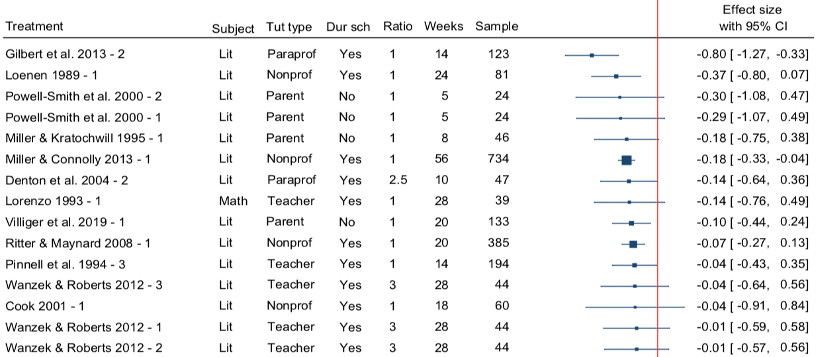
These programs had negative effects! And those are programs that stuck around long enough to be measured.
Imagine all the programs so obviously bad that they disappear without ever being measured. Embrace that reality. Let vaccine candidates and HDT candidates be created, planning all along that most will fail so you have to measure carefully and pull the plug.
The second primary step in finding successful programs and growing them is this: Offer a choice to HDT programs that do work in small settings. One, they can choose to “conditionally scale.” 1,000 students. 5,000 students. But the idea is that we know that their programs might dilute, that they still need to be measured with an understanding that there is a good chance the “scaled version” fails even as the “small version” succeeded.
Or two, those successful small programs should be able to choose to stay small. Don't force growth.
“HDT trials” would cut sharply against the dominant education culture. That is to prescribe the inputs. “Here are 47 pages that describe what you must do. We know what to do, now you do it.” No. We do not know what to do. Adaptations will be required. There is no “thing at rest.”
Instead of prescribing the inputs, describe the results you’re looking for. Define the outcomes. Then free educators to embrace that “it’s weird in there.” A non-negotiable is finding unusually proactive managers to deal with the reality that “schools, like cells, change.”
Also give separate funding for outside researchers to measure the results, allowing tutoring providers to pick from pre-qualified research teams. And consider the market side too, proposed by Paul DiPerna.
The real risk is opportunity cost! Doing this the “normal way” will put HDT in the same K–12 graveyard as every other education intervention that had its fifteen minutes of fame, then didn’t do well when carefully measured at scale, and now is discredited.
Free education leaders to embrace failure (like scientists) instead of “insisting they’ve succeeded and arranging the evidence to look that way” (like educators).
Yes, many educators want the Putin way. Here is our proven vaccine, he claims, though the truth is the Russian Covid-19 vaccine is not proven. Will you take it? Putin won’t.