Commentary

Fifty years of data on gifted youth finds that, contrary to some assumptions, achieving success later in life doesn’t cause unhappiness.

On this week’s Education Gadfly Show podcast, Matt Beienburg, Director of Education Policy
The universe of private elementary-secondary schooling in America today is diverse and confusing, with innumerable twists and turns in efforts to use public funds to help families access schools that suit them—including private schools of all colors and stripes. But the virtue of these institutions is that they’re different, which also means very different from each other. Which complicates the quest to deploy public dollars to assist families to choose them.
I read Mike Petrilli’s very interesting article “How to narrow the excellence gap in early elementary school” in Fordham’s June 2 Education Gadfly Weekly.
The relationship between teacher and student has profound effects on learning. A new study explores whether schools can strengthen this relationship over time by keeping students with teachers for more than one year.


A fifty-year longitudinal study of over 2,000 gifted students finds no connection between success and unhappiness. —The Wall Street Journal The story of Glenn Youngkin’s rise to political prominence in Virginia through education.

This is the first edition of “Advance,” a new Fordham Institute newsletter that will monitor the progress of gifted education. Here, Wright recounts recent developments that reinforce two truths: Gifted education is a clear and substantial good, and it can be much better.
On this week’s Education Gadfly Show podcast, Daniel Buck, a teacher and a Fordham senior visiting fellow, joins Mike Petrilli to discuss “
Research has found that high-quality pre-K programs can have positive impacts on children’s learning and development, improving outcomes like literacy and math skills in the short-term and even increasing
Because of social media’s well-documented risks and harms, we must teach teens to exercise good practical judgment in the challenging circumstances of the online spaces they will need to navigate in our digital age. Parents play an important role. But so should schools, which ought to develop curricula that model how to interact online in ways that meet their general standards and expectations of their student’s social lives.
One of the most unlikely education stories of the last decade has been the rise of Mississippi as a star of NAEP and a science of reading proof point. When looking for models to follow, researchers and policy wonks usually point to places like Shanghai and Finland, even Massachusetts. But Mississippi? Who saw that coming?
States and districts face no shortage of seemingly overwhelming problems, especially the devastating learning loss among vulnerable students from extended pandemic school closures. But leaders do have money: States and districts got $123 billion in federal emergency (ARP ESSER) relief.

If you want to know which schools are good, ask a realtor—so goes the conventional wisdom—and families often do so.

In 2016, the U.S. Department of Education launched an offshoot of the Pell Grant program intended to assist low-income high schoolers in accessing college credit through dual enrollment.

Covid-19 caused “the biggest disruption in the history of American education.” —The Atlantic A call for “a fundamental shift in state accountability systems, in which states primarily hold districts accountable for the coherence of their instructional program and its con

On this week’s Education Gadfly Show podcast, we present the sixth edition of our Research Deep Dive series.
Great education requires great teachers, but the existing system makes it too difficult to retain the best and replace the worst. Fixing this requires, among other things, more generous pay. Instead we face the profession’s persistent, declining productivity.
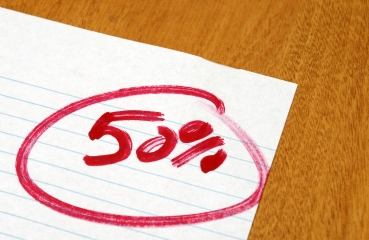
In a recent Fordham article, Daniel Buck makes several thoughtful critiques of the practice of schools that have replaced the mark of zero on a 100-point scale with a minimum grade of fifty.
As a conservative, part of my job is to stand athwart rapid education changes yelling “is this really a good idea?” I did just that in a recent piece for the Fordham Instit
We know that most American students are suffering from unprecedented learning loss.

“The end of school reform?” —Checker Finn and Rick Hess The U.S. Supreme Court rules that Maine can’t exclude religious schools from its tuition program, but allows for possible restrictions based how the funds are used.

On this week’s Education Gadfly Show podcast, Mike Goldstein, founder of Match Education in Boston, a college prep charter s
Districts across the land are witnessing a mass exit of teachers from classrooms, the likes of which has never been seen. It’s going to get worse, says Adams. And it isn’t about low salaries, paltry pensions, or lack of financial support. Teachers are leaving in droves because so many of our children are utterly broken, student behavior is abhorrent, and accountability is out of vogue in our schools.
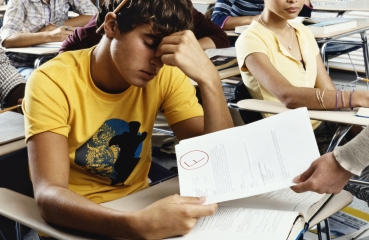
More and more schools across the U.S. have adopted a new grading fad: Teachers cannot assign a grade lower than 50 percent. If a student doesn’t turn in an assignment? 50 percent. Do they miss every problem on a vocabulary quiz? 50 percent.
As a long-time (and often lonely) curriculum enthusiast, I’ve followed the work of the High-Quality Instructional Materials and Professional Development (IMPD) Network for several years.
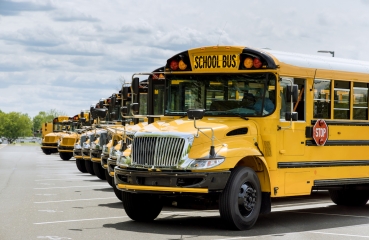
Providing transportation for students to and from school is a basic requirement of most public school districts in America. During the 2018–19 school year, nearly 60 percent of all K–12 students nationwide, public and private, were transported by those ubiquitous yellow buses.