Mobile Navigation

  • National
    • Policy
      • High Expectations
      • Quality Choices
      • Personalized Pathways
    • Research
    • Commentary
      • Gadfly Newsletter
      • Flypaper Blog
    • Events
    • Scholars Program
  • Ohio
    • Policy
      • Priorities
      • Media & Testimony
    • Research
    • Commentary
      • Ohio Education Gadfly Biweekly
      • Ohio Gadfly Daily
  • Charter Authorizing
    • Application
    • Sponsored Schools
    • Resources
  • About
    • Mission
    • Board
    • Staff
    • Career
Home
Home
Advancing Educational Excellence

Main Navigation

  • National
  • Ohio
  • Charter Authorizing
  • About

National Menu

  • Topics
    • Accountability & Testing
    • Advanced Education
    • Career & Technical Education
    • Charter Schools
    • Curriculum & Instruction
    • ESSA
    • Evidence-Based Learning
    • Facilities
    • Governance
    • Personalized Learning
    • Private School Choice
    • School Finance
    • Standards
    • Teachers & School Leaders
    • Think Again
  • Research
  • Commentary
    • Gadfly Newsletter
    • Flypaper Blog
    • Gadfly Podcast
  • Events
  • Scholars Program

Topics

Displaying 1-11 of 11 results
Report
12.1.1998
Governance

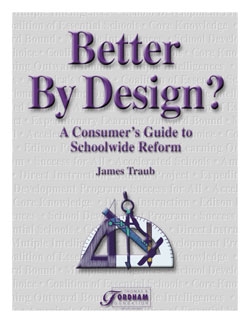
Better By Design? A Consumer's Guide to Schoolwide Reform

James Traub

This book is a guide to ten of today's best-known school designs. It is meant for parents, teachers, school board members, philanthropists, civic leaders and other 'consumers' who must evaluate which, if any, of these models they want to pursue.
Report
10.1.1998
Charter Schools, Standards

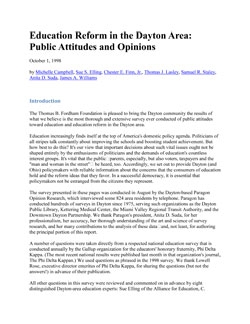
Education Reform in the Dayton Area: Public Attitudes and Opinions

A survey of attitudes towards education reform in Dayton (where Mr. Fordham lived). View the survey results which show, among other things, overwhelming support for parental choice, charter schools, and higher standards.

Report
10.1.1998
Accountability & Testing

Filling In the Blanks: Putting Standardized Tests to the Test

Gregory J. Cizek

Cizek provides a helpful primer on standardized testing. He identifies key terms, clarifies important distinctions between types of tests, and explains how to interpret (and not to interpret) their scores.

Report
7.1.1998
Curriculum & Instruction

Remediation in Higher Education: A Symposium

Robert M. Costrell, David H. Ponitz, Laurence Steinberg, David W. Breneman, William N. Haarlow

Is remediation in additional-topics providing a valuable service to society? Or does it amount to paying for someone's education twice? Read competing views of the issue in this rare Fordham look at the higher-education system.

Report
7.1.1998
Advanced Education

The Tracking and Ability Grouping Debate

Tom Loveless

Tracking and ability grouping strategies differ widely from school to school. They diverge even more widely from their portrayal in the popular criticisms of the 1980s. This report digs into the sensitive matter of whether those criticisms are valid today. The answer tells a more complicated and more honest story than we have heard before on this topic.

Report
7.1.1998
Standards

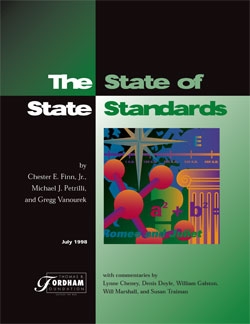
The State of State Standards (1998)

Michael J. Petrilli, Chester E. Finn, Jr., Gregg Vanourek

Three Fordham staff members analyze trends spotted in academic standards across the disciplines. They found that too many state standards are vague, anti-knowledge, entranced with 'relevance,' and focused on teaching rather than learning.

Report
7.1.1998
Accountability & Testing, Governance

Spending More While Learning Less: U.S. School Productivity in International Perspective

Herbert J. Walberg

With OECD data, Walberg shows that the United States' educational system is the 'least productive in the developed world.'

Report
3.1.1998
Standards

State Math Standards

Ralph A. Raimi, Lawrence Braden

In this review of state math standards, authors Raimi and Braden found a disturbing lack of 'mathematical reasoning' in most of the 47 state standards they examined; only three states earned 'A's' while 16 states flunked.

Report
3.1.1998
Standards

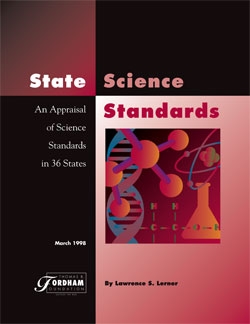
State Science Standards

Lawrence S. Lerner

This review of state science standards is the final in our series of reports analyzing state standards in the five core content areas. For this review, author Lawrence S. Lerner analyzed the science standards of 36 states and found that state science standards are the strongest of the five disciplines we studied. Based on his analysis, six states earned 'A' grades, seven earned 'B's,' and only nine flunked.

Report
2.1.1998
Standards

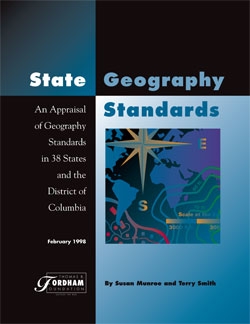
State Geography Standards

Terry Smith, Susan Munroe

This is the third in a series of reports on state standards published by the Fordham Foundation and is our first-ever look at state standards for geography. Authors Susan Munroe and Terry Smith found reason for hope in a few of the excellent standards they found (like Colorado's), but most of the documents they analyzed were extremely weak; only six states earned 'A's' or 'B's,' while 18 states failed.

Report
2.1.1998
Standards

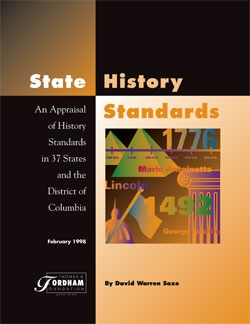
State History Standards

David W. Saxe

The second in a series of evaluations of state standards, this is our first review of state history standards. In his analysis, author David W. Saxe offers a scathing indictment of state history standards, which he judged to be little better than the oft-ridiculed National History Standards; four earned 'A's' or 'B's,' while 19 states flunked.

Type

  • Report (11)

Topics

  • Accountability & Testing (2)
  • Advanced Education (1)
  • Charter Schools (1)
  • Curriculum & Instruction (1)
  • Governance (2)
  • Standards (6)

Date

  • (-) 1998 (0)
  • October 1998 (2)
  • March 1998 (2)
  • July 1998 (4)
  • February 1998 (2)
  • December 1998 (1)
Fordham Logo

© 2026 The Thomas B. Fordham Institute
Privacy Policy
Usage Agreement

National

P.O. Box 110
Burke, VA 22009

202.223.5452

[email protected]

Ohio

P.O. Box 82291
Columbus, OH 43202

614.223.1580

[email protected]

Sponsorship

130 West Second Street, Suite 410
Dayton, Ohio 45402

937.227.3368

[email protected]