Event
In state after state, governors and legislatures have enacted science of reading laws intended to overhaul how children are taught to read—mandating changes in curricula, teacher preparation, professional learning, and/or intervention. But in practice, will these laws live up to their potential? How can we support effective implementation?
In recent years, school boards have become increasingly prominent sites for debate, conflict, and sometimes even violence. Parents, advocates, and community members have argued bitterly about curriculum content, parental rights, public health measures, and school safety. But how well do those at the helm–school board members–really represent the constituents they serve?
Over the last several years, so-called “equitable” grading reforms have generated controversy in many of the school districts across the country that have adopted them. Although their advocates claim that policies like "no zeros" for assignments, eliminating late penalties, and allowing unlimited retakes can make classrooms more equitable, critics argue that they effectively codify lower expec
Over the past decade, American schooling has abandoned its focus on safe, orderly schools and high academic expectations in favor of social and emotional learning and trauma-informed pedagogy, particularly in schools serving low-income students and children of color.

American democracy faces unprecedented challenges from both ends of the political spectrum. On the right, actions to undermine the peaceful transfer of power and suggestions to suspend the Constitution pose severe risks. Meanwhile, on the left, cultural forces on campuses are creating an environment where progressive students increasingly find it acceptable to block opposing views.
Amid intense polarization and concerns for America's youth, Carnegie Corporation of New York’s
In the shadow of a national reckoning on racial equity and in the wake of high-profile debates on the future of advanced (or gifted) education, the landscape of advanced education in the United States stands at a critical juncture.
NACSA is honored to feature the report from the Thomas B.
Join us to discuss Fordham’s recently published report Excellence Gaps by Race and Socioeconomic Status.
The National Working Group on Advanced Education was formed in Spring 2022, prompted by long-standing shortcomings in America’s handling of schooling for advanced learners (a.k.a.

Join us to discuss the implications of Fordham's recently published report Charter Schools and English Learners in the Lone Star State.
Download the webinar PowerPoint.
Like the cicadas now infesting the mid-Atlantic, debates over how to present American history and civics to our children come around with striking regularity. In the early 1990s, the focus was on proposed national standards for U.S. history, which the Senate eventually condemned with a vote of 99–1. A few years ago, the dust-up was over the Advanced Placement U.S. History course.
With federal coronavirus relief, schools are wrestling with a host of thorny questions. Especially under the new Joe Biden administration, how much federal aid is coming? What rules will govern its use? Most importantly, how can schools spend the funds effectively when reopening schools, improving remote learning, and helping students get back on track?
According to the Nation’s Report Card (NAEP), just one-third of U.S. fourth- and eighth-grade students can read proficiently. Among students eligible for free or reduced-price lunch, it’s just one in five.
When schools resume instruction this fall, most students will have been absent from the classroom (and without direct access to teachers, peers, and other school-based supports) for upwards of six months. In addition to addressing significant learning loss, school leaders will need to carefully consider how to address student
With the coronavirus outbreak disrupting nearly every aspect of our work and learning, educators nationwide have been scrambling to provide remote instruction to their students. But what are they and their schools doing to provide children with social and emotional supports during this tough time?
America’s schools have ceded significant ground to trendy nostrums and policy cure-alls that do little to adequately teach young people the skills and knowledge required to realize their full potential and emerge from school as fully-functioning citizens. The latest round of dire NAEP civics and U.S. history scores underscore our continuing failure on the citizenship front.
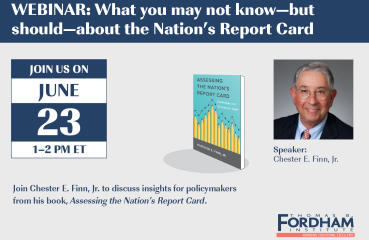
Learning in the Fast Lane: The Past, Present, and Future of Advanced Placement (Princeton, 2019), the new book by Chester Finn and Andrew Scanlan, tells the story of the Advanced Placement (AP) program, widely regarded as the gold standard for academic rigor in American high schools.
What would happen if we invested $1 billion or more in bold education R & D initiatives designed to generate fresh, evidence-backed solutions to some of education’s toughest challenges? On November 5, at 4:00 p.m. ET, online and in Washington, D.C., the Center for American Progress and the Thomas B. Fordham Institute held a a “Shark-Tank” style competition. Ten early-round finalists presented their “billion-dollar Moonshot ideas” to a panel of tough judges, all for a chance to win $10,000 and have their idea propelled to widespread attention and potential major investment.

(Video credit to AEI, Fordham's co-host for the event.)
Twenty years ago, conservative ideas were gaining traction in K–12 education.

Our Fordham-Hoover Education 20/20 speaker series will host its grand finale on June 13, when we bring you another major thinker about American education: William J. Bennett, U.S. Secretary of Education and Chairman of the National Endowment for the Humanities under President Ronald Reagan, and later director of the Office of National Drug Control Policy.
Career and technical education (CTE) is enjoying its moment in the sun, with policymakers and educational leaders across the ideological spectrum embracing it as a solution to lagging upward mobility and distressed working class communities. On May 14, we posed these and other vexing questions to a panel of CTE experts. Watch the video now.
The Fordham-Hoover “Education 20/20” speaker series continued with our penultimate event on May 1, as we brought you another awesome duo. Rod Paige opened by arguing that tomorrow’s school reform needs to focus not just on changing schools, but even more on boosting student effort. Then Pete Wehner made a forceful, principled case for reviving old-fashioned character education in America’s schools.
The Fordham-Hoover “Education 20/20” speaker series continued on April 11 with another star-studded double feature.
The provocative Fordham-Hoover “Education 20/20” speaker series resumes on March 26th with another star-studded duo.
The second half of our Education 20/20 speaker series begins on February 12th as we bring you another double header. Eliot Cohen will argue for civic education that promotes patriotic history, one that not only educates and informs but also inspires. Yuval Levin will make the case for reasserting the role of education in character formation.
Fordham’s Education 20/20 speaker series kicks off the New Year with a bang on January 9th as we bring you another double header.