Mobile Navigation

  • National
    • Policy
      • High Expectations
      • Quality Choices
      • Personalized Pathways
    • Research
    • Commentary
      • Gadfly Newsletter
      • Flypaper Blog
    • Events
    • Scholars Program
  • Ohio
    • Policy
      • Priorities
      • Media & Testimony
    • Research
    • Commentary
      • Ohio Education Gadfly Biweekly
      • Ohio Gadfly Daily
  • Charter Authorizing
    • Application
    • Sponsored Schools
    • Resources
  • About
    • Mission
    • Board
    • Staff
    • Career
Home
Home
Advancing Educational Excellence

Main Navigation

  • National
  • Ohio
  • Charter Authorizing
  • About

National Menu

  • Topics
    • Accountability & Testing
    • Advanced Education
    • Career & Technical Education
    • Charter Schools
    • Curriculum & Instruction
    • ESSA
    • Evidence-Based Learning
    • Facilities
    • Governance
    • Personalized Learning
    • Private School Choice
    • School Finance
    • Standards
    • Teachers & School Leaders
    • Think Again
  • Research
  • Commentary
    • Gadfly Newsletter
    • Flypaper Blog
    • Gadfly Podcast
  • Events
  • Scholars Program

School Finance

Displaying 61-90 of 169 results
Commentary
8.17.2023
Evidence-Based Learning, School Finance, Governance

Examining the role of property assessment in education funding

Jeff Murray

Accurate property assessments are a basic requirement for many school funding systems to function properly.


Commentary
8.3.2023
School Finance, Charter Schools, Governance, Teachers & School Leaders

Fair funding finally flows to charters—but the window won’t stay open forever

Michael J. Petrilli

A remarkable increase in charter school funding across a number of states—and not just red—is finally addressing some of the deepest spending inequities in American education. But with Covid money drying up, declining student enrollment, and an aging population, tougher times lie ahead.

Commentary
7.13.2023
School Finance, Governance

Low- and high-income schools now receive equal funding

Adam Tyner, Ph.D.

State-level school finance reforms and, to a lesser extent, increases in federal funding for schools have worked: America’s shamefully persistent inequities in school funding are finally a thing of the past. School funding is now generally progressive, meaning that students from poor families typically attend better-funded schools than students from wealthier families in the same state.

Report
7.11.2023
School Finance

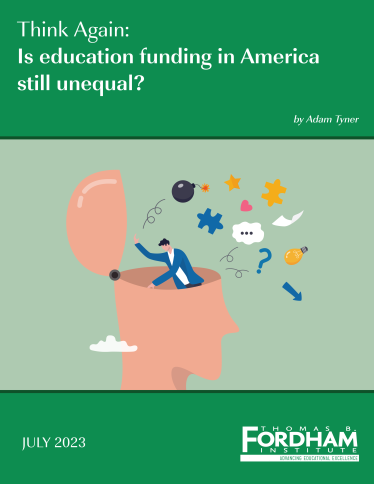
Think Again: Is education funding in America still unequal?

Adam Tyner, Ph.D.

This brief challenges the notion that economically disadvantaged students receive less funding than other students, with implications for equalizing classroom resources and optimizing other social policies.

Podcast
6.21.2023
School Finance, Charter Schools, Curriculum & Instruction, Personalized Learning

#875: Charter schools that help students earn college credentials, with Kevin Teasley

  On this week’s Education Gadfly Show podcast, Kevin Teasley, of the Greater Educational Opportunities F

Commentary
5.25.2023
Evidence-Based Learning, School Finance, Governance, Teachers & School Leaders

Another nail in the “money doesn’t matter” coffin

Adam Tyner, Ph.D.

In recent years, the debate on the impact of financial resources in education has been petering out. Studies showing that more money for schools has had a discernable effect on student academic outcomes, particularly for students from lower-income families, keep accumulating.

Commentary
4.20.2023
School Finance, Charter Schools, Governance, Private School Choice

I’m pro–public education. That’s why I want universal education savings accounts to succeed.

Michael J. Petrilli

There are many reasons to be skeptical of the universal ESA programs that are sweeping the nation, but they are worth rooting for anyway because they’ll likely lead traditional public schools to improve.

Commentary
3.23.2023
Evidence-Based Learning, School Finance, Charter Schools, Governance

Charter schools make district schools more efficient

David Griffith, Ph.D.

Districts that lose students to charter schools can and ultimately will adjust their behavior. And indeed, recent research implies that, while charters marginally reduce districts’ total revenues per pupil, they also make them more efficient. The challenge for policymakers is managing whatever transition costs may be associated with moving to a more choice-based system in a way that is fair to students and taxpayers.

Commentary
3.2.2023
School Finance, Governance, Teachers & School Leaders

We’d be paying teachers far more if we’d chosen quality over quantity

Chester E. Finn, Jr.

Almost everyone wants to raise teacher pay. The push comes in various forms and from various places—mostly recently a proposal by Congressional liberals to create a $60,000 floor under teacher salaries. Yet we’d have far more generous teacher pay today if we hadn’t opted to hire more teachers and support staff over the years rather than raising salaries.

Commentary
3.2.2023
Evidence-Based Learning, School Finance, Governance, Teachers & School Leaders

Steep transportation challenges for choice-rich districts

Amber M. Northern, Ph.D.

School transportation problems have been big news

Commentary
2.23.2023
School Finance, Governance, Private School Choice

On ESAs’ popularity and coming challenges: A letter to Checker Finn

Robert Pondiscio

Dear Checker,

Commentary
2.23.2023
Evidence-Based Learning, School Finance, Governance, Teachers & School Leaders

Is transporting students for intradistrict open enrollment worth the cost?

Meredith Coffey, Ph.D.

In an effort to expand educational opportunity, several large urban school districts—including Boston, Chicago, New York City,

Commentary
2.16.2023
School Finance, Curriculum & Instruction, Governance, Private School Choice

Why I’m wary of universal education savings accounts

Chester E. Finn, Jr.

In the fast-moving, highly energized world of school choice and parent-empowerment advocacy, education savings accounts are the hottest thing since vouchers, maybe even hotter. Ten states already have them in some form, and a dozen more legislatures are weighing bills to create them. But Finn is wary, particularly of the free-swinging, almost-anything-goes version known as “universal” ESAs.

Commentary
2.9.2023
School Finance, Curriculum & Instruction, Private School Choice, Teachers & School Leaders

Give parents wide latitude on ESA uses—and give teachers their own accounts, too

Mike Goldstein

Recent news stories have pushed the narrative that parents are using education savings accounts to buy items of questionable educational value and relevance, including chicken coops, trampolines, and tickets to SeaWorld. But perhaps ESAs’ permissiveness is a feature, not a bug—and perhaps officials would be wise to go one step further and give teachers their own accounts.

Commentary
2.6.2023
School Finance, Charter Schools, Governance, Private School Choice, Teachers & School Leaders

Parent navigators are worth the investment for school choice supporters

Travis Pillow

From 2015 to 2018, the start of spring meant I could expect to hear from parents across Florida. At the time, I worked for Step Up Students, the Florida-based organization that administers the nation’s largest education scholarship (i.e., voucher) program. My job was not in customer service. I was the editor of a blog focused on school choice issues.

Commentary
2.2.2023
School Finance, Governance, Private School Choice, Teachers & School Leaders

How much education is a public responsibility?

Chester E. Finn, Jr.

So many of our debates about paying for higher education hinge on conflicting views of what’s the taxpayer’s responsibility and what’s the recipient’s. These days, that’s also true of pre-schooling and it also arises, albeit in different form, when we fight over vouchers, tax credits, ESAs and such. Is it society’s responsibility to pay for private schooling or is it the family’s?

Commentary
2.2.2023
Evidence-Based Learning, School Finance, Teachers & School Leaders

Schools have been adding teachers and student support staff, even as they serve fewer students

Chad Aldeman

Editor’s note: This was first published by The 74.

Commentary
1.27.2023
Accountability & Testing, Evidence-Based Learning, School Finance, Governance

Interpreting the Covid impact on achievement

David Armor

The release of “The Nation’s Report Card” on October 24, 2022, created shock waves though out the country’s education and policy establishments.

Commentary
1.26.2023
School Finance, Governance, Private School Choice

Public dollars, private schools

Robert Pondiscio

For the vast majority of America’s children, going to school has changed little from their parents’ generation, even their grandparents’: Where you live is where you learn, in a school run by your local public school district.

Commentary
12.8.2022
Evidence-Based Learning, School Finance, Governance, Teachers & School Leaders

How some states are fixing problems with early childhood education

William Rost

A FutureEd report released earlier this year analyzes the problems facing early childhood education offerings across the country and how some states have tackled them.

Commentary
12.2.2022
Evidence-Based Learning, School Finance, Career & Technical Education, Governance

The good and bad news about declining U.S. poverty rates

Jon Baron

Recent news articles have heralded a long-term decline in the U.S.

Robert Kern image
Commentary
11.11.2022
School Finance

In memory of Robert Kern

Chester E. Finn, Jr.

We mourn the passing of Robert D. Kern at 96, even as we recall some of the great good he did—and our encounters with him.

Robert Kern image
Commentary
10.20.2022
Evidence-Based Learning, School Finance, Governance

Will pandemic learning loss cost $700 billion to fix?

Nat Malkus

A new study released this month by Kenneth Shores and Matthew Steinberg tackles the question of whether federal pandemic relief for public schools was provided in the right way and in the right amount.

iStock/Getty Images Plus/Wavebreakmedia
Podcast
10.11.2022
School Finance

Education Gadfly Show #841: Good news for a change: Most states appear to be spending their ESSER dollars wisely

  On This week’s Education Gadfly Show podcast, Carissa Miller, CEO of the Cou

iStock/Getty Images Plus/Wavebreakmedia
Commentary
9.29.2022
Evidence-Based Learning, School Finance, Charter Schools, Curriculum & Instruction, Governance, Teachers & School Leaders

Judge “for-profit” charter schools on their results, not the tax status of their main vendor

Amber M. Northern, Ph.D., Michael J. Petrilli

After a tumultuous reception, the Biden administration’s regulations for the federal

Commentary
9.1.2022
Accountability & Testing, School Finance, Governance, Teachers & School Leaders

What happens when school leaders are allowed to abandon “step and lane” pay scales

Amber M. Northern, Ph.D.

In 2013, the British government ended the use of “annual progression” pay scales for teachers. These were similar to U.S.-style “step and lane” models but were set at the national level across the pond.

Commentary
6.30.2022
School Finance, Governance, Teachers & School Leaders

ESSER is fueling one-size-fits-all strategies. Let’s use data to deliver more targeted efforts.

Marguerite Roza, Ellie Roza

States and districts face no shortage of seemingly overwhelming problems, especially the devastating learning loss among vulnerable students from extended pandemic school closures. But leaders do have money: States and districts got $123 billion in federal emergency (ARP ESSER) relief.

Commentary
5.26.2022
School Finance, Governance, Teachers & School Leaders

Can states clean up their teacher pension messes?

Aaron Churchill

Many state teacher pension systems are woefully underfunded, impose significant costs on teachers and schools, and shortchange tho

Commentary
5.5.2022
School Finance, Curriculum & Instruction, Governance, Teachers & School Leaders

Using ESSER funds for retention bonuses makes sense if targeted strategically

Dan Goldhaber

The money is pouring in, but so are the education challenges. The Covid-19 pandemic has dramatically affected student achievement, particularly for poorer students and students of color.

Christian Eggers SR 5-4-22 image
Commentary
5.2.2022
School Finance

Can investing in elementary schools prevent crime?

Christian Eggers

The nationwide surge in violent crime, which preceded the pandemic but accelerated in 2020, has prompted a range of policy responses, from expanding

Christian Eggers SR 5-4-22 image

Pagination

  • First page « First
  • Previous page ‹ Previous
  • Page 1
  • Page 2
  • Current page 3
  • Page 4
  • Page 5
  • Page 6
  • Next page Next ›
  • Last page Last »

Type

  • Book (1)
  • Commentary (121)
  • Event (1)
  • Podcast (16)
  • Report (30)

Topics

  • Accountability & Testing (504)
  • Advanced Education (267)
  • Career & Technical Education (84)
  • Charter Schools (1117)
  • Curriculum & Instruction (1594)
  • ESSA (129)
  • Evidence-Based Learning (837)
  • Facilities (25)
  • Governance (1416)
  • Personalized Learning (51)
  • Private School Choice (140)
  • (-) School Finance (169)
  • Standards (190)
  • Teachers & School Leaders (1456)

Date

  • 2026 (17)
  • 2025 (16)
  • 2024 (22)
  • 2023 (24)
  • 2022 (12)
  • 2021 (22)
  • 2020 (23)
  • 2019 (5)
  • 2017 (1)
  • 2015 (1)
  • 2014 (3)
  • 2013 (5)
  • 2012 (5)
  • 2011 (4)
  • 2010 (2)
  • 2008 (1)
  • 2006 (1)
  • 2005 (1)
  • 2003 (1)
  • 2001 (2)
  • 2000 (1)
Fordham Logo

© 2026 The Thomas B. Fordham Institute
Privacy Policy
Usage Agreement

National

P.O. Box 110
Burke, VA 22009

202.223.5452

[email protected]

Ohio

P.O. Box 82291
Columbus, OH 43202

614.223.1580

[email protected]

Sponsorship

130 West Second Street, Suite 410
Dayton, Ohio 45402

937.227.3368

[email protected]