Mobile Navigation

  • National
    • Policy
      • High Expectations
      • Quality Choices
      • Personalized Pathways
    • Research
    • Commentary
      • Gadfly Newsletter
      • Flypaper Blog
    • Events
    • Scholars Program
  • Ohio
    • Policy
      • Priorities
      • Media & Testimony
    • Research
    • Commentary
      • Ohio Education Gadfly Biweekly
      • Ohio Gadfly Daily
  • Charter Authorizing
    • Application
    • Sponsored Schools
    • Resources
  • About
    • Mission
    • Board
    • Staff
    • Career
Home
Home
Advancing Educational Excellence

Main Navigation

  • National
  • Ohio
  • Charter Authorizing
  • About

National Menu

  • Topics
    • Accountability & Testing
    • Advanced Education
    • Career & Technical Education
    • Charter Schools
    • Curriculum & Instruction
    • ESSA
    • Evidence-Based Learning
    • Facilities
    • Governance
    • Personalized Learning
    • Private School Choice
    • School Finance
    • Standards
    • Teachers & School Leaders
    • Think Again
  • Research
  • Commentary
    • Gadfly Newsletter
    • Flypaper Blog
    • Gadfly Podcast
  • Events
  • Scholars Program

Accountability & Testing

Displaying 361-390 of 503 results
Podcast
10.9.2019
Accountability & Testing, Curriculum & Instruction, Teachers & School Leaders

The Education Gadfly Show: Research Deep Dive: Everything we know about effective teachers

On this week’s podcast, Dan Goldhaber, the director of CALDER, joins Mike Petrilli, David Griffith, and Amber Northern to discuss what rigorous research says about identifying, developing, and retaining effective teachers.


Commentary
9.25.2019
Accountability & Testing, ESSA, Governance, Teachers & School Leaders

A new era of accountability in education has barely just begun

Michael J. Petrilli

Most states have spent the past decade overhauling their standards, tests, and accountability systems, and finally committing real resources to capacity-building, especially in the form of curriculum implementation. These pieces have only begun to come together in the last year or two, culminating with the release of school ratings as required by ESSA. What’s needed isn’t to spin the wheel of education policy once again, but to show some patience and commitment—and finish what we started.

Commentary
9.24.2019
Accountability & Testing, ESSA, Curriculum & Instruction, Governance, Personalized Learning, Teachers & School Leaders

In math, grade-level tests are holding back low-achieving students

Joel Rose

Imagine that you’re a sixth-grade math teacher. It’s the first day of school, and the vast majority of your students arrived multiple years behind where they should be. Your job is to teach them concepts such as understanding percentages and dividing fractions.

Commentary
9.18.2019
Accountability & Testing, Evidence-Based Learning, Advanced Education, Personalized Learning, Teachers & School Leaders

Why has AP succeeded when so many other reforms have failed?

Chester E. Finn, Jr., Andrew Scanlan

American K–12 education is awash in reforms, nostrums, interventions, silver bullets, pilot programs, snake oil peddlers, advocates, and crusaders, not to mention innumerable private foundations that occasionally emerge from their endless cycles of strategic planning to unload their latest brainstorms upon the land. Yet when subjected to close scrutiny, not much actually “works.” The six-decade old Advanced Placement program is a rare and welcome exception.

Commentary
9.13.2019
Accountability & Testing, Evidence-Based Learning, ESSA, Governance

Why end-of-course exams are being replaced by the ACT and SAT, and how to reverse that

Anne Hyslop

In the last month, two reports have renewed questions about the current direction of states’ high school assessments.

Commentary
9.13.2019
Accountability & Testing, Charter Schools, Governance

The “Upgrade Rule”: How schools and districts can make school closures work better for families

David Keeling

School closures hurt. While they are relatively uncommon nationwide, they are sometimes unavoidable—and they’re always painful, especially for the students and families who are displaced and who rarely see any educational benefit as a result.

Commentary
9.11.2019
Accountability & Testing, Charter Schools, Curriculum & Instruction, Governance, Advanced Education, Standards, Teachers & School Leaders

The GAS Factor: Lessons learned at Success Academy

Robert Pondiscio

Much of the initial response to Robert’s new book, "How The Other Half Learns," has focused on the winnowing effects of Success Academy’s enrollment process, which ensures that the children of only the most committed parents enroll and persist. But that’s just the start of the story. You have to look at what parent buy-in actually buys: a school culture that drives student achievement, and which can only be achieved when parents are active participants, not unwilling conscripts.

Commentary
9.11.2019
Accountability & Testing, Evidence-Based Learning, Curriculum & Instruction, Standards, Teachers & School Leaders

The scourge of education malpractice

Dale Chu

What if you were told that elementary schools in the United States are teaching children to be poor readers?

Commentary
9.11.2019
Accountability & Testing, Evidence-Based Learning, Charter Schools, Curriculum & Instruction, Personalized Learning, Teachers & School Leaders

How personalized learning enthusiasts can ensure they aren’t lowering the bar for the kids who are behind

Michael J. Petrilli

Editor’s note: This is the second in a series of posts looking at how two school networks—Rocketship Public Schools and Wildflower Schools—enable their students to master standards at their own pace. See the first post here.

Podcast
9.11.2019
Accountability & Testing, Governance, Teachers & School Leaders

The Education Gadfly Show: Parents’ role in school improvement

On this week’s podcast, Patrick Corvington, executive director of DC School Reform Now, joins Mike Petrilli and David Griffith to offer advice on how parents can play a role in improving their kids’ schools. On the Research Minute, Amber Northern examines the academic effects of early interventions for children born at a low birth-weight.

Commentary
9.6.2019
Accountability & Testing, Curriculum & Instruction

End-of-course exams should be a matter of course

Dale Chu

A new study released by the Thomas B. Fordham Institute looks at end-of-course exams (EOCs) and their relationship with high school graduation rates and college entrance exam scores.

Commentary
9.4.2019
Accountability & Testing, Charter Schools, Governance

A new reality for charter schools in California

Caprice Young

As part of a national war against school choice, the California teachers union is pouring more than a million dollars a month into anti-charter legislative efforts. Unfortunately, a new “compromise” bill crafted by Governor Gavin Newsom whose language was released this week indicates the union is about to get a big return on its investment. Caprice Young, a Fordham Institute trustee and a leading figure in the state’s charter sector, explains how this painful moment came about—and what it means for California charter schools going forward.

Commentary
8.28.2019
Accountability & Testing, Evidence-Based Learning, ESSA, Curriculum & Instruction, Standards

End-of-course exams benefit students—and states

Chester E. Finn, Jr., Amber M. Northern, Ph.D.

Very little previous research has looked at end-of-course exams. Our new study on their relationship to student outcomes helps remedy that. We learned much that’s worth knowing and sharing. Probably most important: EOCs, properly deployed, have positive academic benefits and do so without causing kids to drop out or graduation rates to falter.

Commentary
8.28.2019
Accountability & Testing, Evidence-Based Learning, ESSA, Governance, Standards

The “left behind” kids made incredible progress from the late 1990s until the Great Recession. Here are key lessons for ed reform.

Michael J. Petrilli

Editor’s note: This is the final post in a series looking at whether and how the nation’s schools have improved over the past quarter-century or so (see the others here,

Commentary
8.28.2019
Accountability & Testing, Governance, Standards

The proficiency bar is inching upward, yes, but…

Chester E. Finn, Jr.

A dozen long years ago, when people were just beginning to take serious stock of what good and not-so-good was emerging from 2002’s enactment of No Child Left Behind (NCLB), we at Fordham, in league with the Northwest Evaluation Association (NWEA), issued a 200-plus page analysis of the “proficiency” standards that states had by then been required to set and test for.

Commentary
8.28.2019
Accountability & Testing, Curriculum & Instruction, Advanced Education, Standards

Influences affecting the educational trajectory of students

Jeff Murray

A new study from Georgetown University reaffirmed an uncomfortable but familiar finding: Socioeconomic status has a significant effect on students’ long-term outcomes, regardless of their academic performance in kindergarten or the quality of the schools they attend in K–12.

Podcast
8.28.2019
Accountability & Testing, Evidence-Based Learning, Curriculum & Instruction

The Education Gadfly Show: Boosting student outcomes with end-of-course exams

On this week’s podcast Mike Petrilli and David Griffith talk to Adam Tyner about the new Fordham report he co-authored with Matthew Larsen on end-of-course exams and student outcomes. On the Research Minute, Amber Northern examines efforts to improve the college application process.

Report
8.27.2019
Accountability & Testing

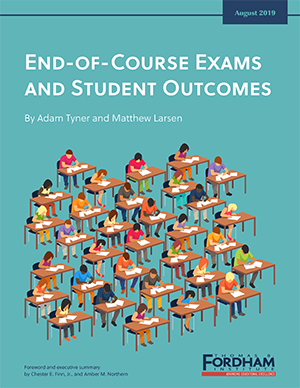
End-of-Course Exams and Student Outcomes

Adam Tyner, Ph.D., Matthew Larsen

Beginning in the late 1990s, many states took it upon themselves to institute end-of-course exams (EOCs) at the high school level, tests specifically designed to assess students’ mastery of the content that various subject-matter courses covered. But was this testing policy good for students? Find out in our new report.

Commentary
8.27.2019
Accountability & Testing, Curriculum & Instruction, Standards

NEW REPORT: End-of-Course Exams and Student Outcomes

Adam Tyner, Ph.D., Matthew Larsen

This report provides a rich longitudinal look at state policies related to end-of-course exams over the past twenty years and the effects of administering EOCs in different subjects on high school graduation rates and college entrance exam scores.

Commentary
8.21.2019
Accountability & Testing, Curriculum & Instruction, Governance, Standards

The kids who had been “left behind” are doing much better today than 25 years ago. But what about everyone else?

Michael J. Petrilli

The past quarter-century has included dramatic progress of America’s lowest-performing students, many of whom are also low-income and children of color. But how’s the vast middle class doing? It’s a mixed bag: They still don’t read very well, but their math skills have improved a bit and they are graduating from college in higher and higher numbers.

Podcast
8.21.2019
Accountability & Testing

The Education Gadfly Show: The homecoming court edition

On this week’s podcast, Jeremy Tate, CEO of the Classic Learning Test, joins Mike Petrilli and David Griffith to discuss what classical learning is and why it’s important. On the Research Minute, Amber Northern examines whether popular children have an outsized influence on their peers.

Commentary
8.14.2019
Accountability & Testing, Charter Schools, Governance

The messy reality of school turnaround

Dale Chu

Ten years ago, then U.S. Secretary of Education Arne Duncan issued a clarion call to turn around 5,000 of the nation’s most distressed schools, serving nearly three million students. It was an audacious goal set by an audacious leader—the likes of which are in terribly short supply these days. A decade later, states have fallen far short of his challenge, and the sticky problem of failing schools refuses to go away. But experience has provided three lessons to those who would make these efforts.

Commentary
8.14.2019
Accountability & Testing, Charter Schools, Curriculum & Instruction, Personalized Learning, Teachers & School Leaders

The new PDK poll: Gems amid the gravel

Chester E. Finn, Jr.

For more than half a century now, back-to-school time has brought another Phi Delta Kappan survey of “the public’s attitudes toward the public schools.” They invariably recycle some familiar questions (e.g., the grades you would give your child’s schools and the nation’s schools). Other topics, however, come and go.

Commentary
8.14.2019
Accountability & Testing, Teachers & School Leaders

Teachers’ complicated attitudes about school discipline

Peter Greene

I have been there; every teacher has. The clock is ticking, you've got just fifteen minutes left to wrap up the lesson, and the time is being chipped away by a student who is disrupting the classroom. How you respond to that situation involves the balance of dozens of different factors. It's complicated, and some of that complexity is captured in a new report out this week.

Commentary
8.14.2019
Accountability & Testing, Curriculum & Instruction, Teachers & School Leaders

Promising state-led assessment innovations

Pedro Enamorado

In the last decade, states have experimented with many new assessment systems in math and reading. A new Bellwether brief by Bonnie O’Keefe and Brandon Lewis examines recent innovations used or proposed by states that could serve educators well.

Report
7.30.2019
Accountability & Testing, Governance, Teachers & School Leaders

Discipline Reform through the Eyes of Teachers

David Griffith, Ph.D., Adam Tyner, Ph.D.

The debate over school discipline reform is one of the most polarized in all of education. Advocates for reform believe that suspensions are racially biased and put students in a “school-to-prison pipeline.” Opponents worry that softer discipline approaches will make classrooms unruly, impeding efforts to help all students learn and narrow achievement gaps.

Commentary
7.23.2019
Accountability & Testing

It’s not grade inflation, it’s the education industry

A number of New York City public schools recently learned that even though close to 100 percent of their students earned passing grades, less than 10 percent were able to pass the standardized state exams. A common explanation is that teachers are lowering expectations and inflating grades, possibly due to the pressure of the city’s bureaucrats’ desire to achieve equitable racial and socioeconomic outcomes. This has some truth, but it actually misunderstands the problem. The students’ inability to demonstrate their learning stems from the most prominent educational theory by which teachers have been trained over the past fifteen years. In essence, the failure of the students is an internal educational problem.

Commentary
3.21.2019
Accountability & Testing

Liberation theology is no savior for low-income schools

Dale Chu

For better or for worse, hard-left politics continue to cast an outsized shadow over the education sector. Nowhere is this more prevalent than within the echo chamber of ed school thinking, where the tweed-jacketed have their feet firmly planted in midair with regard to the nation’s most pressing education challenges. This goes doubly so for low-income schools, where the academy’s hubris makes for swell sounding monographs, but often has little grounding in the difficult work required to raise student performance.

Podcast
3.20.2019
Accountability & Testing

The Education Gadfly Show: Education’s philanthropic shift

On this week’s podcast, Celine Coggins, executive director at Grantmakers for Education, joins Mike Petrilli and David Griffith to discuss philanthropy’s shift to the left on education policies. On the Research Minute, Amber Northern examines America’s persistent achievement gaps.

Event
12.20.2018
Accountability & Testing, Curriculum & Instruction

Education 20/20: Mona Charen and Ramesh Ponnuru

Fordham’s Education 20/20 speaker series kicks off the New Year with a bang on January 9th as we bring you another double header.

Pagination

  • First page « First
  • Previous page ‹ Previous
  • Page 9
  • Page 10
  • Page 11
  • Page 12
  • Current page 13
  • Page 14
  • Page 15
  • Page 16
  • Page 17
  • Next page Next ›
  • Last page Last »

Type

  • Book (1)
  • Commentary (397)
  • Event (6)
  • Podcast (45)
  • Report (44)

Topics

  • (-) Accountability & Testing (503)
  • Advanced Education (265)
  • Career & Technical Education (84)
  • Charter Schools (1115)
  • Curriculum & Instruction (1588)
  • ESSA (129)
  • Evidence-Based Learning (833)
  • Facilities (25)
  • Governance (1407)
  • Personalized Learning (51)
  • Private School Choice (138)
  • School Finance (166)
  • Standards (190)
  • Teachers & School Leaders (1448)

Date

  • 2026 (35)
  • 2025 (47)
  • 2024 (44)
  • 2023 (47)
  • 2022 (54)
  • 2021 (47)
  • 2020 (50)
  • 2019 (65)
  • 2018 (18)
  • 2017 (17)
  • 2016 (7)
  • 2015 (19)
  • 2014 (26)
  • 2013 (1)
  • 2012 (2)
  • 2011 (3)
  • 2010 (2)
  • 2009 (3)
  • 2008 (2)
  • 2007 (2)
  • 2006 (3)
  • 2005 (2)
  • 2004 (1)
  • 2003 (2)
  • 2002 (1)
  • 2000 (1)
  • 1998 (2)
Fordham Logo

© 2026 The Thomas B. Fordham Institute
Privacy Policy
Usage Agreement

National

P.O. Box 110
Burke, VA 22009

202.223.5452

[email protected]

Ohio

P.O. Box 82291
Columbus, OH 43202

614.223.1580

[email protected]

Sponsorship

130 West Second Street, Suite 410
Dayton, Ohio 45402

937.227.3368

[email protected]