Mobile Navigation

  • National
    • Policy
      • High Expectations
      • Quality Choices
      • Personalized Pathways
    • Research
    • Commentary
      • Gadfly Newsletter
      • Flypaper Blog
    • Events
    • Scholars Program
  • Ohio
    • Policy
      • Priorities
      • Media & Testimony
    • Research
    • Commentary
      • Ohio Education Gadfly Biweekly
      • Ohio Gadfly Daily
  • Charter Authorizing
    • Application
    • Sponsored Schools
    • Resources
  • About
    • Mission
    • Board
    • Staff
    • Career
Home
Home
Advancing Educational Excellence

Main Navigation

  • National
  • Ohio
  • Charter Authorizing
  • About

National Menu

  • Topics
    • Accountability & Testing
    • Advanced Education
    • Career & Technical Education
    • Charter Schools
    • Curriculum & Instruction
    • ESSA
    • Evidence-Based Learning
    • Facilities
    • Governance
    • Personalized Learning
    • Private School Choice
    • School Finance
    • Standards
    • Teachers & School Leaders
    • Think Again
  • Research
  • Commentary
    • Gadfly Newsletter
    • Flypaper Blog
    • Gadfly Podcast
  • Events
  • Scholars Program

Topics

Displaying 271-300 of 421 results
Podcast
5.8.2019
Curriculum & Instruction

The Education Gadfly Show: Should U.S. schools mandate foreign language instruction?

On this week’s podcast, William Egginton, a professor of the humanities at Johns Hopkins University, joins Mike Petrilli and David Griffith to make the case for foreign language instruction in America’s schools. On the Research Minute, Amber Northern examines a new analysis of Career and Technical Education course-taking by AEI’s Nat Malkus.

Commentary
5.8.2019

If education advocacy were more like pharmaceutical ads

Robert Pondiscio

Things might look very different in education—we might even manage to sustain promising practices and reform initiatives long enough for them to bear fruit—if advocates for various programs and policies were required to temper their pitches with warning labels, akin to pharmaceutical ads. Make your case. Sell yourself as hard as you want to the consumer—but then comes the legally required disclaimers and warnings about potentially harmful side effects. This piece offers some examples to get us started.

Commentary
5.8.2019

New American Schools: A short, opinionated history, part I

Chester E. Finn, Jr.

This essay is part of the The Moonshot for Kids project, a joint initiative of the Fordham Institute and the Center for American Progress. It will run in three parts, with the second and third appearing in the next two issues of the Education Gadfly Weekly.

Commentary
5.8.2019

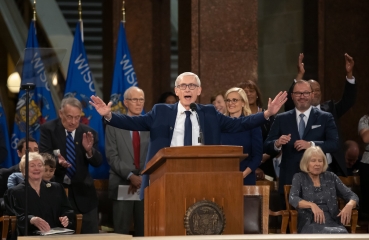
Wisconsin Governor Tony Evers tries to roll back the clock on ed reform

In January of this year, we made predictions for Fordham about the future of education reform in Wisconsin under newly elected Democratic Governor Tony Evers.

Commentary
5.8.2019

The state of crime and safety in our schools

David Griffith, Ph.D.

In the wake of yet another tragedy, the most recent IES report on school crime and safety is a reminder that it gets better, statistically speaking. Among the highlights:

Event
5.7.2019

Education 20/20: William J. Bennett

Our Fordham-Hoover Education 20/20 speaker series will host its grand finale on June 13, when we bring you another major thinker about American education: William J. Bennett, U.S. Secretary of Education and Chairman of the National Endowment for the Humanities under President Ronald Reagan, and later director of the Office of National Drug Control Policy.

Commentary
5.2.2019

The coming storm for financial transparency

Dale Chu

Next year, states will for the first-time report actual school-by-school spending as required under ESSA. This effort represents a quantum leap from the typical practice of tracking and reporting average district per-pupil spending, and is arguably the most complex piece of the law—so much so that states were given an extra year to comply with the new requirement. Marguerite Roza and her team at the Edunomics Lab have ably taken the lead on addressing the many policy related and technical questions involved, but there’s an even larger question of whether we are preparing ourselves for the political challenges that lay ahead.

Commentary
5.1.2019

Discipline Doves hassle charters, too

Chester E. Finn, Jr.

The first obligation of schools is to keep kids safe, and the second is to create and preserve a calm environment in which those who want to learn are able to do so with minimal interruption. We may empathize with the travails that cause kids to disrupt that environment, but it’s still the school’s responsibility—if it can’t speedily and durably solve the problem within its classrooms—to put disrupters somewhere else. So it’s disheartening to see forces exclude and punish institutions that have high suspension rates, independent of reason and regardless of academic outcomes. They’re warring against the very schools that successfully educate thousands of poor and minority kids.

Commentary
5.1.2019

Embrace choice, strengthen American pluralism

Brandon L. Wright

One of the hallmarks of charter schools is their unique ability to align closely with parents’ values. Every American has fundamental moral and ethical principles, some of which can’t always be accommodated by traditional public schools.

Commentary
5.1.2019

What America’s students are reading, and why it matters

Robert Pondiscio

I’ve beaten the drum forever about the importance of building students’ content knowledge if we want to improve their reading comprehension, but another key insight from rigorous research is that kids will read better only if exposed to complex texts. This insight was embedded into the Common Core and other high-quality English language arts standards.

Commentary
5.1.2019

How states can improve CTE data quality and effectiveness

Jessica Poiner

Governors and legislative leaders in almost every state have made expanding and improving career and technical education (CTE) a top priority, yet the importance of quality data is often overlooked. The recent reauthorization of the Carl D.

Podcast
5.1.2019

The Education Gadfly Show: Preschool for children of immigrants

On this week’s podcast, Erica Greenberg, senior research associate at the Urban Institute, joins David Griffith and Brandon Wright to discuss her research on the state of early childhood education for the sons and daughters of immigrants. On the Research Minute, Adam Tyner examines teacher pay, staff size, and student outcomes in states with strong and weak unions.

Event
4.30.2019
Career & Technical Education

Is Career and Technical Education Having an Identity Crisis?

Career and technical education (CTE) is enjoying its moment in the sun, with policymakers and educational leaders across the ideological spectrum embracing it as a solution to lagging upward mobility and distressed working class communities. On May 14, we posed these and other vexing questions to a panel of CTE experts. Watch the video now.

Commentary
4.24.2019

You might be surprised which states prioritize higher teacher salaries

Michael J. Petrilli

It’s one of the great conundrums of American public education: Even when calculated in constant dollars, and even after the Great Recession, we spend dramatically more per pupil than in decades past, yet teacher salaries have barely kept pace with inflation. Where is the money going? And how much could we pay teachers if we had prioritized higher salaries instead? This new analysis compares average teacher salaries to average per-pupil spending—by state, and over time, all in inflation-adjusted dollars. The results aren’t what you’d expect.

Commentary
4.24.2019

The freedom to teach well

Robert Pondiscio

I used to give a talk about teaching reading comprehension to struggling students, mocking some of the dumb and deleterious techniques I was taught in my teacher training and professional development, and arguing that none of it works as well as ensuring kids have a knowledge-rich core curriculum.

Commentary
4.24.2019

Federal education R & D: A brief, opinionated history (part II)

Chester E. Finn, Jr.

This essay is part of the The Moonshot for Kids project, a joint initiative of the Fordham Institute and the Center for American Progress. This is the second of two parts.

Podcast
4.24.2019

The Education Gadfly Show: Searching for "deeper learning"—and not finding it

  On this week’s podcast, Jal Mehta, an associate professor of education at Harvard, joins Mike Petrilli and David Griffith

Commentary
4.19.2019

Aspen’s newest social-emotional learning offering gives cause for pause

Chester E. Finn, Jr.

Having recently unburdened ourselves of seven large gobbets of advice for the champions of today’s surging interest in Social and Emotional Learning (SEL), we intend occasionally to point to developments that strike us as problematic or promising. Our goal isn’t to point fingers—though that can be kind of fun. It’s because we see a clear and present danger that SEL could go off the rails in any number of ways, and wind up compromising academic instruction or serving to advance ideological causes and agendas.

Commentary
4.18.2019
Charter Schools

Florida’s momentum

Chester E. Finn, Jr.

By Chester E. Finn, Jr.

Commentary
4.17.2019

What schools can learn from OrangeTheory about differentiating instruction

Michael J. Petrilli

Teachers will always have to figure out how to provide the right level of instruction to each student that’s neither so difficult it's overwhelming, nor so easy it's boring. Fitness studios face a similar challenge: provide a great, challenging experience for thirty-some students that accounts for great variation in fitness levels and goals and enables participants to gauge their own progress on metrics that they trust and understand. The approaches of one studio and one educational model are especially promising.

Commentary
4.17.2019

Federal education R & D: A brief, opinionated history (part I)

Chester E. Finn, Jr.

This essay is part of the The Moonshot for Kids project, a joint initiative of the Fordham Institute and the Center for American Progress. It ran in two parts.

Podcast
4.17.2019
Charter Schools

The Education Gadfly Show: Will charter opposition come for D.C.?

On this week’s podcast, Jessica Sutter, a newly elected member of the DC State Board of Education, joins Mike Petrilli and David Griffith to discuss the politics of Washington’s ed reform scene. On the Research Minute, Amber Northern examines how Philadelphia school closures affect academic and behavioral outcomes.

Commentary
4.17.2019

Standardized testing in the crosshairs

Dale Chu

From AOC to Stuyvesant to the Varsity Blues scandal, high-stakes assessments have returned to their role as punching bags after a brief hiatus.

Commentary
4.17.2019

The effects of school closures in Philadelphia

Amber M. Northern, Ph.D.

Three years ago, we released a study on school closures in Ohio that found mostly positive results for displaced students, particularly when those students transferred to higher-quality schools.

Commentary
4.17.2019

A review of state report cards in the ESSA era

Jessica Poiner

The Data Quality Campaign, an organization dedicated to advocating for effective educational data policy and use, recently released its third comprehensive review of school report cards in all fifty states and D.C.

Event
4.17.2019
Career & Technical Education, Curriculum & Instruction

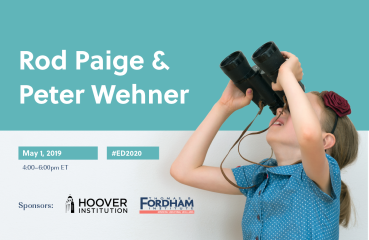
Education 20/20: Rod Paige and Peter Wehner

The Fordham-Hoover “Education 20/20” speaker series continued with our penultimate event on May 1, as we brought you another awesome duo. Rod Paige opened by arguing that tomorrow’s school reform needs to focus not just on changing schools, but even more on boosting student effort. Then Pete Wehner made a forceful, principled case for reviving old-fashioned character education in America’s schools.

Commentary
4.15.2019

Some things old, some things new

Chester E. Finn, Jr.

“Build new, don’t reform old,” says Jason Bedrick as he attempts to use my experience on the Maryland State Board of Education to prove that “the system is beyond reform,” and to imply that school

Commentary
4.11.2019

The testing devil we know or...?

Chester E. Finn, Jr.

Tom Vander Ark is a very smart guy who cares deeply about education, has wide-ranging experience in it (including service as a district superintendent), and knows far more about technology than I do. I like and respect and often agree with him.

Commentary
4.10.2019

The sorry state of career and technical education in America

Fordham’s newest study on career and technical education finds that, although students take more CTE courses in fields for which there is local demand, this is less true when those available jobs are in higher-wage industries. Perhaps the reason is that those lower-wage jobs also require less expertise. They include exactly the kind of low-skill work for which America’s inadequate CTE apparatus prepares students. We need to fix this, which will require better collaboration between local employers, high schools, and community colleges.

Podcast
4.10.2019
Curriculum & Instruction

The Education Gadfly Show: Is Checker going soft on “social and emotional learning”?

On this week’s podcast, Checker Finn joins Mike Petrilli and David Griffith to discuss his new paper with Rick Hess on how the social and emotional learning movement can avoid going off the rails. On the Research Minute, Amber Northern examines the big new RAND study on principal pipelines.

Pagination

  • First page « First
  • Previous page ‹ Previous
  • Page 6
  • Page 7
  • Page 8
  • Page 9
  • Current page 10
  • Page 11
  • Page 12
  • Page 13
  • Page 14
  • Next page Next ›
  • Last page Last »

Type

  • Book (2)
  • Commentary (352)
  • Event (10)
  • Podcast (49)
  • Report (7)

Topics

  • Accountability & Testing (65)
  • Advanced Education (22)
  • Career & Technical Education (10)
  • Charter Schools (49)
  • Curriculum & Instruction (94)
  • ESSA (7)
  • Evidence-Based Learning (47)
  • Governance (56)
  • Personalized Learning (12)
  • Private School Choice (7)
  • School Finance (5)
  • Standards (15)
  • Teachers & School Leaders (86)

Date

  • (-) 2019 (0)
  • September 2019 (61)
  • October 2019 (70)
  • November 2019 (72)
  • May 2019 (70)
  • March 2019 (69)
  • June 2019 (63)
  • July 2019 (64)
  • January 2019 (63)
  • February 2019 (62)
  • December 2019 (46)
  • August 2019 (54)
  • April 2019 (73)
Fordham Logo

© 2026 The Thomas B. Fordham Institute
Privacy Policy
Usage Agreement

National

P.O. Box 110
Burke, VA 22009

202.223.5452

[email protected]

Ohio

P.O. Box 82291
Columbus, OH 43202

614.223.1580

[email protected]

Sponsorship

130 West Second Street, Suite 410
Dayton, Ohio 45402

937.227.3368

[email protected]