Mobile Navigation

  • National
    • Policy
      • High Expectations
      • Quality Choices
      • Personalized Pathways
    • Research
    • Commentary
      • Gadfly Newsletter
      • Flypaper Blog
    • Events
    • Scholars Program
  • Ohio
    • Policy
      • Priorities
      • Media & Testimony
    • Research
    • Commentary
      • Ohio Education Gadfly Biweekly
      • Ohio Gadfly Daily
  • Charter Authorizing
    • Application
    • Sponsored Schools
    • Resources
  • About
    • Mission
    • Board
    • Staff
    • Career
Home
Home
Advancing Educational Excellence

Main Navigation

  • National
  • Ohio
  • Charter Authorizing
  • About

Jessica Poiner
9.2.2025
OH early literacy to do list blog image
Getty Images/Ralf Geithe
Listen to this article
Loading the Elevenlabs Text to Speech AudioNative Player...

If you follow education policy in the Buckeye State, the idea of an early literacy to-do list probably seems strange. It’s only been two years since Governor DeWine and the General Assembly established a statewide initiative focused on the science of reading. By focusing on effective instructional practices that have been proven to work for students of all reading levels, the initiative promises to raise literacy achievement across the board.

But a comprehensive literacy strategy, like the ones that have greatly benefitted students in Florida and Mississippi, also includes intensive interventions for students who are falling far behind. In this area, Ohio still has work to do. Let’s examine two ideas that Ohio lawmakers should consider in an effort to provide extra support to the students who need it most.  

1. Reinstate the original third grade retention requirement

Lawmakers should be familiar with the concept of retaining struggling readers, as Ohio’s Third Grade Reading Guarantee has been the law of the land for more than a decade. The guarantee, a package of early literacy reforms passed during the Kasich era, aims to ensure that all children have the foundational reading skills they need to succeed. Its cornerstone is a requirement for schools to retain students who are still struggling to read fluently at the end of third grade and provide them with intensive interventions before promoting them to fourth.

Or at least that was the cornerstone. In response to political pressure from the education establishment, lawmakers gutted the retention requirement in 2023. Technically, struggling readers can still be retained. But state law now includes a significant loophole that allows schools to avoid retention if parents request promotion. Unsurprisingly, report card data indicate that, after the new policy went into effect, virtually every third grader in Ohio—regardless of their reading skill—was promoted.

Bowing to adult priorities rather than holding the line is a bad look for lawmakers, and it’s not good for kids. In a well-known 2011 study, the Annie E. Casey Foundation found that non-proficient readers in third grade are four times more likely to drop out of high school than their proficiently reading peers. This clearly demonstrated that failing to intervene early has serious long-term consequences for students and helped prompt Ohio’s guarantee in the first place. Meanwhile, rigorous studies published since that landmark report have evaluated states’ third grade retention policies. All of them—including one from Ohio, as well as Florida, Indiana, and Mississippi—have found that the policy significantly boosts the achievement of retained pupils. The upshot? If state lawmakers want to ensure that Ohio’s science of reading initiative reaches its full potential, they need to reinstate a firm retention policy to prevent students from falling through the cracks.

2. Expanding intervention to struggling readers in all grades

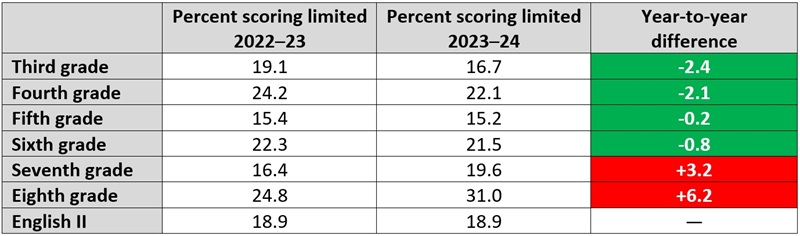
When students take Ohio’s state exams, their results fall into one of five performance levels: limited, basic, proficient, accomplished, and advanced. The top three levels (proficient, accomplished, and advanced) are considered passing scores. But data from the two most recent school years show that a sizable percentage of Ohio’s students are scoring at the limited level in reading.

Chart 1 shows that the number of students in grades 3–8 who scored limited in the last two years ranges from 15 to 31 percent. Things aren’t much better in high school, where nearly 19 percent of students scored limited on the English II end-of-course exam. It’s good news that, in the earlier grades, the number of students scoring limited decreased between 2023 and 2024. But in seventh and eighth grades, the number is rising.

Chart 1. Percentage of students scoring limited on English language arts state tests
OH early literacy to do list blog chart 1

To their credit, lawmakers are considering ways to intervene with struggling students. Senate Bill 19 would require public schools to provide academic intervention services to students who score limited on reading or math state tests. Given the percentage of students who fall into this category—not only in reading, but also in math—lawmakers would be wise to get these provisions into law as soon as possible.

***

With Ohio’s science of reading initiative, state lawmakers established a solid foundation for reading improvement. Building on that foundation is the next step. Reinstating retention and ensuring low-scoring students are provided with intensive intervention could bolster the likelihood that Ohio’s early literacy efforts are successful for all students.


Policy Priority:
Standards & Accountability
Topics:
Curriculum & Instruction
Aaron Churchill
9.2.2025
Masters degrees blog image
Getty Images/designer491
Listen to this article
Loading the Elevenlabs Text to Speech AudioNative Player...

Despite record-breaking funding levels, many Ohio districts are worried about a looming budget crunch. News reports from Cincinnati, Cleveland, Columbus, and elsewhere have detailed efforts to slim down budgets—belt tightening that is necessary as federal Covid-relief dollars have dried up and state and local funds aren’t likely to be as copious as in recent years.

As schools head into more uncertain fiscal times, school officials should look to stretch the school dollar in ways that keep student achievement heading in the right direction. In districts shedding enrollment, one possibility is to close underutilized schools—a money saver that can also benefit students if they transfer to a higher-performing school. Other options include sharing services or even hiring high school students for custodial or food service jobs. (For more ideas, Texas has an inventory of 101 commonsense ways to reduce expenses.)

Trimming here and there can certainly help, but it doesn’t tackle the largest educational expense of all: teacher compensation. Here, there is much school districts could do to address costs, all while putting the teacher-pay portion of the budget to better use. One strategy, which doesn’t entail workforce reductions or jeopardizing achievement, is to tackle the pay premiums that teachers automatically receive just for having a master’s degree.

Now, to some, paying extra for a graduate degree doesn’t sound so bad. And it wouldn’t be such a terrible idea if the credential were a proxy for classroom effectiveness. But research has found no link between effectiveness and a master’s degree. In other words, teachers with master’s degrees are no more likely to improve student achievement than those with a bachelor’s. Moreover, as a recent study from the National Council on Teacher Quality (NCTQ) reminds us, these pay bumps are expensive. Based on an analysis of 135 U.S. districts, NCTQ estimates that they spend almost a half-billion dollars extra each year for teachers with master’s degrees. This doesn’t even count the tuition costs that educators bear to obtain these degrees (or in some cases, that districts reimburse).

And yet Ohio districts—following a mandate in state law—continue to pay more for master’s degrees. Here’s what it looks like in Columbus City Schools. As the table below indicates, seniority automatically generates a higher salary. But then, moving to the degree columns, we also notice that teachers with a master’s degree receive significantly higher pay. For instance, a teacher with ten years of service and a master’s degree receives $80,940, while her bachelor’s degree counterpart receives just $72,990. Despite their likelihood of being equally effective, Columbus pays master’s degree teachers 10.9 percent more at the various seniority levels.

Table 1: Columbus City Schools’ teacher salary schedule

Masters degree blog image table 1
Note: Columbus City Schools’ full salary schedule for 2024–25 is available here.

Ohio should put a fork in the ineffective and costly practice of paying teachers more for master’s degrees. It does absolutely nothing to advance student learning. It encourages teachers to sit through even more coursework, likely taking night classes or clicking through online modules, all while paying tuition or accumulating student debt. This approach is expensive for districts and taxpayers, as 62 percent of Ohio teachers (following the salary incentive) do indeed possess a master’s degree. And it soaks up money that could be directed to more productive ends, such as providing extra pay to teachers who are doing the most for students.  

State lawmakers should do their part to discontinue this practice by repealing the requirement that districts adopt salary schedules based on seniority and degrees earned. They could even take it a step further, as North Carolina has done, and expressly prohibit districts from paying extra for master’s degrees. Enterprising district leaders need not wait for legislative action, either, as they can work to minimize the impact of the state regulation by reducing their pay premiums.[1] For instance, rather than giving master’s degrees a 10.9 percent bump, Columbus could reduce it to 2 percent. To avoid substantial near-term pay cuts, such a reduction may need to be phased in over time. But it would allow a district to transition from a credentials-based system to one that compensates teachers more strategically.

The way that Ohio school districts pay teachers—and the state laws that institutionalize these practices—urgently needs reform. These archaic compensation systems reward seniority and credentials, things that have not been proven to move the achievement needle. To drive higher student outcomes, particularly at a time of tightening budgets, schools will need compensation systems with a laser focus on teacher excellence. By prizing educator talent, skill, and accomplishment—not paper credentials and seniority—merit-based pay systems will help more Ohio students achieve their potential.


[1] There is no prescription on what the master’s premium over a bachelor’s salary must be, so long as the master’s degree salaries remain above the statewide minimum salary schedule.

Policy Priority:
School Funding
Topics:
Teachers & School Leaders
Jeff Murray
9.2.2025
Summer school SR image
Getty Images/Wirestock
Listen to this article
Loading the Elevenlabs Text to Speech AudioNative Player...

More than 70 percent of school districts nationwide reported expanding their summer school programming in 2022, mostly using federal ESSER funds, in one of many efforts to mitigate pandemic-era learning loss. A new study published in the American Educational Research Journal provides the first large-scale evaluation of the effectiveness of that programming.

The 14-strong research team estimates the effect of summer school on learning loss recovery by tracking the academic progress of students who attended programs in the summer of 2022 across eight school districts participating in the Center for Education Policy Research’s Road to Recovery project. The districts were mostly large and urban (including Dallas, Tulsa, and one that remains anonymous in the report), with a total enrollment of about 400,000. They served higher percentages of Black and Latino students (56 percent) and students eligible for free and reduced-price lunch (55 percent) than the national average (33 and 45 percent, respectively). Based on the Education Recovery Scorecard, all had seen sharp decline in math and reading test scores between 2019 and 2020, with varying levels of recovery seen through the end of the 2021–22 school year. On average, the remaining learning loss was approximately 0.19 standard deviations (SD) in math and 0.02 SD in reading, both higher than the national average (0.15 and 0.09 SD, respectively).

Their analytic sample comprises nearly 130,000 students expected to enter grades one through eight in the fall of 2022 and who had NWEA MAP Growth scores in reading and math for both the spring and fall 2022 test administrations. Using value-added models that control for students’ demographics and prior achievement, the research team estimated an overall, though small, positive effect of summer school on math test achievement in all eight districts, ranging from 0.03 to 0.04 SD. The longer students attended (hours and days), the higher the positive impact. However, since attendance was estimated at just 13 percent of K-8 students per district, summer school participation was estimated to have remediated a mere 2 percent of the districts’ loss in math. To add to the bad news, only two districts saw statistically significant impacts on reading test achievement, with the others—and the overall impact—statistically indistinguishable from zero. There was very little variation in impact among subgroups of students, as well. Even worse: Some of the districts actually combined summer programming with tutoring—to no better effect than summer school alone in either math or reading.

Interestingly, these uniformly unimpressive outcomes result from eight disparate efforts, with many permutations of scheduling, duration, content, staffing, and student recruitment across districts and, one assumes, even across different schools in the same district. This report goes into a little detail on matters of implementation in the specific study districts, but one member of the research team has previously conducted a much deeper analysis of Covid recovery programing in four anonymous Road to Recovery districts. Challenges cited there include reaching the neediest students, maintaining student attendance, finding adequate and effective staff, and a lack of central office support for out-of-school-time programming. These speedbumps, similar to those noted in this report, would seem to be universal across districts, schools, and intervention types, as a new and “sobering” analysis of tutoring impacts has also shown.

It seems clear now that recovery from Covid-era learning loss was never going to happen quickly—despite money[1], good intention, and effort—and 2022 was far too soon to see it. At least some states and schools appear to be making headway in more recent years, even if it is too late for the millions of impacted students who have already finished school in the interim.

SOURCE: Ian Callen et al., “Summer School as a Learning Loss Recovery Strategy After COVID-19: Evidence from Summer 2022,” American Educational Research Journal (July 2025).


[1] There is no discussion of the cost of providing summer school in the paper. Analysis of ROI—which some research shows can be high for summer programming—would add some nuance to these generally lackluster findings.

Policy Priority:
Standards & Accountability
Topics:
Governance
The Education Gadfly
8.31.2025
Fordham Gadfly image
Listen to this article
Loading the Elevenlabs Text to Speech AudioNative Player...
  • The post-Katrina “college for all” mindset raised college enrollment rates among New Orleans charter school students, but many dropped out before graduating. —NPR  
  • A fascinating look into the development of a teacherless, homeworkless private school in Austin, where students work toward content mastery in two hours per day via AI-powered tutoring. —Colossus  
  • Public high school teachers reflect on AI, Covid, cell phones, and the direction of the country as they embark on a new school year. —The New York Times
The Education Gadfly
8.31.2025
Fordham Gadfly image
Listen to this article
Loading the Elevenlabs Text to Speech AudioNative Player...

Cheers

  • The Institute for Education Sciences must fundamentally transform its approach to education R&D. —Mark Schneider, American Enterprise Institute

Jeers

  • School counselors, psychologists, and social workers are lobbying to ban AI therapy bots in order to protect their jobs. —Dean W. Ball, Hyperdimensional (Substack)
Kamren Herring
8.29.2025
New Orleans skyline
Getty Images/George Dodd
Listen to this article
Loading the Elevenlabs Text to Speech AudioNative Player...

Nearly twenty years ago, Hurricane Katrina devastated New Orleans. Among other sweeping institutional changes, the unprecedented school reforms enacted in the immediate aftermath have left long-lasting effects on the city’s K–12 public education system. But are New Orleans schools still operating in the way that reformers intended?

Before Katrina, New Orleans’s education system ranked low in several areas, including academic achievement at both the high school and college levels. Although the hurricane caused great damage to the city, it also created an opportunity to reform its education system. Post-Katrina reformers relied heavily on a previously enacted policy: the 2003 Recovery School District Act (RSD), which aimed to reform failing traditional public schools by converting them into high-performing charter schools. In 2005, Katrina seemed to give New Orleans a clean slate to enact the controversial law. The state assumed control of nearly all public schools in the city and turned most of them into charters, using additional resources from nonprofit organizations in an effort to boost academic achievement. Although many educators welcomed the increased financial support for facilities affected by the hurricane, the firing of teachers without proper evaluation created mistrust, especially amongst Black educators.

The Education Research Alliance (ERA) at Tulane University used a combination of qualitative and quantitative research methods to assess the academic impact of post-Katrina education reforms in New Orleans. They found that the reforms improved outcomes. State test scores rose by 11–16 percentiles, graduation rates by 3–­9 percentage points, college entry by 8–15 percentage points, and college completion by 3–5 percentage points. School spending increased by 13 percent due to government and philanthropic support, but instructional spending dropped by 10 percent per student. Much of the new funding went to administrative costs under the decentralized charter model, while lower teacher salaries also contributed to reduced classroom spending. 

Despite positive impacts, the report highlights that certain reforms also led to negative consequences, including mismanagement of funds, lower teacher quality, and reduced access to schools for low income students. An ERA survey conducted between 2018 and 2019 reported that students experienced lower teaching quality in New Orleans compared to students in other areas that had undergone similar reforms. After Katrina, teachers had less experience and fewer advanced credentials, with Black teachers experiencing less compensation and a drastic decrease in representation (from 71 percent to just under half by 2014). Many educators felt disrespected and neglected, especially during the initial implementation when many were abruptly fired or excluded from decision-making.

Post-Katrina reforms caused some additional problems for students and families. Since attendance zones were removed, many students had to travel further to get to school, which made transportation more expensive for the NOLA school district. Fewer early childhood programs were offered because charter schools were not required to fund pre-K. Arts education also received less support, with fewer students taking part in music, art, and similar classes. 

Taken together, the findings suggest that post-Katrina reforms brought many noticeable improvements in academic outcomes but left some teachers and families feeling left out of the decision-making process.

SOURCE: Douglas Harris and Jamie Carroll, “The New Orleans post-Katrina school reforms: Twenty years of lessons,” Education Research Alliance for New Orleans (June 2025).

Policy Priority:
High Expectations
Topics:
Accountability & Testing
School Finance
Charter Schools
Governance
Teachers & School Leaders
Jeff Murray
8.29.2025
Ohio charter news logo
Listen to this article
Loading the Elevenlabs Text to Speech AudioNative Player...

Stories featured in Ohio Charter News Weekly may require a paid subscription to read in full.

A good idea for the future?

We start with new coverage of Ohio House Bill 205, currently pending in the Education Committee. It would make some changes to the infrastructure of student teaching in charter and district schools across the state, including giving schools the ability to pay those educators-in-training and to provide them health insurance benefits. Data and analysis of the bill from Fordham’s Jessica Poiner is linked in the piece, and her colleague Aaron Churchill says the bill is worthy of a discussion, as the teacher pipeline needs good candidates, and supporting them more financially could work to boost their numbers. The piece overall feels a bit too optimistic, given that the bill has been sitting without a hearing since April and does not appear to be a priority for legislators when they return from summer break.

A response to the response

Two weeks ago, we covered two opposing viewpoints on the question of whether charter schools are overregulated and, specifically, whether the inherent flexibility of the charter model is stifled by what regulations exist. Now we have a third viewpoint—from Thibaut Delloue, a Policy Fellow at the Florida Charter Institute—siding more with the idea that some regulation is essential. He specifically believes that regulations in three areas—academic standards, curricula, and assessments—are key to a functional and successful charter school sector. “When good, research-backed policy is effectively implemented,” he writes, “it works for all schools.”

The view from the top

The top two spots on U.S. News & World Report’s newly-released list of best public high schools in America belong to charter schools, and there are numerous others in the top 20. A trio of charter school supporters explained to Education Next, using research findings and anecdotal evidence, why such rankings are important, what it means to be an academically intensive charter school like those at the top of the list, and why everyone should pay attention to what these schools are getting right.

Legacy

This week marks a somber anniversary: twenty years since Hurricane Katrina devastated large parts of the city of New Orleans. Among other lessons learned over this time, pundits and analysts around the country have paid close attention to how the city has rebuilt a school system all but wiped out by the disaster. Ravi Gupta, founder and CEO of nonprofit media company The Branch and former charter network leader, digs deeply into research, journalism, and real-life experiences to tell the story of schools, students, and families of New Orleans. It’s a remarkable look at an unprecedented case of constructing a whole new system in place of one that most observers agree was less-than-perfect in its original form. And charter schools played an oversized role in that rebirth. This detailed analysis is well worth your time and attention.

Is the charter school sector “cooling”?

A new paper from the National Center for Charter School Accountability reports that expansion of and demand for charter schools is waning across the country due to a combination of financial trouble, regulatory creep, and enrollment decline. The authors call their findings “sobering," but they are more accurately par for the course for an anti-charter school organization like NCCSA, funded by teachers unions. Forbes senior contributor Peter Greene seems to accept this analysis at face value--also not surprising--but does note helpfully that charters are “by and large businesses” and should behave as such if growth is desired. Sounds like a plan!

*****

Did you know you can have every edition of the Ohio Charter News Weekly sent directly to your Inbox? Subscribe by clicking here.

Policy Priority:
School Choice
Topics:
Charter Schools
Jeff Murray
8.29.2025
Gadfly Bites logo
Listen to this article
Loading the Elevenlabs Text to Speech AudioNative Player...

News stories featured in Gadfly Bites may require a paid subscription to read in full. Just sayin’.

  1. The next time you hear folks opining about how awesome it would be if “every kid” got free meals at school, you would do well to remember this op-ed from Traci Woodard, Parent Task Force Director for Ohio Parents for Education Freedom and all-around incredible supporter of school choice and student success. In it, she reminds us all that the tens of thousands of virtual charter school students across our state do not receive any kind of school-based food service, no matter if their family income would make them eligible in a district or brick-and-mortar charter or indeed if every student in a district is given free food regardless of their income. “You might meet the same income rules as the student getting on the bus down the street,” Woodard writes, “be counted in the same census numbers that bring federal meal dollars to Ohio, and still be told, ‘No lunch for you’.” To make matters worse: Virtual charter students were offered lunch (and breakfast and more) during Covid, but the waiver allowing this has ended. Despite that, Ohio gets (and has always gotten) its federal school lunch funds based on enrollment counts that include these students. That means the money is there, and only the will is lacking. “The only thing worse than a hungry child,” her op-ed concludes, “is a hungry child that we have the ability to feed but choose not to.” Which is as succinct a condemnation as I can think of. An unacceptable situation that needs to be fixed. (Columbus Dispatch, 8/28/25)

  2. We learned yesterday via Gongwer that the Ohio Supreme Court has unfortunately rebuffed Attorney General Dave Yost’s legal effort to force Columbus City Schools to transport a group of choice-using students while their “impractical to transport” determinations are adjudicated for a second year. Somehow the district’s argument that “numbers are down this year” and the “Department of Education and Workforce’s adjudication process is working just fine” swayed them. Charming. (Gongwer Ohio, 8/28/25)

  3. Hey hey, Ohio Capital Journal, slow down! You can stop selling these awesome-sounding small private schools that accept EdChoice vouchers so hard. You don’t have to convince me that school choice is great—I’m already a fan! (Ohio Capital Journal, 8/28/25) I jest of course, because I’m pretty sure the OCJ is not in the business of pitching private schools or vouchers to their readers. As an example, here is a follow-up piece about two families who opted for private schools—one using EdChoice, the other refusing on principle. Their stance: Not wanting to take away resources from their district of residence via a voucher. While any parent is entitled to believe that, to act upon it, and to say so, I do wish the OCJ would have at least pointed out the important factual inaccuracy inherent in that stance to any of their readers thinking of doing the same. To wit: The primary “resources” (state per-pupil funding, to the tune of over $18K last year) is unavailable to the district immediately when the child is not enrolled. Poof! Same as if he would have moved to Bexley or New York instead. By contrast, this family’s sliding scale voucher amount is maybe a quarter of that. But no matter how much it is, a) it doesn’t come out of a district’s coffers, and b) state EdChoice funds don’t get sent to the district if an eligible family doesn’t use it. It’s just unspent state funds. So yes, I say feel free to stand on your principles folks, and to shout them from the rooftops; but I also say that it’s reasonable for me to expect news outlets to stand on theirs and correct the record when necessary in a non-opinion piece. Or maybe I’m missing something. Oh, and kudos to the private school for both accepting EdChoice students and for allowing whoever wants to refuse a voucher to do so (no matter the reasoning) and to pay full freight on their own. And that's as fair as I can be about the matter. (Ohio Capital Journal, 8/29/25)

  4. Finally this week, y’all know that I am a cellphone ban skeptic, trepidatious that implementation will be bad in many schools and positive outcomes minimal in most. There’s a lot of reasons for my stance, but they all boil down to one word: Adults. We talked about one example of this on Wednesday, where adults believe so fervently that having phones is so detrimental for kids’ attention spans that the devices must even be banned from lunchtime, while simultaneously believing that kids are so bad that not having phones at lunch will cause them to act out and get up to “mischief”. Even books are not enough to soothe these savages. Thus the kids must be distracted the entire time with every board game, craft circle, and foosball table that money can buy (not to mention a raft of adult eyes). Here’s another example, in which a parent says, “The kids have become a little hypersensitive to the ideas of needing these phones, being very codependent on these devices, where it builds up an anxiety within them.” Thus, a complete bell-to-bell phone ban is the only rational response to save them from themselves. (ABC 6 News, 8/29/25) But also on Wednesday, we paraphrased a social media wag who insisted he had proof that his school’s phone ban was airtight because not a single student reported the Kelce/Swift engagement news when it dropped during class. As a counterpoint, I offer this insanity from EdWeek, that not only describes teachers interrupting their classes to announce the news to their poor phoneless kiddos, but also disrupting entire buildings with PA announcements, and even filming TikTok videos of them performing these stunts. The mildest response I have to this nonsense is that it’s more proof that student phone bans are a “do as we say, not as we do” sort of decree. (I am well aware of how these usually work out; are you?) A bit more salty response would be that these adults are clearly missing the obvious clues that they care more about mid-30s celebrities doing anything than today’s high schoolers do. (To which I say: grow the heck up.) And indeed that they care more about such things than they do school—the same thing they accuse kids of doing…with less evidence. And at worst: Phone bans are obviously doomed to failure because the adults implementing them are clearly the ones with anxiety and hypersensitivity and mental angst related to constant connectivity and FOMO and nothing at all is being done to rein in these juvenile delinquents cosplaying as authorities. In fact, they are even more firmly in charge of the asylum than ever these days and will, as ever, say or do anything to keep it that way. (EdWeek, 8/28/25)

Did you know you can have every edition of Gadfly Bites sent directly to your Inbox? Subscribe by clicking here.

Policy Priority:
School Funding
Topics:
Governance
Michael J. Petrilli
8.29.2025
High school football practice
Getty Images/gorodenkoff
Listen to this article
Loading the Elevenlabs Text to Speech AudioNative Player...

My son came home from football practice the other night and showed me the “key performance indicators” from his position coach. This season, a missed tackle results in a “fine” of twenty burpees; a dropped interception is followed by twenty push-ups; and a missed assignment will be punished with fifty squat jumps. But the harshest penalty by far—ten 110s, or wind sprints from the goal line to the 10-yard line and back, then to the 20 and back, then to the 30 and back, and so on, repeated ten times—is for what he calls “swagger slacker.” In other words, not putting in enough effort.

I love that so much, because it sends a clear message to the impressionable boys on the team: effort is what matters most. Yes, it’s a cliché, but it’s one too many people in the worlds of education policy and practice forget. We continue to come up with ways to make life easier for students, as if learning can happen without some degree of exertion and struggle. Doesn’t work in football; doesn’t work in class.

The discussion around artificial intelligence is one prominent example. ChatGPT, also known as CheatGPT, is on call 24/7 to take away the blood, sweat, and tears of writing a school essay or doing practically any other homework assignment.

And there are “leveled readers” for young children, which Tim Shanahan explains in a new book. They rest on the faulty premise: the idea that too much struggle is somehow bad for kids.

But the best example comes from the push for so-called “equitable” grading practices, a push that’s been sweeping the education nation in recent years. I refer to policies like the No Zeros rule, also known as the “gifty fifty,” along with bans on grading homework or class participation and mandates requiring unlimited retakes on assessments and assignments.

The somewhat understandable rationale for all of this, advanced by consultant Joe Feldman among others, is that traditional grading practices don’t actually reward student learning, and that “standards-based grading” more accurately reflects whether students have mastered the knowledge and skills set forth in state standards and encourages them to keep at it until they do. Hence, we shouldn’t count homework or class participation in students’ grades (since these reflect effort, not achievement), and we should allow retakes and redos of tests and assignments until students demonstrate mastery.

That’s all well and good, except that—as my Fordham Institute colleagues Adam Tyner and Meredith Coffey argued last year in their policy brief, Think Again: Does “Equitable” Grading Benefit Students?—in practice these policies “tend to reduce expectations and accountability for students, hamstring teachers’ ability to manage their classrooms and motivate students, and confuse parents and other stakeholders who do not understand what grades have come to signify.”

As Fordham fellow Robert Pondiscio quipped the other day, these insights deserve to be printed in the “Journal of the Obvious and Intuitive.”

Whatever their potential merit, such grading practices seem perfectly designed to diminish student effort. Why bother doing homework if it doesn’t count? Why study for a test if you can simply retake it after failing? Why even come to class if you already have a strong A, there are only a few assignments left in the semester, and the worst you can do is score 50 on each of them?

That’s not just my cynicism talking. It’s also the view of a majority of American teachers, according to a new survey fielded by RAND and written up by my colleagues Tyner and David Griffith, “Equitable” Grading Through the Eyes of Teachers.

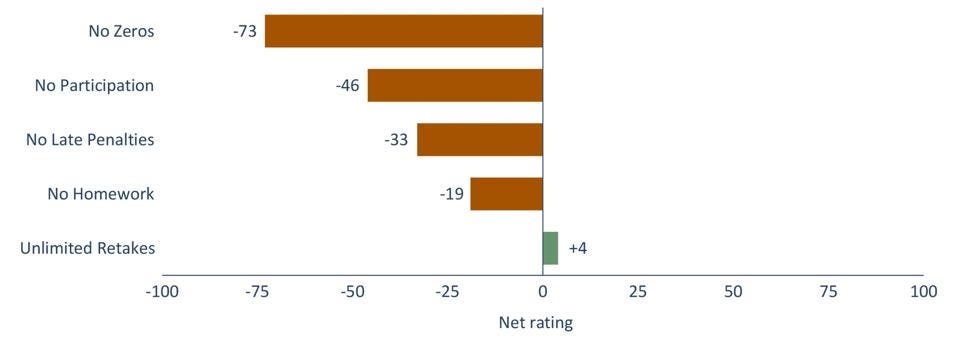
Per Figure 1, the results suggest that teachers are skeptical of the five equitable practices that form the focus of the report.

Figure 1: Teachers are skeptical of most "equitable" grading practices.

Figure 1

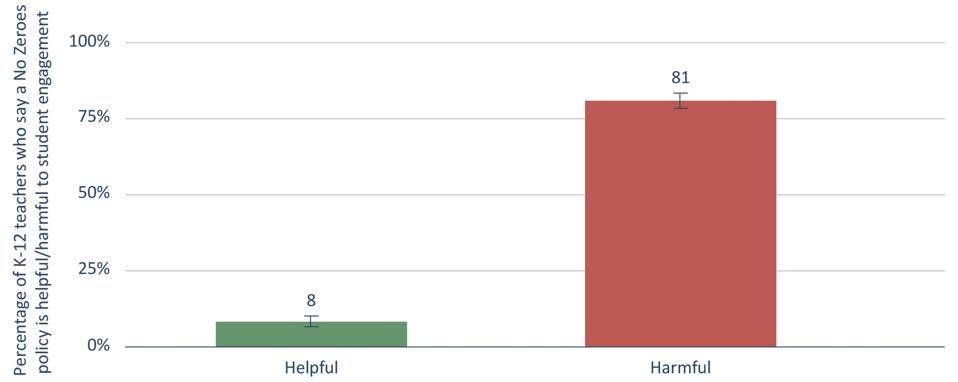
Overall, teachers’ responses suggest that “equitable” grading practices, however well intentioned, are harmful to academic engagement, some more so than others. For example, 81 percent of teachers say giving partial credit for assignments never turned in (the No Zeros policy) is “harmful” to engagement, with 51 percent saying it is “very harmful” and just 8 percent saying it is “helpful” or “very helpful” (Figure 2).

Figure 2: The overwhelming majority of teachers say “giving partial credit for assignments that are never turned in” is harmful to academic engagement.

Figure 2

Consistent with that result, more than fifty teachers used the survey’s open-response section to express their personal opposition to No Zeros, making it the most mentioned—and most widely ridiculed—grading policy. Here are some examples of their comments:

“We have the 50 percent rule, which I think is ridiculous.”

“Being given a 50 percent for doing nothing seems to enable laziness.”

“Everybody gets at least a 50 percent is insulting to the students who work.”

“We have gone to the ‘Do nothing, get a 50’ grade policy. Students have figured out that, if they work hard for a quarter (usually the first) they can ‘coast’ the rest of the year and get a D.”

“Forcing teachers to give students half-credit on assignments that have not been completed and/or turned in is a disservice to students.”

“Most teachers can’t stand the gifty fifty.”

“I am an educator with thirty-three years in the classroom, and I see a terrible trend… Students are starting to feel entitled to points for nothing.”

“Equity grading is not leveling the playing field… It is simply lowering standards so that school districts look like they are meeting kids where they are, when in fact they are hiding their failures behind ‘equitable’ policies.”

Turns out, teachers don’t like it when administrators take a sledgehammer to their few sources of leverage over student motivation and effort. Nor do they like handing out grades that students haven’t earned.

So, for the love of learning, I beg my fellow pundits and policymakers, and so-called experts to stop coming up with prescriptions that reduce student effort. We want kids giving 110 percent when they play sports; we shouldn’t want anything less in the classroom.

Editor’s note: This was first published by Forbes.

Policy Priority:
High Expectations
Topics:
Accountability & Testing
Curriculum & Instruction
Teachers & School Leaders
Meredith Coffey, Ph.D.
8.28.2025
Teacher in a classroom
Getty Images/Drazen Zigic
Listen to this article
Loading the Elevenlabs Text to Speech AudioNative Player...

Upon receiving my first high school teaching placement, I carefully studied my district’s teacher salary schedule, anticipating what I would make each year. As you likely know, most American school districts pay teachers based on a “schedule,” or a table with “steps” (rows) for each year of experience and “lanes” (columns) for education level attained. As a first-year teacher with an arguably excessive graduate education, I knew I’d earn the amount listed at the intersection of the first step and the last lane. I noted that the district also made regular cost-of-living adjustments (COLA). The reliable salary schedule, I felt, was a real benefit of teaching. Nothing about my workday was predictable, but I was heartened by a predictable, guaranteed income. And that was exactly my experience at first.

Four years into my teaching career, I moved states but was pleased that my years of experience transferred easily onto my new district salary schedule. So imagine my shock upon learning, at the end of my first year there, that I would not advance to the next step. Due to a districtwide pay freeze, I would be paid again in my sixth year as if I were still in my fifth. And had I stayed in that district, I would’ve been subjected to yet another freeze, meaning that I would’ve been paid in my seventh year as if I were in my fifth.

Other districts might differ, but in mine, I would have remained two years “behind” for the rest of my career. Elsewhere—such as Flint, Michigan—teachers have been “behind” on pay since the early 2010s. That effectively penalizes teachers for longevity in the district!

It’s discouraging stuff, or at least it was to me. But it hasn’t gotten much attention in either the mainstream media or in education research. Rigorous studies explore the effects of teacher performance pay, teacher benefits, and much else, but I couldn’t find a single study of pay freezes. Researchers, look into this, please!

Such freezes are hardly unusual. They can take a few different forms, whether they block advancement to the next step (as happened to me), deny COLA, or introduce “phantom steps” (in which teachers technically advance to the next step, but the salary for that step isn’t any higher; for a jaw-dropping ten years of these, see this North Carolina schedule).

As one might guess, freezes are especially common during times of economic hardship and budgetary stress. In the aftermath of the 2008 recession, for example, 80 percent of the large districts in a National Council on Teacher Quality study adopted pay freezes or cuts. During the height of COVID, districts such as Fairfax County—the country’s ninth-largest, with 13,000 teachers—froze salaries.

Plenty of other jobs don’t offer consistent raises, but the stability of salary schedules was supposed to be a draw for teachers, both in terms of annual earnings and their outdated but oft-touted pensions. A district freezing salaries is going to be less attractive, especially if a teacher is deciding between neighboring districts, where one isn’t as inclined to freeze as the other.

Speaking to my own experience, the hit to my pay wasn’t what ended my teaching career (although a substantially larger paycheck might have offset at least some of my burnout). But even if I’d been inclined to stay in the classroom, I absolutely would have applied to nearby districts that weren’t so quick to freeze. And while many critics and policy analysts denounce the traditional salary schedule, they’re typically arguing for policies that reward performance or fill hard-to-staff positions, not for across-the-board penalties that make teaching less appealing.

Today, what with the end of COVID relief funding and the precariousness of federal support, we’re probably nearing another moment when salary freezes will arise in many districts. (Layoffs are likely, too, but those already receive a good deal of attention.)

As a former teacher, I wish the answer were as easy as “don’t freeze salaries.” In practice, I know that budgets are limited, and difficult choices must happen.

All the more reason for researchers to investigate the effects of freezes. Anecdotally, I can confirm that mine was an unpleasant surprise, and my colleagues’ reactions ranged from annoyed to outraged. And to this day, salary freezes are clearly a source of frustration on teachers’ social media. But we need real data, too. It seems reasonable to hypothesize that freezes would negatively impact teacher morale, engagement, and retention, but so far no rigorous research has analyzed their effects.

The policy implications are real. As districts evaluate their budgets and make those tough decisions, it would be valuable to know: Does a salary freeze risk driving out teachers? Might teachers in harder-to-staff positions, like special education or Title I settings, be at greater risk of leaving? Does a step freeze have a different impact than the imposition of phantom steps? Does a freeze decrease teacher morale, in turn perhaps impacting their attendance, effectiveness, or other outcomes? Having such data would equip district leaders to make better-informed decisions when it comes to allocating limited resources.

My step freeze didn’t drive me out of teaching, but it was another reason to leave. I don’t know whether it had a similar effect on others, but we could certainly find out.

Policy Priority:
High Expectations
Topics:
Evidence-Based Learning
School Finance
Teachers & School Leaders

Pagination

  • First page « First
  • Previous page ‹ Previous
  • Page 87
  • Page 88
  • Page 89
  • Page 90
  • Current page 91
  • Page 92
  • Page 93
  • Page 94
  • Page 95
  • Next page Next ›
  • Last page Last »
Fordham Logo

© 2026 The Thomas B. Fordham Institute
Privacy Policy
Usage Agreement

National

P.O. Box 110
Burke, VA 22009

202.223.5452

[email protected]

Ohio

P.O. Box 82291
Columbus, OH 43202

614.223.1580

[email protected]

Sponsorship

130 West Second Street, Suite 410
Dayton, Ohio 45402

937.227.3368

[email protected]