Podcast
Standards
Commentary
Curriculum & Instruction, Standards, Teachers & School Leaders
Addressing constructive criticisms of Fordham’s report on state civics and U.S. history standards
Our recent study of states’ U.S. history and civics standards attracted some constructive criticism from both the left and the right. It was, after all, explicitly bipartisan. Here are our responses to four critiques.

Commentary
Evidence-Based Learning, Curriculum & Instruction, Governance, Standards, Teachers & School Leaders
Using deeper learning to strengthen our democracy
The past eighteen months have been some of the most tumultuous in the history of our nation. The twin pandemics of Covid-19 and social injustice have highlighted how today’s students face very different expectations than students encountered in previous generations.

Commentary
Evidence-Based Learning, Curriculum & Instruction, Governance, Standards, Teachers & School Leaders
State civics and U.S. history standards are less politically biased than before. Let’s keep it that way.
In 2020, as we began to look at state U.S. history standards for the first time since 2011, I was concerned about what we would find.

Commentary
Governance, Standards
How not to write state standards for civics and U.S. history
As discussed in Fordham’s new report, many states aren’t making the grade when it comes to their civics and U.S. history standards, which are often vague to the point of being meaningless.

Commentary
Curriculum & Instruction, Standards, Teachers & School Leaders
Strong standards are vital for making history and civics central in K–12 education
Gone are the days when we could all agree with Ben Franklin’s sunny admonition: “Indeed the general tendency of reading good history must be, to fix in the minds of youth deep impressions of the beauty and usefulness of virtue of all kinds.” Instead, we must cope with political polarization, schools preoccupied with the achievement gap, students who learn from social media, and adults who are t

Commentary
Curriculum & Instruction, Standards, Teachers & School Leaders
5 things I’ve learned from teaching U.S. history to high schoolers
I’ve taught U.S. history to high schoolers for almost twenty years, during which time I’ve worked in multiple states with students of varying personal and cultural backgrounds. Below are the five things that I think I’ve learned. 1) Our students need more exposure to U.S. history.

Commentary
Curriculum & Instruction, Governance, Standards, Teachers & School Leaders
We need better civics education, but it won’t happen anytime soon
Fordham’s new report found that twenty states have “inadequate” civics and U.S. history standards that need a complete overhaul. An additional fifteen states were deemed to have “mediocre” standards that require substantial revisions. This fits the lackluster showing of U.S. students on the NAEP exams in these subjects, and suggests that some schools barely teach this content at all. Unfortunately, the obstacles in the way of improving this sad state run up and down the line.

Commentary
Evidence-Based Learning, Curriculum & Instruction, Governance, Standards, Teachers & School Leaders
How to strengthen U.S. history and civics standards
For our constitutional democracy to survive, much rests on our ability to resolve “…differences even as we respect them,” which is The State of State Standards for Civics and History in 2021 report’s definition of the social purpose of civic education.

Podcast
Curriculum & Instruction, Standards
The Education Gadfly Show #776: Can curriculum reform succeed where the rest of standards-based reform failed?
Commentary
Curriculum & Instruction, Governance, Standards, Teachers & School Leaders
Proof that it’s possible to approach civics and U.S. history in a balanced way
Is America a racist country? Or the greatest nation on earth? Or both or neither or some of each?

Commentary
Curriculum & Instruction, Governance, Standards, Teachers & School Leaders
Teaching U.S. history and civics in America’s pluralistic society
The Thomas B. Fordham Institute’s review of state standards for U.S. history and civics comes at a critical moment in American civic life.


Report
Standards
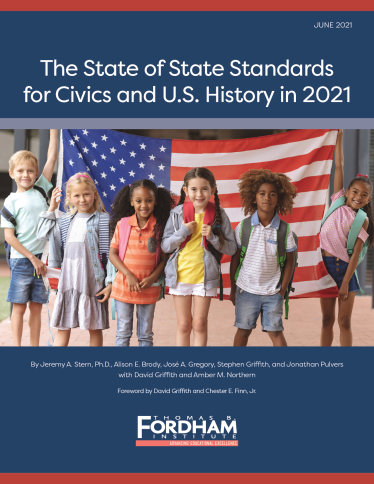
The State of State Standards for Civics and U.S. History in 2021
Is America a racist country? Or the greatest nation on earth? Such a divisive question leaves little room for the complexity, richness, and nuance of our country’s past and present. But it’s the sort of question that often seems to get asked in today’s polarized environment. Small wonder, then, that the tattered condition of civics and U.S. history education constitutes a national crisis.
Commentary
Evidence-Based Learning, Standards
First, do no harm: The initial impact of the Common Core on student learning
Ever since their creation and adoption over a decade ago, the Common Core State Standards (CCSS) have been hotly debated and intensely villainized. The backlash to the CCSS initially took many advocates and supporters by surprise, as state education standards have existed in the U.S.

Report
Curriculum & Instruction, Standards, Teachers & School Leaders
The Acceleration Imperative: A Plan to Address Elementary Students’ Unfinished Learning in the Wake of Covid-19
In school districts and charter school networks nationwide, instructional leaders are developing plans to address the enormous challenges faced by their students, families, teachers, and staff over the past year. To help kick-start their planning process, we are proud to present The Acceleration Imperative, an open-source, evidence-based document created with input from dozens of current and former chief academic officers, scholars, and others with deep expertise and experience in high-performing, high-poverty elementary schools.

Commentary
Governance, Standards
Florida’s new math and English standards aren’t ready for prime time
When policymakers contend that their standards deserve to be replicated, especially when those policymakers lead big, highly regarded states like Florida, we at Fordham think their claims merit a closer look. So we gathered a team of expert reviewers to review the state's new standards, and published a new report based on their results. The verdict: Other states should indeed look for models to emulate, but they won’t find them in Florida.

Report
Standards
The State of the Sunshine State's Standards: The Florida B.E.S.T. Edition
A decade ago, states across the nation adopted the Common Core State Standards (CCSS) in an effort to raise the academic bar for their students. This has provoked countless political battles since then—including an especially intense one in Florida.

Commentary
Accountability & Testing, Charter Schools, Curriculum & Instruction, Governance, Private School Choice, Standards, Teachers & School Leaders
Back to basics for conservative education reform
This major essay comprises one of the concluding chapters of our new book, "How to Educate an American: The Conservative Vision for Tomorrow's Schools." Levin brilliantly—and soberingly—explains what conservatives have forfeited in the quest for bipartisan education reform. He contends that future efforts by conservatives to revitalize American education must emphasize “the formation of students as human beings and citizens,” including “habituation in virtue, inculcation in tradition, [and] veneration of the high and noble.”


Podcast
Standards
The Education Gadfly Show: Why teachers with higher grading standards get better student outcomes
On this week’s podcast, Seth Gershenson, associate professor at American University, joins Mike Petrilli and Da

Podcast
Accountability & Testing, Evidence-Based Learning, Standards
The Education Gadfly Show: NAEP 2019: It (was) the economy, stupid
On this week’s podcast, Marty West, a Harvard professor of education, joins Mike Petrilli and David Griffith to talk about last week’s NAEP results and their relationship to the Great Recession. On the Research Minute, Amber Northern examines how graduation requirements affect arrest rates.
Event
Accountability & Testing, Curriculum & Instruction, Advanced Education, Standards
Is Advanced Placement Good for Everyone? A Discussion with Partisans and Doubters
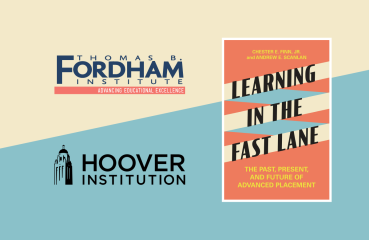
Learning in the Fast Lane: The Past, Present, and Future of Advanced Placement (Princeton, 2019), the new book by Chester Finn and Andrew Scanlan, tells the story of the Advanced Placement (AP) program, widely regarded as the gold standard for academic rigor in American high schools.
Commentary
Accountability & Testing, Curriculum & Instruction, Standards
On NAEP, bright spots amidst the gloom
This year’s NAEP results are bleak. But they were foreseeable, with the Great Recession's effects still impeding progress. Demography need not be destiny though: A few jurisdictions bucked the overall trends and showed improvement. D.C. deserves much of the praise, given its ability to demonstrate sustained and significant progress over time, and its decade-plus commitment to fundamental reform. As does Mississippi, which has been on an upward trajectory for the last decade, especially in reading. Despite the dismal results, there’s hope if we can follow the lead of these notable locales.


Podcast
Accountability & Testing, Curriculum & Instruction, Standards
The Education Gadfly Show: Early warning: Kindergarten readiness skills are trending downward
On this week’s podcast, Megan Kuhfeld, a research scientist at NWEA, joins Mike Petrilli to discuss her recent, sobering findings about the reading and math skills of children entering kindergarten. On the Research Minute, Adam Tyner examines how “stereotype threat” affects the results of cognitive ability tests.
Commentary
Evidence-Based Learning, Curriculum & Instruction, Standards, Teachers & School Leaders
Why struggling students remain below grade level, and how to help them
Editor’s note: This is a submission to Fordham’s 2019 Wonkathon, in which we ask participants to answer the question: “What’s the best way to help students who are several grade levels behind?” This entry does so via answers to hypothe
Commentary
Curriculum & Instruction, Personalized Learning, Standards
Access, equity, and quality in dual enrollment
Programs that allow high school students the opportunity to earn college credit while still in high school are growing fast. In addition to familiar options like Advanced Placement and International Baccalaureate, dual enrollment, concurrent enrollment, and early college high school—otherwise known as college in high school programs–are increasingly popular models in states.

Commentary
Accountability & Testing, Charter Schools, Curriculum & Instruction, Governance, Advanced Education, Standards, Teachers & School Leaders
The GAS Factor: Lessons learned at Success Academy
Much of the initial response to Robert’s new book, "How The Other Half Learns," has focused on the winnowing effects of Success Academy’s enrollment process, which ensures that the children of only the most committed parents enroll and persist. But that’s just the start of the story. You have to look at what parent buy-in actually buys: a school culture that drives student achievement, and which can only be achieved when parents are active participants, not unwilling conscripts.

Commentary
Accountability & Testing, Evidence-Based Learning, Curriculum & Instruction, Standards, Teachers & School Leaders
The scourge of education malpractice
What if you were told that elementary schools in the United States are teaching children to be poor readers?

Commentary
Accountability & Testing, Evidence-Based Learning, ESSA, Curriculum & Instruction, Standards
End-of-course exams benefit students—and states
Very little previous research has looked at end-of-course exams. Our new study on their relationship to student outcomes helps remedy that. We learned much that’s worth knowing and sharing. Probably most important: EOCs, properly deployed, have positive academic benefits and do so without causing kids to drop out or graduation rates to falter.

Commentary
Accountability & Testing, Evidence-Based Learning, ESSA, Governance, Standards
The “left behind” kids made incredible progress from the late 1990s until the Great Recession. Here are key lessons for ed reform.
Editor’s note: This is the final post in a series looking at whether and how the nation’s schools have improved over the past quarter-century or so (see the others here,