Mobile Navigation

  • National
    • Policy
      • High Expectations
      • Quality Choices
      • Personalized Pathways
    • Research
    • Commentary
      • Gadfly Newsletter
      • Flypaper Blog
    • Events
    • Scholars Program
  • Ohio
    • Policy
      • Priorities
      • Media & Testimony
    • Research
    • Commentary
      • Ohio Education Gadfly Biweekly
      • Ohio Gadfly Daily
  • Charter Authorizing
    • Application
    • Sponsored Schools
    • Resources
  • About
    • Mission
    • Board
    • Staff
    • Career
Home
Home
Advancing Educational Excellence

Main Navigation

  • National
  • Ohio
  • Charter Authorizing
  • About

National Menu

  • Topics
    • Accountability & Testing
    • Advanced Education
    • Career & Technical Education
    • Charter Schools
    • Curriculum & Instruction
    • ESSA
    • Evidence-Based Learning
    • Facilities
    • Governance
    • Personalized Learning
    • Private School Choice
    • School Finance
    • Standards
    • Teachers & School Leaders
    • Think Again
  • Research
  • Commentary
    • Gadfly Newsletter
    • Flypaper Blog
    • Gadfly Podcast
  • Events
  • Scholars Program

Topics

Displaying 241-270 of 421 results
Commentary
6.12.2019

How different post-secondary pathways affect the ability of disadvantaged students to attain credentials with labor market value

Amber M. Northern, Ph.D.

Education policy is rife with references to developing suitable “career pathways” that presumably start in high school and extend through college.

Commentary
6.6.2019

SAT and adversity: Taking a second look

Ian Rowe

If you happen to be wondering what’s on tap for America’s next pity party, look no further than the Facebook video entitled “If someone doesn't understand privilege, show them this.” This four-minute tear-jerker has been viewed a staggering 112 million times.

Commentary
6.6.2019

Teacher diversity in North Carolina: Sector differences in exposure and impact raise questions about how benefits are felt

A new report by Seth Gershenson sparks fresh ideas about new directions for the literature on student-teacher matching along demographic characteristics.

Commentary
6.5.2019

Teacher diversity is yet another area where charter schools excel

Amber M. Northern, Ph.D., Michael J. Petrilli

Fordham’s newest study finds that black students in charter schools are about 50% more likely to have a same-race teacher than their black counterparts in traditional public schools, that the impact of having a same-race teacher is twice as large in charters, and that the effect of having a same-race teacher in charters is about twice as large for nonwhite students as for white students. They're doing a better job of recruiting diverse teachers, which gives kids of color a greater chance at having a teacher of their same race.

Commentary
6.5.2019

The making of an edu-myth: The 30-million-word gap has not been “debunked”

Robert Pondiscio

Try this experiment. At your next professional development session, conference, or perhaps on social media, mention the famous “30-million-word gap” study, which demonstrated that low-income children hear far less spoken language before their first day of school than their affluent peers, setting in motion dramatic differences in vocabulary attainment and academic achievement.

Commentary
6.5.2019

Back to the future: How to rescue and reinvent special education

To borrow from the familiar quip about the weather, everybody complains about special education, but nobody does anything about it. Why such policy neglect despite the dismal outcomes for the vast majority of the nearly seven million students in special education and the suffering of their anguished parents?

Podcast
6.5.2019
Charter Schools, Teachers & School Leaders

The Education Gadfly Show: The benefits of having a same-race teacher

On this week's podcast, Seth Gershenson, Associate Professor at American University and author of Fordham's latest study, Student-Teacher Race Match in Charter and Traditional Public Schools, joins Mike Petrilli and David Griffith to discuss that research. On the Research Minute, Amber Northern examines how the actions of turnaround schools affect teacher mobility.

Commentary
6.5.2019

Beating the drum for charter schools

Chester E. Finn, Jr.

Sarah Tantillo is an accomplished teacher, author, and battle-scarred veteran of the charter-school wars, particularly in New Jersey, where she taught for years at acclaimed North Star Academy and led the state charter school association.

Commentary
6.4.2019

The education-health care perplex

Chester E. Finn, Jr.

As I observe health care rise to the top of the policy debates foreshadowing the 2020 election—seems to be second only to Donald Trump among the twenty-three Democrats now seeking the Oval Office—as K–12 education sinks lower on the policy horizon (such that several observers declare ed-reform

Report
6.4.2019
Charter Schools, Teachers & School Leaders

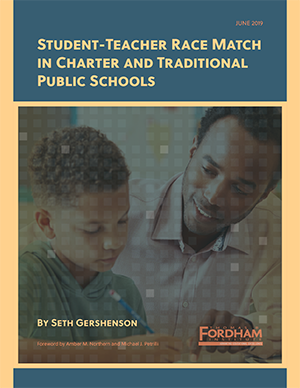
Student-Teacher Race Match in Charter and Traditional Public Schools

There’s mounting evidence that, for children of color especially, having one or more teachers of the same race over the course of students’ educational careers seems to make a positive difference. But to what extent, if any, do the benefits of having a same-race teacher vary by type of school? Existing “race-match” studies fail to distinguish among the traditional district and charter school sectors. This study fills that gap and finds that the effects of having a same-race teacher appear stronger in charter schools than in the traditional district sector—and stronger still for nonwhite students.


Commentary
6.3.2019

Fordham-CAP “Moonshot for Kids” competition is now open

Michael J. Petrilli

In April, the Fordham Institute and the Center for American Progress announced a

Commentary
5.31.2019

Good jobs don’t always require college

Bruno V. Manno

Many contemporary discussions on attending college seem to start with the premise that only folks with bachelor’s degrees have a clear path to good, paying jobs and further economic opportunity.

Commentary
5.29.2019

Spelling bees and Tiger Woods

Chester E. Finn, Jr.

A pair of weekend essays heralding two new books point in very different directions regarding childhood, adolescence, and education—and portend tough choices for parents and educators. One is an anthropologist’s look at the spelling bee phenomenon as it has evolved in recent years. The other is a well-documented argument against the kind of youthful single-mindedness displayed by those spelling-bee fanatics (and their fanatical parents). It’s a quandary that inevitably connects to the larger policy issue of liberal education versus professionalism in college—and to the classic array of academic subjects versus CTE during high school.

Commentary
5.29.2019

Schools aren’t democracies, but they shouldn’t be autocracies either

Dale Chu

Earlier this month, Stephen Sawchuk wrote a thought-provoking article in Education Week—part of a project called “Citizen Z,” which aims to examine the current state of civics education—highlighting a skir

Commentary
5.29.2019

The pragmatism of personalized pacing

Brandon L. Wright

The variance across students’ current abilities and interests is an age-old challenge for educators, and one that’s resulted in a long list of proposed solutions.

Podcast
5.29.2019

The Education Gadfly Show: Rural schools and the urban bleed

On this week’s podcast, journalist Arielle Dreher joins Mike Petrilli and David Griffith to discuss the struggles of rural areas to hold on to their brightest residents. On the Research Minute, Amber Northern examines how different post-secondary pathways affect the ability of disadvantage students to attain credentials with labor market value.

Commentary
5.29.2019

The negative effects of “crime-prone” peers

Adam Tyner, Ph.D.

A recent study uses data from Charlotte-Mecklenberg Schools in North Carolina along with juvenile and adult arrest data to try to isolate the effect of peers on a range of outcomes, including long-term ones.

Commentary
5.22.2019

The results of Florida’s education reforms are impressive. Their ROI is totally off the charts.

Michael J. Petrilli

Florida is celebrating the twenty-year mark of its A+ Plan for Education, which brought accountability, parental choice, and evidence-based practices to the state’s schools. These efforts produced results that put almost every other state to shame, and lifted Florida from the middle of the pack to the top tier. But even more impressive is that these outcomes occurred while the state kept spending per pupil flat as a pancake. This makes Florida a serious outlier, and represents an incredible and laudable return on investment.

Commentary
5.22.2019

New American Schools: A short, opinionated history, part III

Chester E. Finn, Jr.

This essay is part of the The Moonshot for Kids project, a joint initiative of the Fordham Institute and the Center for American Progress.

Podcast
5.22.2019
Governance

The Education Gadfly Show: Education leadership’s gender imbalance

On this week’s podcast, Julia Rafal-Baer, chief operating officer at Chiefs for Change, joins Mike Petrilli and David Griffith to discuss her organization’s recent report on the gender imbalances at the very top levels of educational leadership. On the Research Minute, Amber Northern examines how closing chronically underperforming schools affects neighborhood crime.

Commentary
5.22.2019

How does teachers union strength affect school funding allotments?

Adam Tyner, Ph.D.

A recent study in The Review of Economics and Statistics looks at changes in school funding over the last several decades, a period when courts ordered states to remedy the huge funding inequalities that had resulted from local funding of education by allocating additional state funds to poorer districts.

Commentary
5.22.2019

Finding the right balance in an early college high school

Jeff Murray

Early college high schools are those in which students pursue college credits as a requirement for graduation.

Podcast
5.15.2019

The Education Gadfly Show: Can we really transform district schools?

On this week’s podcast, Donald P. Nielsen, program director of the Discovery Institute’s American Center for Transforming Education, joins Mike Petrilli and David Griffith to discuss the feasibility of empowering school administrators, and whether it’s feasible in district schools. On the Research Minute, Amber Northern examines efforts in Boston to scale up successful charter schools.

Commentary
5.15.2019

New American Schools: A short, opinionated history, part II

Chester E. Finn, Jr.

This essay is part of the The Moonshot for Kids project, a joint initiative of the Fordham Institute and the Center for American Progress. This is the second of three parts.

Commentary
5.15.2019

What we know about early learning

Robert Pondiscio

To a degree most of us would prefer not to acknowledge, classroom practice tends to run less on research and empirical evidence than on some combination of philosophy, faith, or personal preference.

Commentary
5.15.2019

Examining high school student credential attainment compared to workforce demand

Jessica Poiner

“Credentials Matter,” a new report released by the Foundation for Excellence in Education and Burning Glass Technologies, joins other recent

Commentary
5.14.2019

Local norms improve equity in gifted identification

Almost every article on gifted education highlights inequity as an issue for the field. Indeed, inequity and large excellence gaps are among society’s most vexing educational problems, and scholars have proposed a variety of approaches to address them.

Commentary
5.13.2019
Advanced Education

Are educators neglecting the needs of high-flying students?

Good teachers are warm and compassionate people, and like parents, they tend to love all their kids equally. Nevertheless, they also have a special tenderness for the students who struggle in their classrooms and feel a particular urgency about meeting their needs. This often means less attention paid to high flyers. Educators tend to believe these children will be fine no matter what. But they’re are their own “high-needs” subgroup because they’re at the greatest risk for extreme boredom.

Commentary
5.10.2019
Teachers & School Leaders

Teacher Appreciation Week: He pushed us hard and held on tight

Erika Sanzi

As we wrap up Teacher Appreciation Week, I’ve done some reflecting about my own years as a student. There are teachers who have a lasting impact on our lives and on April 2, I lost one of mine. Mr. Murphy wasn’t just special because of how much knowledge of history and politics was crammed into his brain and shared with all of us, but he pushed us in ways that every student deserves to be pushed. He challenged us to think and come to our own conclusions. He may not have agreed with where we all landed but he sure did love to wave his hands in the air and debate us when he didn’t.

Commentary
5.10.2019
Governance

The Secretary of School Choice

Dale Chu

Earlier this week, I had the pleasure of speaking on a panel at the Education Writers Association’s (EWA) National Seminar, the largest annual gathering of journalists covering the education beat. With over five hundred education reporters in attendance, it was an opportunity to talk (on the record, of course) about the ins and outs of state accountability systems in the ESSA era, and to meet face-to-face with an assortment of folks I’ve long admired from afar and only previously known through social media.

Pagination

  • First page « First
  • Previous page ‹ Previous
  • Page 5
  • Page 6
  • Page 7
  • Page 8
  • Current page 9
  • Page 10
  • Page 11
  • Page 12
  • Page 13
  • Next page Next ›
  • Last page Last »

Type

  • Book (2)
  • Commentary (352)
  • Event (10)
  • Podcast (49)
  • Report (7)

Topics

  • Accountability & Testing (65)
  • Advanced Education (22)
  • Career & Technical Education (10)
  • Charter Schools (49)
  • Curriculum & Instruction (94)
  • ESSA (7)
  • Evidence-Based Learning (47)
  • Governance (56)
  • Personalized Learning (12)
  • Private School Choice (7)
  • School Finance (5)
  • Standards (15)
  • Teachers & School Leaders (86)

Date

  • (-) 2019 (0)
  • September 2019 (61)
  • October 2019 (70)
  • November 2019 (72)
  • May 2019 (70)
  • March 2019 (69)
  • June 2019 (63)
  • July 2019 (64)
  • January 2019 (63)
  • February 2019 (62)
  • December 2019 (46)
  • August 2019 (54)
  • April 2019 (73)
Fordham Logo

© 2026 The Thomas B. Fordham Institute
Privacy Policy
Usage Agreement

National

P.O. Box 110
Burke, VA 22009

202.223.5452

[email protected]

Ohio

P.O. Box 82291
Columbus, OH 43202

614.223.1580

[email protected]

Sponsorship

130 West Second Street, Suite 410
Dayton, Ohio 45402

937.227.3368

[email protected]