
Editor’s note: This essay is an entry in Fordham’s 2025 Wonkathon, which asked contributors to answer this question: “What needs to happen next—at the state, district, and school levels—for the science of reading revolution to fulfill its promise and ensure that far more children learn to read well?” Learn more.
The question, “What needs to happen next for the science of reading revolution to fulfill its promise?” appears straightforward. But it inherently assumes that there is one “next step,” a single lever that any system can pull to improve reading outcomes at scale. Questions framed like this can move systems toward an action-first mode: adopt this curriculum, mandate this training, change this assessment. Reform becomes a checklist.
But the problem in U.S. literacy isn’t a shortage of actions and evidence-based best practices. It’s that we continue to move to action without a shared discipline for how to design, sequence, and implement change. We “do” before we agree on “how we think about” doing. The field doesn’t have a shared mental model for strategy—not at the federal, state, district, school, or community level. Instead, we have a patchwork of preferences, slogans, and inherited, performative habits.
So when we ask “What needs to happen next?” we risk repeating the oft-copied reform cycle: new mandates, new magic bullets, new materials, new trainings—same results. The next phase of the science of reading movement, really any holistic education reform effort, requires pausing the reflex to do more and act quickly. Instead, the success of literacy and young people depends on developing a shared understanding of how change is designed, staged, and carried out.
Before we decide what to do next, we must learn how to think together about how change works.
The first barrier is structural: The field lacks a common understanding of strategy. We use the same terms—implementation, capacity, coherence, scale—but we mean different things by them. When strategy’s raw elements are understood differently across actors, even strong reforms fracture upon contact with reality.
In the absence of a shared strategic model, states issue mandates, districts purchase materials, schools schedule professional development, and classrooms attempt to adjust instruction—all necessary actions, but not necessarily strategy. This produces activity without accumulation—movement without progress.
This is why literacy reforms feel familiar: not because they lack new ideas but because they are executed through the same fragmented implementation patterns that undermined the reforms and change efforts before them. Interrupting this pattern requires normalizing a shared discipline and mental model for strategy design and implementation.
Strategy, at its core, is not a list of priorities, initiatives, or tasks. Strategy is a logic model—a living hypothesis that links a system’s collective reasoning, specifying:
- The intended outcome(s) and impact(s).
- The problem(s) or barrier(s) preventing it.
- The beliefs, knowledge, skills, and conditions that must shift.
- The sequence of actions that will cause those shifts at each layer of the system.
- The early indicators that signal whether the strategy is working.
Without this early, shared logic blueprint, reforms resemble a collection of components rather than systems of cause and effect. And without a logic model, a strategy cannot be improved, passed down, or collectively shared. It can only be repeated, defended, or abandoned.
Beyond having a logic model and before systems decide what to do next, they must first answer three foundational questions with clarity and consensus:
- Purpose: What outcome are we accountable for achieving, and why does this matter now?
- Problem: What is the specific barrier preventing us from achieving it?
- Positioning: Where does the barrier actually live in the system? Is this system or this layer of the system currently positioned to make this change, given its capacity, structures, or the time horizon?
Many literacy initiatives falter not because the idea is flawed, but because the system is not positioned to execute it. For example, high-quality instructional materials (HQIM) cannot produce impact without protected planning time, instructional leadership capacity, and structures for educator learning and collaboration. The change collapses under the weight of missing conditions. The curriculum wasn’t bad; the system’s positionality was.
Even when strategy is well-intended and well-designed, a second pattern consistently undermines literacy reform: misplaced universalism—the tendency to universalize actions rather than outcomes and reasoning.
Misplaced universalism assumes that what works in one system—both the discrete action and the logic model—can and should be replicated everywhere. Systems copy visible practices and “steps”—adopt curricula, conduct PD, use this walkthrough template—without reconstructing the reasoning and enabling conditions behind them. The result is predictable:
Two districts adopt the same materials. One sees improvement. The other doesn’t.
It isn’t the curriculum’s fault—it is whether both systems had the conditions required to make the materials meaningful. System one had a well-crafted, organic, nimble strategic ecosystem. The other system had what I call initiative mannequins—the appearance of true strategic initiatives, but hollow replicas in reality.
Initiative mannequins occur when we universalize actions or activities instead of outputs, outcomes, and logic.
This is the central implementation trap of most reform or change efforts, including the “science of reading” movement. We try to install coherence instead of building coherence. To correct this, we must place universality at the right levels of the strategy. The table below illustrates this placement.
Table 1: Where universality belongs inside a strategy

When universality is placed correctly—impact, logic, and leading indicators (outputs)—systems build coherence without demanding uniformity.
This requires coordination, communication, and capacity building across the “vertical spine of the system.” A clear, coherent vertical spine articulates the lane or role each layer of the system must stay in. In other words:
- Federal levels must prize and incentivize evidence-based practice, stable investment, and continuous learning.
- States (SEAs) must define how evidence-based research and practice will be contextualized, enacted, supported, and monitored across the system.
- Districts must build and sustain leadership and instructional capacity, rigor, and educative supports.
- Schools and classrooms must enact coherent daily literacy practices.
- Communities must extend and reinforce literacy beyond the classroom.
- Parents and families must advocate for their child, support education, and demand transparency and clarity.
- No layer can skip its part.
- No layer can substitute action for logic.
This is Strategic Systemic Universalism: the discipline of establishing universal outcomes, a shared causal logic, and common early indicators across the system and within each layer, in highly contextualized ways.
This extends the core insight of Targeted Universalism, as developed by John A. Powell and Berkeley’s Othering & Belonging Institute, which argues that systems should pursue universal goals through differentiated strategies. Strategic Systemic Universalism applies that principle across every layer of the system, not just to the final impacted group (students).
In other words, Strategic Systemic Universalism attends to both:
- The outcomes and experiences of the Ultimate Impact Group (in this case, students), and
- The specific efforts, results, outputs, and decision-making behaviors (or logic) of the ecosystem’s vertical spine or System Actor Layer(s) (in this case, the state, district, school, classroom, student, parent/family, and community).
It holds constant the ultimate impact, logic, and early indicators, while differentiating, attending to, and monitoring how each layer contributes to these outcomes based on its role, capacity, and context.
Strategic Systemic Universalism, therefore, isn’t merely a conceptual correction. It’s a practical way of organizing how systems design, stage, and support literacy improvement over time. Once universality is placed at the levels of impact, logic, and leading indicators, the question becomes:
How should each layer of the system carry out its part of the causal chain?
This is the role of the vertical spine: the coordinated set of responsibilities across federal, state, district, school, classroom, and community levels that ensures strategy accumulates rather than fragments.
Each layer contributes to the same universal outcomes and shared reasoning—but each does so in ways that reflect its authority, time horizon, constraints, and capacity. In other words, the outcome and logic are shared. The work is differentiated. The table below illustrates how Strategic Systemic Universalism translates into action across the system.
Table 2: How that universality plays out across the layers of the system
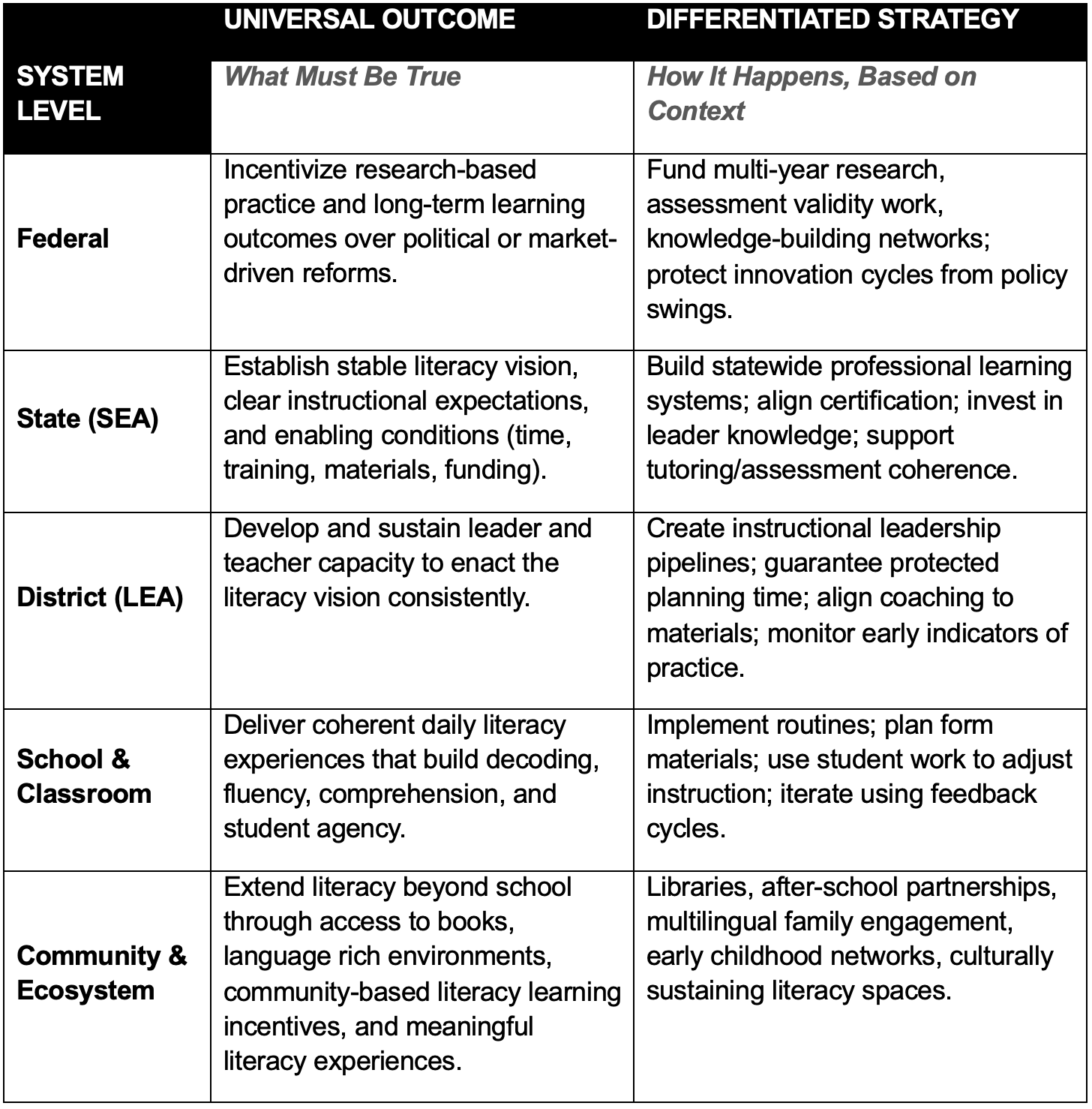
When systems adopt Strategic Systemic Universalism, they stop treating literacy as something to be “fixed” at the classroom level and start treating it as the product of a coherent system. They begin considering how adopting one practice within a particular level of the system will shape, depend on, and ripple across other levels of the system—like shifting tectonic plates whose movement affects the entire terrain. Here, strategy becomes an act of coordinated alignment, not isolated intervention.
If we fail to build a shared strategic discipline, we’ll continue to repeat the reform cycle—adopting new programs, retraining educators, reorganizing systems—only to watch the work dissolve again. But when systems share a common mental model for strategy, when universality sits at the levels of impact, logic, and early signals rather than isolated actions, improvement becomes cumulative. Learning deepens. Practice stabilizes. Coherence becomes systemic and engineered rather than accidental or siloed.
This is how systems stop performing change and begin producing it.
The promise of the science of reading was never just that all students could learn to read. It was that systems could learn to change and transform. We already know what to do. The challenge now is learning how to do it together.