Editor’s note: This essay is an entry in Fordham’s 2025 Wonkathon, which asked contributors to answer this question: “What needs to happen next—at the state, district, and school levels—for the science of reading revolution to fulfill its promise and ensure that far more children learn to read well?” Learn more.
Mississippi’s reading revolution offers powerful lessons: the state paired phonics mandates with on-the-ground capacity-building—training, coaching, and assessments—to catch struggling readers early. The results demonstrate that all children can succeed when given appropriate and sufficient opportunities. Broad adoption of science of reading (SoR) laws is a fortunate arrival, as we face a literacy challenge with barely a third of our fourth graders proficient on the NAEP. Mississippi’s success proves that passing a law is just the beginning.
While many wonks highlight essential work in teacher training and curriculum, these advances require an often-overlooked backbone: an assessment system that ensures every child’s learning is visible. Optimizing SoR 1.0 approaches is necessary but insufficient; teachers won’t get far flying blind without timely insights. SoR laws will succeed best if states, districts, and schools prioritize assessment in the service of learning.
To truly fulfill its promise, the focus must move beyond K–3 to include both pre-kindergarten and older readers who were omitted by earlier efforts. Implementing this requires alignment across educators, training programs, and parents.
A balanced assessment system—where each quiz, screening, and exam is used to improve instruction, not just audit status—will help ensure SoR reforms translate into real reading gains. This approach builds upon existing commitments to instructional excellence and high expectations for every learner, proposing we move towards what we characterize as SoR 2.0. As members of the editorial team of the recently published Handbook for Assessment in the Service of Learning series, we base the arguments herein on rigorous, hyperlinked research.
Building reader positioning systems: From single-score verdicts to balanced assessment

While current SoR approaches have promoted high standards, transparency for families, and data disaggregation, their assessment systems have often fallen short of their potential to support teaching and drive better decision-making. Technological breakthroughs, analytic methods, and artificial intelligence (AI) are rapidly transforming how we can measure and enhance reading.
To best support educators, states and school systems must establish balanced assessment systems designed to maximize learning for every child. The redesign must center ambitious instruction, using data to inform schools and teachers. Assessment in the service of learning holds educators and communities accountable to cultivate ability. With colleagues, we have proposed research-backed principles to guide the design and use of learning-focused assessments. For these systems to advance SoR-grounded approaches, they must:
- Measure what matters most, not just what’s easy to measure.
- Leverage emerging technologies to provide rich, useful insights.
- Prioritize solutions optimized for scientific soundness, SoR fidelity, scalability, usefulness and usability.
The sciences of learning and development can and should guide this innovation.
Learning to improve: Practical measures to inform ambitious teaching of reading
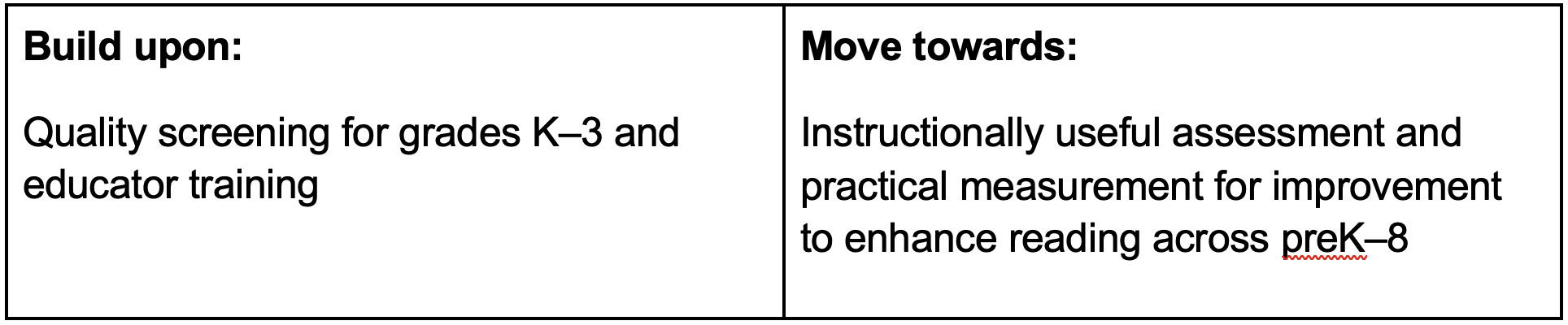
The Mississippi lesson is clear: Lasting gains require ongoing monitoring and support.
Traditional assessment systems administer infrequently, focus on distal outcomes, and return results too late, remaining distant from the specific needs of practitioners. In contrast, practical measurement for improvement uses evidence to inform judgment about the “why,” “how,” and “for whom” of daily improvement.
How might educators translate the snowstorm of data into actionable insights? Through instructionally useful assessment, which facilitates educator engagement in high-leverage practices such as quality formative assessment. This includes dynamically integrating SoR curriculum, instruction, and assessment. For example, a quick phonemic awareness quiz for a small group on a Friday might help a first-grade teacher immediately reteach a blending skill on Monday, long before it becomes a months-long lag.
We recommend Hattie’s evidence-backed mindframes that emphasize insights into reader progress, strategies, emotions, and self-regulation rather than just status. This means prioritizing the development of “assessment-capable learners”—students who can interpret and act on feedback to take charge of their own improvement. Odemwingie shares a practical example where reading assessments foster learner agency and self-efficacy while supporting classroom learning culture. A culture of formative assessment makes it impossible to ignore a child’s needs until it’s too late, serving as a continuous GPS, recalculating the route to reading success for each child.
Embracing reader variation: Customized learning powered by SAFE AI
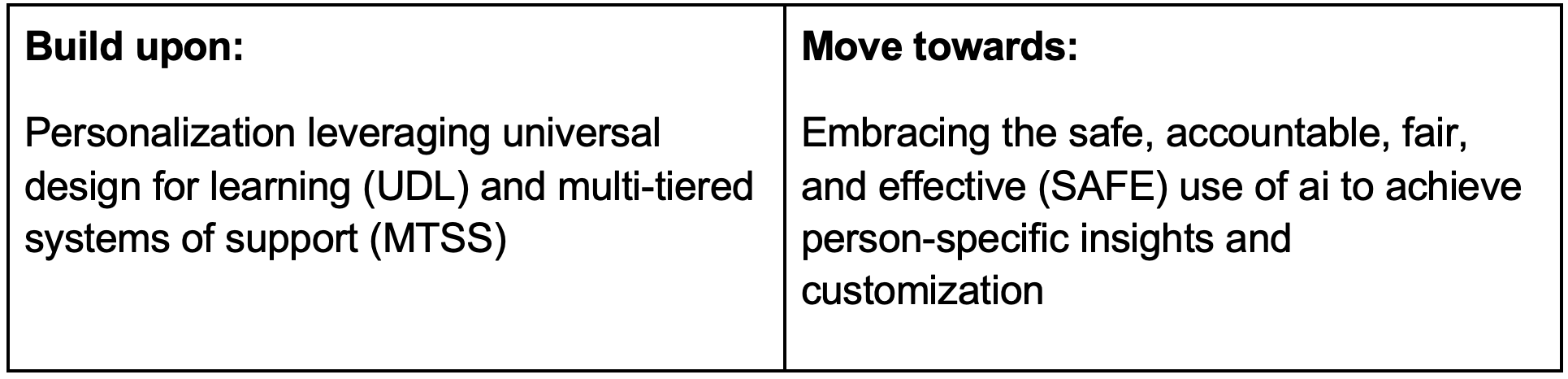
AI and person-specific measurement can reshape how we understand and nurture reading processes. AI has the potential to generate insights that:
- Customize learning, adapting to reader strengths and weaknesses, optimizing pace, accessibility, content, and scaffolding.
- Provide real-time feedback, supporting readers’ processes like motivation, attention, engagement, and metacognition.
- Leverage predictive analytics to match interventions to learner needs.
The integration of AI into assessment, while beneficial, demands a rigorous evaluation of its safety and efficacy, necessitating clear guidelines and guardrails. Duolingo‘s responsible AI standards are instructive.
The Personalized Mastery Learning Ecosystem (including My Reading Academy®) has showcased significant learning gains across multiple ESSA-aligned studies. PBS KIDS uses dynamic leveling systems to adapt to individual reader motivations and needs. Khan Academy analyzes performance data—like accuracy and scaffold usage—to provide continuous, skill-level insights. Its AI-powered assistant, Khanmigo, is transforming the modalities through which insights are generated and understood. Huff, of Curriculum Associates, proposes design approaches that foster a deeper shared understanding of the reader’s cognitive processes and maintain the integrity of the reading constructs being measured.
Together, these examples reflect a rising generation of assessment: highly personalized, multi-modal, adaptive, and focused on continuously optimizing the learning journey for every student.
SoR 2.0: A call for assessment systems that cultivate reading ability
States and districts have a window to marry proven reading science-driven standards with efficacious implementation. The SoR wave set strong expectations; now, we must actively deploy modern, balanced assessment systems that personalize and inform reading instruction at scale. This can transform assessment from a bureaucratic speed bump into a building block for learning.
We urge three critical steps, which compliment the recommendations outlined above:
- Tie balanced assessment into SoR implementation: Ensure that SoR rollout plans include robust universal preK–3 screeners, appropriate middle-years screeners, and revamped summative exams that integrate SoR domains.
- Invest in innovation pilots: Fund pilot programs for AI-powered literacy interventions and tutors guided by embedded assessments, and evaluate which tools best boost reading gains.
- Incentivize innovation with accountability: Create policies that encourage school systems to try new assessment models while holding them accountable for transparent, real-time learning.
The payoff is clear: confident third-grade readers, engaged middle-schoolers, and graduates prepared for the future of work. As our first author has long championed, assessment must be re-purposed to facilitate the cultivation of ability and actively support the learning process, not just audit outcomes after the fact. By embracing this vision, honoring the strength of the learning sciences and potential AI, together we can help to secure literacy and flourishing for more children.