Editor’s note: This essay is an entry in Fordham’s 2025 Wonkathon, which asked contributors to answer this question: “What needs to happen next—at the state, district, and school levels—for the science of reading revolution to fulfill its promise and ensure that far more children learn to read well?” Learn more.
The science of reading (SoR) revolution has propelled instructional change, but to fulfill promised reading results at scale, there is more to do: We need families in true partnerships with schools.
The case for tapping into parents is based on two issues that are endemic to the larger reading problem regardless of approach used. But this time, with research-based approaches in the public eye and embraced by more and more educators, we have a chance to engage untapped stakeholders to help us fix these persistent and critical issues.
1. We have a watchful-eye problem
Many key reading skills accumulate over time. If skill growth stagnates, there are effective tools to change trajectories. But if teachers are distracted or overwhelmed, if they’re not teaching research-based programs with fidelity, or if they just don’t organize sufficient support to address a child’s struggles, the intervention opportunity is missed and the struggling continues. Our current “system” is like too many people watching a child at the beach; parents assume teachers will make sure a child reads successfully, teachers count on the process and assume time will make the difference, principals count on teachers—it’s set up to end badly, and it often does.
For SoR programs to be successful, we need more informed eyes on a child’s learning-to-read progress, all through the early years. Currently, families are in the dark. According to Learning Heroes’ research, almost 90 percent (!) believe that their children read at or above grade level. There’s no motivated to engage when there’s no identified problem to solve. We need to give these invested stakeholders the opportunity to understand enough about how learning to read “works” so they can bring more attention to a child’s struggles at school, and ensure the default instructional approach in classrooms is SoR based.
Parents could do that alerting and monitoring. With the right messaging, the reporting feels collaborative, not antagonistic.
2. We have an oral-language “dosage” problem:
To read books beyond the early years, children need to have been steeped in rich language settings their whole young lives. That’s because academic vocabulary and complex language fill texts throughout middle school, high school, and beyond, and take lots and lots of exposure and practice to learn. To succeed, students need to become so familiar with this kind of language and vocabulary that they can read it fluently and respond to it in speech or writing.
Schools can’t do this language-building alone because of the high dosage of complex language opportunities that it demands.
For SoR programs to prepare students to read complex high-school texts, schools need more people to help children accumulate these language- and knowledge-based skills through regular, high-quality, back-and-forth talk about ideas and books. When supported and motivated, any caring adult can provide high-quality language moments throughout a child’s days and years, with the added bonus of building personal connection.
Parents could initiate the extra dosage children need if given realistic, ongoing support and motivated by knowledge of the task’s importance.
How do we set up strong partnerships between schools and families that address both problems listed above—and therefore make sure the SoR revolution makes a difference?
We combine the best research on reading development/SoR with the best research on family partnerships to create substantive, productive, more transparent and mature (!) partnerships between schools and parents/caregivers. This combination lets us:
- Raise SoR awareness of all the adults who spend time with children.
- Set up parents to feel integral to reading success but not be overwhelmed by the task.
- Make implementing partnerships turn-key and low lift for teachers and leaders.
Our recent standing-room-only presentation at The Chicago Reading League conference showed that teachers, principals, and district leaders are ready to hear how to engage families in SoR. They are often mandated to include families more generally, but haven’t thought through how SoR might include parents to boost reading outcomes. Besides, they don’t have simple, realistic tools to make it happen. I left a literacy lab at Harvard GSE to take on the family partnership challenge. I spent a summer at MIT’s delta v to figure out how. If that doesn’t show a “wonk” component to this work, I don’t know what does.
For more information about the program we’re using in schools and why this kind of structured, systematic family-partnership approach is necessary, see the “wonkier” part below. Note that we have made the charge minimal—enough for schools to have skin in the game but not so much to exclude any school. $500/school/yr for any and all members of the community (e.g., staff, families, afterschool providers):
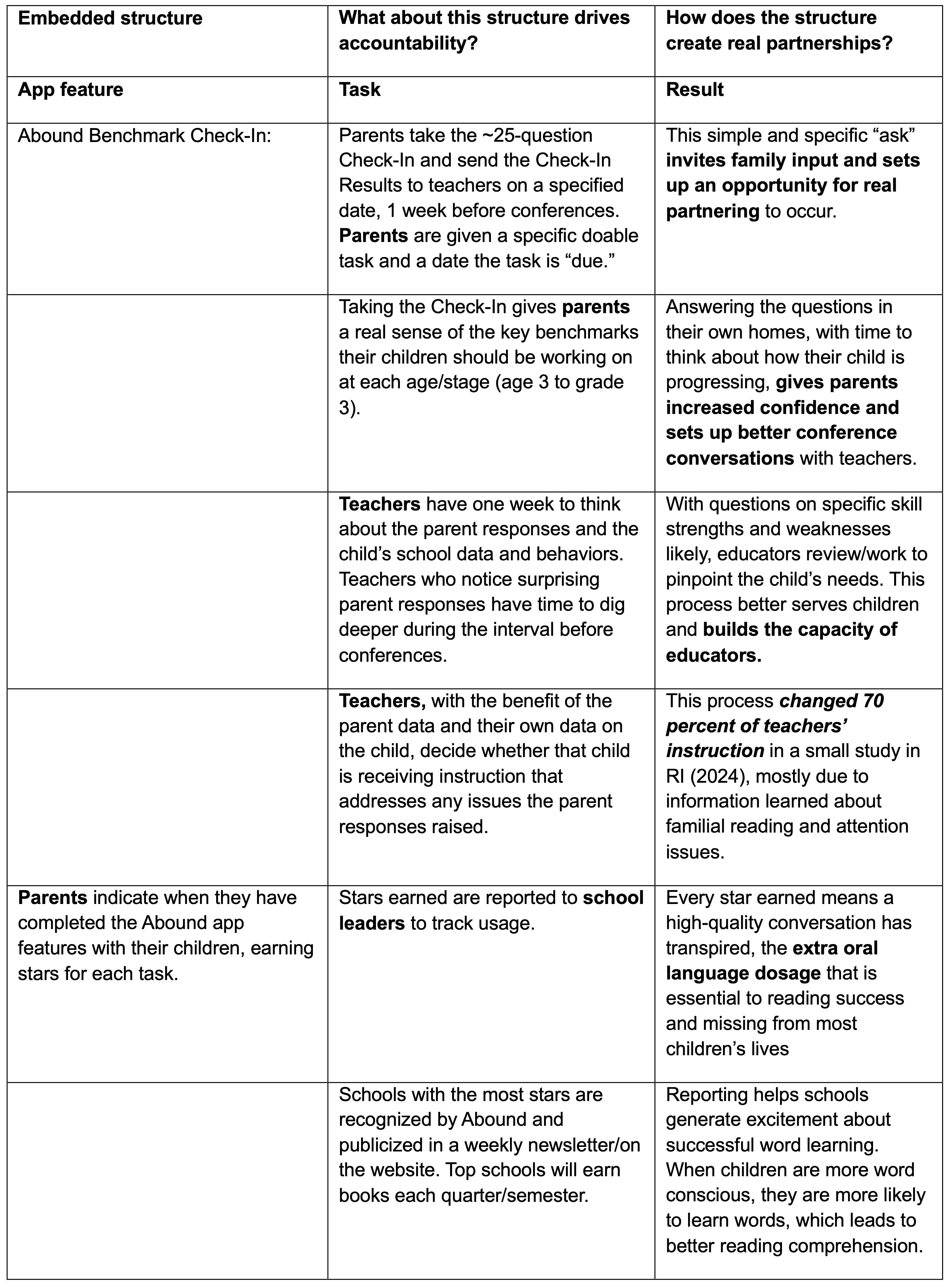
Program specifics:
1. Schools offer each family (via the Abound app and supported by weekly newsletters): a 25-question benchmark check-in (taken two times yearly), with check-in results to be shared with a child’s teacher one week before each conference; and daily app questions to support skill building through back-and-forth conversations about ideas and words—conversations that also connect adults and children.
2. Weekly book suggestions (publicly-available video links) and discussion content to support family talk about books.