Editor’s note: This essay is an entry in Fordham’s 2025 Wonkathon, which asked contributors to answer this question: “What needs to happen next—at the state, district, and school levels—for the science of reading revolution to fulfill its promise and ensure that far more children learn to read well?” Learn more.
“The Mississippi Miracle.” In an era of discouraging reading results, Mississippi’s fourth grade reading gains have earned nationwide attention, and the state deserves the recognition. But we agree with Dr. Carey Wright, who shepherded the state in its transformation, that it wasn’t a miracle—it was a marathon.
State reading legislation is the right start, but educators will put in the hard work to get results. In our work with states across the country, we see well-intentioned leaders hit three common implementation challenges: a proliferation of assessments, incoherent instruction and random acts of coaching.
There can—and should—be many more Mississippis. A recent review of the reading research “clearly indicates that approximately 95 percent of all students can be taught to read." In other words, it’s not the kids; it’s the way we’re teaching them to read.
To deliver on the promise of the science of reading, literacy best practices must take root in around half a million classrooms across the country. We recommend state education leaders focus on three core ideas as they run their own reading marathons.
1. Smarter screening to measure the right reading component at the right time.
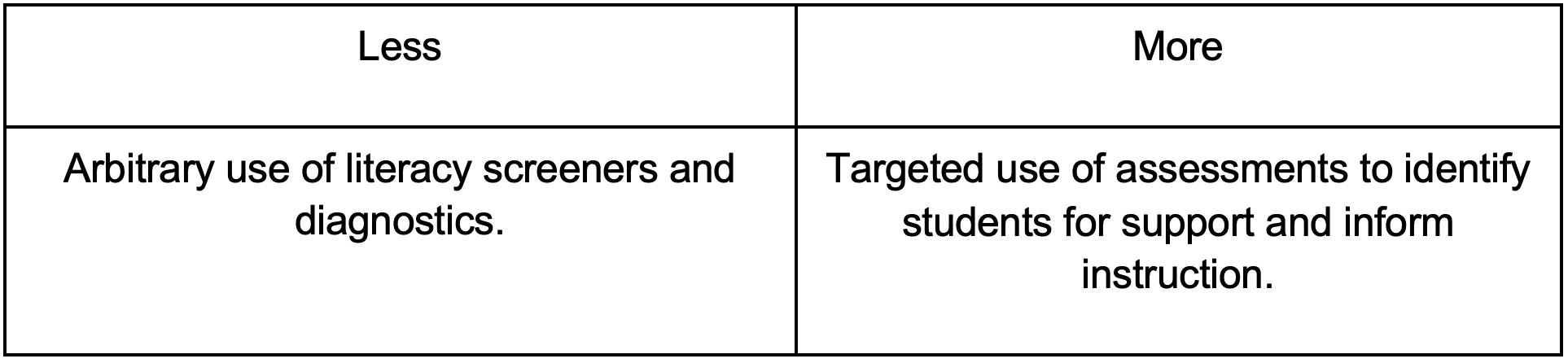
In action: When Delaware required its local education agencies (LEAs) to assess all students K–3 for reading three times a year with both screeners and diagnostic measures, the assessments proliferated. The state’s approximately 30 LEAs recently reported that they use more than 60 different literacy assessments! Going forward, Delaware will recommend a short list of quality assessments that align to the science of reading’s key domains for language acquisition.
We’ve found nationwide that there is widespread confusion between universal screeners (which identify who is at risk for not acquiring key reading skills) and diagnostics (which pinpoint exactly what skills kids need to learn and when they need to learn them).
Across the country, brief universal screeners (like DIBELS) are intended to identify who may need additional support. Many districts stop there and assign students to intervention groups purely based on these scores (a practice we don’t recommend). Many districts administer a different diagnostic assessment (like iReady) to the subset of students identified by the screener, to provide in-depth information about an individual learner’s needs. This can be a helpful practice, but it can lead to a lot of extra assessment when done with the wrong instruments or with too little understanding of what is being measured.
We are working with Delaware to streamline the approved list of screening and diagnostic measures. An early, important finding: Commonly-used tools of good technical quality do not each measure all of the key reading acquisition domains. For instance, many screeners do a good job of assessing phonemic awareness and alphabet knowledge, but a smaller number fully assess for comprehension. States also have an opportunity to create evidence-driven definitions of the core components of the reading domains they seek to assess and help districts understand what these tools do and don’t assess.
Better guidance can help districts collect better data—and know how to use it—which should directly inform coherent literacy support for students and systematic coaching for teachers.
Key levers:
- Clarify the purpose of universal screeners versus diagnostics, what information each assessment provides, and how those data should inform student support.
- Define the criteria for literacy assessments, both in terms of quality (reliability, validity, classification accuracy) and which assessments capture which science of reading domains.
- Streamline the number of tools in use so that states can compare results across districts and identify trends in aggregate.
2. Coherent literacy instruction in all learning settings.
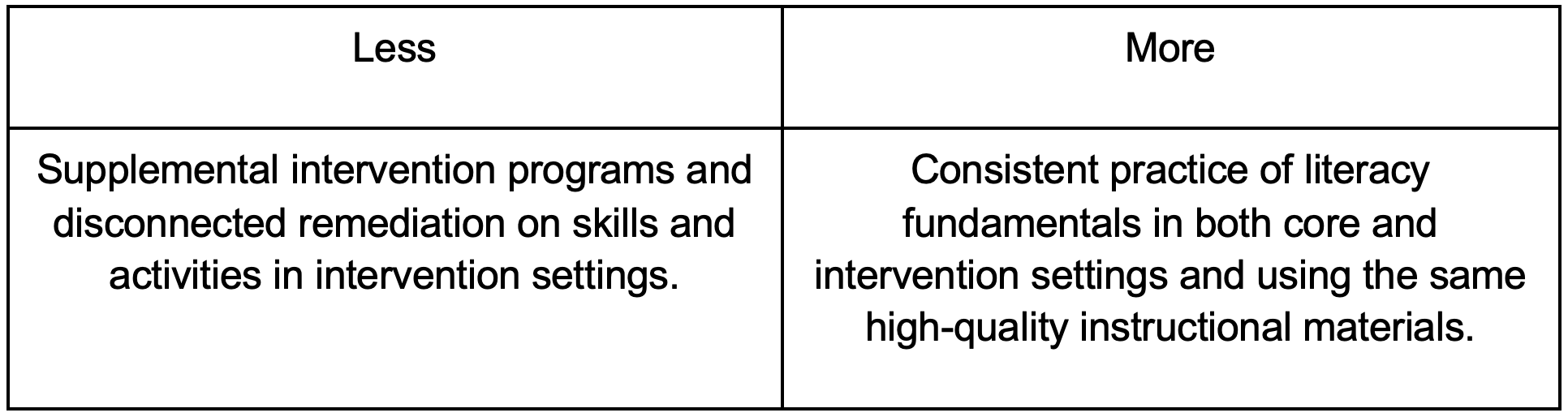
In action: When Tennessee adopted literacy best practices in K–3 classrooms, intervention settings still used a wide range of supplemental programs and did their own thing. “English language learners were pulled for an hour a day,” explains a kindergarten teacher in Knox County Schools. “We just assumed that they were working on the same sounds.”[1] In 2022, the state updated its Response to Intervention (RTI) guidance to encourage more consistent student support.
The science of reading articulates the building blocks of the English language, such as phonemes (sounds), graphemes (letters), and morphemes (the smallest unit of meaning in a word). But core teachers can struggle to connect those concepts to their daily lessons, and many specialists—like those working with English language learners or students with disabilities—never get trained at all.
As a result, students who struggle with reading tend to receive fragmented support. For example, a kindergartener might practice identifying the “short A” vowel sound in “cat” in their core class, learn a nursery rhyme in their English language development block, and practice high-frequency words (“I” and “like”) in their small group time. Those are valuable exercises, but students struggle to connect the dots.
School systems spend millions of dollars on supplemental intervention programs that are fully disconnected from the core curriculum. They can stop spending these dollars and instead train all educators K–3 to use the core instructional materials for just-in-time intervention that is aligned to what’s being taught in each student’s main classroom.
When literacy instruction is coherent, core classes and intervention work together to prepare students for grade-level work. Intervention focuses on just-in-time instruction that connects to the core materials and prepares students for what they will read in an upcoming class.
Key levers:
- Use high-quality instructional materials in all student learning settings! These should blend foundational literacy skills and rich texts.
- Train all staff who support students in reading—interventionists, tutors or specialists for English language development or special education—on literacy fundamentals.
- Dedicate time in the school schedule for core teachers and specialists to internalize these concepts, co-plan upcoming lessons, and align their support for students.
For more details, watch for an upcoming paper on Instructional Coherence from the Council of Chief State School Officers (CCSSO), which we helped write.
3. Skilled literacy coaches to build teacher capacity.

In action: When Dr. Carey Wright, the former State Superintendent of Education for Mississippi, moved to the same role in Maryland, she found that the state’s 25 LEAs employed 650+ instructional coaches. Her team retrained at least 250 of them on how to be a literacy coach.
Research tells us that coaching can be an effective professional learning strategy—but, in RAND’s recent AIRS surveys, most teachers say they only see a coach 1–3 times per year. For years, school districts have used Title II dollars to hire general instructional coaches, usually former teachers, who may work with a broad set of teachers across a range of subjects. Too often, they provide only general feedback during their infrequent visits.
Supporting literacy requires a specific body of knowledge and an ability to model best teaching practices for teachers. With help from some of our colleagues at Education First, Maryland defined the essential knowledge and skills for a literacy coach and four core coaching competencies: foster strong partnerships, develop data-driven goals, implement consistent coaching cycles, and design and deliver effective teacher professional development. The state department of education offered free training to the LEAs’ coaches on the science of reading and to implement these competencies. In addition to this intensive training, the state organized a community of practice training for nearly every district’s LEA literacy specialists on the science of reading.
With clear expectations and focused training, skilled literacy coaches serve as implementation champions for evidence-based literacy practices.
Key levers:
- Define an explicit job description for literacy coaches, including deep knowledge of the science of reading and adult learning, and the skills to coach shoulder to shoulder
- Assign coaches to a consistent group of teachers. Ensure they are in the building frequently, that they have a deep understanding of the HQIM in that building, and can participate in the teachers’ collaborative planning time.
- Give coaches the capacity to advise teachers over time and hold coaches accountable for improving teacher practice. Replace or retrain coaches who don’t meet their goals.
In sum, meaningful progress isn’t about miracles—it’s about sustained, thoughtful implementation. Streamlined assessments, coherent instruction, and skilled coaching capacity can help turn science of reading legislation into results. When these elements come together, we will see many more Mississippis—and many more students who can read.
[1] Council of Chief State School Officers. (Forthcoming). Making Sense of Instructional Coherence at the State Level.