Editor’s note: This essay is an entry in Fordham’s 2025 Wonkathon, which asked contributors to answer this question: “What needs to happen next—at the state, district, and school levels—for the science of reading revolution to fulfill its promise and ensure that far more children learn to read well?” Learn more.
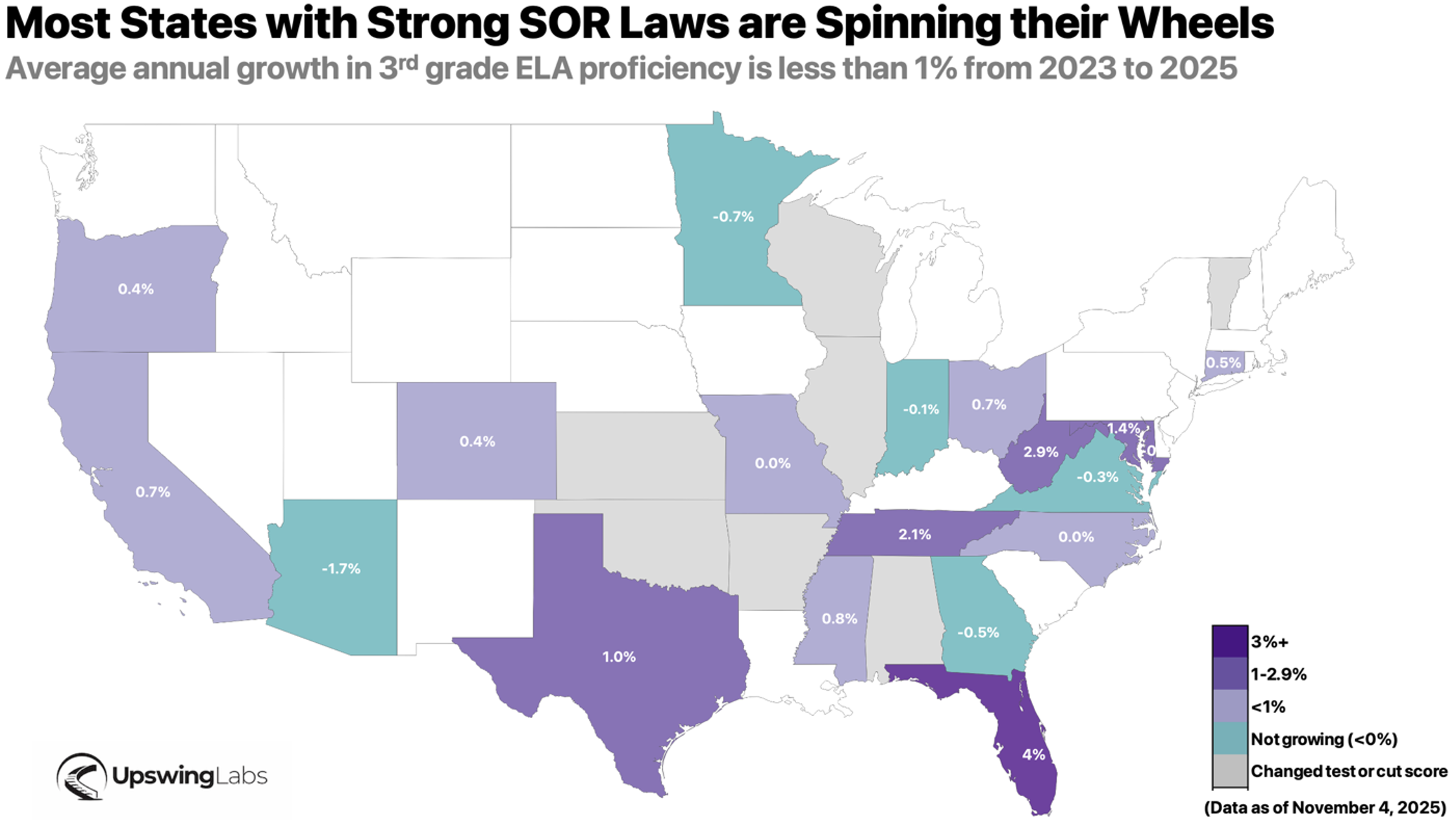
Nineteen states have passed strong science of reading laws. Most are spinning their wheels over the last three years, growing third grade English language arts achievement by less than 1 percent. The sharpest decline, as the map below shows, has been in Arizona, which has long borrowed from Florida’s playbook on education policy. Laws are necessary but insufficient for progress.
Three things state superintendents and board members can do now to get more robust results: get the feedback right, create the right supports for students, and set the right goals.
Other essays in this collection will likely offer valuable recommendations on the early years, curriculum, assessment, professional support, leadership and parent involvement. But for state leaders these three “do nows” are low-hanging fruit.
First, offer clear feedback to parents and students. Eighty nine percent of parents think their kids are reading at or above grade level, according to a national survey by 50CAN. But in the states that have published 2025 data, only 48 percent of third graders are reading proficiently.
To correct the disconnect, states can offer guidelines about grades. Too many kids get A’s and B’s that are about effort, not literacy achievement. Kentucky recently crosswalked grades for fifth grade students and their scores on the state exam. More than half (56 percent) of students who had A’s and B’s in class were not reading at proficiency on the state test.
Mississippi also has been a pioneer in how to communicate with parents when their kids are struggling to learn to read. The state’s reading law requires that parents are notified in writing within 10 days of a screening assessment revealing a deficiency. A letter to parents explains what interventions will be provided the student and how progress will be monitored. Susan Neuman and colleagues writing for the Albert Shanker Institute also hold up Alaska as an example of how to make parents active participants in a child’s literacy improvement plan.
Both states have a read-at-home guide that recommends what parents can do to help improve their child’s reading skills. See more about how Mississippi communicates with parents at the state’s website: “Know Your Child’s Reading Score.”
Parents can only respond to the problems they see. Their trust in schools erodes the longer states permit the gaps between perceptions and reality to exist.
Second, create the right supports for students. Targeted, small-group tutoring can add three to four months of extra learning for struggling readers. But most states didn’t scale it well during the pandemic. Programs grew too fast, sessions after school led to spotty attendance, groups were too big, and providers couldn’t coordinate with teachers.
Louisiana is a promising model of how a state can continue to support funding for high-dosage tutoring. They’ve partnered with virtual models such as Air Reading, Open Literacy, and Teach For America’s Ignite. They run daily, small-group sessions staffed by college students or certified teachers and require an on-site facilitator to keep the work matched to student needs. Despite being virtual, the daily interactions allow tutors to build meaningful connections with students, while operating at a lower cost than in person tutoring. They tweak their designs based on what they learn in each new round of program implementation.
Finally, states need to set the right goals. Both Maryland and Utah have goals to grow ELA achievement by 6 percent annually. These are too hard. The leading states on the map, West Virginia and Florida grew at 3–4 percent annually since 2023.
Isn’t it better to be “hairy and audacious” even if we fall short??? Some state leaders will argue that anything less than 100 percent abandons our most vulnerable students. But decades of experience with Goals 2000 and NCLB show us that unreachable targets don't consistently inspire—they demoralize and eventually lead to gaming the system.
The leading scholars of goal setting, Edwin Locke and Gary Latham find that goals should be meaningful and difficult, but achievable. If teachers and school leaders believe the goals set for them are unreachable, Locke and Latham warn that the entire organization can easily become demoralized and disengage.
Meaningful goals need a rationale. States should match their reading proficiency aspirations to the number of people who need to be college and career ready in the next decade. In their report, After Everything, Anthony Carnevale and colleagues at Georgetown University predict that by early next decade, 72 percent of the jobs will require at least some college, while 55 percent will demand an associate degree or more.
Setting goals at these levels—55 percent as the initial target for every student group to reach, and 72 percent or higher as the ultimate destination—would require 2–3 percent annual growth for most states that have rigorous ELA standards. As management expert Peter Drucker advised: “The results should be hard to achieve—they should require stretching, but they should also be within reach. To aim at results that cannot be achieved—or that can be under the most unlikely circumstances—is not being ambitious; it is being foolish.”
State education agencies don’t have the resources large districts do, but these recommendations don’t require massive funding. They are modest and immediately actionable, and they require strategic choices and resolve. More children will learn to read and write well if state leaders improve the signaling to parents, enable smartly structured supports for students, and set goals that are meaningful and difficult but achievable.