Mobile Navigation

  • National
    • Policy
      • High Expectations
      • Quality Choices
      • Personalized Pathways
    • Research
    • Commentary
      • Gadfly Newsletter
      • Flypaper Blog
    • Events
    • Scholars Program
  • Ohio
    • Policy
      • Priorities
      • Media & Testimony
    • Research
    • Commentary
      • Ohio Education Gadfly Biweekly
      • Ohio Gadfly Daily
  • Charter Authorizing
    • Application
    • Sponsored Schools
    • Resources
  • About
    • Mission
    • Board
    • Staff
    • Career
Home
Home
Advancing Educational Excellence

Main Navigation

  • National
  • Ohio
  • Charter Authorizing
  • About

Jeff Murray
6.10.2026
Gadfly Bites logo
Listen to this article
Loading the Elevenlabs Text to Speech AudioNative Player...

News stories featured in Gadfly Bites may require a paid subscription to read in full. You have been warned.

  1. Our Aaron Churchill is quoted here on provisions of Senate Bill 19 that are designed to improve math instruction of Ohio students, in a process akin to the science of reading. Ohio, he says, “has way too many kids who are just struggling with the basics.” He explains that passage of SB 19 will, among other things, allow the state to say, “Okay, there’s probably some textbooks and materials that are more aligned with best practices” and, of course, some that definitely are not aligned and should be dumped. (Columbus Dispatch, 6/10/26) SB 19 passed in the House of Representatives late yesterday on a vote of 81-11. But not before it was amended to include a lot of other education-related proposals. This coverage is more about those other things, although Fordham’s Chad Aldis is quoted in support of the math provisions. The bill now heads back to the Senate—where it had been previously approved—in order to reconcile the House changes. (Cleveland.com, 6/10/26)

  2. This excellent piece is subtitled “What school choice looks like in Cleveland”. I find it highly accurate and I offer kudos to reporter Franziska Wild for her thorough coverage of the topic. It includes a nice description of charter schools vis-à-vis districts (with specific and important CMSD nuances covered), how to apply for a voucher, and a discussion of the transportation questions that complicate choosing a non-district school (without answers, of course, because even the estimable Signal Cleveland doesn’t have any of those right now). Now if only Cuyahoga County could get an independent STEM school option… (Signal Cleveland, 6/9/26)

Did you know you can have every edition of Gadfly Bites sent directly to your Inbox? Subscribe by clicking here.

Policy Priority:
School Funding
Topics:
Governance
Ohio Education Gadfly
6.9.2026
Media alerts stock image
Getty Images/almir1968
Listen to this article
Loading the Elevenlabs Text to Speech AudioNative Player...

Today, the Ohio House Education Committee voted unanimously to favorably report Senate Bill 19. The legislation, which Senate lawmakers passed unanimously last November, includes critical reforms aimed at turning around Ohio’s sluggish performance in mathematics. In 2024-25, just 55 percent of students statewide achieved proficiency in math, a rate that falls 6 percentage points below pre-pandemic marks. Just over one in four Ohio students score “limited”—the state’s lowest achievement mark—on state math exams.

SB19 requires the following:

  • Schools will provide targeted academic intervention when students score “limited” on state math assessments;

  • The Ohio Department of Education and Workforce will identify and publish a list of high-quality math curricula;

  • Schools with low math proficiency rates will develop a schoolwide math improvement plan and use curricula on the department’s approved list;

  • Prospective elementary teachers will need to pass the math section of the state licensure exam before teaching the subject;

  • High-achieving math students will be automatically enrolled in advanced math opportunities as early as fourth grade with a goal that all such students complete Algebra I by the end of 8th grade.

“Too many Ohio students are falling behind in math,” said Chad L. Aldis, Vice President for Ohio Policy at the Thomas B. Fordham Institute. “Students struggling in math will have difficulties demonstrating the critical-thinking and problem-solving skills necessary for 21st century success. Some students may even struggle to complete routine tasks that require basic measurement and computational abilities. To its credit, the House Education Committee has recognized the urgent need to strengthen math instruction and ensure that all students achieve their potential in this critical area. We commend the leadership of Education Chair Fowler Arthur, and urge swift passage of SB19 by the full Ohio House of Representatives.”

Policy Priority:
Media Statements
Topics:
Curriculum & Instruction
Vladimir Kogan
6.9.2026
Kogan Columbus Promise blog image
Getty Images/SPmemory
Listen to this article
Loading the Elevenlabs Text to Speech AudioNative Player...

Columbus State Community College graduated its largest ever class last month—including the most Columbus Promise students since the program to provide local students six semesters of free tuition and a modest stipend started in 2022, the college noted in a triumphant press release.

But the same figures also tell a more pessimistic story. The Columbus State class of 2026 included just 57 Columbus Promise participants. This brought the total number of students who completed the program over the first four years to only about 430. Over the same period, Columbus City Schools—the only school district whose students are eligible to participate—awarded approximately 10,000 high school diplomas.

This means that only about 5 percent of eligible Columbus high school graduates have gone on to earn an associate degree or certificate through Columbus Promise, and many of those who did would have almost certainly received a college degree anyway. Despite millions of dollars in spending, the program has barely moved the needle on helping students attain higher education and economic opportunity.

The numbers matter because Columbus Promise has taken on new political significance in recent months. Its chief architect, Columbus City Council President Shannon Hardin, has made no secret of his plans to challenge incumbent Mayor Andrew Ginther in next year’s election. Hardin has touted the Columbus Promise as one of his signature legislative achievements and one of the few points of contrast with the incumbent mayor, who attempted to defund the program in his proposed budget for next year. (During its first three years, the cost of the program was split roughly evenly between the city and private donors.)

Despite its centrality in the campaign, no one has seriously examined the actual educational impact of Columbus Promise. An honest assessment would show that the program probably did help a small number of students—while also doing harm to many others.

For many participants, the Columbus Promise has meant enrollment in courses they ultimately ended up failing and likely delayed their entry into the labor force. Others were diverted from better-resourced, higher-quality four-year programs—precisely the kinds of institutions that research shows help disadvantaged and low-income students succeed.

In short, it is far from obvious that the Columbus Promise has been a net positive for most affected Columbus students.

A flawed evaluation

This gloomy verdict may surprise many readers who have followed the discussion about Columbus Promise and hundreds of similar efforts around the country or those familiar with an evaluation of the program released by the Michigan-based Upjohn Institute last spring.

“The Columbus Promise has dramatically increased the number of Columbus City Schools (CCS) students attending Columbus State Community College (CSCC),” the report began, “and expanded access for students who may otherwise not have enrolled in college at any institution.”

This language—with its focus on attendance (rather than completion) and use of a tentative verb (may)—was intentional.

The Upjohn analysis focused on one question: comparing the performance of students attending Columbus State under the program to earlier cohorts who had to fund their own tuition. 

To account for the fact that the more recent, larger Columbus State cohorts include more disadvantaged, lower-achieving students who enrolled only because of the Columbus Promise, the report carries out statistical “adjustments” to provide a more apples-to-apples analysis. Such adjustments, while useful for making over-time comparisons, are misleading for current students trying to understand their own likelihood of success at Columbus State.

The analysis, in other words, focused on tracking relative performance across different cohorts, not highlighting shockingly low absolute levels of achievement and completion seen among all students. While interesting to academic researchers, this question is of little relevance to students, families, and the funders ultimately footing the program’s bill.

For families, the real question is whether high school graduates who would’ve otherwise skipped higher education were made better off by attending Columbus State for free. Although not the focus of the Upjohn report, the data in it suggest that the answer for nearly all such Columbus high school graduates is “no.”

The reason is that 90 percent of students who begin Columbus State through the Columbus Promise don’t end up completing a certificate or an associate degree.[1] For all but a small handful of participants, community college enrollment doesn’t lead to new credentials.

About half of all Columbus Promise students drop out during or after their first year of community college. Even a single wasted year can have career consequences if it means delaying these students’ entry into workforce because it represents forgone earnings and time they could’ve spent building valuable work experience and seniority instead.[2]

To be sure, a small number of students—approximately 40 per year, based on the first cohort—successfully earned Columbus State certificates and associate degrees they would not have otherwise attempted, and some of them may go on to earn a bachelor’s, too. But a roughly similar number would have attended a four-year university instead.[3] These students were lured to Columbus State by the promise of free tuition, and several careful economics studies suggest that they were likely made worse off in the long run.

Reasonable people can disagree about how to weigh these offsetting impacts, but the bottom line is that typical Promise participants obtain no measurable educational benefits from the time they enter the program.

For policymakers, the main question is about return on investment of a different kind. The first three years of the Columbus Promise program cost a reported $9.5 million, with half coming from Columbus taxpayers. Even under the most optimistic assumptions that ignore potential diversion of students who would’ve gone elsewhere, this comes out to nearly $100,000 for each additional Columbus State certificate and associate degree earned,[4] an astronomical cost.

How to better help Columbus students

Acknowledging these issues is the first step to improving the Columbus Promise program to help achieve its original goals. There are three concrete ways to do so.

One simple change is to expand the program to cover tuition at any Ohio public college or university, rather than just Columbus State. This was precisely the design of the original, well-studied college “promise” program in Kalamazoo and explains why it produced much larger effects on both college enrollment and completion. Students who begin their college careers at more selective, four-year universities are far more likely to earn degrees.

This is also the structure of Ohio’s other major free-college program, Say Yes Cleveland, which seems to achieve significantly higher college graduation rates.

A second reform would add academic eligibility requirements, tied to a combination of high school grades and standardized test scores. (Currently, all Columbus high school graduates can participate.) While almost certainly controversial, narrowing eligibility would have three benefits.

First, it would help target Columbus Promise toward students who are likely to complete higher education and avoid pulling those who have almost no prospect of doing so out of the labor force. Second, academic requirements would also increase incentives for students to perform better while in high school, putting them in a better position to succeed in college. Finally, reducing the number of participants would free up money that could be used to increase the $500 per semester stipend students in the program receive on top of their tuition.

The last necessary change—improving the quality of Columbus students’ K-12 education—is the most difficult task. But it is also the most necessary.

The main barrier to higher education for Columbus students is not cost—despite the recent moral panic over student loans—but rather inadequate academic preparation during their public school years. According to the Upjohn analysis, Columbus Promise students attending Columbus State barely clear a D+ average. Among those who drop out without completing a degree, more than a third explicitly cited their poor academic preparation as the reason for leaving the program.

In truth, as currently designed, the Columbus Promise seems more like a program designed to serve the interests of Columbus adults rather than its students.

For city officials, it provides a highly visible credit-claiming opportunity on which to build campaigns for higher office. For school district leaders, it helps boost enrollment and appeal to families considering charter and private school options. (There is a reason why Columbus Promise eligibility is limited only to students graduating from Columbus City Schools.) The program similarly boosts enrollment at Columbus State, the only college students can attend. And for local corporate leaders and other financial benefactors, it creates the impression of supporting Columbus students without having to take on the entrenched school employment interests and dysfunctional systems that stand in the way of academic achievement and economic opportunity.

Columbus students deserve better.

Vladimir Kogan is a senior research fellow at the Thomas B. Fordham Institute and a professor of political science at the Ohio State University. He is the author of the 2025 book No Adult Left Behind: How Politics Hijacks Education Policy and Hurts Kids (Cambridge University Press).


[1] This estimate is based on the first cohort of Columbus Promise students who graduated from high school in 2022, the only group for which completion data are available in the Upjohn Report. However, the cumulative count of Columbus Promise students who have received degrees or certificates, covering the first four cohorts, suggest that completion rates did not increase dramatically in more recent years.

[2] Only 22 percent of students who left the community college without a degree reported that they were working full- or part-time while attending in a survey fielded by the Upjohn researchers, suggesting that enrollment did indeed delay employment for most.

[3] Bizarrely, the Upjohn evaluation claims that “increased enrollment at CSCC is not coming at the expense of the four-year college/university enrollment rate”—hedging the claim with “it appears.” Yet the report’s own data (in Figure 5) suggests otherwise. Before the rollout of the Columbus Promise program, 12 percent of Columbus City Schools high school graduates immediately enrolled in four-year Ohio public universities. In 2022, this fell to 9 percent. Although not large in absolute terms, these numbers imply that one in four students who would’ve otherwise gone directly to a four-year school enrolled in Columbus State instead, similar in magnitude to effects documented by other two-year promise programs.

[4] In the first Columbus Promise cohort, two-thirds of students who completed the program earned a certificate and not an associate degree, according to the Upjohn report.

Policy Priority:
School Funding
Topics:
Accountability & Testing
Jeff Murray
6.9.2026
Population loss and education SR image
Getty Images/icafreitas
Listen to this article
Loading the Elevenlabs Text to Speech AudioNative Player...

America is deep into a years-long baby bust—with the total fertility rate at below-replacement levels since 2010, and accelerating. Maybe there will be a rebound in births at some point, maybe not. But until that happens, impacts of a shrinking population will continue to reverberate widely for years to come. A new policy paper attempts to model the impacts of population decline on the provision of a variety of public services, with K–12 education as the primary exemplar.

Jeffrey Clemens, an economist at the University of California, San Diego, starts by illustrating how population increases have historically impacted per-capita expenditures by state and local governments, using Census data from 1979 to 2019 as provided by The Urban Institute. His best-fit line graph analysis shows that a 10 percent increase in a state’s population predicts a 2.2 percent smaller increase in its per-capita expenditure. That is, while total spending grows (services expanding to cover more people), per-capita spending grows more slowly than it would in a slow-growth cycle. Thus, per-resident expenditures by state and local governments increase more slowly when the population grows more quickly. This basic pattern held true for education, highway, health and hospital, and utility spending categories. Clemens suggests this is a class case of economies of scale, but we shouldn’t discount the possibility that public sector spending simply lags population in a fast-growing state, due to the amount of time needed to pass levies, collect tax revenue, and then disburse the proceeds.

Next, Clemens looks at education specifically—around 9,000 districts nationwide—over the same 40-year historical period. Best-fit line graphs for districts both gaining and losing enrollment over that period show patterns similar to the larger model. For expanding districts, a 10 percent increase in enrollment predicts a 1.1 percent rise in per-student expenditure. But for districts in decline, a 10 percent decrease in enrollment predicts a much larger 4.1 percent rise in per-student expenditure. This overall pattern, however, masks specific local variations. Clemens provides two contrasting examples: Cleveland Metropolitan School District (CMSD) and St. Louis City Schools, both of whose enrollment shrunk by half between 1999 and 2019, and both of whose test score performance was similarly poor prior to the pandemic (based on Stanford Education Data Archive data). While St. Louis’s per-student expenditures rose only modestly over that period, CMSD’s nearly doubled. More on all that shortly.

“Declines in population imply reductions in service need,” Clemens writes, “and hence reductions in required capacity.” He investigates three areas of service provision likely to determine how efficiently school districts are managing population decline. The first is building capacity. Returning to the sample of 9,000 districts from 1979 to 2019, he finds that those experiencing rising enrollment add buildings at a moderate and reasonable rate (specifically, a 10 percent increase in the number of students predicts a 6 percent increase in the number of schools). However, in shrinking districts, a 10 percent decline in the number of students predicts just a 3 percent decrease in the number of schools, a sure sign that remaining buildings are operating far under capacity with concomitant inefficiencies in transportation, utilities, and maintenance.

The second area is staffing. Clemens doesn’t fully spell out the difference in per-pupil staffing rates between expanding and contracting districts, only saying they are “substantially” higher in those that are losing students. He cites the usual culprits—collective bargaining agreements, tenure-like job protections, and service-level “guarantees” imposed by state or district policy—as causes of staffing “inertia”, but he analyzes none of them.

The third area is pension and retirement commitments for retirees. This is even more sparsely analyzed in the paper, except to say that other research indicates that existing, already-enormous financial commitments to public system retirees generally are underestimated by states to the tune of an additional $1 trillion. If true, continued population decline will even more quickly lead to too few younger workers paying in to an overburdened system supporting a growing sector of older beneficiaries.

It is not inevitable that shrinking districts must succumb to all of these inefficiency triggers, however. Clemens returns to the comparison of the Cleveland and St. Louis school districts in two of those spending categories. Both districts lost nearly 50 percent of their student population between 1999 and 2019. St. Louis reduced the number of buildings in operation from 115 to 74 (36 percent) over that period, while CMSD reduced from 124 to 104 schools (a decline of just 16 percent). As for staffing, both districts refrained from eliminating teacher positions as student enrollment declined—leading to a similarly-increasing teacher/student ratio over time. However, St. Louis did shrink its non-teaching staff ranks (instructional aides, administrators, and other support staff) more aggressively and more in tandem with enrollment declines than CMSD over that time. Clemens speculates that greater fiscal support from the state for Cleveland schools as compared to St. Louis’s primary (and growing) reliance on local tax funding could explain why St. Louis was more aggressive in right-sizing its operations, which tracks.

Clemens concludes that it is not until revenue declines brought on by a shrinking population become catastrophic that school districts will truly begin to reckon with the level of “retrenchment” needed in their service provision. Interestingly, he limits his data to 2019 because he feared “the unusual spending circumstances of the pandemic years” might skew his analysis. Specifically, using infusions of temporary funding to hire permanent staff or make other long-term spending commitments. But that pattern has served to accelerate the inevitable and push districts across the country to just the fiscal precipice they needed to see to force them into action. Cleveland Metropolitan School District—for only one apt example—is closing as many school buildings this year as it did in the entire two decades between 1999 and 2019, consolidating dozens more, and laying off hundreds of employees—including teachers. Covid-era funding boosts may have allowed district leaders to kick the downsizing can down the road a few years, but the need for retrenchment due to student enrollment loss has only gotten more urgent since 2019. Jeffrey Clemens concludes that doing so efficiently should be the priority unless and until the American baby bust abates.

SOURCE: Jeffrey Clemens, “Implications of Low Fertility and Declining Populations for the Operations of US State and Local Governments,” Aspen Economic Strategy Group Policy Paper Series (April 2026).

Policy Priority:
School Funding
Topics:
School Finance
Jessica Poiner
6.8.2026
Teacher licensure grade bands blog image
Getty Images/Goran13
Listen to this article
Loading the Elevenlabs Text to Speech AudioNative Player...

Three years ago, warnings about potential teacher shortages dominated education headlines. Ohio policymakers, determined to alleviate concerns, included in the state budget a number of provisions aimed at bolstering the teacher workforce. Unfortunately, one of those well-intentioned provisions could soon have a negative impact on teacher preparedness and student achievement.

Before the 2023 budget changes, the law required Ohio educators to obtain a teaching license in one of three grade bands: pre-K–5, 4–9, and 7–12. But the budget reduced those grade bands from three to two: one for grades pre-K–8 and a second for grades 6–12. It also permitted public schools to allow educators to teach up to two grade levels outside their licensure grade band for up to two years. The goal was to provide school leaders with additional flexibility to meet classroom needs in the midst of teacher shortages. Broader licensure grade bands wouldn’t create more teachers overall, but they would expand the number of teachers available in certain grades and subjects. A shortage of sixth grade science teachers, for example, is easier to deal with if fifth grade science teachers can move up to sixth without running afoul of licensure laws.

But K–12 schools aren’t the only entities impacted by grade bands. They matter to teacher preparation programs, too. As part of their training efforts, preparation programs largely focus on two areas: content (knowledge about a specific subject, like reading or math) and pedagogy (knowledge about effective teaching, which includes things like instructional strategies, classroom management, and assessing student learning). Both areas can and should be tailored to specific grade levels. For example, teaching first graders to read requires different content and pedagogical knowledge than teaching middle schoolers how to write a thesis statement or high schoolers how to analyze Shakespeare. Math content for elementary educators is very different than it is for middle school educators, who could be tasked with teaching algebra, or high school educators, who might teach calculus.

In short, tailoring content and pedagogical instruction to specific grade levels is a key part of effectively preparing teachers. But expanding grade bands makes that a lot more difficult. When grade bands include all of elementary and middle school (as the pre-K–8 grade band does) or all of middle and high school (as the 6–12 grade band does), teachers have to master an enormously broad set of content and pedagogical knowledge. And that means their preparation programs must cram all the knowledge they need to teach as many as nine different grade levels into just four years of college (which is even more challenging if you take into account most universities’ general education requirements). For elementary and middle school educators, who teach more than one subject, that burden is even heavier.

If current law remains unchanged, preparation programs will attempt to ensure that teacher candidates get all the content and pedagogical training they need. But it will be almost impossible for them to succeed. What’s most likely to happen is that preparation programs will sacrifice depth for the sake of breadth. Future teachers will graduate with surface-level knowledge rather than in-depth expertise. And that’s a problem, given that many teachers already graduate without a strong content base. A recent report from NCTQ, for example, found that more than a third (36 percent) of Ohio’s elementary teacher preparation programs failed to provide sufficient instruction in math content.

The good news is that there’s already a solution available. Senate Bill 144, which unanimously passed out of the Senate in October, would require the state board of education to reestablish three licensure bands: pre-K–5, 4–8, and 7–12. It would also limit public schools’ ability to assign educators to teach up to two grades outside their grade band to only those who have at least one year of experience.

These are smart, simple changes. Narrower grade bands ensure that teachers (and preparation programs) aren’t required to sacrifice depth for breadth. And K–12 school administrators still have flexibility. They just have to make sure the teachers they assign to teach outside their grade band have at least a little experience—a reasonable expectation that benefits both students and first-year educators.

It’s unfortunate that the bill has spent the last six months languishing in the House. But that’s an easy fix, too. Lawmakers in the lower chamber just need to vote it out. Senate Bill 144 is one of those rare instances where simple, bipartisan legislation can fix an unintended consequence and benefit a wide variety of stakeholders, all without any sort of financial cost. House members would be wise to act as soon as possible.

Policy Priority:
Standards & Accountability
Topics:
Teachers & School Leaders
Jeff Murray
6.8.2026
Gadfly Bites logo
Listen to this article
Loading the Elevenlabs Text to Speech AudioNative Player...

News stories featured in Gadfly Bites may require a paid subscription to read in full. You have been warned.

  1. More discussion of student transportation to start the week. First up is the (strongly district-centric) view from public media in Cincinnati, where we learn that nearly 1,000 non-district charter and private school students were declared “impractical to transport” by the district and given payments between $607 and $1,214 as recompense. That does not seem like enough to get a kid to and from school every day for a year to me, but the elected board member quoted here doesn’t seem to care mind. Luckily, Fordham’s Aaron Churchill is on hand to offer a contrasting take. Transporting resident students to charter and private schools “is not overburdensome,” he says, “because we’ve been doing it for 50 years. This is something that should be a basic expectation of local government, which a school district is, to provide the public service to the students in their communities so that they can get to school.” Well said, sir. Well said. (WVXU-FM, Cincinnati, 6/7/26) Meanwhile, public media in Cleveland gives us more detail on the draft report from the Ohio School Transportation Workgroup, expected later this summer. The report seems to cover all the relevant bases to me—focusing on getting all kids to school no matter what type of school they attend, creating options to district-controlled busing systems, and funding the services to benefit families. The coverage still seems a bit district-centric to me—including the aside that “several provisions that favor nonpublic schools were added to the draft report recently that weren’t directly discussed” by the workgroup—but kudos to Ideastream for at least allowing United Schools leader Andy Boy to explain how difficult the current model is for his public charter schools here in Columbus. (Ideastream Public Media, 6/8/26)

  2. A whole lot of opining on education topics in Cleveland this weekend…I think. I’m not sure what specifically former Plain-Dealer editor Brent Larkin is complaining about here, given the 60-year time span of this op-ed and the copious targets at which he aims his ire. I think he’s bothered that CMSD’s Collinwood High School is now closed, despite the litany of very good reasons he cites that led up to it. I definitely don’t understand how expanded pre-K could possibly have saved a 1,500-student building operating with less than 250 kids from shutting down, but dude seems really sure that it would have. A weird one. (Cleveland.com, 6/7/26) This op-ed, from current Cleveland.com editor Leila Atassi, has a similar vibe in that she hates the idea of closing school buildings, but it is much clearer in focusing on the source of her ire: Legislators who want to allow closures/transformations/takeovers of persistently low-performing schools. Doesn’t matter that the goal is to, you know, make them stop underserving their students. “Public schools belong to the communities that built them, fund them and depend on them,” she writes. “They are not the state’s to take, and they are certainly not the state’s to give away.” (Cleveland.com, 6/8/26)

  3. Speaking of “community”, this piece paints a generally-positive picture of a community-funded afterschool program in Akron, although the impacts on student absenteeism focused on in the story are ultimately lackluster. Nevertheless, we learn that the City of Akron is dropping another $300K on the program in its 27th year of operation. As I usually do in response to these kinds of stories, I conducted an internet search to see if the Akron After School program was open to charter or private school students—a.k.a. members of the community, but not those attending Akron City Schools—were eligible for this, but I hit a dead end when the only parent information I could find on their website was a handbook hailing from 2020. So I’ll just have to go out on a limb here and suggest that if you have to ask, the answer will be no….and everyone who needs to know that already does. (Signal Akron, 6/4/26)

  4. Finally today, here’s a look at the recent commencement ceremony for the Class of 2026 at Maumee Valley Country Day School, a bougie (I assume) private school in the Toledo area. Their keynote speaker was nationally-known red carpet personality, actress, journalist, and MVCDS alum Zuri Hall. She talked about how much the school helped her to come out of her shell as a child, to find and embrace opportunities, and to be tenacious in chasing her future. How awesome. While Hall’s family was dependent upon a test-based scholarship to afford to send her there in the early aughts, I did a web search to discover that yes, they do accept EdChoice vouchers these days (I know you were as curious about that as I was). Their website even notes that they have a dedicated EdChoice Navigator on staff. I love it when my web surfing internet research leads me to good answers. (Toledo Blade, 6/5/26)

Did you know you can have every edition of Gadfly Bites sent directly to your Inbox? Subscribe by clicking here.

Policy Priority:
School Funding
Topics:
Governance
Aaron Churchill
6.5.2026
School demolitions blog image
Getty Images/VictorHuang
Listen to this article
Loading the Elevenlabs Text to Speech AudioNative Player...

Amid plunging enrollment and budgetary woes, Ohio’s urban districts have moved to permanently close dozens of school buildings. Rightsizing their physical footprint is a necessary step, but in so doing, districts are skirting legal provisions requiring them to offer buildings to public charter schools. These violations of state law—the intent for sure, if not the plain lettering—demand legislative action that ensures compliance with state requirements.

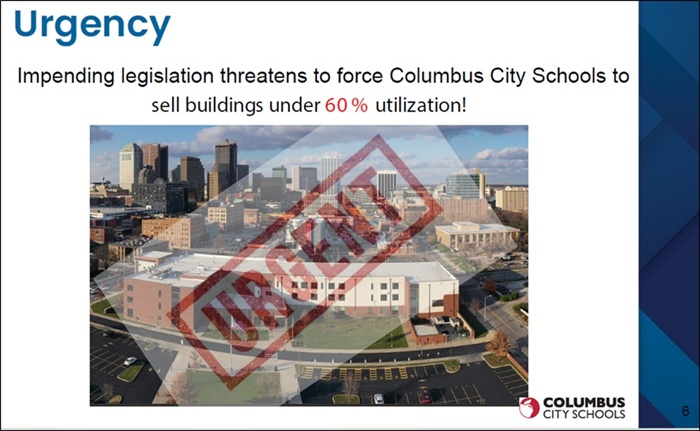
As a policy refresher, districts must offer for sale or lease an “unused” facility to nearby charter schools. Such facilities have either been entirely unused for one year—sitting vacant—or less than 60 percent utilized for instruction during the previous year. Charter schools located within a district’s boundaries are eligible to bid on an unused facility, with priority given to high-performing charters. If no bidders emerge from this process, a district is then allowed to pursue other options—e.g., selling it to a private developer—or simply keep the facility in its possession. In addition to this mandatory disposal process for “unused” facilities, districts—when voluntarily seeking to offload a facility—must also first offer it to charter schools before soliciting other bids.

These laws make perfect sense. Keeping facilities open as public schools honors the original purpose of the building and the taxpayer investments in it. Moreover, by handing the keys to a charter school, it ensures the facility receives maintenance and care, while serving children in a community. This is a much better option than allowing districts to mothball facilities and leave them to crumble and become urban blight. Lastly, the law assists charter schools, which have long struggled to secure adequate facilities due to policies that deny them access to local bond revenues and state construction grants. Through the processes outlined in state law, charters have an avenue to obtain a building at a more affordable cost.

With these legal requirements and districts downsizing, we should be seeing more charter schools gaining access to facilities. But that’s not happening, as districts are sidestepping procedures set forth in state law. We at Fordham have repeatedly raised concerns about possible noncompliance—as has Governor DeWine—and this piece provides more examples of questionable behavior.

Columbus

Last December, the Columbus school board voted to demolish four school buildings after the 2025–26 school year. When asked about their right to bid on the buildings, board president Michael Cole told the Dispatch, “I don't know that if I were a charter school, that I would want that facility—we closed it for a reason.” But speculating on whether charters may or may not be interested is irrelevant. What the school board was obligated to do was offer the buildings and actually find out if any charters had use for them—and indeed, Andy Boy, a Columbus charter-school leader, suggested interest in the Dispatch story. Unfortunately, due to the district’s lack of cooperation, these facilities will be torn down when they could have received new life under charter school ownership.

Another apparent violation of state law relates to buildings that Columbus operates, despite having utilization rates under 60 percent—the threshold that obligates a district to offer a half-empty building to a charter school for lease or sale. According an October 2025 board meeting presentation, administrators identified 15 buildings with utilization rates under 60 percent. In that very same presentation, the district also strangely indicated that the 60 percent rule was not current law, even though the provision has been in effect since 2022. Whether this reflects legal incompetence or was an intentional misrepresentation of statute is unclear. But the fact remains that these severely underutilized schools should be on the offer to Columbus charter schools.
 

School demolitions blog figure 1

What is happening with these underutilized schools? While none of them were among the four building slated for demolition, three will continue operating in 2026–27 and permanently close next spring. A fourth, Fairwood Elementary, closed at the conclusion of the 2025–26 school year. In a recent article, the principal said, “Hopefully, we’ll be able to keep the building or refurbish the building or do something in this space that will be of a benefit to the community.” A nice parting thought, but the quote evidences no whiff of possible charter ownership. As for the other 11 underutilized buildings, they were all in operation through 2025–26, and one might reasonably assume they will continue operating next school year as district-run schools—seemingly in defiance of state law, if the buildings were not first offered to charter schools.

Cleveland

Turning northwards, Cleveland has made news for its aggressive plan to close some two dozen schools. A recent Signal Cleveland article indicates that several buildings will remain district property, while others may be handed over to the municipal government. For 12 other buildings, the district in partnership with the city is looking to sell them to developers. This is all well and good, but the legal question remains: Did the district offer these facilities first to city charter schools before keeping these buildings in their possession or engaging private developers? On the redevelopment side, the city’s Request for Qualifications makes no mention of having fulfilled state requirements to offer the vacant buildings to charters before seeking other development opportunities. The omission is not proof positive, but word on the street is that the buildings were never offered to the city’s charter schools.

Senate Bill 311

The intent of state law is clear: Taxpayer-funded school buildings should be used to educate Ohio students. When school districts aren’t using these public assets, they are responsible for making good-faith efforts to transfer ownership of the building (or lease it) to a public charter school. But whether out of fear of competition or outright hostility toward charters, districts are playing keep-away games with facilities.

Introduced earlier this year, Senate Bill 311 takes aim at curbing the abuse through stronger statutory language. The legislation, which Fordham supports, would do the following:

  • Clarifies the 60 percent rule by setting an unambiguous capacity standard;[1]

  • Clarifies that districts cannot demolish a facility before offering it to charter schools, and adds a fine for noncompliance;

  • Clarifies that districts cannot offer a facility to another municipal government before offering it to charter schools;

  • Requires the state to publish an annual list of districts’ unused facilities; and

  • Includes several commonsense exceptions to mandatory disposal.[2]

In addition to these provisions, Senate Bill 311 also increases the likelihood that an offered facility will be purchased or leased. It allows high-performing charter schools located outside of a district to bid on an unused facility (with secondary priority behind local high-performing charters); private schools are added to the mix, as well, given third-tier priority alongside non-high-performing local charter schools. Finally, the bill contains language intended to make an unused facility more affordable for charters to actually purchase.

* * *

Public school officials are supposed to uphold the law and model for young people how to be law-abiding citizens. But when it comes to state laws regarding unused school facilities, some administrators seem to be taking them as suggestions—not legal imperatives. This gamesmanship not only sets a poor example, but also keeps half- to fully-empty buildings out of the hands of educational entities that are helping students succeed. It’s time to stop the games and ensure that taxpayer-funded buildings are used to educate Ohio students.


[1] Specifically, for the past two school years, a building is “unused” if enrollment is less than 60 percent of the building’s maximum enrollment per its certificate of occupancy or its highest enrollment over the past ten years.

[2] For instance, if a facility is less than ten years old or is undergoing significant renovations.

Policy Priority:
School Funding
Topics:
Governance
Jeff Murray
6.5.2026
Ohio charter news logo
Listen to this article
Loading the Elevenlabs Text to Speech AudioNative Player...

Stories featured in Ohio Charter News Weekly may require a paid subscription to read in full.

Big changes needed in Ohio transportation

While this story focuses on dozens of private school students being declared “impractical to transport” by an Ohio school district, charter school leaders and families everywhere will find its details all-too-familiar. What’s interesting is that the district’s difficulty in accommodating that private school’s bell schedule is put forward as proof positive that big changes are needed in the state’s student transportation infrastructure. One solution would be to let districts have control over choice schools’ schedules, as implied here. But another, simpler, option would be to take control of busing away from districts and to create a system that truly focused on getting every student to school on time, regardless of school attended.

Ratification

Teachers at Cleveland’s Menlo Park Academy recently ratified their initial union contract with the school after four years of negotiations. “It has been a long road, but we are pleased with the results in our contract,” said union reps in a statement.

The view from Detroit

Detroit Public Schools are finally closing several school buildings due to years of ongoing enrollment losses throughout the district. Despite having other district buildings automatically assigned to receive their children next year, Chalkbeat reports that some families are taking this opportunity to look at charter school options for the first time as well as schools of choice within the district.

Charter school success in Oklahoma

A new report from the University of Oklahoma’s Adam Tyner touts the performance of charter high schools in the Sooner State as compared to their traditional district peers. Not only did 31 of 49 brick-and-mortar charter schools outperform their neighboring district schools last year on ACT scores, College and Career Readiness Assessments (CCRA), and four-year graduation rates, but they also did so with less funding. Virtual charter schools fared less well, however, across the board. Tyner’s full report can be found here.

The view from Louisiana

Louisiana House Bill 1003 is sitting on Gov. Jeff Landry’s desk for signature. When enacted, it will make several big changes to charter school law. This in a state where the largest city, New Orleans, is served almost entirely by charters. Among the changes: An end to the existing requirement that school districts must offer vacant buildings to charter operators before selling or repurposing them, and giving New Orleans’ district superintendent the ability to terminate the contract of an existing charter at any time if the school system has more seats than students. Sounds like the traditional school district model is working to reassert itself after decades of charter dominance.

*****

Did you know you can have every edition of the Ohio Charter News Weekly sent directly to your Inbox? Subscribe by clicking here.

Policy Priority:
School Choice
Topics:
Charter Schools
Jeff Murray
6.5.2026
Gadfly Bites logo
Listen to this article
Loading the Elevenlabs Text to Speech AudioNative Player...

News stories featured in Gadfly Bites may require a paid subscription to read in full. You have been warned.

  1. We start today by noting the arrival of every Ohio superintendent’s favorite time of year. No, silly; not that. Double-dip season is finally upon us! (Cleveland.com, 6/3/26)

  2. All I have to say in response to this story—discussing a pending bill to dissolve the neglected and rotting carcass of Academic Distress Commissions here in Ohio—is ahahahahahahahahahaha!! But really, that’s enough. (Cleveland.com, 6/3/26)

  3. “O Young Wildcat Initiate! Choose wisely for your high school learning mode. Do you…or do you not…accept…The OP-tionnnnnnnn?!” I mean, how else should I read this piece hyping the “alternative” modes of high school instruction available for students at Mayfield High School, one of the highest-rated and highest-performing schools in the state? The career-centered pathway discussed here seems pretty normal (as in, not exactly groundbreaking), and I suppose we probably know what “traditional classrooms and lectures” refers to. So that leaves only The Option as the seemingly-novel part of this story, although even it has been around for at least six years (so long that I’m sure I’ve ridiculed it at least once before). Even so, I come away from this piece wondering how it truly warrants the moniker of “alternative” (calling it “a structured study hall” for “lack of a better word” does it no favors at all in that regard). And why it’s even needed since the school and its kids have always been super high-performing. And unsure of how can it even work when kids opt in and out of it at will throughout the year (again, “the students are with their teacher for study hall” is a money quote, but not for the reason everyone thinks). And of course why no one has come up with another name for it that doesn’t sound like it’s from Doctor Who in all this time. (The 74, 6/4/26)

  4. Finally this week, we have a fascinating case study that I think illustrates the promise and the pitfalls of current high level “agreement” that big changes need to be made to student transportation in Ohio. In it, we learn about the year that one private school in Delaware County dared to change its bell schedule to a pattern which the local school district couldn’t figure out how to accommodate and thus they chose to declare every single student attending that school “impractical to transport” after years of providing busing without problem. The reportage stops there, making a sort of coup de grâce out of the district’s “We tried to make that work and we just couldn’t” declaration, and leaving the impression that the obvious solution to a problem like this would be for districts to dictate the daily schedules of every school for which they provide transportation to their own satisfaction. (Your interpretation may vary, of course, but that’s how I read it. It is at least clear that that the district in the example tried to do so as its one and only effort to solve their problem.) Even if I stipulate that incompatible bell schedules represents a large proportion of the “impractical to transport” epidemic in Ohio (which I don’t, but just for the sake of argument…), there is another, far simpler, solution that goes unmentioned in this piece’s 720+ words. Can you guess what it is? If so, do you think the current high level agreement that “big changes to transportation” are needed would survive a serious legislative attempt to implement it? I for one am skeptical. (Cleveland.com, 6/3/26)

Did you know you can have every edition of Gadfly Bites sent directly to your Inbox? Subscribe by clicking here.

Policy Priority:
School Funding
Topics:
Governance
The Education Gadfly
6.5.2026
Gadfly Guy
Listen to this article
Loading the Elevenlabs Text to Speech AudioNative Player...

WHAT WE’RE READING

Financial pressure from falling enrollment is layering on top of other costs beyond districts’ control, ranging from rising gas prices to GLP-1 prescriptions upping health care plan costs. “More than half of the country’s 50 largest school districts are poised to or already have made cuts, or are facing a reported deficit,” writes Lily Altavena in Chalkbeat.

There’s more to this story, though, as state funding and local property taxes are up in many areas. As Marguerite Roza—who’s been sounding the alarm on this issue for years—told 50CAN’s Marc Porter Magee, “The fiscal cliff is no surprise. It’s been right there in district multi-year financial forecasts. Lots of districts used one-time Covid money to add staff and raise pay. What we’re seeing now is the fallout now that relief funding is gone. Some chose to spend down reserves to put cuts off a year. But math is math.” Right-sizing may be unpleasant, but it’s also inevitable.


Editor's note: This was first published on Mike Petrilli's Substack, SCHOOLED, a twice-weekly free Substack and email newsletter restarting the education-reform conversation.

Click here to subscribe for:

  • Sharp analysis of the week’s biggest K–12 debates

  • Curated commentary from across the ed-policy world

  • Lively discussion—including reader reactions and pushback

Pagination

  • First page « First
  • Previous page ‹ Previous
  • Page 30
  • Page 31
  • Page 32
  • Page 33
  • Current page 34
  • Page 35
  • Page 36
  • Page 37
  • Page 38
  • Next page Next ›
  • Last page Last »
Fordham Logo

© 2026 The Thomas B. Fordham Institute
Privacy Policy
Usage Agreement

National

P.O. Box 110
Burke, VA 22009

202.223.5452

[email protected]

Ohio

P.O. Box 82291
Columbus, OH 43202

614.223.1580

[email protected]

Sponsorship

130 West Second Street, Suite 410
Dayton, Ohio 45402

937.227.3368

[email protected]