Mobile Navigation

  • National
    • Policy
      • High Expectations
      • Quality Choices
      • Personalized Pathways
    • Research
    • Commentary
      • Gadfly Newsletter
      • Flypaper Blog
    • Events
    • Scholars Program
  • Ohio
    • Policy
      • Priorities
      • Media & Testimony
    • Research
    • Commentary
      • Ohio Education Gadfly Biweekly
      • Ohio Gadfly Daily
  • Charter Authorizing
    • Application
    • Sponsored Schools
    • Resources
  • About
    • Mission
    • Board
    • Staff
    • Career
Home
Home
Advancing Educational Excellence

Main Navigation

  • National
  • Ohio
  • Charter Authorizing
  • About

National Menu

  • Topics
    • Accountability & Testing
    • Advanced Education
    • Career & Technical Education
    • Charter Schools
    • Curriculum & Instruction
    • ESSA
    • Evidence-Based Learning
    • Facilities
    • Governance
    • Personalized Learning
    • Private School Choice
    • School Finance
    • Standards
    • Teachers & School Leaders
    • Think Again
  • Research
  • Commentary
    • Gadfly Newsletter
    • Flypaper Blog
    • Gadfly Podcast
  • Events
  • Scholars Program

Advanced Education

Displaying 151-180 of 266 results
Podcast
10.21.2020
Governance, Advanced Education

The Education Gadfly Show: The loathsome war on exam schools

On this week’s podcast, Fordham’s Checker Finn joins Mike Petrilli and David Griffith to discuss the growing, misguided war on selective-admissions

Commentary
10.7.2020
Accountability & Testing, Curriculum & Instruction, Advanced Education, Teachers & School Leaders

Equity and unintended consequences in the Washington suburbs

Chester E. Finn, Jr.

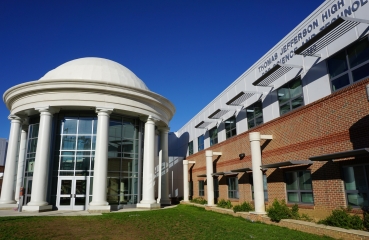
Two big public-school systems in the D.C. area are on the verge of letting their zeal for equity and racial justice lead to consequences they may end up regretting. Fairfax County, which operates one of America’s best known and most esteemed “exam schools,” is may use a lottery, rather than test scores and other quality measures, for admissions. And Loudoun County is considering revising its rules for “professional conduct” by school staff to punish employees—teachers included—in truly Orwellian ways.

Commentary
8.26.2020
Advanced Education

The gifted kids are all right

Jeff Murray

Academic acceleration—either through grade skipping or advanced coursework such as Advanced Placement or early college access—is a longstanding practice for primary and secondary students who show above average ability for their age and grade level.

Commentary
7.31.2020
Curriculum & Instruction, Advanced Education, Teachers & School Leaders

Many students with the potential to excel in STEM fields struggle in school

Joni Lakin, Jonathan Wai

Students who have the kinds of talent scientists and engineers need to solve problems by visualizing how objects could be rotated, combined or changed in three dimensions often struggle at school.

Commentary
7.24.2020
Evidence-Based Learning, Advanced Education

The “gifted gap” was already growing before the pandemic

Chris Yaluma

The Covid-19 pandemic has further exposed the inequities that have long existed in K–12 education system.

Commentary
6.24.2020
Evidence-Based Learning, Advanced Education

Do programs for advanced learners work?

Jonathan Plucker

As I noted in a recent post, attitudes toward advanced education are cyclical. From gifted education to talent development programs, from honors classes to AP, we have experienced a largely positive stretch of media attention and state-level policy gains.

Commentary
6.12.2020
Career & Technical Education, Curriculum & Instruction, Governance, Advanced Education, Teachers & School Leaders

Why not eliminate at least one year of high school entirely?

Kalman R. Hettleman

Michael J. Petrilli’s recent article “Half-Time High School may be just what students need” is compelling. Yet proposals to cut school time in half in grades nine through twelve may be only half right.

Commentary
4.15.2020
Advanced Education

Want more Doctor Faucis? Ensure that smart kids get educated, too.

Chester E. Finn, Jr.

Amid the plague that surrounds us, essential attention is properly getting paid to the education challenges of out-of-school kids: What can their parents, their schools, and their districts do to compensate for missed classroom time and the learning loss that’s bound to occur between now and the resumption of something resemb

Event
2.24.2020
Curriculum & Instruction, Governance, Advanced Education, Teachers & School Leaders

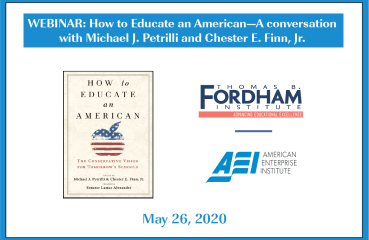
WEBINAR: How to Educate an American—A conversation with Michael J. Petrilli and Chester E. Finn Jr.

America’s schools have ceded significant ground to trendy nostrums and policy cure-alls that do little to adequately teach young people the skills and knowledge required to realize their full potential and emerge from school as fully-functioning citizens. The latest round of dire NAEP civics and U.S. history scores underscore our continuing failure on the citizenship front.

Commentary
2.12.2020
Curriculum & Instruction, Advanced Education

AP versus the excellence gap

Chester E. Finn, Jr.

That K–12 education in the U.S. has long been plagued by “excellence gaps” is no secret, although the terminology may be just a decade old (and owes much to Jonathan Plucker and his colleagues).

Policy Brief
2.11.2020
Accountability & Testing, Advanced Education

The Role of Advanced Placement in Bridging Excellence Gaps

Chester E. Finn, Jr., Andrew Scanlan

This report presents key findings from Learning in the Fast Lane: The Past, Present, and Future of Advanced Placement, by Chester E. Finn, Jr. and Andrew E. Scanlan, and published by Princeton University Press in 2019.

Commentary
1.29.2020
Accountability & Testing, Advanced Education

Enduring math woes jeopardize America’s standing in the world

Brandon L. Wright

Considerable research suggests that “math skills better predict [individuals’] future earnings and other economic outcomes than other skills learned in high school,” report Eric A. Hanushek, Paul E. Peterson, and Ludger Woessmann.

Commentary
1.15.2020
Advanced Education

Students of color lack access to advanced coursework, but there are solutions

Brandon L. Wright

Gifted education in the U.S. is too scarce and lacks substance, and that’s especially true for high achieving black and Latino children. A new report by the Education Trust concludes that this gap has “everything to do with policies, adult decisions, and practices and little to do with students’ academic abilities.”

Commentary
11.21.2019
Advanced Education

Shining a light on bright students

Jonathan Plucker

Education is a great equalizer, yet our nation does not consistently support advanced students, especially low-income, and racial and language minority students. Too often, these students are drastically under-challenged in school, leading to boredom, underachievement and incalculable amounts of lost potential.

Commentary
11.6.2019
Accountability & Testing, Advanced Education, Teachers & School Leaders

High achievers are doing better on NAEP, and that’s good news. Period.

Brandon L. Wright

Most everyone has read by now about the dismal scores on our Nation’s Report Card, which again measured how fourth and eighth graders did in math and reading. Aside from fourth grade math, marks on the 2019 National Assessment of Education Progress were generally flat or down, especially for our lowest-performing children. One prominent official remarked that “the bottom fell out.” But the results among high achievers offer a bright spot that has been mostly overlooked and undercelebrated.

Event
11.5.2019
Accountability & Testing, Curriculum & Instruction, Advanced Education, Standards

Is Advanced Placement Good for Everyone? A Discussion with Partisans and Doubters

Learning in the Fast Lane: The Past, Present, and Future of Advanced Placement (Princeton, 2019), the new book by Chester Finn and Andrew Scanlan, tells the story of the Advanced Placement (AP) program, widely regarded as the gold standard for academic rigor in American high schools.

Commentary
11.1.2019
Advanced Education

Low-income students are profoundly underrepresented in gifted programs

Jason A. Grissom, Christopher Redding, Joshua F. Bleiberg

Gifted education scholars have long pounded the drum regarding the need to increase racial and ethnic diversity in gifted programs. A recent study we published in the Harvard Educational Review suggests that increasing socioeconomic diversity needs similar attention.

Commentary
10.22.2019
Advanced Education

Failing and passing the “Tiffany Test,” part II

David Scarlett Wakelyn

Part I discussed Robert Pondiscio’s “Tiffany Test”: How do high-achieving students fare as they move through a high-poverty elementary school?

Commentary
10.16.2019
Advanced Education

Failing and passing the “Tiffany Test,” part I

David Scarlett Wakelyn

What happens to initially high-achieving students from high-poverty families as they move through elementary school? In the opening of his new book, How the Other Half Learns, Robert Pondiscio worries about these students while teaching fifth grade in the South Bronx.

Commentary
10.9.2019
Accountability & Testing, Curriculum & Instruction, Advanced Education, Teachers & School Leaders

AP: Great for gifted high schoolers

Chester E. Finn, Jr., Andrew Scanlan

When considering the available options for gifted high-school kids, the Advanced Placement (AP) program may not be the first thing that comes to mind. That’s too bad because AP might be America’s most effective large-scale “gifted and talented” program at the high school level.

Commentary
10.9.2019
Advanced Education

Advanced Placement, giftedness, and Hispanic student success

Pedro Enamorado

Advanced Placement (AP) courses are the gold standard for preparing students for college. In fact, studies have found that AP participation correlates with higher rates of college enrollment and completion, even among young people who don’t pass their end-of-year AP exams.

Commentary
10.2.2019
Curriculum & Instruction, Advanced Education, Personalized Learning

Advanced coursework gets a needed boost

Chester E. Finn, Jr.

Last week in Austin, at the annual “summit” sponsored by the PIE (“Policy Innovators in Education”) Network, prizes were conferred on a handful of state-based education-reform groups that had accomplished remarkable feats in the previous year, this despite the reform-averse mood that chills much of the nation.

Commentary
9.18.2019
Accountability & Testing, Evidence-Based Learning, Advanced Education, Personalized Learning, Teachers & School Leaders

Why has AP succeeded when so many other reforms have failed?

Chester E. Finn, Jr., Andrew Scanlan

American K–12 education is awash in reforms, nostrums, interventions, silver bullets, pilot programs, snake oil peddlers, advocates, and crusaders, not to mention innumerable private foundations that occasionally emerge from their endless cycles of strategic planning to unload their latest brainstorms upon the land. Yet when subjected to close scrutiny, not much actually “works.” The six-decade old Advanced Placement program is a rare and welcome exception.

Commentary
9.18.2019
Evidence-Based Learning, Curriculum & Instruction, Advanced Education, Personalized Learning, Teachers & School Leaders

Low public support for ability grouping is an opportunity for personalized pacing

Brandon L. Wright

The latest Education Next poll asked respondents whether they support ability grouping, whereby students take classes with peers at similar academic achievement levels, and for middle school the majority’s answer was no.

Commentary
9.18.2019
Evidence-Based Learning, Charter Schools, Curriculum & Instruction, Advanced Education, Personalized Learning, Teachers & School Leaders

How two personalized learning models accelerate the progress of their high-achieving students

Michael J. Petrilli

Editor’s note: This is the third in a series of posts looking at how two school networks—Rocketship Public Schools and Wildflower Schools—enable their students to meet standards at their own pace.

Getty Images/dcdebs
Podcast
9.18.2019
Curriculum & Instruction, Advanced Education

The Education Gadfly Show: All about AP

  On this week’s podcast, Mike Petrilli talks with Checker Finn and Andrew Scanlan about their new book on the past, present, and future of Advanced Placement.

Getty Images/dcdebs
Book
9.17.2019
Curriculum & Instruction, Advanced Education

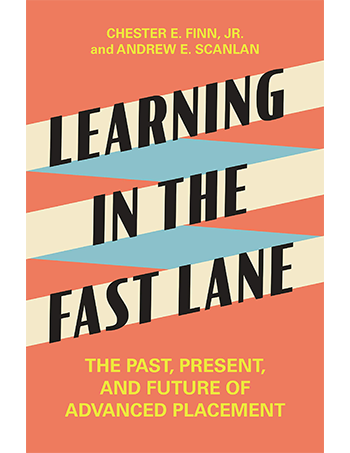
Learning in the Fast Lane: The Past, Present, and Future of Advanced Placement

Chester E. Finn, Jr., Andrew Scanlan

Termed by the Washington Post’s Jay Mathews “the most comprehensive book on Advanced Placement, the most powerful educational tool in the country,” this book traces AP’s history from its mid-twentieth-century origins as a niche benefit for privileged students to its contemporary role as a vital springboard to college for high school students nationwide, including hundreds of thousands of poor and minority youngsters. It's a must-read for anyone with a stake in American K–12 education.

Commentary
9.11.2019
Accountability & Testing, Charter Schools, Curriculum & Instruction, Governance, Advanced Education, Standards, Teachers & School Leaders

The GAS Factor: Lessons learned at Success Academy

Robert Pondiscio

Much of the initial response to Robert’s new book, "How The Other Half Learns," has focused on the winnowing effects of Success Academy’s enrollment process, which ensures that the children of only the most committed parents enroll and persist. But that’s just the start of the story. You have to look at what parent buy-in actually buys: a school culture that drives student achievement, and which can only be achieved when parents are active participants, not unwilling conscripts.

Commentary
9.4.2019
Advanced Education, Teachers & School Leaders

How teachers encourage students to take AP classes

Tran Le

A recent report by Eugene Judson, Nicole Bowers, and Kristi Glassmeyer investigates what classroom mechanisms compel students to enroll in Advanced Placement (AP) science and math courses and to complete their associated exams—and how that differs between low- and high-income schools.

Commentary
8.28.2019
Accountability & Testing, Curriculum & Instruction, Advanced Education, Standards

Influences affecting the educational trajectory of students

Jeff Murray

A new study from Georgetown University reaffirmed an uncomfortable but familiar finding: Socioeconomic status has a significant effect on students’ long-term outcomes, regardless of their academic performance in kindergarten or the quality of the schools they attend in K–12.

Pagination

  • First page « First
  • Previous page ‹ Previous
  • Page 1
  • Page 2
  • Page 3
  • Page 4
  • Page 5
  • Current page 6
  • Page 7
  • Page 8
  • Page 9
  • Next page Next ›
  • Last page Last »

Type

  • Book (2)
  • Commentary (227)
  • Event (5)
  • Podcast (12)
  • Report (15)

Topics

  • Accountability & Testing (503)
  • (-) Advanced Education (266)
  • Career & Technical Education (84)
  • Charter Schools (1115)
  • Curriculum & Instruction (1589)
  • ESSA (129)
  • Evidence-Based Learning (833)
  • Facilities (25)
  • Governance (1409)
  • Personalized Learning (51)
  • Private School Choice (139)
  • School Finance (167)
  • Standards (190)
  • Teachers & School Leaders (1450)

Date

  • 2026 (14)
  • 2025 (19)
  • 2024 (30)
  • 2023 (41)
  • 2022 (31)
  • 2021 (13)
  • 2020 (15)
  • 2019 (22)
  • 2018 (2)
  • 2017 (1)
  • 2016 (39)
  • 2015 (7)
  • 2014 (5)
  • 2013 (9)
  • 2012 (7)
  • 2011 (5)
  • 2009 (2)
  • 2008 (1)
  • 2007 (1)
  • 2004 (1)
  • 1998 (1)
Fordham Logo

© 2026 The Thomas B. Fordham Institute
Privacy Policy
Usage Agreement

National

P.O. Box 110
Burke, VA 22009

202.223.5452

[email protected]

Ohio

P.O. Box 82291
Columbus, OH 43202

614.223.1580

[email protected]

Sponsorship

130 West Second Street, Suite 410
Dayton, Ohio 45402

937.227.3368

[email protected]