Mobile Navigation

  • National
    • Policy
      • High Expectations
      • Quality Choices
      • Personalized Pathways
    • Research
    • Commentary
      • Gadfly Newsletter
      • Flypaper Blog
    • Events
    • Scholars Program
  • Ohio
    • Policy
      • Priorities
      • Media & Testimony
    • Research
    • Commentary
      • Ohio Education Gadfly Biweekly
      • Ohio Gadfly Daily
  • Charter Authorizing
    • Application
    • Sponsored Schools
    • Resources
  • About
    • Mission
    • Board
    • Staff
    • Career
Home
Home
Advancing Educational Excellence

Main Navigation

  • National
  • Ohio
  • Charter Authorizing
  • About

National Menu

  • Topics
    • Accountability & Testing
    • Advanced Education
    • Career & Technical Education
    • Charter Schools
    • Curriculum & Instruction
    • ESSA
    • Evidence-Based Learning
    • Facilities
    • Governance
    • Personalized Learning
    • Private School Choice
    • School Finance
    • Standards
    • Teachers & School Leaders
    • Think Again
  • Research
  • Commentary
    • Gadfly Newsletter
    • Flypaper Blog
    • Gadfly Podcast
  • Events
  • Scholars Program

The Education Gadfly Weekly

Sign Up to Receive Fordham Updates

We'll send you quality research, commentary, analysis, and news on the education issues you care about.
Thank you for signing up!
Please check your email to confirm the subscription.

The Education Gadfly Weekly: What the political conventions meant for ed reform

Volume 20, Number 35
9.9.2020
9.9.2020

The Education Gadfly Weekly: What the political conventions meant for ed reform

Volume 20, Number 35
view
High Expectations

How the conventions showcased education and what it means for ed reform

The first-ever virtual political conventions have come and gone, during which neither party offered a serious path forward on education reform. The Democrats belong to the self-interested teacher unions, and the GOP has become a single-issue party in pursuit of choice, leaving us with a lot of talk but little action.

Dale Chu 9.9.2020
NationalFlypaper

How the conventions showcased education and what it means for ed reform

Dale Chu
9.9.2020
Flypaper

Hey, Democrats and Republicans: Don’t cut federal charter funding

Kelly Robson
9.9.2020
Flypaper

Months without play dates, hugs from grandma, and trips to the library

Victoria McDougald
9.9.2020
Flypaper

A virtual scramble: Google searches in the time of Covid-19

Amber M. Northern, Ph.D. | Jeff Murray
9.9.2020
Flypaper

Rural districts’ Covid-19 response

Jessica Poiner
9.9.2020
Flypaper

The Education Gadfly Show: Two years after Janus, why are teachers unions stronger than ever?

9.9.2020
Podcast
view

Hey, Democrats and Republicans: Don’t cut federal charter funding

Kelly Robson 9.9.2020
Flypaper
view

Months without play dates, hugs from grandma, and trips to the library

Victoria McDougald 9.9.2020
Flypaper
view

A virtual scramble: Google searches in the time of Covid-19

Amber M. Northern, Ph.D., Jeff Murray 9.9.2020
Flypaper
view

Rural districts’ Covid-19 response

Jessica Poiner 9.9.2020
Flypaper
view

The Education Gadfly Show: Two years after Janus, why are teachers unions stronger than ever?

Michael J. Petrilli, Colin Sharkey, David Griffith, Ph.D., Olivia Piontek 9.9.2020
Podcast
view

How the conventions showcased education and what it means for ed reform

Dale Chu
9.9.2020
Flypaper

The first-ever virtual political conventions have come and gone, and it was hard not to notice how Democrats and Republicans took wildly different approaches in their handling of education. Not only did their choices reveal the divergent ways that they view the issue, they also spoke volumes about the state of each party.

The Democrats went first. Elizabeth Warren addressed the convention from a classroom with letter blocks spelling out “BLM“ in the background, but Jill Biden’s keynote speech from the high school where she once taught garnered the most attention for her personal and emotional take on the struggles of teachers during the pandemic. With many schools still shuttered, she empathized with the frustrations around reopening but promised that a Biden-Harris victory in November would allow classrooms to “ring out with laughter and possibility once again.” To the extent that education reappeared during the week, the themes revolved around remote learning, funding, and gun violence.

Most telling were the two teachers—both union officers—who were given prime time (though brief) speaking slots as part of the DNC’s roll call of the states. Wearing a “Red For Ed” T-shirt and a “Strong Public Schools 2020” pin, Marisol Garcia, a middle school teacher and vice president of the Arizona Educators Association, highlighted her credentials as an NEA organizer. Representing West Virginia, Fred Alpert, president of the AFT’s local affiliate, underscored his union bona fides by pressing on the point that “elections matter, but so does activism,” calling for “safe and welcoming schools,” “sufficient funding,” and “fair wages.” Taken together with the party platform that was adopted, the spectacle left no daylight between the national Democratic Party and the union apparatus—a fundamentally troubling sign for education reform.

For their part, Republicans decided to forego a party platform altogether, instead releasing a brief, bulleted list with just two education items: “Provide School Choice to Every Child in America” and “Teach American Exceptionalism.” The first point drew plenty of additional attention, as the RNC featured impassioned demands for school choice from a variety of speakers. For better or worse (more on that below), the GOP now sees it as a wedge issue to peel off Black and Latino voters.

To wit, Rebecca Friedrichs, a former public school teacher who helped pave the way for the landmark case that struck down mandatory union fees, said, “[President Trump has] proposed education freedom scholarships to return control to parents, protect religious liberties and empower kids to escape dangerous, low-performing schools. The Republican platform supports educational freedom. The Democrat Party does not.”

Former U.N. Ambassador Nikki Haley noted, “We know that the only way to overcome America’s challenges is to embrace America’s strengths. We are striving to reach a brighter future where every child goes to a world-class school chosen by their parents.”

And South Carolina Senator Tim Scott remarked, “A quality education is the closest thing to magic in America. That’s why I fight to this day for school choice...to make sure every child, in every neighborhood has a quality education. I don’t care if it’s a public, private, charter, virtual, or home school. When a parent has a choice, their kid has a better chance. And the president has fought alongside me on that.”

Indeed, some celebrated the showcasing of school choice as a signature K–12 issue, and it’s true that U.S. Secretary of Education Betsy DeVos has fought for school choice her entire career—not for political gain, but because she’s a true believer. But Trump’s support is as a big-picture sloganeer (“SCHOOL CHOICE NOW!“) rather than as a policy aficionado. To wit, his FY 2021 budget proposed throwing the federal Charter Schools Program into a block grant, which would have effectively killed it. Moreover, DeVos wasn’t even invited to speak!

—

At this point, it’s instructive to look past the conventions and toward the bigger picture. Namely, the politics of choice and the issues surrounding Trump.

In what has become a self-fulfilling prophesy in nature, the more school choice advocates have aligned themselves with mobilizing Republicans, the more Democrats have felt they’ve been given the permission structure to be anti-charters—which is where the unions have wanted them all along. Trump’s reality distortion field has convinced some that the president has been a boon for public school choice and charter schools, but in the long run, history may show that proponents made a tactical error by allowing choice to become a brand of one party rather than a value deemed worthy of protection by both.

In the sweltering hothouse of today’s politics, the GOP’s play for choice voters remains an open question as to whether it will bear fruit. The Trump administration has repeatedly failed to coax a sweeping expansion of school choice during his tenure. If voters rehire him for a second term, this state of affairs is unlikely to change. After all, if they couldn’t get choice done when Republicans controlled the House and Senate, it’s unlikely they will succeed once they have neither, which could very well happen. Their myopia on choice notwithstanding, there is no blueprint or grand design about how to improve the nation’s education system. Whether it’s choice, school safety, patriotic education, or criticism of the 1619 Project, the president is more interested in “owning the libs” than he is about meaningfully addressing educational shortcomings. Which is too bad because Trump’s hyperbolic embrace muddies the real merits and worthiness of these issues.

By the same token, there’s little reason for education cheer on the other side of the aisle. Democrats have betrayed Black and Latino parents and choice advocates by abandoning them, functionally saying, “What are you going to do about it? Vote for Trump?” And for all of the much deserved lambasting during the Democratic Convention of the president’s mishandling of the coronavirus, there were crickets on how the teacher unions, emboldened by last year’s labor unrest, have unabashedly exploited the pandemic to hold our schools hostage, even in places where the science suggests it’s relatively safe to reopen.

Although most of this is state business, not federal, neither party offered a serious path forward on education reform during the two conventions. The Democrats belong to the deplorably self-interested teacher unions, and the GOP has become a single-issue party in pursuit of choice, leaving us with a lot of talk and no action. Combine this with the Covid-19 reopening challenges and what results is total neglect on both sides of every other substantive element of education reform (e.g., curriculum, standards, accountability). As my colleague Checker Finn recently wrote, teacher unions—and Democrats by association—are “in pursuit of a multi-part agenda: more money, less work, less competition, less testing, less accountability, and while they’re at it, help elect candidates in November (national, state, and local) who will adhere to that agenda.” Meanwhile, Republicans are in the midst of a meltdown as their focus on school choice and little else belies a party now mostly bereft of ideas, principles, or a vision for governing. All told, when it comes to education, there’s going to be a lot of nose holding on Election Day.


view

Hey, Democrats and Republicans: Don’t cut federal charter funding

Kelly Robson
9.9.2020
Flypaper

Some Democrats and Republicans have an unlikely alliance these days around one thing: their sudden rejection of the federal Charter Schools Program (CSP), which funds start-up costs for new, high-quality charter schools.

President Trump, who says he supports charter schools, surprised charter advocates back in February when his administration’s FY 2021 budget proposal collapsed the CSP into a K–12 block grant, which, if enacted by Congress, would effectively eliminate the program. Democrats, too, have suggested getting rid of the CSP. And while Democratic nominee Joe Biden hasn’t taken a stance on the CSP specifically, the Democratic platform promises to “increase accountability” for charter schools.

Calls to eliminate the CSP go against both parties’ long-standing support for the program, which the Clinton administration enacted in 1994. The Bush administration helped launch two of CSP’s subprograms—Credit Enhancement and the State Charter School Facilities Incentive Grant (SFIG)—and oversaw consistent increases in funding for the CSP. The Obama administration oversaw the highest annual percent increase in appropriations to the program since Clinton. Under the Trump administration, funding reached its current high of $440 million, though, as noted above, its most recent budget proposal would effectively zero it out, given that states could choose to spend any block grant dollars on a wide range of activities instead of starting charters.

Not only do both sides’ current arguments overlook long-standing bipartisan support, they also ignore the long history of charter schools serving some of the nation’s highest-need students and communities. In the midst of health and economic crises that disproportionately affect Black and Hispanic communities, cutting federal funding that supports schools serving those very populations is simply unconscionable.

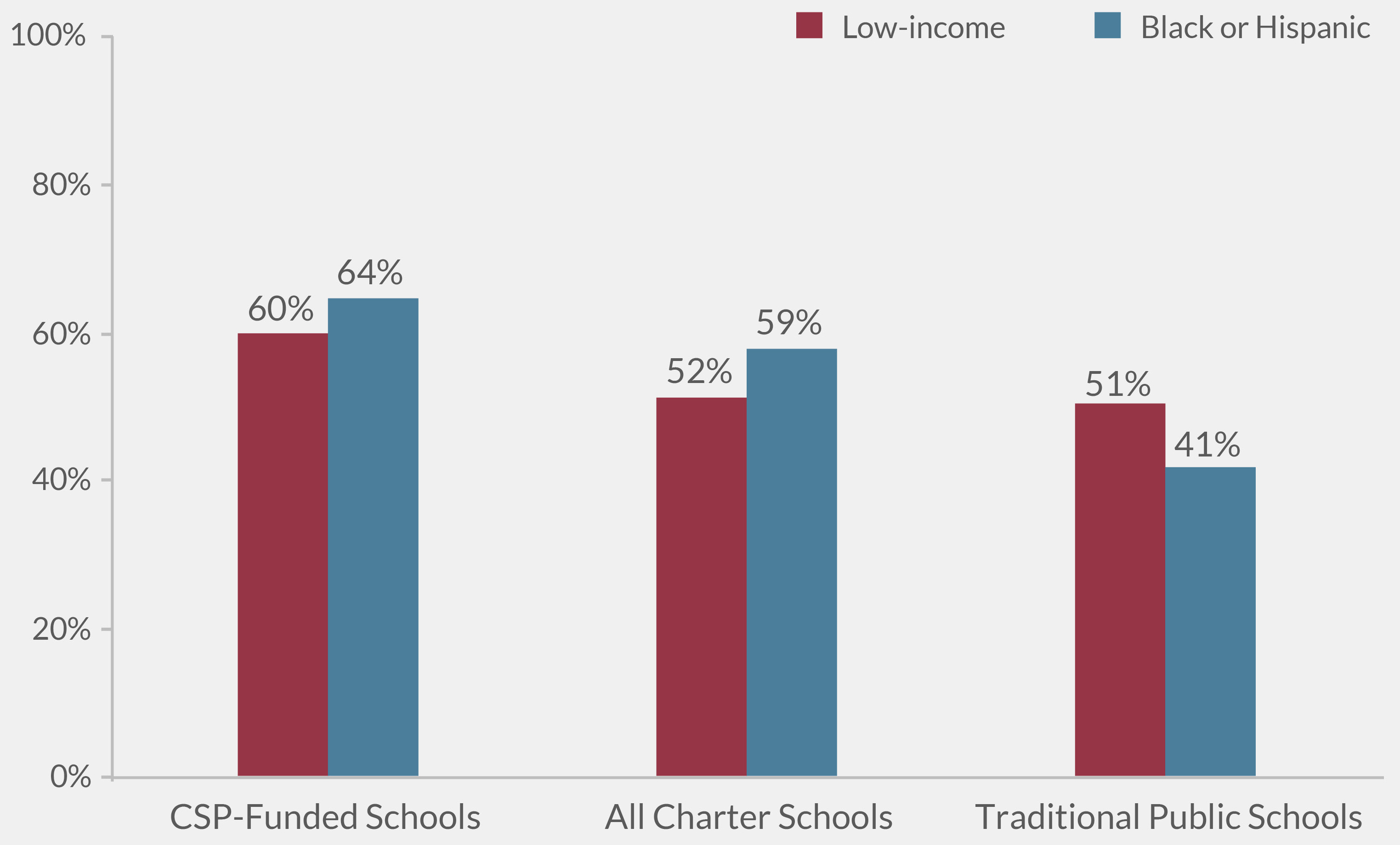
The charter school sector serves higher rates of low-income and Black and Hispanic students compared to traditional district schools. Charter schools that are recipients of federal CSP grants serve even higher rates of low-income and Black and Hispanic students: fully 60 percent of students in CSP grantee schools are from low-income backgrounds, and 64 percent are Black or Hispanic.

Figure 1. Percentage of study population that is low-income and Black and Hispanic, by school type

kr 9920

Source: Data for CSP-funded and traditional public schools obtained from the U.S. Department of Education and NCES CCD.

Without the start-up funding provided by the CSP, many of these schools simply would not exist: Just nineteen states and D.C. provide start-up or planning grants to new charter schools, and those that do provide far less than a charter school typically needs. And philanthropic dollars, while critical for some charter schools, are unevenly distributed across the sector. Just one-third of all charter schools receive 95 percent of all philanthropic support, while 34 percent of charter schools receive no philanthropic support at all. It’s more than likely that these already-limited sources of start-up funding will become even more constrained as the current health and economic crises wear on. 

In a new report released last week, my colleagues and I offer a non-partisan look at the CSP to better situate the debate in its true context, looking deep into the history of the program, its current design, and some common critiques. Consider this a Congressional Research Service–type report for those who want the facts about what the program is, how it works, and how it could be improved.

To be sure, the CSP isn’t perfect. For example, although “supporting innovation” is one of the goals outlined in the legislation, and innovation is a core component of the charter school theory of action, Congress and the U.S. Department of Education (USED) have struggled to assert innovation as a central goal of the CSP. As a result, not all elements of the CSP’s subprograms are designed to encourage innovation or tolerate appropriate levels of risk. This makes it too easy for stakeholders to misinterpret charter school closures as a waste, rather than as an investment in the process of innovation that the sector overall can learn from.

There’s also more that can be done to strengthen the CSP’s data collection processes to ensure that Congress and USED have the information they need to rigorously evaluate the success or failure of the CSP overall or its individual subprograms—and, just as importantly—aren’t collecting a slew of data they don’t need.

But while some Democratic and Republican lawmakers would have us throw the program out altogether, we offer a set of recommendations for how to strengthen the CSP so that it can continue to support high-quality schools for high-need students:

  • Support charter schools’ access to facilities by increasing the annual appropriation to the Credit Enhancement and SFIG programs and by addressing key challenges in these programs that will enable them to support more schools.
  • Support schools that serve high-need student populations by retaining the CSP’s current focus on low-income students and other underserved groups, including those in rural communities and Native American students, and by finding new ways to prioritize other high-need groups of students, such as those with disabilities or those who are experiencing homelessness or are in foster care.
  • Find new ways to address barriers to equitable access, especially enrollment processes and transportation.
  • Assert and protecting innovation as a central goal of the CSP by articulating the role that innovation plays in developing a high-quality charter sector and ensuring that the design of CSP subprograms supports that goal.
  • Better measure, capture, and communicate the CSP’s impact by articulating a clear vision for the CSP overall and aligning data collection and analysis processes to that vision.

It’s more important than ever to shore up resources for schools, especially those that serve high-need communities disproportionately affected by Covid-19. Preserving and strengthening the federal CSP must be a core component of that effort.

Kelly Robson, Ed.D, is an Associate Partner at Bellwether Education Partners.

view

Months without play dates, hugs from grandma, and trips to the library

Victoria McDougald
9.9.2020
Flypaper

Around six months ago, stay-at-home orders and school closures upended normal life for children of all ages across the United States. The loss of academic learning has been a huge concern, but we’re not talking enough about the implications of long-term “social distancing” for babies, toddlers, and preschoolers.

As a parent who has been trying to work from home while caring for two little ones around the clock, I was initially more worried about my husband’s and my mental health. Our three-year-old son and one-year-old daughter have never been healthier—not mixing with other kids has some advantages—and both are relishing the extra time with mom and dad. Our son even recently declared that he never wants to return to daycare, which I’m sure will come back to bite us down the line.

But I know that even in our very fortunate situation, where we’ve had the flexibility to work from home, our small children are still missing out on important opportunities to grow and learn because they can’t leave the family cocoon. Given the brain’s incredible development during the first few years, isolating small children for an extended period of time surely isn’t a good thing. Many young children have been away from peers, caregivers, extended family members, and other adults, as well as all manner of stimulating activities outside the home, from playgrounds to grocery stores to story time at the library, for nearly half a year now. As states continue to roll back social distancing measures, and as families begin to leave the confines of their homes, will we be able to make up for what’s been lost?

We just don’t know yet. But parents, educators and experts would be wise to consider the impact of the current crisis on America’s youngest citizens, and how best to mitigate it.

It’s well known that young children learn and develop social skills through playing and interacting with others. An expert I consulted on this topic, Kate Zinsser, associate professor of psychology at the University of Illinois at Chicago, explained: “Learning, especially for very young children, cannot happen in a vacuum and is grounded in social interactions. Right now, children simply do not have as many opportunities to practice interacting with and learning from a variety of people across a variety of contexts. Loss of interactions with caregivers and opportunities to practice social skills with same-aged peers will eventually take its toll.”

Children also thrive on routines, which can help them learn to anticipate and regulate their emotions and meet social expectations. My son’s daycare class followed the same general schedule every day, which helped kids know what to expect and how to transition between activities: After naptime, we have our snack and then get to play outside. But during the current crisis, even the best-planned, color-coded, Pinterest-inspired family schedules often fall victim to the daily chaos of simultaneously trying to keep up with child care, meal prep, and housekeeping while coping with time-sensitive work demands.

The current crisis has likely had an especially harmful effect on disadvantaged children, who often have less access to space to play inside and exercise outdoors, and who will be disproportionately affected by parents’ diminished income, which may bring losses of safe housing and healthy food.

“Many in the field are considering the events of this pandemic to be a pervasive collective trauma for young children, but some children will be more negatively affected than others,” Zinsser said. “When coupled with the loss of access to supportive high-quality learning environments, this adversity will undoubtedly widen the already existing gaps in school readiness and well-being.”

As a new school year gets underway, parents now face the excruciating decision of whether and when to return their young children to preschools, play groups, and childcare centers. Parents, caregivers and educators will also need to consider how to adjust care in light of the social and emotional damage and potential trauma that children and families have experienced in recent months. Erratic and challenging behavior will be normal, Zinsser said, and “drop-offs will be hard at first.”

But, she added, “with love, support, and sensitive care, children are incredibly resilient.”

For toddlers, reading stories aloud and discussing characters’ feelings and actions may be helpful now, as always. And all who can should continue to strategize about ways to help particularly vulnerable children, such as those living in poverty, those exposed to domestic violence or those with substance-addicted caregivers.

While 2020 has pushed many of us to our limits, we parents should not abandon hope. However challenging the past six months have been, social distancing has also served as a poignant reminder of how important our community networks and supports are to our daily lives and happiness. That lesson is worth noting and appreciating, even as we collectively struggle with the ongoing crisis.

Editor’s note: This story was produced by The Hechinger Report, a nonprofit, independent news organization focused on inequality and innovation in education.

view

A virtual scramble: Google searches in the time of Covid-19

Amber M. Northern, Ph.D. | Jeff Murray
9.9.2020
Flypaper

Upon the pandemic-induced closure of schools across the country this past March, millions of students and parents were thrust into a brand-new world of remote learning. Where else would they turn for help but the internet?

A recent NBER working paper examines the frequency and type of online searches for learning resources conducted in the United States in this volatile period. The analysts, based at Boston University and RAND Corporation, use nationally representative Google search data to document in real time how parents and students sought out online resources. Specifically, their outcome measures of search intensity come from Google Trends, which makes publicly available weekly measures of internet search behavior both nationally and by Designated Market Area (or DMA)—of which there are 210 in the U.S. DMAs are defined by the Nielsen Company of television ratings fame and comprise mutually exclusive groups of counties in all fifty states and are ranked by size. New York City is top, Los Angeles number 2, Chicago third, etc. The analysts’ search-intensity measure calculates the fraction of a given DMA’s Google searches devoted to that term or topic. They also use county-level demographic data from the Census Bureau’s American Community Survey to generate DMA-level demographic data.

The methodology requires some explanation before we can delve into the findings. The analysts use a difference-in-difference strategy to estimate how Covid-19-induced demand for online resources changes over time and how that demand varies by a range of geographic and socioeconomic factors. They first assembled a list of forty-five keywords related to online learning, then downloaded weekly search data from June 2015 through May 2020, ranking the forty-five keywords by national popularity. Then they identified the ten most popular of those keywords in each of two buckets: one related to branded online learning resources (like Class Dojo or Schoology) that they also refer to as school-centered resources, and one related to general or generic online learning resources (such as “online learning,” “home school,” and “math worksheets”). These they dub parent-centered resources.

The difference between the two categories is important for interpreting the findings. Based on the terms and their popularity ratings under the category of branded or school-centered resources, these are likely to be resources with which students were interacting as part of their school’s pandemic pivot to remote learning. Google Classroom and Khan Academy were far and away the most-searched keywords across the country, followed by Kahoot and Seesaw. Presumably, on the one hand, families were looking up such resources not because they didn’t have them and wanted them, but because their kids were suddenly needing or using them per their schools’ requirements. On the other hand, the general or parent-centered resources are likely additional supports being sought out by individuals to supplement or replace the more formal, brand-based remote learning resources.

The analysts calculate the differences in search intensity as compared to the same weeks in prior years. Their analysis covers all fifty-two weeks in the most recent year of data other than the week starting March 1, 2020, when states began discussing closures. The other four years of data are used to identify “week of year” effects. They also examine overall post-Covid-19 increases in search intensity compared to the same weeks in prior years; specifically because nearly all schools were closed between March 16 and March 23, they estimate the average increase in search intensity in April and May 2020 when schools and parents were fully aware of the scope of the disruption.

Two topline findings are worthy of discussion. First, nationwide search intensity followed regular patterns until March 2020, at which point the nationwide search intensity dramatically increased for both types of resources—roughly doubling by late March—relative to similar months in prior years. Search intensity then started to drop off, presumably since folks found what they needed and or because the school year was nearing an end in May or June. Second, growth in post-Covid-19 search intensity varied by geography and socio-economic status, with weekly search intensity for learning resources increasing significantly in areas with higher income and better technological access. For example, search intensity for resources was roughly twice as high in high-socioeconomic-status (SES) areas than in low-SES areas. Individuals in low-SES areas searched 36 percent more intensely for school-centered resources, but those in high-SES areas searched an additional 48 percent more intensely. Moreover, search intensity for school resources increased by an additional 15 percent, with every additional $10,000 in mean household income and by a roughly additional 50 percent with every 10-percentage-point increase in the fraction of households with broadband internet and a computer.

The analysts close their report with a set of implications for policymakers, saying that school leaders may want to prioritize access to home computers and broadband internet, and that improving access to and engagement with online learning platforms will be an important step in equalizing learning opportunities. This makes sense, given the longstanding digital divide upon which the pandemic has shone a bright light. Plans are in place to continue monitoring these data into fall 2020. It is possible that the digital divide could be smaller then, due to federal assistance, state-level efforts, repurposing of existing funds, and other charitable efforts. Let’s hope that those later results close some gaps revealed in this first spring scramble.

SOURCE: Andrew Bacher-Hicks, Joshua Goodman, and Christine Mulhern, “Inequality in Household Adaptation to Schooling Shocks: Covid-Induced Online Learning Engagement in Real Time,” NBER Working Paper #27555 (July 2020).

view

Rural districts’ Covid-19 response

Jessica Poiner
9.9.2020
Flypaper

The National Center for Rural Education Research Networks (NCRERN) is a recently established organization out of Harvard that studies and supports a network of rural school districts in New York and Ohio. To better understand how these districts were navigating the pandemic, NCRERN staff conducted phone interviews with district officials and other leaders. They spoke to representatives from forty of their forty-nine partner districts during the month of April, approximately three to five weeks after school shutdowns. This summer, they published a report that outlines the results in four key areas: meeting students’ basic needs, facilitating access to learning, educating students, and building community.

Districts focused on three aspects of basic needs: access to food, physical safety, and mental health. When schools officially closed, the education departments in both states emphasized how critical it was for districts to continue distributing meals. Many families were unable to leave their homes or arrange transportation to school sites, so districts had to get creative. Some rose to the challenge by creating meal delivery programs where school bus drivers dropped off food at designated stops or delivered it door to door.

District officials were worried that students might be experiencing physical abuse at home and couldn’t seek help. Their concern is understandable: In-person classes allow teachers and staff to keep an eye out for signs of abuse and neglect, but virtual learning makes that far more difficult. To complicate matters further, districts struggled to get in touch with some families despite intensive outreach efforts. In an effort to connect with these missing students and ensure their safety, some schools sent school resource officers to conduct wellness checks.

Addressing students’ social and emotional health was also a top priority. In fact, based on interview responses, districts appeared to place more emphasis on supporting students’ mental health than on academic progress. For the most part, teachers were responsible for addressing mental health concerns. They identified struggling students and connected them with school counselors, social workers, and psychologists. District officials also expressed frustration with the lack of social and emotional health resources at their disposal.

As far as learning access, rural districts in both states reported that, like their suburban and urban counterparts, students were struggling with connectivity issues. Twelve districts in New York and an additional three in Ohio had one-to-one device programs in place prior to the pandemic, making their transition to remote learning a little easier. Most schools were able to distribute devices to students who needed them. A lack of stable internet access, though, proved to be a major problem. The magnitude varied—some districts only had a handful of students without internet, while others reported as many as 33 percent—but nearly every district acknowledged the issue. School leaders took several approaches to address it, including creating community maps that displayed locations with free Wi-Fi, purchasing cellular data plans for students, connecting families with low-cost internet, and buying and distributing individual hotspots. One district reported spending more than $25,000 for ninety-seven hotspots.

In terms of educating students via distance learning, districts focused on instruction, curriculum, grading, and student engagement. Instruction took one of three forms: synchronous online learning, asynchronous online learning, or self-guided learning through packets or workbooks. Many teachers focused on reviewing previous content rather than presenting new material. Districts also reported that mimicking a typical six-hour school day on digital platforms like Zoom was difficult for students, so they limited online hours. Grading practices varied. Some districts maintained their normal standards, while others transitioned to pass/fail or other more “flexible” approaches. Methods for taking attendance also varied, though most schools linked it to completion; students were marked present as long as they submitted assignments.

The trickiest metric to measure—but also the most interesting to district leaders—was student engagement. Seventeen districts reported tracking it in quantifiable terms. They had an average rate of 75 percent, though numbers ranged between 20 and 95 percent and varied based on classroom and grade level. District officials shared that it was difficult to determine whether low engagement was due to Covid-19-related barriers, such as limited internet access. Overall, engagement seemed to mirror in-person patterns; students who were highly engaged in-person were more likely to engage in distance learning.

The final priority for rural districts was maintaining community. Communication was vital, and districts used a variety of methods to connect with families, including school websites, Facebook Live check-ins, phone calls, social media posts, text messages, emails, home visits, postcards, and letters. Several districts got creative about how to maintain their usual programming in the age of social distancing, and hosted virtual field days, Zoom lunches, art shows, and open mic nights. There was also a consistent focus on celebrating graduating seniors.

The NCRERN staff were careful to note that these results should be interpreted with caution, as not all districts answered every question. The sample size was also relatively small. But the findings, which were published back in July, are still applicable today and don’t just pertain to rural districts. For instance, the report closes with some key questions that policymakers should consider for all districts, not just rural schools. They include how districts can identify effective ways to measure student attendance during distance or hybrid learning, and how schools can deliver the same quality of instruction to all students when some lack access to the internet or internet-enabled devices. Considering how many schools recently reopened using a virtual or hybrid model, these questions seem particularly important—and, unfortunately, remain unanswered. 

SOURCE: Tara Nicola, Alexis Gable, and Jennifer Ash, “The Response of Rural Districts to the COVID-19 Pandemic,” Center for Education Policy Research at Harvard University (July 2020).

view

The Education Gadfly Show: Two years after Janus, why are teachers unions stronger than ever?

9.9.2020
Podcast

On this week’s podcast, Colin Sharkey, executive director of the Association of American Educators, joins Mike Petrilli and David Griffith to discuss the state of teachers unions two years after Janus v. AFSCME, the Supreme Court case that prevents unions from charging agency fees to non-members. On the Research Minute, Olivia Piontek examines how well elementary school test scores predict high school outcomes.

Amber's Research Minute

Dan Goldhaber, Malcolm Wolff, & Timothy Daly, “Assessing the Accuracy of Elementary School Test Scores as Predictors of Students’ High School Outcomes,” CALDER Working Paper No. 235-0520 (May 2020).

The Education Gadfly Show is available on Google Podcasts, Libsyn, Spotify, iHeartRadio, Apple Podcasts, TuneIn, The Podcast App, PodBean, Podbay, Chartable, Castbox, and myTuner Radio.

Fordham Logo

© 2026 The Thomas B. Fordham Institute
Privacy Policy
Usage Agreement

National

P.O. Box 110
Burke, VA 22009

202.223.5452

[email protected]

Ohio

P.O. Box 82291
Columbus, OH 43202

614.223.1580

[email protected]

Sponsorship

130 West Second Street, Suite 410
Dayton, Ohio 45402

937.227.3368

[email protected]