Mobile Navigation

  • National
    • Policy
      • High Expectations
      • Quality Choices
      • Personalized Pathways
    • Research
    • Commentary
      • Gadfly Newsletter
      • Flypaper Blog
    • Events
    • Scholars Program
  • Ohio
    • Policy
      • Priorities
      • Media & Testimony
    • Research
    • Commentary
      • Ohio Education Gadfly Biweekly
      • Ohio Gadfly Daily
  • Charter Authorizing
    • Application
    • Sponsored Schools
    • Resources
  • About
    • Mission
    • Board
    • Staff
    • Career
Home
Home
Advancing Educational Excellence

Main Navigation

  • National
  • Ohio
  • Charter Authorizing
  • About

National Menu

  • Topics
    • Accountability & Testing
    • Advanced Education
    • Career & Technical Education
    • Charter Schools
    • Curriculum & Instruction
    • ESSA
    • Evidence-Based Learning
    • Facilities
    • Governance
    • Personalized Learning
    • Private School Choice
    • School Finance
    • Standards
    • Teachers & School Leaders
    • Think Again
  • Research
  • Commentary
    • Gadfly Newsletter
    • Flypaper Blog
    • Gadfly Podcast
  • Events
  • Scholars Program

Evidence-Based Learning

Displaying 571-600 of 837 results
Commentary
8.4.2022
Evidence-Based Learning, Charter Schools, Governance, Teachers & School Leaders

Impacts of charter school growth on school and neighborhood diversity

Amber M. Northern, Ph.D.

Student demographics in traditional district schools largely reflect patterns of housing availability and affordability within neighborhoods. Much of that is due to strict attendance zoning.


Commentary
8.4.2022
Evidence-Based Learning, Curriculum & Instruction, Governance, Teachers & School Leaders

More evidence that making school easier does students no favors

Adam Tyner, Ph.D., Christian Eggers

It’s one of those zombie mantras that just won’t die: Letting students cut corners, giving them grades they haven’t earned, and generally lowering the bar is a nice thing to do for vulnerable kids—those living in poverty, often with turbulent home lives or mental health struggles to boot.

Commentary
7.28.2022
Evidence-Based Learning, Curriculum & Instruction, Teachers & School Leaders

The problem with “differentiation”

Daniel Buck

Shouldn’t we all seek to individualize instructions to meet each child’s needs? Who could oppose “differentiation”? Well, I do.

Commentary
7.28.2022
Evidence-Based Learning, Curriculum & Instruction, Governance, Teachers & School Leaders

When students feel unsafe, absenteeism grows

Amber M. Northern, Ph.D., Christian Eggers

School shootings are profoundly tragic—scarring not only the families whose children become victims, but casting a shadow over the lives, mental health, and outcomes of the surviving students. But evidence is also clear that it’s not only horrific mass shootings that can lead a child to miss school. Any feeling of not being safe can prompt children and teenagers to stay home.

Commentary
7.28.2022
Evidence-Based Learning, Charter Schools

CREDO examines charter school performance in three cities

Christian Eggers

Are charter schools helping students succeed?

Commentary
7.21.2022
Evidence-Based Learning, Curriculum & Instruction, Governance, Private School Choice, Teachers & School Leaders

In a time of crisis, Catholic schools offered a choice, not an echo

Kathleen Porter-Magee

“New data suggest that the damage from shutting down schools has been worse than almost anyone expected,” the Economist tweeted recently to promote a

Commentary
7.21.2022
Evidence-Based Learning, Curriculum & Instruction

Chatbot nudges boost student outcomes

Amber M. Northern, Ph.D.

“Nudges” to induce specific actions take many forms in education.

Commentary
7.15.2022
Evidence-Based Learning, Curriculum & Instruction, Teachers & School Leaders

How do teachers spend their time?

Mike McShane

One of my favorite quotations comes from J.R.R. Tolkien’s The Fellowship of the Ring. When Gandalf the wizard recounts the story of the ring and the havoc that it has brought to Middle-earth to the hero Frodo, Frodo says to him, “I wish it need not have happened in my time.” To which Gandalf replies, “So do I, and so do all who live to see such times.

Commentary
7.15.2022
Evidence-Based Learning, Governance, Advanced Education, Teachers & School Leaders

Gifted-student screenings often miss poor students who should qualify

Bich Thi Ngoc Tran, Jonathan Wai, Sarah McKenzie

High-achieving students from low-income backgrounds are half as likely to be placed in a gifted program as their more affluent peers, according to our new study.

Commentary
7.14.2022
Evidence-Based Learning, Governance

Beyond free tuition: How college promise scholarships are perceived by awardees

Jeff Murray

Dozens of states and cities provide “college promise” programs.

Commentary
7.7.2022
Evidence-Based Learning, Teachers & School Leaders

On the persistence of the achievement gap

David Armor

I read Mike Petrilli’s very interesting article “How to narrow the excellence gap in early elementary school” in Fordham’s June 2 Education Gadfly Weekly.

Commentary
7.7.2022
Evidence-Based Learning, Curriculum & Instruction, Governance, Teachers & School Leaders

Does keeping students with the same teacher for multiple years boost outcomes?

Nathaniel Grossman

The relationship between teacher and student has profound effects on learning. A new study explores whether schools can strengthen this relationship over time by keeping students with teachers for more than one year.

Commentary
7.6.2022
Evidence-Based Learning, Curriculum & Instruction, Governance, Advanced Education, Teachers & School Leaders

Hope and progress for gifted education

Brandon L. Wright

This is the first edition of “Advance,” a new Fordham Institute newsletter that will monitor the progress of gifted education. Here, Wright recounts recent developments that reinforce two truths: Gifted education is a clear and substantial good, and it can be much better.

Commentary
7.1.2022
Accountability & Testing, Evidence-Based Learning, Curriculum & Instruction, Governance, Teachers & School Leaders

Building better evidence on pre-K by strengthening assessments of children’s skills

Meghan McCormick

Research has found that high-quality pre-K programs can have positive impacts on children’s learning and development, improving outcomes like literacy and math skills in the short-term and even increasing

Commentary
6.30.2022
Evidence-Based Learning, Governance

Baked in: School quality and home values

Amber M. Northern, Ph.D.

If you want to know which schools are good, ask a realtor—so goes the conventional wisdom—and families often do so.

Commentary
6.30.2022
Evidence-Based Learning, Governance

Complicating factors: Evaluating a federal program to increase access to dual enrollment

Jeff Murray

In 2016, the U.S. Department of Education launched an offshoot of the Pell Grant program intended to assist low-income high schoolers in accessing college credit through dual enrollment.

Commentary
6.16.2022
Evidence-Based Learning, Curriculum & Instruction, Teachers & School Leaders

Encouraging progress on “high quality instructional materials”

Robert Pondiscio

As a long-time (and often lonely) curriculum enthusiast, I’ve followed the work of the High-Quality Instructional Materials and Professional Development (IMPD) Network for several years.

Commentary
6.16.2022
Evidence-Based Learning, Governance, Teachers & School Leaders

Bus commutes and their academic impacts in New York City

Jeff Murray

Providing transportation for students to and from school is a basic requirement of most public school districts in America. During the 2018–19 school year, nearly 60 percent of all K–12 students nationwide, public and private, were transported by those ubiquitous yellow buses.

Undefined
6.15.2022
Evidence-Based Learning

Education Gadfly Show #824: Dana Suskind on supporting low-income parents in their children’s early years

  On this week’s Education Gadfly Show podcast, Dr.

Commentary
6.9.2022
Evidence-Based Learning, Curriculum & Instruction, Teachers & School Leaders

“Expert” idiocy on teaching kids to read

Robert Pondiscio

Every teacher of struggling readers has experienced the moment when a student says, “I read it, but I didn’t get it.” It can be a bewildering experience. Why don’t they get it?

Commentary
6.9.2022
Evidence-Based Learning, Curriculum & Instruction, Advanced Education, Teachers & School Leaders

Do gifted and talented programs contribute to racial imbalances in elementary school?

Amber M. Northern, Ph.D.

The clatter that rose in late 2021 over New York City’s plan to phase out its gifted and talented (G/T) programs had much to do with the presumed negative effects of such programs on racial sorting.

Commentary
6.9.2022
Evidence-Based Learning, Curriculum & Instruction, Teachers & School Leaders

How much do teachers matter in the early grades?

William Rost

A recent CALDER study examines the effects that earlier-grade teachers have on students’ eighth-grade math outcomes by analyzing Washington State administrative data.

Commentary
6.2.2022
Accountability & Testing, Evidence-Based Learning, Curriculum & Instruction, Teachers & School Leaders

How does a child’s religious background affect her choices about higher education?

Nathaniel Grossman

“From Bat Mitzvah to the Bar: Religious Habitus, Self-Concept, and Women’s Educational Outcomes,” a new study by Ilana Horwitz et al., analyzes the college-going rates of women raised by Jewish versus non-Jewish parents.

Commentary
5.26.2022
Accountability & Testing, Evidence-Based Learning, Curriculum & Instruction, Governance, Advanced Education, Teachers & School Leaders

The excellence gap opens early

Michael J. Petrilli

Last week, I provided sobering evidence of the “excellence gap” among twelfth grade students—the sharp divides along lines of race and class in achievement at the highest levels.<

Commentary
5.26.2022
Evidence-Based Learning, Career & Technical Education, Curriculum & Instruction, Governance, Teachers & School Leaders

Getting to work: The effect of school-year employment on student outcomes

Amber M. Northern, Ph.D.

Calls are rising for America’s aging high-school model to modernize, in part by accommodating work experience through hands-on internships or actual employment for students.

Commentary
5.26.2022
Accountability & Testing, Evidence-Based Learning, Curriculum & Instruction, Teachers & School Leaders

Will every high schooler soon have a 4.0?

Adam Tyner, Ph.D.

Scholars and testing companies have been following grade inflation for decades. The first ACT study on the topic dates to the mid-1990s, while researchers have used SAT data to study grade inflation since the 1970s.

Commentary
5.19.2022
Accountability & Testing, Evidence-Based Learning, Curriculum & Instruction, Governance, Teachers & School Leaders

The excellence gap and underrepresentation at America’s most selective universities

Michael J. Petrilli

America’s education system suffers from a variety of “excellence gaps”—sharp disparities in performance by race and class at the highest levels of academic achievement. These gaps explain why college administrators turn to various forms of affirmative action in order to create freshmen classes that more closely represent the nation’s diversity—actions that may soon be declared unconstitutional. But when do these gaps start?

Commentary
5.19.2022
Accountability & Testing, Evidence-Based Learning, Curriculum & Instruction, Governance, Teachers & School Leaders

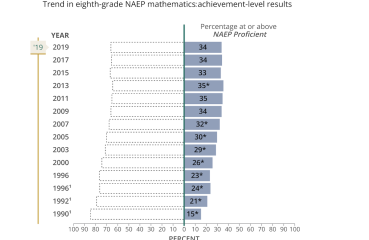
“What do you mean, ‘proficient’?” The saga of NAEP achievement levels

Chester E. Finn, Jr.

As I write this, representative samples of fourth and eighth graders are taking National Assessment of Educational Progress tests in math and English.

Commentary
5.19.2022
Evidence-Based Learning, Curriculum & Instruction, Governance, Teachers & School Leaders

What does teacher certification contribute to outcomes for students with disabilities?

Jeff Murray

Reams of research have reported contradictory outcomes for students with disabilities (SWDs) who are taught in general education classrooms alongside their non-disabled peers versus learning in settings with only SWDs. A new report focuses on teacher certification as a possible mechanism to explain the variations in outcomes.

Commentary
5.19.2022
Evidence-Based Learning, Curriculum & Instruction, Governance, Teachers & School Leaders

More data on the impact of remote and hybrid learning during the pandemic

Julia Wolf

Throughout the pandemic, we encountered much speculation about the impact that remote learning would have on student performance. The expected learning loss was a concern not just of American parents and educators, but of citizens all around the world.

Pagination

  • First page « First
  • Previous page ‹ Previous
  • Page 16
  • Page 17
  • Page 18
  • Page 19
  • Current page 20
  • Page 21
  • Page 22
  • Page 23
  • Page 24
  • Next page Next ›
  • Last page Last »

Type

  • Book (1)
  • Commentary (814)
  • Event (1)
  • Podcast (9)
  • Report (4)

Topics

  • Accountability & Testing (504)
  • Advanced Education (267)
  • Career & Technical Education (84)
  • Charter Schools (1117)
  • Curriculum & Instruction (1594)
  • ESSA (129)
  • (-) Evidence-Based Learning (837)
  • Facilities (25)
  • Governance (1416)
  • Personalized Learning (51)
  • Private School Choice (140)
  • School Finance (169)
  • Standards (190)
  • Teachers & School Leaders (1456)

Date

  • 2026 (89)
  • 2025 (124)
  • 2024 (161)
  • 2023 (129)
  • 2022 (138)
  • 2021 (111)
  • 2020 (37)
  • 2019 (47)
  • 2007 (1)
Fordham Logo

© 2026 The Thomas B. Fordham Institute
Privacy Policy
Usage Agreement

National

P.O. Box 110
Burke, VA 22009

202.223.5452

[email protected]

Ohio

P.O. Box 82291
Columbus, OH 43202

614.223.1580

[email protected]

Sponsorship

130 West Second Street, Suite 410
Dayton, Ohio 45402

937.227.3368

[email protected]