Mobile Navigation

  • National
    • Policy
      • High Expectations
      • Quality Choices
      • Personalized Pathways
    • Research
    • Commentary
      • Gadfly Newsletter
      • Flypaper Blog
    • Events
    • Scholars Program
  • Ohio
    • Policy
      • Priorities
      • Media & Testimony
    • Research
    • Commentary
      • Ohio Education Gadfly Biweekly
      • Ohio Gadfly Daily
  • Charter Authorizing
    • Application
    • Sponsored Schools
    • Resources
  • About
    • Mission
    • Board
    • Staff
    • Career
Home
Home
Advancing Educational Excellence

Main Navigation

  • National
  • Ohio
  • Charter Authorizing
  • About

National Menu

  • Topics
    • Accountability & Testing
    • Advanced Education
    • Career & Technical Education
    • Charter Schools
    • Curriculum & Instruction
    • ESSA
    • Evidence-Based Learning
    • Facilities
    • Governance
    • Personalized Learning
    • Private School Choice
    • School Finance
    • Standards
    • Teachers & School Leaders
    • Think Again
  • Research
  • Commentary
    • Gadfly Newsletter
    • Flypaper Blog
    • Gadfly Podcast
  • Events
  • Scholars Program

Governance

Displaying 1291-1320 of 1434 results
Commentary
11.13.2019
Evidence-Based Learning, Curriculum & Instruction, Governance, Teachers & School Leaders

All 2019 Wonkathon submissions are in. Here’s what the wonks proposed.

Tran Le

The past decade’s shift to significantly higher academic standards and more rigorous assessments means that many more students are now far below grade-level expectations. In recent months and years, there’s been much debate about how best to help such students catch up.

Commentary
11.13.2019
Accountability & Testing, Governance

The states that are swimming against the NAEP tides

Michael J. Petrilli

The bad news from the latest Nation’s Report Card has us analysts wearing out our thesauruses. The good news is that a handful of states managed to make gains or stand pat on the assessment as their peers went backwards. Most noteworthy are D.C. and Mississippi, the only two locales where low achievers made gains. But several other states deserve credit for maintaining their scores in the face of adversity.

Commentary
11.12.2019
Evidence-Based Learning, Curriculum & Instruction, Governance, Teachers & School Leaders

Driving learning for all students: A framework for Multi-Tiered Systems of Support

Bonnie Hain, Laura Slover

In our work with schools at CenterPoint, we often are asked to help design or support the implementation of research-based, high quality curriculum. Almost invariably, discussions with school leaders turn to the connections among and between the core curriculum and the tiered supports for students who are off grade level and struggling to advance.

Commentary
11.12.2019
Curriculum & Instruction, Governance, Teachers & School Leaders

The best way to help students who are several grade levels behind is to do a better job of following their progress, or lack of it, in the long term

Barbara Gottschalk

By the time struggling students reach middle school, it’s pretty obvious it took time for them to get several grade levels behind. It’s also obvious we have numerous ways to help these students. I’m guessing many other submissions to Wonkathon 2019 describe these strategies and approaches. What isn’t so obvious, however, is what’s causing some students to struggle.

Commentary
11.11.2019
Governance, Teachers & School Leaders

Why hiring more veterans as teachers would benefit them, our communities, and our children

Ryan Hooper

Every year on Veterans Day, we show our gratitude to the men and women who have served our country in uniform. We reach out to a loved one who has served, we thank a soldier in the airport, or we honor them through a variety of free meals.

Commentary
11.8.2019
Accountability & Testing, School Finance, Governance

NAEP 2019: The terrible impact of the Great Recession

Michael J. Petrilli

In previous posts and in comments to the media, I’ve been making the case that the lingering effects of the Great Recession might partially explain the disappointing student achievement trends we’ve seen as of late, both on the Nation’s Report Card and on state assessments.

Commentary
11.8.2019
Accountability & Testing, Evidence-Based Learning, Curriculum & Instruction, Governance, Teachers & School Leaders

To ensure success for all students, state assessment makers must be learners, too

In the last two decades, since states began implementing standardized testing under No Child Left Behind, there has been much debate about the value of those assessments. In Louisiana, where I serve as an Assistant Superintendent, we know measurement of student learning is critical, and tests hold the power to define the academic bar for all students.

Commentary
11.6.2019
Charter Schools, Governance

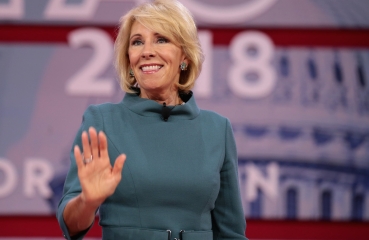
Why reformers will miss Secretary DeVos when she’s gone

Dale Chu

With less than a year to go until the 2020 presidential election, Elizabeth Warren’s ascendancy to ostensible Democratic frontrunner, and the release of her voluminously noxious education proposal, I fell into a fever dream of the same stra

Commentary
11.1.2019
Curriculum & Instruction, Governance, Teachers & School Leaders

To help students who are several grade levels behind, implement IEPs in elementary and middle school

Charles Ogundimu, Ph.D.

The obvious but fundamental question is: Why are the students several grade levels behind? Undoubtedly, the answer is complex and will include, inter alia, insufficient preparation (student and teacher), poor teaching, poverty, inadequate foundation, behavior, and other psycho-social factors.

Commentary
11.1.2019
Accountability & Testing, Evidence-Based Learning, Governance, Teachers & School Leaders

On our Nation’s Report Card, strong leadership gets an “A”

Mike Magee

This week, the federal government released the results of the National Assessment of Educational Progress (NAEP)—known colloquially as “the Nation’s Report Card.” As always, the results are the subject of intense scrutiny, and are fodder for arguments on both sides of the political aisle and all sides of education debates.

Commentary
10.31.2019
Accountability & Testing, Evidence-Based Learning, Curriculum & Instruction, Governance, Teachers & School Leaders

2019 WONKATHON WINNER: Beyond the binary: We can foster equity in both opportunity and outcomes

Abby Javurek

Editor’s note: This was the first-place submission, out of nineteen, to Fordham’s 2019 Wonkathon, in which we asked participants to answer the question: “What’s the best way to help students who are several grade levels behind?”

Commentary
10.30.2019
Curriculum & Instruction, Governance

Classroom content: A conservative conundrum

Robert Pondiscio

The content of K–12 education is a minefield for conservatives. Over the past thirty years, education reformers who wanted parents to have choices for their children have tended to focus more on the creation of new public charter schools, or on private school scholarships, than on curriculum and classroom content.

Podcast
10.30.2019
Charter Schools, Governance, Private School Choice, Teachers & School Leaders

The Education Gadfly Show: On education, Warren’s got a pander for that

On this week’s podcast, Mike Petrilli and David Griffith talk to Checker Finn about Senator Warren’s flawed education proposal. On the Research Minute, Amber Northern examines improvements to the student teaching experience that can help candidates feel more prepared for success in the classroom.

Commentary
10.24.2019
Charter Schools, Governance

An open letter to the Board of Directors of Ascend Learning

Ed Kirby, Ken Campbell

Dear Directors:

Commentary
10.23.2019
Governance

Can that plan, Senator Warren!

Chester E. Finn, Jr.

Senator Elizabeth Warren revealed a K–12 plan on Monday that’s big, substantive—and awful. It would reverse most of the major education reforms of the past two decades, drive a stake through the heart of what’s left of bipartisan federal and state policy, and re-enshrine adult interests (especially those of the teacher unions) in place of children’s, while wasting immense sums of taxpayer dollars.

Commentary
10.16.2019
Evidence-Based Learning, Governance, Teachers & School Leaders

Don’t oversell SEL

Chester E. Finn, Jr.

Social and emotional learning could do much good if deployed in pursuit of academic learning, but it runs multiple risks of going off the rails when its boosters ignore its limitations. It’s in this context that a recent brief by the NewSchools Venture Fund lands. There’s considerable wisdom in it, but leaders and policymakers should be careful what they do with the SEL measures for which it advocates. They should not, for example, incorporate them into accountability systems. Nor should they get so preoccupied with them that they neglect English, math, science, and history, or forget how much those matter in the real world.

Commentary
10.16.2019
Charter Schools, Governance, Teachers & School Leaders

Denver’s rapidly-shrinking school choice tent

Dale Chu

Just weeks away from what could be a watershed school board election, Denver hosted a community

Commentary
10.16.2019
Governance, Teachers & School Leaders

When a school is improving, stay out of the way, warns an important new book

Robert Pondiscio

There’s a not-so-secret tension that separates frontline educators from ed reformers, policymakers, and even district office poobahs. This tension, and the cost of top-down initiatives disrupting what’s working on the ground, form the through line of Eric Kalenze’s important new book, What the Academy Taught Us.

Commentary
10.9.2019
Evidence-Based Learning, Charter Schools, Governance

When it comes to charter schools, it’s Democrats who are in denial

David Griffith, Ph.D.

Dozens of studies have found black and brown students in urban charter schools make substantially more academic progress than otherwise similar students in traditional public schools; literature suggests achievement in district-run schools increases in response to competition from charters; and Fordham’s new study confirms the logical implication of those two strands: an increase in the percentage of students in a community who enroll in charter schools leads to systemic gains.

Commentary
10.9.2019
Evidence-Based Learning, Governance, Teachers & School Leaders

No witch left behind

Dale Chu

Pop quiz: When was the first law providing for public education in America enacted? It’s true that the Bay State passed the first universal education law in 1852, but the very first law put down its roots two centuries earlier, also in what became Massachusetts.

Event
10.9.2019
Evidence-Based Learning, Curriculum & Instruction, Governance

A Moonshot for Kids

What would happen if we invested $1 billion or more in bold education R & D initiatives designed to generate fresh, evidence-backed solutions to some of education’s toughest challenges? On November 5, at 4:00 p.m. ET, online and in Washington, D.C., the Center for American Progress and the Thomas B. Fordham Institute held a a “Shark-Tank” style competition. Ten early-round finalists presented their “billion-dollar Moonshot ideas” to a panel of tough judges, all for a chance to win $10,000 and have their idea propelled to widespread attention and potential major investment.

Commentary
10.4.2019
Governance, Teachers & School Leaders

Restorative justice gone wrong: One mother’s horror story

Julia Carlson

In 2015, I started a three-year journey to acquire my doctorate in educational leadership. On top of going back to graduate school, I was a high school principal. It was a job I loved and for which I felt tremendous passion. The high school I led was plagued by a history of low academic performance, discipline issues, attendance problems, and low morale among faculty and staff.

Commentary
10.2.2019
Curriculum & Instruction, Governance, Teachers & School Leaders

The metric that matters most: Ask kids, “Are you in?”

Robert Pondiscio

Editor’s note: At last week’s PIE Network Summit in Austin, Texas, Fordham senior fellow Robert Pondiscio was asked to participate in a panel discussion on “What is the purpose of education?” His answer to the question consisted of the following remarks.

Commentary
9.25.2019
Accountability & Testing, ESSA, Governance, Teachers & School Leaders

A new era of accountability in education has barely just begun

Michael J. Petrilli

Most states have spent the past decade overhauling their standards, tests, and accountability systems, and finally committing real resources to capacity-building, especially in the form of curriculum implementation. These pieces have only begun to come together in the last year or two, culminating with the release of school ratings as required by ESSA. What’s needed isn’t to spin the wheel of education policy once again, but to show some patience and commitment—and finish what we started.

Commentary
9.25.2019
Charter Schools, Governance

Charter schools point to new ways of racially integrating public schools

Bruno V. Manno

The racial integration or segregation of K–12 schools is again a debate topic in education circles. Today’s controversy has a new twist: casting charter schools as the main antagonist to integration, claiming they resegregate public schools.

Commentary
9.24.2019
Accountability & Testing, ESSA, Curriculum & Instruction, Governance, Personalized Learning, Teachers & School Leaders

In math, grade-level tests are holding back low-achieving students

Joel Rose

Imagine that you’re a sixth-grade math teacher. It’s the first day of school, and the vast majority of your students arrived multiple years behind where they should be. Your job is to teach them concepts such as understanding percentages and dividing fractions.

Commentary
9.18.2019
Charter Schools, Curriculum & Instruction, Governance, Teachers & School Leaders

How charter school attendance affects students’ special-needs status

Amber M. Northern, Ph.D.

Charters schools are often criticized for not enrolling enough or not adequately serving special student populations, particularly students with special needs. A new study by Tufts University’s Elizabeth Setren evaluates this claim with a unique dataset in Boston.

Commentary
9.13.2019
Accountability & Testing, Evidence-Based Learning, ESSA, Governance

Why end-of-course exams are being replaced by the ACT and SAT, and how to reverse that

Anne Hyslop

In the last month, two reports have renewed questions about the current direction of states’ high school assessments.

Commentary
9.13.2019
Accountability & Testing, Charter Schools, Governance

The “Upgrade Rule”: How schools and districts can make school closures work better for families

David Keeling

School closures hurt. While they are relatively uncommon nationwide, they are sometimes unavoidable—and they’re always painful, especially for the students and families who are displaced and who rarely see any educational benefit as a result.

Commentary
9.11.2019
Accountability & Testing, Charter Schools, Curriculum & Instruction, Governance, Advanced Education, Standards, Teachers & School Leaders

The GAS Factor: Lessons learned at Success Academy

Robert Pondiscio

Much of the initial response to Robert’s new book, "How The Other Half Learns," has focused on the winnowing effects of Success Academy’s enrollment process, which ensures that the children of only the most committed parents enroll and persist. But that’s just the start of the story. You have to look at what parent buy-in actually buys: a school culture that drives student achievement, and which can only be achieved when parents are active participants, not unwilling conscripts.

Pagination

  • First page « First
  • Previous page ‹ Previous
  • Page 40
  • Page 41
  • Page 42
  • Page 43
  • Current page 44
  • Page 45
  • Page 46
  • Page 47
  • Page 48
  • Next page Next ›
  • Last page Last »

Type

  • Book (3)
  • Commentary (1256)
  • Event (2)
  • Podcast (82)
  • Report (78)

Topics

  • Accountability & Testing (509)
  • Advanced Education (268)
  • Career & Technical Education (84)
  • Charter Schools (1119)
  • Curriculum & Instruction (1611)
  • ESSA (129)
  • Evidence-Based Learning (849)
  • Facilities (25)
  • (-) Governance (1434)
  • Personalized Learning (51)
  • Private School Choice (144)
  • School Finance (169)
  • Standards (190)
  • Teachers & School Leaders (1474)

Date

  • 2026 (167)
  • 2025 (192)
  • 2024 (189)
  • 2023 (177)
  • 2022 (184)
  • 2021 (220)
  • 2020 (156)
  • 2019 (56)
  • 2018 (11)
  • 2017 (13)
  • 2016 (4)
  • 2015 (4)
  • 2014 (5)
  • 2013 (8)
  • 2012 (11)
  • 2011 (7)
  • 2010 (1)
  • 2009 (2)
  • 2008 (5)
  • 2007 (4)
  • 2006 (1)
  • 2005 (1)
  • 2004 (1)
  • 2003 (1)
  • 2002 (1)
  • 2001 (6)
  • 2000 (3)
  • 1999 (2)
  • 1998 (2)
Fordham Logo

© 2026 The Thomas B. Fordham Institute
Privacy Policy
Usage Agreement

National

P.O. Box 110
Burke, VA 22009

202.223.5452

[email protected]

Ohio

P.O. Box 82291
Columbus, OH 43202

614.223.1580

[email protected]

Sponsorship

130 West Second Street, Suite 410
Dayton, Ohio 45402

937.227.3368

[email protected]