Mobile Navigation

  • National
    • Policy
      • High Expectations
      • Quality Choices
      • Personalized Pathways
    • Research
    • Commentary
      • Gadfly Newsletter
      • Flypaper Blog
    • Events
    • Scholars Program
  • Ohio
    • Policy
      • Priorities
      • Media & Testimony
    • Research
    • Commentary
      • Ohio Education Gadfly Biweekly
      • Ohio Gadfly Daily
  • Charter Authorizing
    • Application
    • Sponsored Schools
    • Resources
  • About
    • Mission
    • Board
    • Staff
    • Career
Home
Home
Advancing Educational Excellence

Main Navigation

  • National
  • Ohio
  • Charter Authorizing
  • About

National Menu

  • Topics
    • Accountability & Testing
    • Advanced Education
    • Career & Technical Education
    • Charter Schools
    • Curriculum & Instruction
    • ESSA
    • Evidence-Based Learning
    • Facilities
    • Governance
    • Personalized Learning
    • Private School Choice
    • School Finance
    • Standards
    • Teachers & School Leaders
    • Think Again
  • Research
  • Commentary
    • Gadfly Newsletter
    • Flypaper Blog
    • Gadfly Podcast
  • Events
  • Scholars Program

Topics

Displaying 151-180 of 421 results
Commentary
9.4.2019
Evidence-Based Learning, Curriculum & Instruction, Personalized Learning, Teachers & School Leaders

Effective social studies interventions for students with emotional and behavioral disorders

Pedro Enamorado

Teaching students to engage with history and civics is important in a democratic society. The critical thinking and communication skills taught in social studies classes are all the more essential to students with Emotional and Behavioral Disorders (EBD) because they equip them to overcome difficulties interacting with and relating to peers.


Commentary
8.29.2019
Governance, Teachers & School Leaders

Merit pay melts away

Dale Chu

Summer ’19 is showing its age: My daughter recently returned to school, bright yellow buses are canvassing my neighborhood again, and Pumpkin Spice Latte is back.

Commentary
8.28.2019
Accountability & Testing, Evidence-Based Learning, ESSA, Curriculum & Instruction, Standards

End-of-course exams benefit students—and states

Chester E. Finn, Jr., Amber M. Northern, Ph.D.

Very little previous research has looked at end-of-course exams. Our new study on their relationship to student outcomes helps remedy that. We learned much that’s worth knowing and sharing. Probably most important: EOCs, properly deployed, have positive academic benefits and do so without causing kids to drop out or graduation rates to falter.

Commentary
8.28.2019
Accountability & Testing, Evidence-Based Learning, ESSA, Governance, Standards

The “left behind” kids made incredible progress from the late 1990s until the Great Recession. Here are key lessons for ed reform.

Michael J. Petrilli

Editor’s note: This is the final post in a series looking at whether and how the nation’s schools have improved over the past quarter-century or so (see the others here,

Commentary
8.28.2019
Accountability & Testing, Governance, Standards

The proficiency bar is inching upward, yes, but…

Chester E. Finn, Jr.

A dozen long years ago, when people were just beginning to take serious stock of what good and not-so-good was emerging from 2002’s enactment of No Child Left Behind (NCLB), we at Fordham, in league with the Northwest Evaluation Association (NWEA), issued a 200-plus page analysis of the “proficiency” standards that states had by then been required to set and test for.

Commentary
8.28.2019
Accountability & Testing, Curriculum & Instruction, Advanced Education, Standards

Influences affecting the educational trajectory of students

Jeff Murray

A new study from Georgetown University reaffirmed an uncomfortable but familiar finding: Socioeconomic status has a significant effect on students’ long-term outcomes, regardless of their academic performance in kindergarten or the quality of the schools they attend in K–12.

Commentary
8.28.2019
Evidence-Based Learning, Curriculum & Instruction, Personalized Learning, Teachers & School Leaders

Can educational data mining predict student performance and enhance personalized learning?

Olivia Piontek

Artificial intelligence and machine learning are ubiquitous, playing a role in everything from Netflix and Instagram algorithms to transportation and healthcare delivery. But it’s also increasingly being used to improve educational pedagogy and delivery through a process called educational data mining (EDM).

Podcast
8.28.2019
Accountability & Testing, Evidence-Based Learning, Curriculum & Instruction

The Education Gadfly Show: Boosting student outcomes with end-of-course exams

On this week’s podcast Mike Petrilli and David Griffith talk to Adam Tyner about the new Fordham report he co-authored with Matthew Larsen on end-of-course exams and student outcomes. On the Research Minute, Amber Northern examines efforts to improve the college application process.

Report
8.27.2019
Accountability & Testing

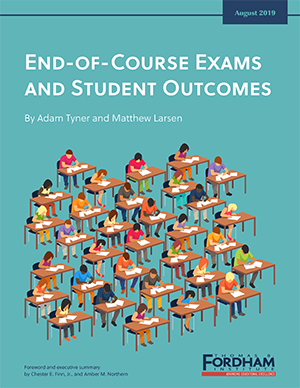
End-of-Course Exams and Student Outcomes

Adam Tyner, Ph.D., Matthew Larsen

Beginning in the late 1990s, many states took it upon themselves to institute end-of-course exams (EOCs) at the high school level, tests specifically designed to assess students’ mastery of the content that various subject-matter courses covered. But was this testing policy good for students? Find out in our new report.

Commentary
8.27.2019
Accountability & Testing, Curriculum & Instruction, Standards

NEW REPORT: End-of-Course Exams and Student Outcomes

Adam Tyner, Ph.D., Matthew Larsen

This report provides a rich longitudinal look at state policies related to end-of-course exams over the past twenty years and the effects of administering EOCs in different subjects on high school graduation rates and college entrance exam scores.

Event
8.23.2019

Getting the most bang for the education buck

(Video credit to AEI, Fordham's co-host for the event.)

Commentary
8.23.2019
Governance, Teachers & School Leaders

The meeting is dead, long live the meeting

Hollie Pettersson, Kerri Briggs

A few weeks back, New York City Schools Chancellor Richard Carranza said that principals would not be required to attend district meetings this coming September.

Commentary
8.21.2019
Accountability & Testing, Curriculum & Instruction, Governance, Standards

The kids who had been “left behind” are doing much better today than 25 years ago. But what about everyone else?

Michael J. Petrilli

The past quarter-century has included dramatic progress of America’s lowest-performing students, many of whom are also low-income and children of color. But how’s the vast middle class doing? It’s a mixed bag: They still don’t read very well, but their math skills have improved a bit and they are graduating from college in higher and higher numbers.

Commentary
8.21.2019
Charter Schools, Governance

Democratic presidential candidates are wrong: Racist redlining caused school segregation, not charter schools

Derrell Bradford

During a political campaign, the savviest candidates excel at two things. First, they offer a compelling message that differentiates them from their competitors. Second—which demands true skill and sophistry—they ascribe all their own failings to those very same competitors, forcing them to answer for political, policy and social issues for which they are not responsible.

Commentary
8.21.2019
Curriculum & Instruction, Advanced Education, Personalized Learning

Can AP ease Gotham’s selective-high-school deadlock?

Chester E. Finn, Jr., Andrew Scanlan

Controversy surrounds New York City’s selective-admission high schools and Mayor Bill de Blasio’s plan to change the time-honored path by which students gain entry to them; the dispute largely concerns how to ration the limited supply of a valued commodity in the face of mounting demand.

Commentary
8.21.2019
Curriculum & Instruction, Teachers & School Leaders

Training teachers and principals to support the needs of diverse students

Tran Le

A new report by William Johnston and Christopher Young from the RAND Corporation examines the perspectives of teachers and principals about their pre-service training programs, with an emphasis on their preparation for work with non-white and low-income students.

Podcast
8.21.2019
Accountability & Testing

The Education Gadfly Show: The homecoming court edition

On this week’s podcast, Jeremy Tate, CEO of the Classic Learning Test, joins Mike Petrilli and David Griffith to discuss what classical learning is and why it’s important. On the Research Minute, Amber Northern examines whether popular children have an outsized influence on their peers.

Podcast
8.14.2019
Curriculum & Instruction

The Education Gadfly Show: Media literacy in our schools

On this week’s podcast, Alice Huguet, an associate policy researcher at RAND, joins David Griffith and Adam Tyner to discuss whether and how K–12 schools should teach students media literacy. On the Research Minute, Adam Tyner examines the effects of flipped classrooms.

Commentary
8.14.2019
Accountability & Testing, Charter Schools, Governance

The messy reality of school turnaround

Dale Chu

Ten years ago, then U.S. Secretary of Education Arne Duncan issued a clarion call to turn around 5,000 of the nation’s most distressed schools, serving nearly three million students. It was an audacious goal set by an audacious leader—the likes of which are in terribly short supply these days. A decade later, states have fallen far short of his challenge, and the sticky problem of failing schools refuses to go away. But experience has provided three lessons to those who would make these efforts.

Commentary
8.14.2019
Accountability & Testing, Charter Schools, Curriculum & Instruction, Personalized Learning, Teachers & School Leaders

The new PDK poll: Gems amid the gravel

Chester E. Finn, Jr.

For more than half a century now, back-to-school time has brought another Phi Delta Kappan survey of “the public’s attitudes toward the public schools.” They invariably recycle some familiar questions (e.g., the grades you would give your child’s schools and the nation’s schools). Other topics, however, come and go.

Commentary
8.14.2019
Accountability & Testing, Teachers & School Leaders

Teachers’ complicated attitudes about school discipline

Peter Greene

I have been there; every teacher has. The clock is ticking, you've got just fifteen minutes left to wrap up the lesson, and the time is being chipped away by a student who is disrupting the classroom. How you respond to that situation involves the balance of dozens of different factors. It's complicated, and some of that complexity is captured in a new report out this week.

Commentary
8.14.2019
Curriculum & Instruction, Teachers & School Leaders

Should schools give children more time to play?

Chester E. Finn, Jr.

The education solar system is endlessly distorted by the extraordinary presence within it of two separate suns with gravitational fields that tug the policy planets in different directions.

Commentary
8.14.2019
Accountability & Testing, Curriculum & Instruction, Teachers & School Leaders

Promising state-led assessment innovations

Pedro Enamorado

In the last decade, states have experimented with many new assessment systems in math and reading. A new Bellwether brief by Bonnie O’Keefe and Brandon Lewis examines recent innovations used or proposed by states that could serve educators well.

Commentary
8.8.2019
Teachers & School Leaders

“Discipline Reform through the Eyes of Teachers” proves Trump was right to rescind Obama-era school discipline policies

Max Eden

When President Trump rescinded an Obama-era directive pressuring schools to adopt lenient discipline policies, almost every major education advocacy organization united in outrage.

Commentary
8.8.2019
Governance

How to not blow the continuous school improvement moment

Eric Kalenze

As I belong to the legion of education professionals that’s usually on the receiving end of the term “top-down,” I’m not too keen on the enterprise’s more top-down improvements.

Podcast
8.7.2019
Career & Technical Education

The Education Gadfly Show: Should all students be prepared for both college and career?

On this week’s podcast, Kate Blosveren Kreamer, deputy executive director of Advance CTE, joins Mike Petrilli and David Griffith to discuss whether we should change the conjunction in “college and career readiness” to “or.” On the Research Minute, Amber Northern examines how teachers and principals view social and emotional learning.

Commentary
8.7.2019
Charter Schools

The federal Charter Schools Program: A short, opinionated history, part III

Chester E. Finn, Jr.

This essay is part of the The Moonshot for Kids project, a joint initiative of the Fordham Institute and the Center for American Progress.

Commentary
8.7.2019
Curriculum & Instruction

The Lost Children of Hirsch: Will a fresh argument for content-rich curricula make a difference?

Robert Pondiscio

The case for content cannot be made too often or too emphatically, but it’s also been made repeatedly for thirty years, to little avail. Natalie Wexler’s new book, "The Knowledge Gap," offers a strong argument for offering a knowledge-rich education to every child, but also documents our frustrating lack of progress. It's one hell of an indictment of American education.

Commentary
8.7.2019
Evidence-Based Learning

Education research: Does the United States have the right model?

Marc Tucker

This essay, which first appeared on Marc’s blog at the National Center on Education and the Economy, illumines the problems addressed by The Moonshot for Kids project, a joint initiative of the Fordham Institute and the Center for American

Commentary
8.5.2019
Governance

An Obama-era regulation is likely to establish unconstitutional racial quotas

Lucas Vebber, William D. Flanders

The Fordham Institute’s recent survey of teachers has brought the issue of discipline reform back to the forefront. But even as teachers say that discipline policies are leading to unsafe educational environments, a new federal rule threatens to further exacerbate the issue.

Pagination

  • First page « First
  • Previous page ‹ Previous
  • Page 2
  • Page 3
  • Page 4
  • Page 5
  • Current page 6
  • Page 7
  • Page 8
  • Page 9
  • Page 10
  • Next page Next ›
  • Last page Last »

Type

  • Book (2)
  • Commentary (352)
  • Event (10)
  • Podcast (49)
  • Report (7)

Topics

  • Accountability & Testing (65)
  • Advanced Education (22)
  • Career & Technical Education (10)
  • Charter Schools (49)
  • Curriculum & Instruction (94)
  • ESSA (7)
  • Evidence-Based Learning (47)
  • Governance (56)
  • Personalized Learning (12)
  • Private School Choice (7)
  • School Finance (5)
  • Standards (15)
  • Teachers & School Leaders (86)

Date

  • (-) 2019 (0)
  • September 2019 (61)
  • October 2019 (70)
  • November 2019 (72)
  • May 2019 (70)
  • March 2019 (69)
  • June 2019 (63)
  • July 2019 (64)
  • January 2019 (63)
  • February 2019 (62)
  • December 2019 (46)
  • August 2019 (54)
  • April 2019 (73)
Fordham Logo

© 2026 The Thomas B. Fordham Institute
Privacy Policy
Usage Agreement

National

P.O. Box 110
Burke, VA 22009

202.223.5452

[email protected]

Ohio

P.O. Box 82291
Columbus, OH 43202

614.223.1580

[email protected]

Sponsorship

130 West Second Street, Suite 410
Dayton, Ohio 45402

937.227.3368

[email protected]