Mobile Navigation

  • National
    • Policy
      • High Expectations
      • Quality Choices
      • Personalized Pathways
    • Research
    • Commentary
      • Gadfly Newsletter
      • Flypaper Blog
    • Events
    • Scholars Program
  • Ohio
    • Policy
      • Priorities
      • Media & Testimony
    • Research
    • Commentary
      • Ohio Education Gadfly Biweekly
      • Ohio Gadfly Daily
  • Charter Authorizing
    • Application
    • Sponsored Schools
    • Resources
  • About
    • Mission
    • Board
    • Staff
    • Career
Home
Home
Advancing Educational Excellence

Main Navigation

  • National
  • Ohio
  • Charter Authorizing
  • About

Thibaut Delloue
10.23.2025
Military personnel writing
Getty Images/Cunaplus_M.Faba
Listen to this article
Loading the Elevenlabs Text to Speech AudioNative Player...

During my second tour as a U.S. Navy officer, I served as a navigator aboard a test warship in San Diego. In port, navigators often have little to do other than prepare for the next deployment. But not every military job is created equal.

On warships, even when tied to a pier, something always breaks, and it’s the Navy’s enlisted men and women who are called upon to fix it. The Navy’s most impressive asset isn’t aircraft carriers, it’s these young servicemembers who, often barely out of high school, roll up their sleeves in the middle of the night to repair a gas turbine, install a new pump, or less heroically, unclog a sewage line. The Navy has mastered the formidable task of turning fresh-faced teenagers into engineers, technicians, radar operators, information systems specialists, chefs, and logisticians.

After completing my military service, I worked for some years as a public school administrator, looking after young people who weren’t too far removed in age from my previous Navy shipmates. Though I entered education with a renewed mission of “making a difference for these kids,” my optimism crashed head-on into the stark realization that school remains a place utterly inept at preparing young people for the world. It’s worth asking why our public education system, which is better funded on average than in nearly every other developed country, isn't capable of doing in 12 years what the military does in a few months.

By the time they complete their initial training, service members have a keen sense of their purpose within the organization they have just joined. When they graduate from high school, however, young people have little understanding of how the system they’ve just been funneled through will prepare them for the job market they are now expected to enter. It’s no wonder our public schools don’t seem to be doing a good job when it’s not clear what their graduates should be able to know or do.

It’s a tired refrain, in fact, to remark that our education system is broken. Our kids’ academic achievement has hit all-time lows, and they’re reporting higher struggles with mental health than ever before. Public confidence in our schools has dropped precipitously since the pandemic. Meanwhile, employers are struggling to hire qualified employees, and college graduates are increasingly finding themselves unemployed. If you only looked at their test scores, you would conclude the average Gen Zer was barely able to tie their shoelaces together. Give them some time aboard a Navy ship, however, and they suddenly become technical experts. The Navy alone trained over 40,000 sailors last year, many newly out of high school, in hundreds of specialties.

Reshaping public schooling to equip young people with the skills and incentives to enter the job market is a potent path to reforming this wayward institution. There is a growing movement in public education, sometimes called opportunity pluralism, to reverse the “college for all” mentality with a system that more meaningfully connects students with employment. As Michael B. Horn and Daniel Curtis have pointed out, despite the decades-long push to increase access to higher education, “many American students have little sense of what jobs and careers are even possible and no concrete understanding of how college might help.”

Career technical education programs, while common in public school districts, generally fail to emphasize school-business partnerships that allow employers to provide mentorship and real-world learning opportunities for students. Apprenticeships, meanwhile, once a common system for upward mobility, have been supplanted by the ballooning college industrial complex. Every year, we invest over $500 billion of taxpayer money in colleges and universities and under $400 million in apprenticeship programs.

Not every high school graduate should have the same credentials or abilities. Specialization is prized in the job market, like in the Navy, because that is what employers want. While many young people leave the school system feeling inadequate, in the military, everyone becomes an expert in his or her trade. Associating “ability” solely with academic proficiency remains one of the most baffling features of our education system.

This is not to minimize the importance of academics or to suggest that “getting a job” ought to be the only function of public schools. Academic knowledge is not only crucial in many occupations, but it’s worthy in itself. Yet research shows that the academic achievement gap is predictable from the moment students enter school, and that instilling academic knowledge in students is best done early. We can both reform the lack of academic preparation in earlier grades while also allowing older learners, as they enter high school, to specialize in more varied types of knowledge and skills that have more direct application to entry-level jobs. And for anyone who assumes that technical trades are beneath academics, I would argue a 19-year-old who can fix a centrifugal pump has a better understanding of physics than his peer who has just completed his high school science requirement.

Because most sailors do not serve past their initial enlistment—generally four years—the Navy must maintain a well-tuned system of job training. Connecting young people with a profession, and even a purpose, may just be the cure to the “anxious generation.”

There are bright spots to follow. The nonprofit organization The Urban Assembly has established a network of career-themed high schools in New York City that focus not only on college readiness but on connecting young people with career fields as varied as health care, software engineering, and the performing arts. And P-TECH, or Pathways in Technology Early College High Schools, is a pioneering school model that allows students to earn both a high school diploma and a two-year postsecondary degree in STEM fields at no cost. There are over 300 P-TECH schools internationally, partnering with 600 companies in sectors like IT, advanced manufacturing, and energy. These models, however, are exceedingly rare and very much alternatives to traditional schooling.

Schools cannot do it alone. They do not direct education policy. It is up to policymakers and education leaders to refocus the function of schools toward what young people will actually do with their education. While the military excels at running its own education system, families are fleeing our actual education system in droves. That benefits military recruiters, but it’s a troubling state of affairs for our schools.

Editor’s note: This was first published by Real Clear Education.

Policy Priority:
High Expectations
Topics:
Career & Technical Education
Curriculum & Instruction
Governance
Teachers & School Leaders
Jeff Murray
10.23.2025
Students testing
Getty Images/hxdbzxy
Listen to this article
Loading the Elevenlabs Text to Speech AudioNative Player...

The types, amounts, and modes of testing done in our schools are subject to debate and analysis, with “too much,” “too often,” “too complex,” and “not helpful” among the many complaints. A new report looks to address these questions by focusing on optional assessments called “benchmark modules.” They appear to counter some of the criticisms of testing—proving popular with teachers and seeming to provide positive impact on students’ end-of-year exam scores.

Data come from Utah, where the state board of education launched benchmark modules for instructional use in 2016. These are available for grades 3–8 in English language arts (ELA), math, and writing, and for grades 4–8 in science. Use was—and remains—optional from the state’s perspective and is typically determined at the school or classroom level. (Parents can also opt students out of these or nearly any test in Utah.) While the state doesn’t report who uses them, that information is collected, and researchers were given access to it down to the classroom level. State policymakers see the modules as a “productivity tool”: short, targeted interim assessments for teachers to understand how students are performing in relation to Utah’s state standards during the course of instruction.

Researcher Kyla McClure of the University of Colorado Boulder looks at administrative data for all benchmark modules assigned by Utah teachers from the 2020–21 through the 2022–23 school years in grades 3–8. Each observation identifies the student, teacher, class, and school, as well as scores on every module, thus allowing those results to be linked to end-of-year test scores. McClure runs fixed effects regressions to estimate the effect of completing benchmark modules on end-of-year outcomes.

Use of benchmark modules more than doubled during the relatively brief period under study, from 486,000 in 2020–21 to 1.3 million in 2022–23. The number of students in Utah also increased over this period, as did the percentage of eligible classrooms and teachers assigning modules (from 26 percent to 50 percent), which accounted for some of that growth. Also relevant was that teachers assigned a growing number of benchmark modules per student per class.

In 2022–23, most teachers who used the modules did not begin assigning them until March, indicating primary usage as preparation for end-of-year state testing. The second largest group included teachers who only assigned modules at or near the start of the school year, perhaps as diagnostic tools. The third largest group comprised teachers who used modules continuously through the year—and the number of such users increased by over 400 percent since 2020–21. Across all three years of the study, teachers gave an average of 2.4 to 4.2 benchmark modules per student, with end-of-year users giving the fewest. Continuous users gave almost triple the number of benchmark modules as the other groups, on average.

McClure finds a small, positive, and statistically-significant relationship between having taken a benchmark module and end-of-year summative test scores. Students who took at least one module in a grade and subject scored about 0.02 to 0.05 standard deviations higher than their peers in the same school or with the same teacher. Students who took an additional benchmark module scored about 0.006 to 0.012 standard deviations higher, on average, compared to students who took one fewer module—a smaller but still statistically significant impact as the number of modules rose. The effect was higher on end-of-year math tests than on ELA tests but near zero on science tests. Scores were higher in classes where modules were assigned continuously throughout the year, versus start-of-year and end-of-year classes.

In the end, this report presents an interesting snapshot. No causal effects can be determined, and mechanisms to explain the observations can only be conjectured at. Are kids responding to the feedback they get via benchmark modules? Do teachers make changes in their instructional approach based on module scores? Does experiencing multiple modules sharpen a student’s test-taking ability? Do school leaders review and address module data with teachers? Utah’s schools and classrooms remain black boxes, but the data emanating from them—especially in terms of this optional interim testing regime—are intriguing.

SOURCE: Kyla N. McClure, “Benchmark Modules: A Better Interim Assessment? Evidence From Statewide Use of Benchmark Modules in Utah,” AERA Open Journal (October 2025).

Policy Priority:
High Expectations
Topics:
Evidence-Based Learning
Curriculum & Instruction
Governance
Teachers & School Leaders
Robert Chung
10.23.2025
Teacher in a classroom
Getty Images/Jacob Wackerhausen
Listen to this article
Loading the Elevenlabs Text to Speech AudioNative Player...

Although teacher quality policies involving salaries, working conditions, performance evaluations, and professional development play important roles across the profession, such factors only matter once one enters the classroom. At least as consequential is who enters the classroom in the first place and their experiences prior to being a teacher: What types of individuals does the teaching profession attract? Do careers such as nursing and social work attract students with the same demographic and academic characteristics as those interested in K–12 teaching? And what types of higher education institutions tend to draw students interested in teaching?

A new study aims to address these questions by looking at the demographics of college applicants interested in teaching in America. It analyzes potential reasons why some groups who enter other fields steer clear of the classroom. Researchers merged eleven years of Common Application data with publicly available information from the National Center for Education Statistics (NCES), the Common Core of Data (CCD), the Private School Universe Survey (PSS), and the Integrated Postsecondary Education Data System (IPEDS) to develop a detailed picture of applicants’ academic and personal characteristics. If one checks a box on the Common App saying that teaching is something they’d consider, the researchers define that as “interest” in the profession.

The authors employ a logistic regression model that compares applicants’ interest in teaching to characteristics like race, gender, and SAT composite score. They also compare the demographic and academic characteristics of applicants interested in teaching and other careers, such as nursing and social work. Finally, they examine which types of postsecondary institutions tend to draw prospective educators, looking at Carnegie classification (school type), distance from home, applicants’ test scores, and other features, such as whether the school is a HBCU or a Hispanic-Serving Institution.

Consistent with prior research and much real-world evidence, they find that women and White students are more likely to be interested in teaching than men and other racial and ethnic groups. The odds of Asian students expressing interest in teaching are approximately 54 percent lower than White students. For Black students, the odds drop further to 60 percent less. Applicants who applied to more selective colleges (and submitted more applications) were also less likely to be interested in teaching, echoing previous studies that found a negative correlation between interest in teaching and such measures as SAT and ACT scores. The authors also examine whether family background and income affect applicants’ desire to go into teaching but find a weaker connection.

While interest in K–12 teaching varies across groups, interest in the profession as a whole has seen a steady decline, dropping 20 percent from 2015 to 2025 (with similar trends seen in school counseling, social work, and therapy). In contrast, careers such as law, business, and nursing have seen mounting interest. Nursing, in particular, saw a 25 percent increase over the same ten-year period. The authors note that, because racial and ethnic disparities in teaching interest are more stark than for other career fields, factors exclusive to K–12 education may help explain the long-standing racial representation gaps seen in the country’s teacher workforce.

College applicants interested in teaching are 45 percent more likely to apply to a less selective college and to one close to home. Students applying to colleges within 50 miles of their homes are nearly 40 percent more likely to flag teaching as a career interest than those applying to colleges more than 500 miles away.

Who wants to be a teacher? Certainly not everyone. Women, White students, and those who pursue less selective colleges seem to show the most interest. Education policymakers and practitioners hoping to alleviate teacher shortages and improve teacher quality would do well to familiarize themselves with the findings of this study, some of which confirms prior knowledge on the teacher workforce. Meanwhile, schools and classrooms across the U.S. can certainly use all the help they can get from prospective teachers.

SOURCE: Brendan Bartanen, Andrew Avitabile, and Andrew Kwok, “Who Wants to Be a Teacher in America?” EdWorkingPapers (September 2025).  

Policy Priority:
High Expectations
Topics:
Evidence-Based Learning
Teachers & School Leaders
Jeff Murray
10.22.2025
Gadfly Bites logo
Listen to this article
Loading the Elevenlabs Text to Speech AudioNative Player...

News stories featured in Gadfly Bites may require a paid subscription to read in full. Just sayin’.

  1. Fordham’s Chad Aldis is among the voices urging Ohio to stay the course on the science of reading, despite disappointing results on state tests in the previous school year. You can count Elyria City Schools literacy specialist Andrea McKenzie among the hopefuls too. Because the kids who started with SoR-aligned curricula in kindergarten in her district in 2022 are now at the all-important third grade year. “This is the moment I have been waiting for,” she said. “I’ve been waiting for these students to get to third grade to see this through, so I feel like this is the year.” (The 74, 10/22/25)

  2. We have already had one occasion in these clips to say hello to Akron City Schools’ new treasurer Wayne Bowers back when he first hove onto the scene proclaiming a gloomy outlook on the future of the district’s finances. Here is a proper introduction, courtesy of a profile from the ABJ. Bowers seems like a good guy, with a clear vision of what he wants and a working knowledge of how things operate. It’s too bad, then, that he’s probably going to be buried in a landslide of sass, as per his eye-opening and all-too-frank descriptions of those operations and how he’s going to try to change them. (Akron Beacon Journal, 10/21/25)

  3. It’s “The state of…” presentation season here in Ohio. Let’s start with the State of Youngstown schools. Everything is great there, based on this reading by the supe, except for those dastardly charter and private school students messing up busing for everyone else. (Vindy.com, 10/21/25)

  4. There is very little detail on the current state of Cleveland Metropolitan School District in this coverage of CEO Warren Morgan’s recent “state of the district” event. Most of the piece is dedicated instead to discussing which buildings are to be closed and consolidated to deal with continuing student enrollment declines and concurrent budget woes. The details are still lacking, but Morgan sounds more serious than ever about those closures. Most tellingly, CMSD’s intradistrict school choice application portal—which typically opens in mid-November for the following school year—will definitely not be opening this November. Likely because everyone will be dealing with a much-reduced number of available buildings and default assignments at that time. (Signal Cleveland, 10/22/25)

  5. Next up is the “state of school transportation” in Ohio, from the perspective of the Ohio School Boards Association. Sounds like the message is there are not enough drivers (blame: Amazon), there is not enough flexibility (blame: “Nobody wants to start at 10 o’clock when there’s buses available”), there is less money (blame: the General Assembly), and there are still too darn many kids (blame: those dastardly charter and private schools). Charming stuff. (Statehouse News Bureau, 10/21/25)

  6. As I have long said, districts clamoring for state-level fixes for their transportation complaints need to be careful what they wish for. Case in point: Senate Bill 93, unveiled in the Finance Committee yesterday, would not only overhaul school funding in a pretty profound way, but would also take student transportation away from districts and create a single countywide system to serve all students who want it, regardless of school type attended. As if those two things won’t generate enough heat on their own, SB 93 also proposes making interdistrict open enrollment mandatory rather than voluntary, and would make it easier for districts to merge. (Cleveland.com, 10/21/25)

  7. To end the day with some great news: Lake Center Christian School in Hartville, Ohio, is on the grow, and its previous (and clearly beloved) community hub had to be converted to additional classroom space to educate all those kiddos. Luckily, the very supportive community (school, citizens, municipal leaders, businesses) helped build a new commons space to keep the historic ties between Lake Center and Hartville tight. You love to see it. (Your Ohio News, 10/22/25)

Did you know you can have every edition of Gadfly Bites sent directly to your Inbox? Subscribe by clicking here.

Policy Priority:
School Funding
Topics:
Governance
Jeff Murray
10.20.2025
Gadfly Bites logo
Listen to this article
Loading the Elevenlabs Text to Speech AudioNative Player...

News stories featured in Gadfly Bites may require a paid subscription to read in full. Just sayin’.

  1. I know the voucher grouchers quoted in this piece are trying to raise alarm at the combined cost of all of Ohio’s private school tuition programs for the 2025 fiscal year. $1.09 billion is a big number after all and it is larger than the amount predicted by the Legislative Service Commission. But I’m with my colleague Aaron Churchill, who is matter-of-fact here about the stunning accuracy of that forecast. Being off by just $50 million in a big program like this—with a ton of highly-variable moving parts over more than a year of time—is as close to being right on the money as you’re likely to find in the annals of state government budgeting. (Ohio Capital Journal, 10/20/25)

  2. Several school district leaders are trying to raise very sudden alarms in this piece also; having somehow just realized that another state budget provision (signed into law more than five months ago) was going to hit them in their bottom line. You can read the details of the issue here, but I regret to say I am not terribly sympathetic—to either the supposed problem or the sudden realization thereof. Surely these guys have many lobbyists whose (highly-paid) job it is to tell them what is in every piece of legislation—enacted or otherwise—and how those provisions will impact their clients. Especially when it comes to the balance sheet. Don’t they? (They do.) And even if they don’t (they do), Aaron has written helpfully about this issue several times before in his usual highly-accessible fashion. And he was right on the money as usual. (IdeaStream Public Media, 10/20/25)

  3. State Representative Kevin Ritter waxes rhapsodic about his recent visit to MAGNET in Cleveland—a wide-ranging program supported by local employers, non-profits, and the State of Ohio—designed to cultivate high-tech skills in students and adults to help fill the pipeline for manufacturing talent in northeast Ohio. He’s talking specifically about something called the Experiential Robotics Platform, their newest whiz bang training and excitifying effort, which will be deployed at a number of buildings in Cleveland Metropolitan School District this year. Sounds good to me as far as it goes, but of course I would like it much better if it weren’t so darned exclusionary. Here’s hoping that charter, private, and STEM school kids in the region are at least permitted to participate in MAGNET programs in other ways…should they ever want to. (Columbus Dispatch, 10/20/25)

Did you know you can have every edition of Gadfly Bites sent directly to your Inbox? Subscribe by clicking here.

Policy Priority:
School Funding
Topics:
Governance
Jeff Murray
10.17.2025
Ohio charter news logo
Listen to this article
Loading the Elevenlabs Text to Speech AudioNative Player...

Stories featured in Ohio Charter News Weekly may require a paid subscription to read in full.

The data—and the details—on chronic absenteeism

Kudos to the Columbus Dispatch for digging deeply into the issue of chronic student absenteeism in charter schools in Franklin County and around the state. Not only do they include data analysis from Fordham’s Aaron Churchill, but they also solicited commentary from two charter leaders. United Schools’ Andy Boy said, “When you don’t have reliable transportation, it’s going to impact your attendance. We don't have control of our transportation unless we take it over on our own.” Which, of course, he has done for the first time this year. Christopher Bond, director of YouthBuild Community School, pointed out that poor attendance at other schools was likely the reason why many of his students ended up with him. “Dropout recovery provides a different equation for a student that’s tried traditional, and they can’t figure it out,” he said. “I think for dropout recovery — it can’t be the excuse…” [for attendance issues and absenteeism] “…it can’t be the why… You have to dig deep and try to find alternative messages ... trying different ways to reach these students and give them a sense of resiliency they haven’t encountered, or weren’t aware of.” Great to see those important stories getting out there.

Specialized schools for student needs

Here is a fantastic, in-depth look at South Florida Autism Charter School (SFACS) outside Miami. It was founded in 2009 to provide area families with a public school tailored specifically for children on the autism spectrum. It began in a library with just 81 students. Today its two-story facility sits on a large campus and services nearly 300 students ranging from kindergarten through age 22. It also provides resources and services, like housing and employment, for adults with severe autism. SFACS is likened to Columbus’ own Oakstone Academy, and it is noted that Ohio, Texas, and Florida collectively account for around 40 percent of total nationwide enrollment in charters dedicated to serving students with special needs. Awesome!

Another week, another big announcement

Spectrum News Ohio reported this week that ResponsiveEd, one of the largest charter networks in the country, was awarded $72 million from the U.S. Department of Education to provide better quality charter school experiences for its students. Chuck Cook, CEO of ResponsiveEd, said, “For over 25 years, we have provided innovative, personalized learning environments, and we are excited to expand our impact, helping more students reach their goals, succeed academically, and transform their futures across four states.” Ohio being one of those states.

Hope-ful

Florida’s Schools of Hope legislation is already having an impact. The program allows charter operators to take up space in any district building whose utilization is below a certain threshold and whose academic performance has fallen below specific parameters for 2 of the previous 3 years. Seems like a lot of criteria, but there are apparently dozens of buildings that meet the definition and charter operators are already reaching out to those districts to ask for space as soon as they are allowed access by law. The new rules require districts to give up the space and to pay maintenance, security, student transportation, and food service costs for qualified charter operators. Objections to requests will be heard by the state, but only minimal reasons for denial are seen in the language. Traditional district supporters are sounding the alarm across the state.

Overturned

Back in July, the elected school board of Jackson-Madison County School System in Tennessee voted to deny the application of a charter school to open in their district, citing financial concerns, among other things. It was the second attempt of the school to meet the board’s demands. Leaders of the Jackson Museum Charter School appealed to the Tennessee Public Charter School Commission and this week the denial was overturned. The school is now back on course to open in fall of 2026, but there’s still one more sticky issue: The elected school board would typically be the authorizer for any new charter established there, as per Tennessee law, but it seems unlikely a majority of members will vote in favor of this arrangement now. Luckily, the state could take up the mantle if the board votes against it. Another twisty tale to watch.

*****

Did you know you can have every edition of the Ohio Charter News Weekly sent directly to your Inbox? Subscribe by clicking here.

Policy Priority:
School Choice
Topics:
Charter Schools
Jeff Murray
10.17.2025
Gadfly Bites logo
Listen to this article
Loading the Elevenlabs Text to Speech AudioNative Player...

News stories featured in Gadfly Bites may require a paid subscription to read in full. Just sayin’.

  1. In case you missed it, we here at Fordham released a new report examining Ohio’s current diploma requirements as well as recent trends in high school graduation and student achievement. As you might have guessed, author Aaron Churchill uncovers troubling discrepancies between graduation and proficiency rates, indicating that many students leave high school without the strong academic preparation they deserve from our schools. Kudos to several TV news outlets around the state who covered the release, including ABC 6 News in Columbus and Dayton 24/7/Now News. If you want kudos, you should read or download the full report from the link at the top of this clip.

  2. The only other story of note today is ongoing confabulation among Columbus City Schools’ elected board members about all of the possible things they might maybe do to potentially perhaps help cut their budget before they most definitely and assuredly hit a fiscal wall. Make of all the hemming and hawing what you will (especially the prospective palaver about potentially conceivably limiting intradistrict school choice). Personally, I’m still waiting for them to actually and verifiably close, vacate, and sell the district’s valuable downtown headquarters property, which they indisputedly voted to do back in December. (Columbus Dispatch, 10/16/25)

Did you know you can have every edition of Gadfly Bites sent directly to your Inbox? Subscribe by clicking here.

Policy Priority:
School Funding
Topics:
Governance
Holly Korbey
10.17.2025
Teacher in a classroom
Getty Images/monkeybusinessimages
Listen to this article
Loading the Elevenlabs Text to Speech AudioNative Player...

Editor’s note: This was first published on the author’s Substack, The Bell Ringer.

Last week, Eric Hirsch, the Chief Executive Officer of curriculum review nonprofit EdReports, announced he is stepping down in June of 2026.

“We’ve helped create conversations about what high-quality curriculum looks like and supported so many in making more informed decisions about materials selection,” Hirsch wrote on LinkedIn.

According to their website, in the last decade nearly 1800 districts serving 18 million students have used EdReports to choose learning materials. Originally launched to help states and districts figure out which curricula were aligned with the Common Core State Standards, EdReports has become the de facto authority for many states in either choosing curricula or helping create lists of approved materials that districts are allowed to choose from. A “green light” from EdReports means to people who make decisions that those reading, math or science materials are going to be “high quality.”

But as EdReports has grown, that prominence has also exposed some pretty big flaws with their process and product. Critics say that what started out as quality recommendations coming from a streamlined review process executed by groups of well-trained educators has, over time, devolved into more uneven reviews.

Reviews are only produced by groups of educators, and no researchers or experts are consulted. And reading and math programs that use techniques unsupported by research have received the coveted “green light,” while others that have been proven successful—often through randomized control trials—have not, creating confusion.

EdReports doesn’t rate materials on whether they have a successful track record in helping students learn, but rather how well they align with Common Core State Standards. And even after they amended their process to try to correct for some of these challenges, experts say EdReports hasn’t gone back and re-reviewed materials using the new criteria—so materials green-lit before remain so today.

“Relying on EdReports blindly is not reliable,” said education journalist Natalie Wexler, who wrote her own widely-read critique examining how EdReports reviews could be misleading to consumers last year.

That would be big news to practically every state leader looking for something good their schools can use. And when I asked a small group of researchers and experts whether a better review platform exists? Also, no. Maybe. With caveats.

I think it goes without saying that curriculum choice, what students actually learn all day at school, is important; research has confirmed it. Using learning materials that are well-designed, organized, and sequential, year upon year, add up to more than the sum of their parts, according to cognitive science, because a store of knowledge in long-term memory is so crucial to the kind of thinking and analyzing we want students to be able to do.

But U.S. schools have just recently jumped back on the bandwagon of believing that using a curriculum—any curriculum—is good in the first place.

Morgan Polikoff, a researcher at the University of Southern California’s Rossier School of Education, told me earlier this year that teachers creating their own lessons from scratch is “ingrained in the American culture of teaching.” A 2022 survey showed that 80 percent of teachers say they often create their own materials and 90 percent of teachers mix and match, using the curriculum and a bunch of other stuff they often find on Google or Teachers Pay Teachers. (This is kind of complicated because obviously some teachers assess that the approved curriculum isn’t any good, so they may be searching around for something better to use.)

It’s also apparent that the idea of a curriculum review platform is a good one. Not every single state leader or board of educators who help make decisions on what to use can be an expert in the efficacy of curricula, Common Core, what teachers will be enthusiastic about using, read all the studies supporting the science of learning, as well as be resistant to (or at least skeptical of) the sweet, sweet marketing tactics of gigantic, influential publishers. That’s a totally unreasonable ask; they need a shorthand.

So schools need curriculum review, and the curriculum review currently on offer is lacking. I wanted to know two things: First, is this shake-up at EdReports a sign of a more comprehensive reform, and what could that look like? And second, are there other review sites doing this well or better? If we dared to dream, what should the perfect review platform look like?

Each review platform looks at one specific aspect of curriculum—and that’s a problem

EdReports dominates the market of curriculum review, but there are others doing this work, also nonprofits like them, also working hard to be objective in their ratings. That’s not the problem, said researcher Holly Lane, director of the University of Florida Literacy Institute and author of the UFLI Foundations phonics program.

The problem is how the different platforms have targeted specific curricular aspects to review, giving a kind of lopsided inspection. “Each of the entities that does these reviews does a good job at it,” she said. “But none are comprehensive enough to be informative for people to make decisions in schools and districts. Each one takes a different angle, and looks at different things.”

EdReports is mainly looking at Common Core alignment. Federally funded What Works Clearinghouse does efficacy reviews of curricula—something that’s desperately needed—but makes them really hard to understand. “They’re great at explaining something to other researchers, but not great at breaking it down in a way that a practitioner can understand,” Lane said. The Knowledge Matters Campaign is looking at knowledge-building, and The Reading League tool evaluates evidence-based reading materials.

To make things more complicated, Johns Hopkins’ Evidence for ESSA, which came about to support districts implementing the Every Student Succeeds Act, rates the quality of the evidence being used to test out different curriculum to see if they work. The quality of the studies is really important, especially since education research standards can be wishy-washy and downright unreliable—but also somehow makes trying to find an evidence-based curricula harder because the quality of the study is quite different from the quality of the material itself, i.e., whether a lot of children learned when using it.

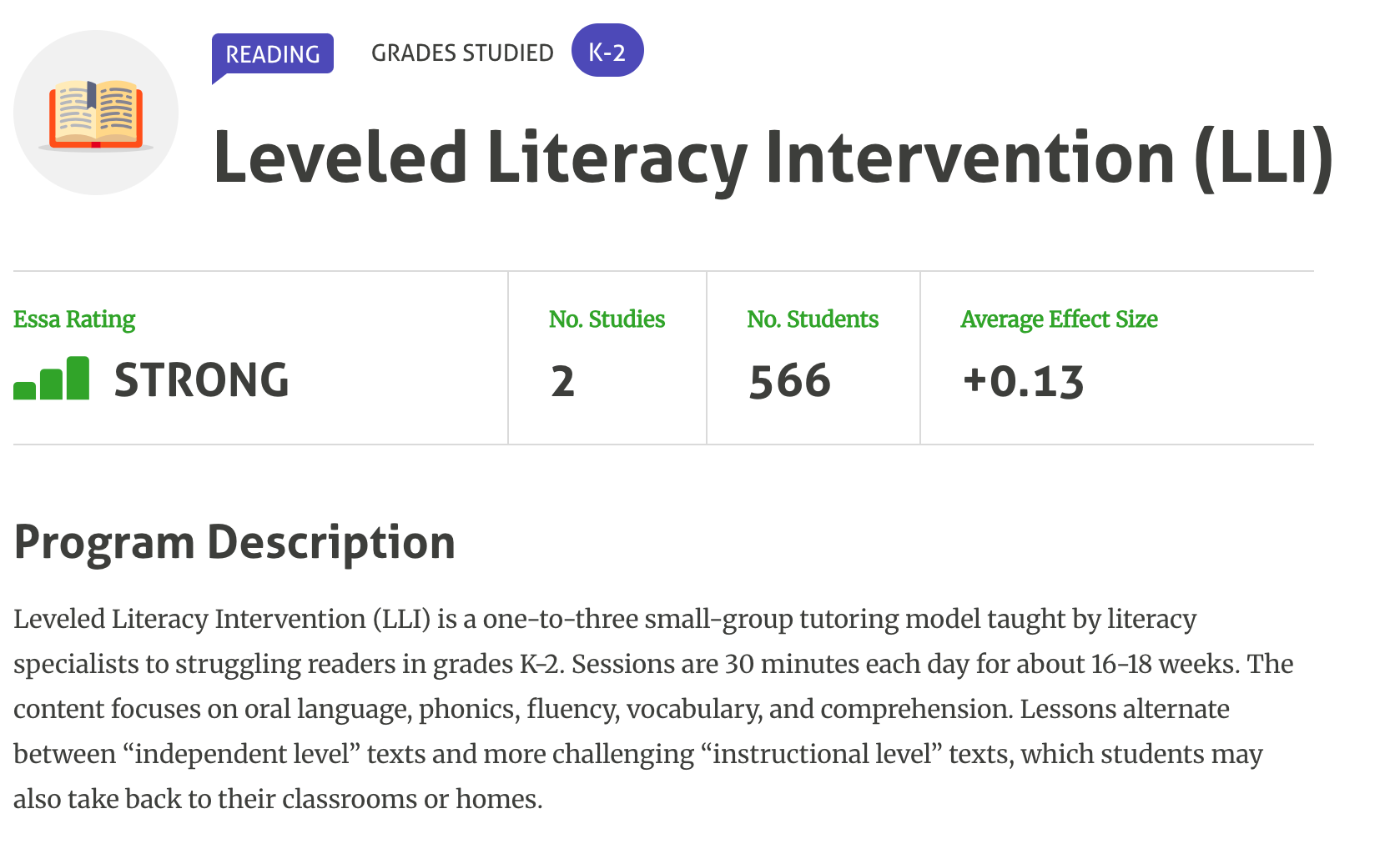
Lane makes this point with an example: Here is the Evidence for ESSA review of Leveled Literacy Intervention (LLI), a small-group tutoring curricula made by Fountas & Pinnell, which has been called out for recommending teaching practices that aren’t supported by evidence.

1

Image source: Evidence for ESSA website.

The green “Strong” rating is given to the quality of the studies used to test this program, Lane said. The effect size for struggling readers, however, is +0.13—a very weak effect size, so small that it’s in a category below having any instruction at all.

That’s extremely confusing. “There are very strong programs out there that, to date, don’t have very strong evidence,” Lane said on a recent podcast, meaning that the program is following the science on how material should be taught, how it should be assessed, etc. but maybe hasn’t been run through a randomized controlled trial. Then there are programs that have strong study quality, like LLI, “but they’re not strong programs.”

Program evidence is often a low priority for decision makers

Adding more complexity to this stew is to understand what state and district leaders are looking for, what they consider important, when choosing curriculum in the first place. If the goal is to get more districts using materials that are supported by scientific evidence and help large groups of students learn a lot—do decision makers put a high priority on evidence and research when choosing?

In one fascinating survey conducted last year, researchers asked school administrators to explain their thinking when weighing one program over another, and to rate a set of considerations in order of importance that included factors like a need for the program, educators’ buy-in, and the evidence base of a program.

“Research evidence was the lowest weighted piece of information,” said lead researcher Cortenay Barrett Morsi, a psychologist at Michigan State University. “The evidence base was the least weighted. The most weighted considerations were things like community buy-in, do teachers like it, do they think they need it, and do they want it.”

“That makes a lot of sense when we think about why there is so much variability in the programs or interventions or supports that are available to students. There’s going to be a lot of variability in what people like,” she said.

Trying to tease out how administrators thought about “research” and “evidence-based” programs, Morsi found that those words were often used broadly to mean several different things. “People actually conceptualize ‘research’ differently,” she said. Asking about research data, she said administrators often said, “I did my research” or “my teachers did their research,” and what they meant was they gathered information about that program from others—neighboring districts, for example, to see how well they liked it.

“When you ask them, ‘OK, well, what do you think about this published randomized control trial?’ That’s a little bit of a different thing—that’s the part of it they’re skeptical about.” Many administrators said research-based curriculum they’d used often “didn’t work.”

“They’re not necessarily like, ‘oh, I don’t value research.’ They’re just valuing this other use of the word, if that makes sense,” Morsi said.

Administrators put high value on whether their teachers liked the program and found it usable, and were concerned about “fit”—whether the program aligned with the values and perspectives already going on at the school. “If a teacher has been trained and they are using a very heavily inquiry-based approach to everything they do, then you bring in something [explicit and systematic] like SpringMath—it really doesn’t fit. It doesn’t go with what they’re doing all day long, right?” Morsi said.

This makes a lot of sense, considering how many districts use and rely on EdReports. Many administrators value educators’ perspectives, and they may not necessarily be thinking about the evidence base for a curriculum’s use.

In a perfect world…

Lane said she believes the answer to all these problems is an FDA-like entity, government-run, that calls balls and strikes on which curricula pass a minimum standard of evidence that children are going to learn while using them. The people who would run this imaginary Federal Education Quality Administration (my creative name) would have expertise in the science of learning, what stands for quality research, the standards, and curriculum design, as well as the realities of classroom teaching.

Individual districts don’t have the capacity—nor should they—to evaluate every curriculum they’re using in classrooms, going to multiple websites and platforms to put all the pieces together. “It’s like expecting doctors to conduct their own drug trials, it’s not doable,” Lane said.

Reviews based on whether certain curricula helped children grow, like the What Works Clearinghouse produces, are good measures of learning but they have “no teeth” to them, Lane said. A federal minimum standard could force publishers to include basic science in the quality of materials if they wanted to get them on the market. “There’s [currently] nothing to say, like we do with food and drugs, you cannot sell this product to the American public, because it doesn’t work,” she said.

Having a government-run, FDA-like review platform might also help eliminate some of the current curriculum reviews’ biggest problems, like conflicts of interest in funding. When the same funders support curriculum review sites and other big-name education platforms, some suggest that has kept prominent literacy and math advocates from having a more open conversation about review sites’ problems.

“No one will speak out about EdReports,” said Karen Vaites, founder of the Curriculum Insight Project. Vaites, an original supporter of EdReports, has been trying to draw attention to the need for reform for years. “One of the key problems is self-silencing around EdReports, people won’t speak truth to power. They are afraid to put their funding at risk, that’s a well-understood problem.”

Even amid all these challenges, other countries are eyeing the curriculum review model to help bolster their own education reforms. When I spoke with Wexler recently, she was preparing for a speaking tour of Australia, where they are thinking of—you guessed it—launching their own nonprofit-style curriculum review platform. She’s going to address how it’s going in the U.S. in her talks to Australian educators and leaders.

“I think they need to reconsider the model [of EdReports],” Wexler said. “Teachers can have input, that’s fine, as long as they’re trained carefully. But even if you’ve done those things, they need expert oversight and guidance. It makes sense to have experts who really understand what makes curriculum good.”

In addition, a lot has changed in the curriculum space and in general knowledge of cognitive science and psychology research over the last decade, Vaites said. Reviews need to reflect those shifts, like whether a curriculum includes whole books or only excerpts; or including how much of learning takes place on a screen, considering the growing body of evidence that reading on paper produces better reading comprehension.

EdReports could take this opportunity, with Hirsch on his way out, to do a whole-cloth reform.

“I would love EdReports to be reformed. It would be perfectly possible for EdReports to say we’re going to materially change our process,” Vaites said. Review quality would improve if the review team included both experts and teachers, and they not only reviewed materials but also went out into districts to see how they were being used in real districts.

“I don’t expect to see that happening. And the biggest reason I don’t expect to see it happening is states aren’t demanding it, funders aren’t demanding it. If people demanded it, it’s possible. Nothing about this is impossible. It would take resources and leadership,” she said.

Policy Priority:
High Expectations
Topics:
Evidence-Based Learning
Curriculum & Instruction
Governance
Teachers & School Leaders
Peter Greer
10.17.2025
Wonkathon
Listen to this article
Loading the Elevenlabs Text to Speech AudioNative Player...

Editor’s note: This essay is an entry in Fordham’s 2025 Wonkathon, which asked contributors to answer this question: “What needs to happen next—at the state, district, and school levels—for the science of reading revolution to fulfill its promise and ensure that far more children learn to read well?” Learn more.

I am not a reading expert, but I have extensive and successful school experience in public, private, international, university, and government settings. And two telling episodes during that experience provide confidence that there are several productive ways to “play it smarter” to fortify the reading revolution.

At the school level, the single most important activity is constant school year testing and evaluation of the students’ progress in reading. By constant, I don’t mean just the quarterly report card. I mean after each unit or during each week.

One telling episode from which I learned was at the time a delegation of educators came to my school from Singapore to learn about our character program. I took that opportunity to ask the delegation what made Singapore a consistent top world-wide education system. Their response was that they constantly tested and assessed student progress. Teams of teachers in each school would make the assessments short-term to find out if there were any student shortcomings as the school year progressed and what was going well in student learning. If there were shortcomings, teacher teams immediately discussed the teaching, the curriculum, the strategies, and the content philosophies and attempted the needed corrections for each student or for each batch of students in need. If there were strong signs of success, the teams attempted to identify why and how and then shared all this with other teacher teams.

What I got out of this explanation was that, by constant evaluation, few if any students fell behind in any subject during each school year. I figured that this meant that, by the middle school grades, fewer students in U.S. schools would have “given up” because they were so far behind (in reading) and begin missing school, acting out, and giving up on their education. Constant assessment of each student’s progress in reading at each grade each year and doing something about it at each grade during the year is essential.

Also important at the school level is the avoidance of program disintegration. So-called model programs often fail when key teachers get sick, leave, or retire. Then the once-successful reading teams must hire new people or train new people. The key is to train as many teachers as possible, even if they are not the official reading teachers. Because the reading program should begin as early as possible, the reading teachers should be training all the elementary teachers with the teaching method, and several of those teachers might become the backup reading teachers for the school.

Also substitute teachers untrained in the reading program being instituted in the school can cause student confusion and waste precious learning time. Although I only instituted the idea in mathematics in one of my schools, I am convinced that offering in-service for substitute teachers who are supposed to teach reading would be beneficial.

Clearly, training of school administrators is a must. This will enable those leaders to know the rudiments of the reading program, to hire more appropriate teaching replacements, and to evaluated reading teachers more precisely and fairly.

At the district level, I am reminded of a second telling episode that was an eye-opener for me. When Boston University took over the Chelsea Public Schools in Massachusetts, it was pointed out to me that grandparents and other family members often were the caregivers for the young children who were not yet in school, or the family members were responsible during school down-time and in the summers. A secured grant from IBM trained family members in reading in conjunction with reading professors from Boston University. This was done via media from Boston University to the homes. This proved to be a far better use of time than family members propping up the youngsters in front of the television to keep them quiet. I would also encourage schools or districts to attempt similar programs for willing parents. About 185 school days should be supplemented at home where possible. Similar grants (or grants for other creative programs) should be pursued at both the district and state levels (corporate and state funds).

Districts should also set up relationships with local college education departments that already teach potential teachers effective (or not) reading methods, or that are open to learning more successful reading methods from the district itself to enhance the college programs and to make sure future teachers of reading are not being taught unsuccessful teaching methods by professors. Chelsea teachers and Boston University education professors had a strong relationship, and teachers could also take Boston University reading and other courses at a reduced rate. The district should also be aggressive in encouraging teachers of reading to share successes and issues during each school year. Model programs don’t often take off, but in this case, the single issue of better teaching of reading might make teachers more interested in what others are doing in the district. Districts should also provide teacher and administrative in-service training in assessment and follow up with all teachers. Districts would be wise to identify college sources teaching reading effectively in order to use those sites for future hiring of teachers.

At the state level, there should be timely (not at the beginning of the reading revolution in a state) regular “reading report cards” during each school year for each district in terms of teacher and student reading progress, and other criteria such as in-service training of personnel. The “report cards” should not be punitive, though they will probably be seen as such by many, but will be an important “encouragement factor” to keep the reading revolution fresh and alive.

“Playing it smarter” to advance the reading revolution means frequent testing of student results and then immediately making corrections and piling on successes; consistent training of teachers, administrators, substitute teachers, and family members; identifying sources of new teachers of reading from good college education department matches; revealing successes from state level gathering of information and reading report cards; and district- and state-encouraged sharing of successful and unsuccessful teaching practices, with follow up.

Policy Priority:
High Expectations
Topics:
Curriculum & Instruction
Governance
Harry Anthony Patrinos
10.17.2025
Fork in the road
Getty Images/monts11
Listen to this article
Loading the Elevenlabs Text to Speech AudioNative Player...

The headlines last month, as the newest results of the National Assessment of Education Progress (NAEP) were released, painted a dire picture of a massive ship taking on water. Indeed, the results were awful. Reading and math scores of high school seniors dropped to their lowest levels in more than two decades.

The NAEP, regarded as one of the best indicators of academic achievement in America’s schools, gave the first results for 12th graders in math and reading since the pandemic. It was hard not to picture sinking: The average score for 12th graders in reading was the lowest since 1992 and almost half of all 12th graders scored below the basic level in math.

As an expert on the economics of education, the fact that these results were for 12th graders stood out. High school seniors are typically embarking on the next phase of life, entering the workforce, the military or college. We know that lower test scores are linked to reduced economic growth; a less-educated workforce hampers productivity. It’s not just students who are on this struggling ship. These scores give insight into our country’s future.

Not often mentioned in the conversation on NAEP scores, however, is a crucial point. This story doesn’t have to end in decline. Evidence from successful education reform shows that we can turn things around with research and decisive action from policymakers, educators, and communities.

Twenty years ago, education reform was a hot topic. No Child Left Behind, President George W. Bush’s signature education law, was signed in 2002 and implementation had begun. Of course, critical to that law were transparency, test-based accountability, and school choice. Major shake-ups to public education, like the growth of public charter schools and teacher merit pay, were in motion.

This was the context in which the University of Arkansas Department of Education Reform in the College of Education and Health Professions, of which I am now chair, was established. The mission? To point the way to improved education outcomes across Arkansas and the nation. The department was designed to make Arkansas a place for rigorous policy research and leadership development.

In 2023, EDRE research played a contributing role in shaping Arkansas’s LEARNS Act, with teacher workforce data explicitly cited in the initiative’s design. Beyond that, EDRE studies help inform multiple policy domains, from absenteeism and teacher grading to English language learners and teacher turnover during Covid-19. My colleagues have been devoted to this work for years.

Two decades later, we are at an inflection point. We face the persistent challenges of teacher shortages, achievement gaps, and questions of equity. The latest NAEP scores clearly demand urgency. And again, researchers and policymakers should turn to successful education reforms to improve student outcomes for the benefit of individuals and our collective society.

At the end of October, the University of Arkansas Department of Education Reform will host a convening tackling this very issue for our 20th anniversary—an opportune time to look at promising reforms that can help guide the next 20 years of education work.

One recent example comes out of the state of Arkansas. In a report released on October 2, researchers from our department, in collaboration with the Arkansas Department of Education, found that the state’s Education Freedom Accounts (EFA) program was demonstrating strong results and substantial growth. The EFA program gives parents financial resources for eligible students to attend an approved private school or homeschool. For the 2024–25 school year, each EFA provided most families with $6,856 per student. Funds are dispersed quarterly.

Originally limited to students with disabilities, those attending F-rated schools, and other disadvantaged groups, the program enrolled over 5,000 students in its first year. By the second year, expanded eligibility increased participation to nearly 15,000 students. As of September, every student in the state is eligible, and enrollment is at nearly 50,000 students—slightly less than 10 percent of the school-age population in Arkansas.

Participating schools administered nationally norm-referenced tests, giving us insight into student achievement. On average, EFA students scored above the national median. While these results are promising, they’re also preliminary. Future research will document the causal effect of the EFA program and EDRE will contribute that research. At this inflection point, we can help guide the ship and improve academic outcomes for students everywhere.

Arkansas and the country are at a pivotal moment. Years of education reform, informed by the department’s research and other state initiatives, have laid the groundwork for true improvement. We can’t ignore that, as a nation, we have a lot of challenges left to tackle, like teacher shortages, achievement gaps, and questions of education equity, but there are opportunities for change.

With evidence-backed policy, strong community support, and academic expertise, Arkansas is positioned to lead, not follow, the national conversation on education reform.

Policy Priority:
High Expectations
Topics:
Evidence-Based Learning
Governance

Pagination

  • First page « First
  • Previous page ‹ Previous
  • Page 78
  • Page 79
  • Page 80
  • Page 81
  • Current page 82
  • Page 83
  • Page 84
  • Page 85
  • Page 86
  • Next page Next ›
  • Last page Last »
Fordham Logo

© 2026 The Thomas B. Fordham Institute
Privacy Policy
Usage Agreement

National

P.O. Box 110
Burke, VA 22009

202.223.5452

[email protected]

Ohio

P.O. Box 82291
Columbus, OH 43202

614.223.1580

[email protected]

Sponsorship

130 West Second Street, Suite 410
Dayton, Ohio 45402

937.227.3368

[email protected]