Mobile Navigation

  • National
    • Policy
      • High Expectations
      • Quality Choices
      • Personalized Pathways
    • Research
    • Commentary
      • Gadfly Newsletter
      • Flypaper Blog
    • Events
    • Scholars Program
  • Ohio
    • Policy
      • Priorities
      • Media & Testimony
    • Research
    • Commentary
      • Ohio Education Gadfly Biweekly
      • Ohio Gadfly Daily
  • Charter Authorizing
    • Application
    • Sponsored Schools
    • Resources
  • About
    • Mission
    • Board
    • Staff
    • Career
Home
Home
Advancing Educational Excellence

Main Navigation

  • National
  • Ohio
  • Charter Authorizing
  • About

Josiah Padley
10.28.2025
Board meeting
Getty Images/panumas nikomkai
Listen to this article
Loading the Elevenlabs Text to Speech AudioNative Player...

School boards—an elected group of community members that sets policy, approves the yearly budget, and establishes a vision for a school district—haven’t been around forever.

In fact, school boards are a profoundly American invention. Puritans first passed the Massachusetts Law of 1647, which established the first public school system in America by mandating that communities of 50 or more households had to hire a schoolteacher to teach students reading and writing. Affectionately nicknamed the “Old Deluder Satan Act,” the law was created to ensure that all children could read the Bible and avoid the machinations of malevolent spiritual forces. Especially considering the difficult homesteading conditions and low literacy standards of the day, this public priority was groundbreaking.

As time marched on, variations on what we now call the school board evolved through organic efforts of community members to improve schools. After the American Revolution, school function and form took a prominent seat at the debating table. In his famous bill A Bill for the More General Diffusion of Knowledge, a bill that aimed to give three years of free education to free girls and boys, Thomas Jefferson outlined his beliefs about the purpose of public education:

[W]hence it becomes expedient for promoting the publick happiness that those persons, whom nature hath endowed with genius and virtue, should be rendered by liberal education worthy to receive, and able to guard the sacred deposit of the rights and liberties of their fellow citizens, and that they should be called to that charge without regard to wealth, birth or other accidental condition or circumstance; but the indigence of the greater number disabling them from so educating, at their own expence, those of their children whom nature hath fitly formed and disposed to become useful instruments for the public, it is better that such should be sought for and educated at the common expence of all, than that the happiness of all should be confided to the weak or wicked.

Education, therefore, was to be a truly liberal, publicly funded freeing of the mind for wealthy and poor alike so that the new republic could benefit from the best leadership possible. (While American education was not truly extended to all until 1954’s Brown v. Board of Education, it’s important to remember that Jefferson’s writings would have stood in stark contrast to the feudalistic pay-to-play attitudes elsewhere in the world at the time.) Partially through Jefferson’s influence, the school board, representing local interests, became an essential part of guaranteeing that schools could truly serve their constituents. Jefferson, for example, believed that a system that put education primarily in the untried, elite hands of the newborn government rather than local groups of parents “is a belief against all experience.”

The process of evolution struggled on, and by the 1820s, American school districts had what Professor Adam Laats calls “a pretty recognizable modern school board.” As the business of organizing schools grew ever more complex, the unpaid members of the school board tended towards educated, competent citizens and the paid position of superintendent was added in order to handle the weight of administrative tasks.

Jefferson’s ideal of a free public school system of “common schools,” a distinguishable ancestor of our system today, emerged in the 1830s. Schools began to be more open to girls in the 1840s. Restricted by the organizational difficulties of the largely rural nation, public elementary schools did not become commonplace nationwide until the late 19th century, with high schools only becoming popular in the 20th century.

According to the George Washington University’s School of Education and Human Development, 55 percent of children between the ages of 5 and 14 were in public schools in the 1830s, rising to 78 percent by the 1870s.

This emphasis on the community-led orientation of school boards has meant that, especially since the Progressive Era, school board races are often held in off-cycle election years and ballots do not list political parties next to candidates’ names. Too much partisan political influence in the race, the argument goes, could lead to national donors and high-profile interest groups meddling in local schools to their great detriment.

School boards today rarely make splashy headlines unless a video of obscene or farcical behavior at a meeting goes viral, as they have unfortunately been doing in increasing numbers. It’s slow, tiresome work, especially for those serving in large urban districts. A 2002 American Enterprise Institute (AEI) study found that board members generally spent about 25 hours per month, usually unpaid, on board business. “Substantial numbers of board members, however-especially those in large districts-spend 20 or more hours a week on board affairs.”

At the same time, the term “school board” is invoked like a spell again and again on both sides of the aisle in the great ongoing battle of the “culture wars.” Everyone, it seems, believes that the health of the nation begins at the local level, when school board members possess robust characters and strong civic inclinations. Both sides tend to agree that a school board should (1) represent the local community, (2) act as strong, healthy vision casters for the school, and (3) fight for academic excellence.

As this civic institution evolves into the 21st century, is it fulfilling its purpose? Should the current national format of school boards be given medicine, and if so, what type and dosage?

Checking in

It’s important that the political makeup of school boards, in general terms, reflect the political makeup of their communities. While a political skew towards one party or another might simply reflect a superior, sophisticated party apparatus, it might also represent national interests and national donors manipulating the strings of these generally low-visibility elections.

An October 2025 report by the Fordham Institute surveyed over 5,000 board members representing over 3,000 national school districts. Since the United States has over 13,000 school districts (most small, rural, and sparsely populated), these data do not fully represent all board members and districts. The Fordham Institute controlled for this sample with limited representation by weighing the results carefully. You can read about their method here.

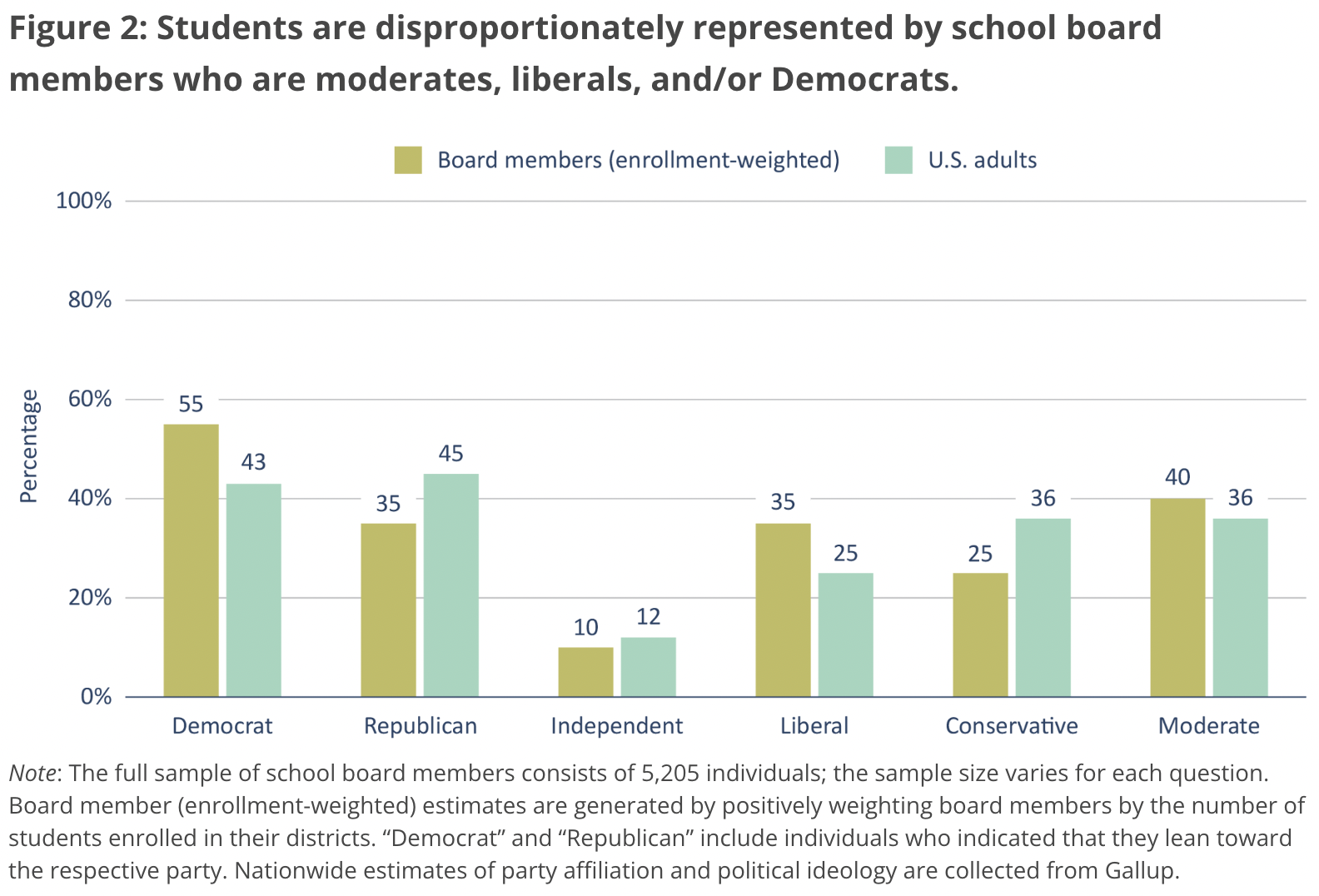
The Fordham Institute found that, nationally, school board members’ party ideologies and leanings map loosely onto the U.S. public’s leanings. However, since most students are in urban areas, a high majority of students tend to be disproportionately represented by moderates, liberals, and/or Democrats, who tend to hold urban seats.
1

However, it also appears that two-thirds of school board members match the political leanings of their district. The Fordham Institute writes, “This pattern suggests that board–citizen mismatches are not the norm but they are also not uncommon. Moreover, these mismatches may be more common in less populated districts.”

So school boards tend to represent their communities politically (though with limited success). However, they don’t necessarily reflect their communities demographically. School board members skew White, female, highly educated, and towards former teachers. This isn’t surprising when one remembers that the majority of school districts are in rural, White areas and that highly educated or former teacher board members are more likely to both be civically involved and elected for their professional competency. Once the Fordham Institute controlled for population, they found that over four-fifths of board members are of the race/ethnicity that is most common among their residents, but such board members represent only two-thirds of all students.

They also noted that if 1:1 ethnic representation did occur, it might not truly signify that board members match their community’s desires. After all, a White community might elect a Black candidate because they believe that she will represent them better than the opposing White candidate might. Political leanings, not ethnicity or gender, likely tell a better story when it comes to accurate representation.

There are a few significant issues where the opinions of school board members tend to differ from those of the American public, including support for charter schools, transgender athletic eligibility, and interestingly, local school quality. School board members were very likely to rate their school more highly than members of the community would rate their school.
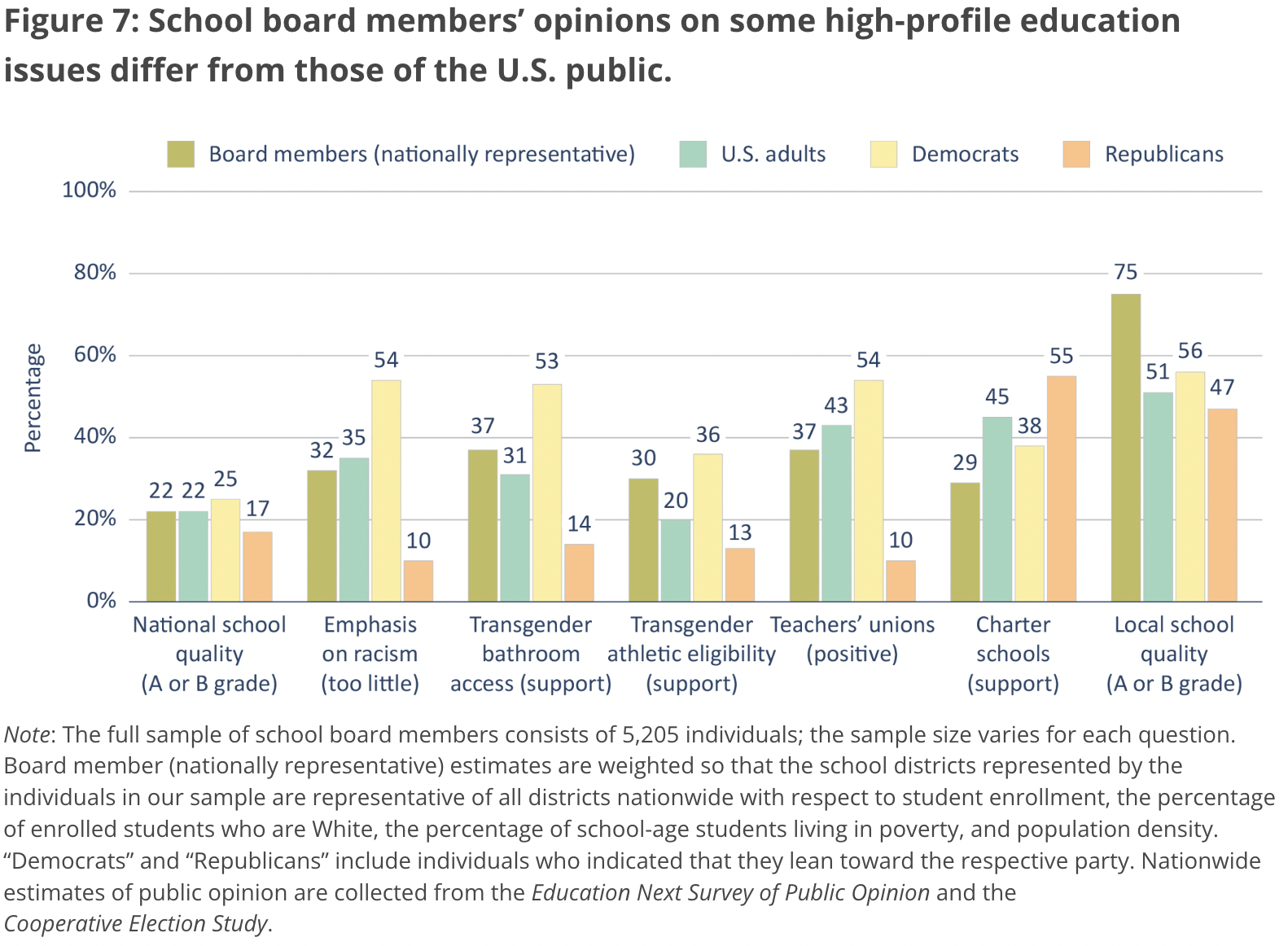
2

However, when the data were analyzed while taking the population differences between dense urban centers and rural countryside districts into account, the Fordham Institute found that a majority of all students (generally, about two out of three) were represented by board members that have views that align with local politics. Fordham also noted that “only about half of school board members hold positions on recent polarizing issues that line up with the party affiliation of the majority of their residents.”

It seems that while the majority of school board members tend to drift more leftward than their communities, board makeups are still somewhat representative of the communities that elected them. But the cracks are widening and have widened dramatically since a similar study conducted in 2002. Today, Hispanics tend to be underrepresented by school boards, and school board members are less likely to hold views commensurate with the average Black citizen than they are with any other group.

One piece of data was cause for significant concern: There’s a large gap between the public perception of how well schools are doing and how school board members rated their schools. School board members are far more likely to rate their schools higher than their community would rate them.
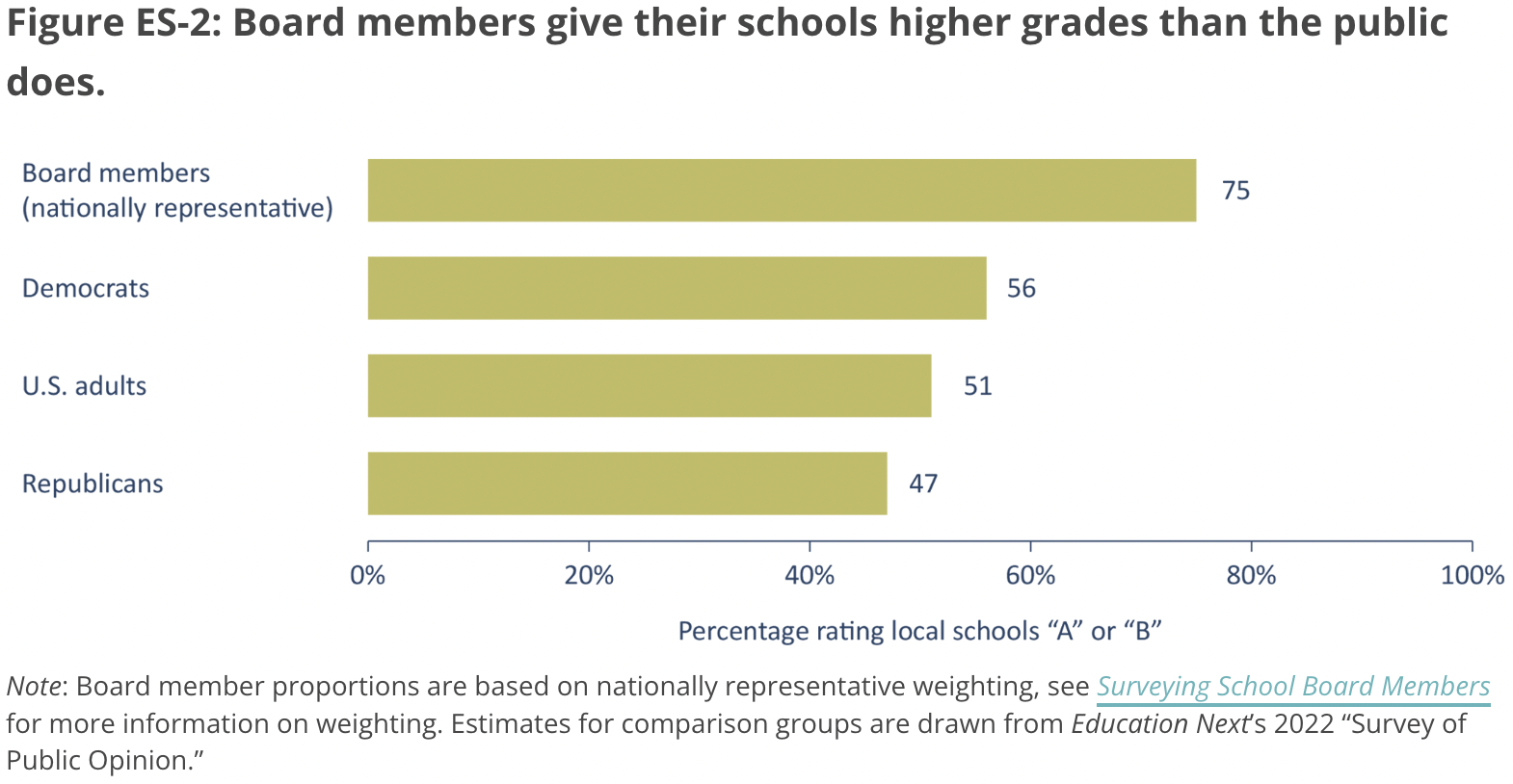
3

The consequences of incorrect perception, likely shaped by a natural inclination towards institutional loyalty and a desire to believe that one is doing a good job on a board, can have tremendous effects. Board members may ignore or dismiss systemic problems and pass budgets that don’t responsibly reflect district needs. They may feel immune to the checks and balances of the system that are represented by the ballot box. And, in an age of the lowest NAEP scores the nation has seen in a generation, it might mean that board members are casting aside their duty to steer the ship back to safety.

There’s no reason to believe that school boards as an institution currently strongly merit any type of creative structural overhaul. But reforms and refreshments are always a good idea. While reforms that aim to insert national partisan politics into local races (like listing party affiliation on the ballot) open the door to out-of-state donor control, other reforms can put the emphasis back on local community development. Local news interviews can ask candidates frank questions about what needs to change in their local school district. Districts and communities can take the initiative to plan local events that create strong connections and reject elite party control. And, too, accountability at the local level for poorly performing districts is an essential change.

Just as the original architects of the fledgling American school system predicted: The more robust the grassroots, the stronger the school.

Editor’s note: This was first published by American Experiment.

Policy Priority:
High Expectations
Topics:
Evidence-Based Learning
Governance
Teachers & School Leaders
Douglas Carnine
10.28.2025
Teacher in a classroom
Getty Images/Drazen Zigic
Listen to this article
Loading the Elevenlabs Text to Speech AudioNative Player...

Discredited ideas don’t return to most professions.

In the distant past, surgeons did not wash their hands before performing surgery. Once sterile technique was settled science, it was incorporated into practice with no turning back. Surgeons have continued washing their hands ever since. Similarly, at one time, doctors treated ulcers by advising patients to reduce their stress. Once it was discovered that antibiotics cured ulcers, doctors never went back to suggesting stress was the cause.

Professions grounded in evidence don’t revert to disproven practices. Education does. It lurches on a pendulum, swinging back and forth between approaches already tested and found wanting.

Nowhere is this clearer than in reading instruction. Phonics has been adopted, abandoned, rediscovered, and abandoned again. In the 1980s, whole language shoved it aside. In the 1990s, phonics made a comeback, only to be marginalized again until Sold a Story and the “Mississippi Miracle” brought it back to center stage. As journalist Emily Hanford has said, “I don’t like the analogy of the pendulum; it swings back and forth, with no sense of progress…if the pendulum is phonics—I hope that never happens again.”

This endless cycling is not progress. It is a symptom of a deeper, disquieting flaw: Education has never become a research-based profession.

The cost of standing still

The evidence is plain. At a 2025 Congressional hearing, Chair Kevin Kiley noted that national reading and math scores have essentially “flatlined” since 1971. Today, only 31 percent of fourth graders and 30 percent of eighth graders read at a proficient level. Said differently, nearly seven in ten are not proficient. These numbers are not mere statistics. They represent millions of children starting life with an academic handicap that often compounds into a lifetime of diminished opportunity.

Macke Raymond of Stanford’s Center for Research on Education Outcomes captured the futility of four decades of reform when she titled a recent retrospective essay “Times Have Changed. The School System? Not So Much.” That frank assessment should force us to ask: Why have wave after wave of reform produced so little durable change?

The answer is that education lacks the institutional safeguards other professions take for granted.

Five pillars of a research-based profession

Professions that truly put evidence at their core—medicine, aviation, engineering, seamanship—are built on five common pillars. Education needs all five.

  1. A shared knowledge base. Effective practices exist in early reading and math, but unlike medicine’s consensus on germ theory, education does not consistently adopt or adhere to them. This leaves classrooms open to fad and opinion.
  2. Research-aligned preparation. Aspiring doctors learn evidence-based medicine during their residencies. By contrast, a recent review found only 28 percent of teacher-prep programs fully equip future teachers with the essentials of reading. Even worse, 91 percent earned “C” or below for clinical practice. If the majority of medical residencies were so poor, we would call it malpractice.
  3. Licensure rooted in competence. Half of states allow teachers to enter classrooms without passing a research-based exam in reading instruction. Imagine licensing surgeons who had never demonstrated skill in sterile practice.
  4. Accreditation with teeth. Today, 72 percent of teacher-prep programs that fail to prepare candidates effectively still receive accreditation. No other serious profession tolerates such laxity.
  5. Accountability for quality of practice. Teachers can lose their licenses for misconduct but rarely for persistently poor instruction. In malpractice suits, the school—not the teacher—is held accountable. Compare that to medicine, where professional liability drives fidelity to evidence.

Until these pillars are in place, education will continue to swing with the pendulum.

Professions rarely reform themselves voluntarily. They change after a crisis of trust forces the issue. The Titanic’s sinking spurred international standards for maritime safety. The Great Depression gave rise to the SEC. Medicine itself only embraced evidence systematically after public frustration with poor and inconsistent outcomes.

We are in education’s own crisis of trust. The flatlined scores, the persistent inequities, the exasperation of parents—all signal a system that no longer commands confidence. The question is whether we will respond with seriousness equal to the challenge.

Building guardrails for education

Other professions confronted with crisis responded by installing guardrails—the five pillars both limited professional discretion and empowered practitioners who wanted to do right by their clients. After the Titanic, sea captains lost some freedom of movement but gained a coherent system of safety standards that saved lives. Education needs to make the shift to become a research-based profession, the same shift that all genuine professions have had to make.

The shift for education requires:

  • A shared knowledge base to ensure the profession has one canonical source of truth.
  • Implementation tools that translate the shared knowledge base into daily practice.
  • A consortium of states and districts willing to adopt the five pillars, ensuring scale and coherence rather than isolated pockets of reform.

But this shift will succeed only through the combined pressure of insiders and outsiders.

The Evidence Advocacy Center, of which I am a cofounder, has crafted a plan to bring about this shift. It describes not only the five pillars but also the role of two entities: an alliance and a collaborative, which are described below.

Inside the profession, an alliance of evidence-aligned organizations must codify, monitor, and advocate for research-based practice in the five pillars: preparation, licensure, accreditation, professional learning, and job descriptions. This is the work of research-aligned teachers’ colleges, subject-matter associations, and professional groups.

But history shows insiders alone are not enough. External pressure has always been essential to reform. This requires a collaborative of parents, families, business leaders, social justice advocates, elected officials, and community colleges. They provide the urgency, the public voice, and the political leverage to demand lasting change.

The alliance ensures fidelity to evidence. The collaborative ensures the profession cannot drift back to fad and fashion. Together, they are the necessary architecture of a research-based education profession.

Editor’s note: This was first published on Robert Pondiscio’s Substack, The Next 30 Years: The Future of Education Reform.

Policy Priority:
High Expectations
Topics:
Evidence-Based Learning
Curriculum & Instruction
Governance
Teachers & School Leaders
Jessica Poiner
10.27.2025
TIA lessons for Ohio blog image
Getty Images/gguy44
Listen to this article
Loading the Elevenlabs Text to Speech AudioNative Player...

Since 2019, education officials in Texas have been implementing the Teacher Incentive Allotment (TIA), a statewide initiative that offers districts and schools the opportunity to create and use a local designation system to identify top educators. When participating districts employ those teachers, they receive additional state funding via an annual allotment based on a teacher’s performance level. Identified teachers can then receive sizable pay bumps. (For a more in-depth look at how TIA works, see here.)

A statewide analysis conducted by Texas Tech University found that implementing TIA “moderately and meaningfully” impacted math and reading achievement. TIA also mitigated teacher turnover, with “particularly pronounced” effects for teachers with three to five years of experience. These findings align TIA’s initial impact with prior research demonstrating that merit pay programs are associated with a statistically significant increase in student test scores and the potential to decrease teacher turnover and increase recruitment. That’s a solid evidence base. But it’s important to note that success largely depends on program design and context. In other words, merit pay can be beneficial for students, teachers, and schools—but only if it’s done right.

Texas appears to be doing it right. And when other states figure out how to thread the needle on complicated policy issues, Ohio leaders should pay attention. Here are three lessons that policymakers should learn from TIA as they consider bringing merit pay to the Buckeye State.

1. Make it optional.

Participation in TIA is voluntary. In fact, the word “optional” is right there in state statute. By not requiring districts and open-enrollment charter schools to participate, Texas leaders ensure authentic buy-in. Schools sign up because they want to participate not because they’re being forced to, and that kind of willing engagement increases the likelihood of rigorous implementation.

It’s also likely that TIA’s voluntary nature has been instrumental to its growing popularity. According to the 2024–25 annual report, TIA participation jumped from 35 districts in 2019 to more than 800 by 2025, which is roughly two-thirds of all Texas school systems. Read that again: Two-thirds of districts in Texas are choosing to participate in a teacher merit pay program. TIA also enjoys growing support among individual teachers, too. In 2025, 63 percent of teachers supported linking pay to classroom effectiveness, up from 56 percent in 2022. The steady climb in participation numbers and popularity indicates that TIA has a lot of staying power. That level of durability—especially when it benefits students—is hard to find in education. And while it’s possible that a mandate could have achieved the same, the fate of other top-down initiatives suggests it’s unlikely.

The upshot? TIA is the merit pay version of “if you build it, they will come.” The quality of the initiative matters immensely. If TIA was poorly designed or poorly implemented, it’s unlikely that so many districts would continue to participate or that a majority of teachers would be on board. But TIA is well-designed and well-implemented, and inviting districts to participate instead of requiring them to do so is a key part of why this initiative has been successful. In Ohio, where top-down teacher policy mandates have routinely endured pushback until they’re eliminated, the best path forward is an optional program.

2. Strike a balance between flexibility and oversight.

TIA permits districts to design their own designation systems to identify high-performing teachers. This flexibility is crucial for two reasons. First, it creates a sense of ownership. When teachers play a role in designing the system that evaluates them, districts are more likely to implement it faithfully. Second, it empowers local leaders to design systems that support their specific staffing needs and meet localized goals for retention and recruitment. Unique design, rather than a one-size-fits-all system, is a win-win.

Designing a local designation system isn’t a free-for-all, though. Texas has constructed strong guardrails around the process. Table 1 identifies the three main components that each system is required to address, as well as some of the flexibilities that are available to districts.

Table 1. Three main components of a TIA local designation system
 

Component

Requirement

Flexibility

Eligibility

Districts must identify which teachers are eligible.

Districts can make all teachers eligible for evaluation or choose which teaching assignments and campuses qualify. They can also establish local eligibility prerequisites, such as mentoring, years of experience, attendance, or leadership roles.

Teacher performance data and designation criteria

Teacher performance data consist of classroom observation and student growth. TIA requires the observation component to amount to at least 45 minutes of instructional time, and all teachers must be evaluated using a state-approved rubric (there are multiple options). Districts must establish growth targets at the individual student level.

Districts can incorporate additional measures like results from student and parent surveys or teacher attendance. To meet the requirement for a valid and reliable student growth measure, districts can choose from four options: student learning objectives, pre- and post-tests that include expected growth targets (like nationally norm-referenced exams), portfolios, or value-added models.

TIA spending plan

Districts are required to develop a local spending plan that outlines how they’ll distribute their allotment. State law identifies allowable uses.

Districts have plenty of options among the allowable uses, including signing bonuses, higher starting salaries, annual retention bonuses, stipends for professional development, and increased compensation for teachers serving in leadership roles or mentoring new teachers.

The key to how Texas balances flexibility and oversight is TIA’s three-year application and approval process, which requires districts to obtain two separate forms of approval before they can receive TIA funding. Unlike some initiatives, where approval processes are mostly for show, TIA’s historical acceptance rates indicate that Texas isn’t just rubber-stamping whatever districts submit. These are legit expectations.

The first step is system approval. As outlined in Table 1, districts are permitted to design their own systems, including identifying which teachers are eligible to participate and determining how they can earn a designation. Districts develop their systems over the course of a year—the application year—while engaging in technical assistance sessions that are offered for each component. They are required to submit their system to the state for approval by April. The Texas Education Agency (TEA) then scores applications to determine whether the locally designed system meets state standards. Districts must meet “Full Readiness” in all the statutory categories for their system to be accepted. Those that fail to do so have an opportunity to go back to the drawing board. But districts with accepted systems move on to initial implementation and the second step of the approval process.

The second step is data validation. During year three of the process, districts are required to submit their teacher designations and performance data to a third party—Texas Tech University—to evaluate its validity and reliability. Texas Tech conducts ten different data checks, including correlations between teacher observation scores and student performance ratings (if a teacher earns high marks on the observation component, they should have equally high marks on the student growth measure), confirming alignment between district designations and statewide value-added data, and a comparison of district designation percentages to statewide performance standards. If districts earn approval, TEA processes their designations. Districts that fail to earn approval can make improvements to their system using feedback from the data validation process and try again in subsequent years.

3. Don’t skimp on funding.

Since its inception, TIA has funded more than $1 billion in allotments. That’s a significant amount of money. But it’s also the cumulative total over six school years. And while Texas’s 2025 allotment total—$481 million—is the largest to date, it’s not even 5 percent of Ohio’s foundation funding for public schools in FY25.

It’s also important to remember that Texas is much bigger than Ohio. The Lone Star State has more than 5.5 million students to Ohio’s 1.6 million public school students and nearly 375,000 teachers to Ohio’s roughly 100,000. Even if we copied and pasted every single aspect of TIA into Ohio, it would cost much less to implement here. For example, Texas had 42,294 designated teachers in 2025—roughly 11 percent of the total teacher population—and distributed $481 million in allotments. TIA amounts vary widely, but that works out to $11,373 per teacher. In Ohio, 11 percent of the total teacher population would be just over 11,000 teachers. At $11,373 dollars per teacher, that’s roughly $125 million total—a much smaller price tag with the same amount of bang for the buck in terms of outcomes.

All that said, doing merit pay the right way isn’t going to be cheap. If lawmakers aren’t willing to invest a consistently significant amount of money into this policy over time, they’d be better off steering clear. But if they are willing to invest, there are four crucial funding details they have to get right.

First, it should not be a grant program. TIA is an allotment included within Texas’s school funding system, making it a steady and sustainable funding source for schools. Grant programs, on the other hand, are temporary infusions of cash that have to be re-upped every few years and are subject to political whims and budget constraints. If Ohio wants to implement a TIA-style program that achieves similar success, then that program needs to be a part of the state’s school funding formula.

Second, lawmakers need to go big or go home. Measly bonuses of $500 to $1,000 aren’t going to cut it. If Ohio leaders want to incentivize greatness, then they need to put their money where their mouth is and offer our best teachers meaningful amounts of money that match their meaningful impact on students. TIA’s allotment formula is complex, but generally ranges from $3,000 to $32,000 depending on a teacher’s designation level and where they teach. Ohio doesn’t have to use those exact numbers, but it should follow Texas’s lead and make a sizable investment.

Third, Ohio policymakers need to commit upfront to fully fund the program. That will be a departure from the norm, as there are currently several incentive programs that are structured to award smaller funding amounts than promised based on how many applicants qualify. Funding incentive programs this way makes political sense, as it allows lawmakers to allocate a specific amount of money upfront. But it’s also irrational because it diminishes the power of the incentive. If a teacher in Cleveland works her butt off to earn a $15,000 bonus but only ends up receiving $5,000 due to funding availability, it’s highly unlikely that she—and every other teacher, once the word spreads—is going to positively respond to future incentives. Delivering smaller rewards than promised is also a surefire way to torpedo efforts to retain top talent, teachers who have plenty of other higher-paying options available outside the classroom. In Texas, there’s no cap on TIA allotment funds or the number of teachers who can earn a designation. Ohio should follow suit. Yes, it’s going to be expensive. But cutting funding corners will undercut the incentive and eventually render the program ineffective. 

Fourth, Ohio should provide additional dollars to schools that serve high-need students. Texas does so by including multipliers for rural schools and socioeconomic status in its allotment calculation. Ohio could also prioritize rural schools (data show they often struggle to fill teacher vacancies) and low-income communities. But it doesn’t have to stop there. It could allocate additional funding to other students and communities, as well, like urban schools, special education students, or English learners. And thanks to the recently passed state budget, Ohio will soon have data on teacher vacancies. State leaders could use those data to direct funding toward the subjects, grades, and schools where teacher shortages are the most persistent.

***

Teacher merit pay has a long history of controversy and pushback, including in Ohio. Much of that pushback can be attributed to valid questions about fairness and effectiveness. If Ohio leaders want to bring performance pay to the Buckeye State, they’ll have to answer those questions. Designing an initiative that’s modeled after TIA—an optional program that balances flexibility and oversight and doesn’t cut funding corners, all while benefitting students and teachers—would go a long way toward doing so.

Policy Priority:
School Funding
Topics:
Teachers & School Leaders
Jeff Murray
10.27.2025
Gadfly Bites logo
Listen to this article
Loading the Elevenlabs Text to Speech AudioNative Player...

News stories featured in Gadfly Bites may require a paid subscription to read in full. Just sayin’.

  1. This long Cleveland.com piece looking at the pros, cons, mechanics, and history of school district consolidation in Ohio may at first seem a little frosty toward the idea, especially in light of new legislation under debate which aims to make the process easier so as to encourage more of it. But given how virulently the folks at Cleveland.com have hated on some other recent legislation, I would consider this less-than-outright-hostile coverage of consolidations to be qualified approval. (Cleveland.com, 10/26/25)

  2. Staying on topic, here is a great look at the data which Cleveland Metropolitan School District leaders say they are prioritizing in their decision making on building closures and consolidations, with capacity and utilization being first and foremost. Per this analysis: “District leaders say they’re aiming for all K-8 schools to have 450 students and all high schools to have over 500 students, with around 125 students per grade level. Right now, 11 out of 61 elementary schools and three out of 27 high schools meet those goals.” There are also physical condition measures, report card standings, and student/teacher ratios as well. This all sounds great to me, and a recipe for some serious right-sizing to come. Hopefully soon! (Signal Cleveland, 10/27/25)

Did you know you can have every edition of Gadfly Bites sent directly to your Inbox? Subscribe by clicking here.

Policy Priority:
School Funding
Topics:
Governance
Jeff Murray
10.24.2025
Ohio charter news logo
Listen to this article
Loading the Elevenlabs Text to Speech AudioNative Player...

Stories featured in Ohio Charter News Weekly may require a paid subscription to read in full.

The governor visits

Governor Mike DeWine and First Lady Fran DeWine visited Springfield Sports Academy this week, to get a firsthand look at the charter school’s unique mix of athletics and academics. DeWine had praise for former Ohio State football great Braxton Miller’s efforts to give back to the community and to support young students to success.

The state of transportation, aka the blame game

From the perspective of the Ohio School Boards Association, there appears to be plenty of blame to throw around for the state of student transportation across the state. The driver shortage is due to Amazon hiring away all the potential drivers for themselves; lack of route flexibility is due to the fact that “nobody wants to start at 10 o’clock when there’s buses available”; and, as ever, there are still too darn many kids districts are responsible to transport courtesy of charter and private school choice.

New funding formula—and more—proposed

Speaking of student transportation in Ohio, a new bill unveiled in the State Senate this week would, among many other things, take this job away from districts and create countywide systems across the state to serve all students who want it, regardless of school type attended. That may not make as much news as, say, ending all local school property taxes and replacing them with a single statewide 20-mill property tax and a 1.75 percent sales tax increase—which this bill also proposes—but it’s still pretty big.

Defending Hope

Florida Governor Ron DeSantis was asked this week about the impending expansion of the state’s Schools of Hope program, which would allow charter operators to take up space in any district building whose enrollment and utilization falls below a certain threshold, and which has generated a lot of angst among traditional school districts and their supporters. “Being able to provide operators…some existing infrastructure that’s not being utilized makes economic sense,” he said in defense of the plan, and “it also helps attract folks to come in and do it.” Meanwhile, one of those folks—Eva Moskowitz, whose Success Academy network has chosen to expand out of New York City for the first time—took to the pages of The Washington Post to explain why she did so. “Miami alone has 130,000 empty desks,” she writes. “Rather than wasting that capacity, Florida will fill it with schools that can change lives — removing one of the biggest barriers to growth and ensuring that taxpayer dollars are used as intended: to educate children.”

Good news/bad news from Indiana

First, the good news: Efforts to forge alliances between school sectors continue in Indianapolis, following a flurry of new state legislation aimed at centering student needs and parental choice in a new and cooperative system. In that spirit, the Indiana Department of Education last week approved a three-year program that will allow more than 50 Indy charter and private schools to pilot projects that would use transportation and building resources collaboratively, rather than competitively as in the past. Exciting stuff. However, the bad news shows us that “competition” between district and charter schools is still alive in the Hoosier State, and just as detrimental to students and families as ever. To wit: the elected board of Richland-Bean Blossom Community School Corporation in Ellettsville quietly voted to no longer compete against Seven Oaks Classical School, a charter located in the same town, due to their general concerns about charter schools “stealing funding” from districts. Seven Oaks students found out about this decision the hard way: when their middle school cross country team was uninvited to a countywide meet they were prepping for that is being hosted by the district (even though it’s not THEIR meet). Despicable and indefensible.

*****

Did you know you can have every edition of the Ohio Charter News Weekly sent directly to your Inbox? Subscribe by clicking here.

Policy Priority:
School Choice
Topics:
Charter Schools
Amy Rhyne
10.24.2025
wonkathon
Listen to this article
Loading the Elevenlabs Text to Speech AudioNative Player...

Editor’s note: This essay is an entry in Fordham’s 2025 Wonkathon, which asked contributors to answer this question: “What needs to happen next—at the state, district, and school levels—for the science of reading revolution to fulfill its promise and ensure that far more children learn to read well?” Learn more.

To ensure science of reading laws succeed, states and districts need ongoing support and funding from their legislature and SEA.

This commitment must remain a visible priority for students and educators.

Once you have that investment, there are three essential next steps to consider

North Carolina stands out nationally with all 18 fundamental principles of early literacy firmly in place to support educators and student learning. The foundation has been laid for a robust, sustainable implementation structure. While the statewide rollout of LETRS professional development was both powerful and necessary, the next phase requires ongoing coaching aligned to data and high-quality instructional materials (HQIM) to deepen and sustain these early gains.

1. Actionable planning with a learners mindset

Continuous improvement happens within professional communities of educators who collaborate to highlight effective strategies, identify gaps, and act on data. True improvement requires more than conversation; it demands structured, transparent processes for follow-through and accountability. In-action coaching, modeling, and courageous conversations about non-negotiables lead to measurable change.

Reflective question: Does your system’s culture include processes that both celebrate progress and recognize areas requiring actionable planning, monitoring, and support?

2. Maximizing effective frameworks of support

Sustainable implementation also depends on intentional effort, consistent data review, and clearly defined next steps.

The NC Early Literacy Specialist (ELS) initiative provides a prime example. Originally designed to support all districts equally, the model has evolved into an equitable, data-driven approach with specialists now providing targeted, school-level support based on student performance trends. In many districts, ELSs spend their time in focus schools, assisting new principals, coaches, or schools with the greatest literacy needs.

Just as teachers cycle through review, reteach, assess, and adjust, leaders must adopt similar cycles for adult learning. Progress monitoring every 10–20 days ensures timely adjustments and meaningful improvement.

Reflective question: Does your system embrace a mindset that everyone, from the teacher to the superintendent, benefits from coaching and an accountability partner to translate data into action?

3. Every component every day in every grade

As districts continue to analyze literacy outcomes, one core principle remains: every classroom, every grade, every day must address all five components of literacy—phonemic awareness, phonics, fluency, vocabulary, and comprehension—along with oral reading fluency and writing.

Effective instruction begins with standards-aligned, high-quality instructional materials rather than isolated pacing guides. Teachers can teach multiple skills through a single text, revisiting foundational concepts daily to strengthen retention.

Timely progress monitoring (every 10–20 days) should be a systemic expectation. Assigning responsibility for tracking ORF and MAZE results helps ensure rapid intervention and clarity on next steps. Early identification of foundational skill gaps allows for meaningful individual reading plans that involve families, tutors, and community partners.

Waiting until mid-year in kindergarten to act risks widening gaps that become increasingly difficult to close. Any child leaving kindergarten below 90 percent readiness remains at long-term risk without targeted, timely intervention.

Reflective question: Does your system’s HQIM require explicit instruction in all five components, oral reading, and writing across every grade, every day? If not, what are your next steps?

How to react to state data

Examining data is essential for highlighting best practices, as well as driving continuous improvement.

In North Carolina, recent state-level literacy data revealed a slight decrease in the Grade 3 EOG reading assessment.

Next steps?

The Office of Early Learning (OEL) is awaiting final state kindergarten data and national Amplify results to further analyze trends, identify bright spots, and pinpoint areas for improvement compared to national benchmarks.

OEL is also helping interested districts continue to expand the use of DIBELS 8 assessments into grades 4 and 5 for another year.

In the meantime, OEL Regional Consultants and Early Literacy Specialists are engaging with local data through structured data protocols, continuing to emphasize the importance of oral reading fluency (ORF). This critical skill, often underemphasized, has a strong correlation with comprehension and overall EOG performance. Ensuring students achieve automaticity in foundational and core skills remains essential for long-term gains in reading proficiency.

To deepen districts and schools’ understanding of effective language comprehension instruction, the Office of Early Learning (OEL) continues to leverage key resources such as The Reading Comprehension Blueprint Activity Book by Nancy Hennessy and Julia Salamone. This resource reinforces the practical application of the science of reading in classroom practice.

With the ongoing guidance of early learning specialists in each district, educators are intentionally connecting their LETRS knowledge to the North Carolina Standard Course of Study (NCSCOS) and to locally adopted high-quality instructional materials (HQIM).

Establishing a seamless connection between professional learning, standards, curriculum, and classroom implementation is essential to sustaining progress toward improved literacy outcomes.

Continuous improvement requires national support and local nuance

North Carolina continues to benefit from a strong partnership with ExcelinEd, whose commitment to advancing literacy has played a critical role in shaping the state’s success. ExcelinEd’s engagement extends well beyond policy development. Their ongoing communication with the agency, the State Board of Education, and other stakeholders has strengthened North Carolina’s capacity for sustainable literacy improvement.

One question that continues to surface locally is whether Hurricane Helene had a measurable impact on statewide end-of-grade literacy outcomes. In Watauga County Schools, the district lost approximately 17 instructional days, with some schools missing additional hours due to displacement and transportation adjustments. Yet, rather than succumbing to the setback, the district focused on recovering lost time and ensuring every student’s opportunity to learn was maximized.

Last year, Watauga County Schools adopted Core Knowledge Language Arts (CKLA) as its new HQIM to complement its existing Letterland program. This strategic and timely adoption allowed for aligned professional development, robust professional learning communities (PLCs), and consistent instructional support across the district, key factors in their recovery following Hurricane Helene.

Watauga County Schools demonstrated notable growth among its youngest learners, with kindergarten students showing a 40 percent increase in the number of students scoring at or above benchmark from the beginning to the end of the year, as measured by mCLASS composite scores. Third grade performance also remained strong, with 67 percent of students scoring at or above benchmark on mCLASS assessments, even as the statewide average showed a slight decrease. Early 2025–26 beginning-of-year data are consistent with previous years, reinforcing this positive trajectory. Current results indicate that 67 percent of third grade students scored at or above benchmark on early literacy measures—an increase of seven percentage points compared to the previous two years.

This district was able to maintain strong K–3 performance even through adversity.

Stay the course to turn the ship

Every great voyage faces storms, detours, and moments of calm. But North Carolina’s educators are not adrift with a 2 percent dip.

Effective implementation takes time, commitment, and hard work.

For science of reading laws to succeed, we need to figure out how to best support educators. They need to both feel like they are not alone and believe the journey will be worth it.

Through the collective effort of educators, leaders, and community members, it is resilient local systems that will translate challenge into opportunity—building capacity, strengthening systems, and sustaining statewide momentum in early literacy improvement.

Policy Priority:
High Expectations
Bridget K. Cherry
10.24.2025
wonkathon
Listen to this article
Loading the Elevenlabs Text to Speech AudioNative Player...

Editor’s note: This essay is an entry in Fordham’s 2025 Wonkathon, which asked contributors to answer this question: “What needs to happen next—at the state, district, and school levels—for the science of reading revolution to fulfill its promise and ensure that far more children learn to read well?” Learn more.

A parent opens an envelope and pulls out a report card. It looks like the child is getting good grades on the sections related to literacy. But then a note comes home: “Your child has been identified for reading intervention.” The parent says, “What happened? I thought everything was fine.”

This disconnect between the information a parent or caregiver receives and what the school knows about a child’s performance is not uncommon. Research shows that nearly nine in ten parents believe their child is at or above grade level in reading (88 percent). Yet according to the Nation’s Report Card in 2024, only 31 percent of fourth grade students scored proficient in reading.

Parents and caregivers are not receiving routine, timely data on how their children are progressing in reading. Additionally, parents and caregivers often lack basic information about whether a school or district has aligned its efforts with the science of reading, trained its teachers to implement new curricula, or equipped its teachers with resources to support evidence-based instruction.

While changes to policy and practice in states across the country are encouraging, we will not be able to dramatically increase the number of students reading on grade level without more deliberate engagement of parents. We need to better equip parents and caregivers to accelerate literacy gains through greater transparency and accountability, and by addressing common system gaps.

States, districts, and schools must harness parent power to increase the impact of existing policies and enlist parents and caregivers as partners in boosting literacy instruction implementation. The key components are:

  1. Equipping parents and caregivers as partners in accountability.
  2. Increasing awareness of student literacy performance.
  3. Providing actionable recommendations for parents and caregivers.

Equipping parents and caregivers as partners in accountability

Given that state assessments typically begin in third grade, it is challenging for parents to understand how well a school is teaching reading in the critical period before the end of third grade. Universal screener tools like the DIBELS are teacher-administered, posing potential hazards for aggregating the data to share publicly. But parents and caregivers should receive insights into whether their district or school is implementing key components of state science of reading laws.

Some states require specific types of communication, primarily related to students who may be eligible for intervention. Yet we need to move beyond check-the-box exercises to meeting parents where they are. Districts should provide regular information and data to parents in accessible ways that are not an afterthought, but are core to their approach.

States can:

  • Require districts and schools to share publicly on their websites the literacy curriculum/a used at each grade level.
  • Require districts and schools to share publicly which assessments are administered to assess literacy skills, and on what frequency, for early elementary students.
  • Require districts and schools to share publicly how educators are trained on science of reading and literacy curriculum implementation.

Further, states can encourage districts and schools to proactively share this information with parents and caregivers at in-person events, such as kindergarten orientations and back-to-school nights, and through regular communications, including district and school newsletters.

Increasing awareness of student literacy performance

Schools notoriously keep parents in the dark about individual student performance, whether it be through difficult-to-decipher standards-based report cards or shying away from sharing clear information about how a student is doing in class. Many states now have a requirement for parents to be informed if students are off track, related to third grade retention policies. But it would benefit all parents and caregivers if there were uniform approaches to sharing students’ literacy assessment results on a routine basis. That information should be found in the primary place parents look for information on student progress: the school report card.

Districts can:

  • Provide a twice-yearly literacy assessment score on the report card for students in grades K–2 (e.g., on the first and final report cards).
  • Provide detailed literacy assessment reports for students identified as needing additional support. While some states have templates that indicate specific areas where the child is struggling, this approach is not universally required, and in some cases, a child begins intervention without a caregiver receiving the actual assessment report or any explanation of the specific challenges the child is facing.
  • Develop explanatory cover sheets for assessment results for all students to summarize what the results mean, what questions to ask of the school about support, and how the school will track progress and report back to the parent or caregiver. Plain-language explanations support a better understanding of challenges and how to support the child.

In this information-rich age, districts and schools could also test out what methods are most effective to inform parents and caregivers. Would a short video help? New technological tools such as AI provide more options than ever before to provide customized communications. Additionally, school calendars can be arranged to provide more regular opportunities to discuss students’ performance. For example, could schools routinely schedule parent/caregiver conferences not only in the fall but also in the spring?

Providing actionable recommendations for parents

Parents and caregivers are passionate advocates for their children, express interest in resources to support learning, and can have an impact on reading performance, but frequently schools keep them out of the loop on how to support literacy. While elementary school students often receive math workbooks that allow parents insights into the strategies in use, a common literacy assignment is to “read with your child.” That’s a great activity, but schools can do more to give caregivers guidance on how to support students with literacy. While states are banning the use of “three-cueing” due to its pervasiveness in schools, parents may not be aware of best practices. One study in Massachusetts showed that parents lack an understanding of which literacy methods are proven, with only 29 percent of parents indicating that phonics is the most effective method, versus cueing or a combination.

As an added bonus, parents and caregivers who have a better understanding of evidence-based approaches to teaching literacy are great “implementation detectors.” They can be alert for guidance from educators that may be outdated or unaligned to ensure that any misunderstandings are addressed, rather than persisting. States have developed resources on the science of reading, but parents and caregivers are most likely to receive and process information from their school.

Schools can:

  • Provide plain-language resource guides for caregivers on how they can support students with literacy, with examples of specific types of language to use with reading with children or when conducting daily activities.
  • Share information on the types of strategies that are effective and those that are less effective (e.g., “look at the pictures” is not a helpful approach).
  • Share access to parent-focused curricular materials provided by the curriculum provider.
  • Provide access to literacy tech tools that are vetted and aligned with the science of reading.
  • Send home decodable books, rather than legacy literacy materials such as leveled readers.
  • Send home letter manipulatives and examples of the types of games you can play with the letters.
  • Share lists of grade-appropriate books available at local libraries or the school library.

These strategies at the state, district, and school levels are mutually reinforcing. By increasing transparency about literacy instruction, improving access to digestible student performance data, and providing resources aligned with the science of reading, parents and caregivers will be better equipped to hold schools accountable for teaching their children to read and be more effective in their own efforts to reinforce reading instruction.

Systematically engaging and informing parents will provide the boost states, districts, and schools need to launch our country to new heights of reading achievement.

Policy Priority:
High Expectations
Topics:
Curriculum & Instruction
Governance
Jeff Murray
10.24.2025
Gadfly Bites logo
Listen to this article
Loading the Elevenlabs Text to Speech AudioNative Player...

News stories featured in Gadfly Bites may require a paid subscription to read in full. Just sayin’.

  1. Is EdChoice here to stay or is it not? I mean, there’s that whole voucher groucher lawsuit thing (hah!), whose plaintiffs were recently joined by super-bougie and super-high-performing Oakwood City Schools, whose bottom line cannot possibly be impacted by vouchers… (Dayton Daily News, 10/22/25) …as well as the suggestion that a proposed new school funding plan would ultimately make vouchers unnecessary. (NBC 4 News, Columbus, 10/24/25) Meanwhile, over in Akron City Schools, the incumbent school board president is once again being besieged by haters for her pro-voucher stance as she runs for re-election. “Families are not obligated to stay in underperforming systems,” Carla Jackson writes in a new ABJ op-ed. “The public school system should aim to attract and retain students by meeting their needs — just like any other service. Telling families to stay, no matter how poorly they feel served, is not equity. It’s entitlement.” (Akron Beacon Journal, 10/23/25) Despite all the slings and arrows, the state has just contracted with a new outside vendor—ClassWallet—to handle financial transactions for EdChoice and the other voucher programs. Ohio Department of Education and Workforce folks say it will speed up processing, protect against fraud, and cost less than the old in-house system. Sounds like a good investment for the long haul if you ask me. (NBC4 News, Columbus, 10/22/25)

  2. Speaking of the long haul, the Ohio Senate this week passed a bill that would require schools to teach kids about the “success sequence”. That is: Graduate from high school, get a job, get married, have kids—in that order—as a research-proven way to avoid poverty. “We have been throwing money at the war on poverty, and where has it gotten us?” said co-sponsor Sen. Jerry Cirino. “What we need are better life goals. We need better life decisions to be made.” The bill now moves on to the House of Representatives. (Cincinnati Enquirer, 10/22/25)

  3. Staying on topic, Licking Heights Local Schools is celebrating its first graduate to be accepted as a part of Ohio’s Grow Your Own Teacher Program. Jillian Armentrout is a new freshman in college but will soon be back at her alma mater as a substitute while working toward becoming a certified math teacher in a few years. Nice! (Newark Advocate, 10/23/25)

Did you know you can have every edition of Gadfly Bites sent directly to your Inbox? Subscribe by clicking here.

Policy Priority:
School Funding
Topics:
Governance
Robert Pondiscio
10.23.2025
School bus
Getty Images/xphotoz
Listen to this article
Loading the Elevenlabs Text to Speech AudioNative Player...

School boards rarely make national news unless someone is shouting. A community member reads a passage from a controversial library book; a teacher’s social media post ignites outrage; a member storms out over masks or diversity policies. Skirmishes over culture war issues dominate headlines, giving the impression that the most pressing questions in local education politics are whether the local school board is too conservative or too “woke.” The deeper and more consequential problem is far more banal: Too many school boards don’t govern. They cheerlead.

A new study from the Thomas B. Fordham Institute, Who’s on Board? School Boards and Political Representation in an Age of Conflict, by David M. Houston and Michael T. Hartney, offers an unvarnished look at the nation’s school board members. The findings confirm what I’ve long suspected (and said, including during my own ill-fated run for school board in my upstate New York town): Local school boards function less like independent oversight bodies and more like glorified parent-teacher associations.

Houston and Hartney surveyed more than 5,000 board members across 3,000 districts. The portrait that emerges is of a group that doesn’t always mirror the communities they serve demographically. Nearly nine in ten are white; almost half hold postgraduate degrees; one in four is a current or former teacher. Board members’ partisanship and ideology largely mirror the American public’s and tend to align with local voters on hot-button cultural issues, the pair found. They’re also less supportive of charter schools and teachers unions than their constituents. However (and this, to my mind, is the troublesome bit), school board members give their districts glowing marks. Three-quarters grade their districts an A or B, while the public is much less sanguine.

This is not evidence of corruption or malice. It’s something more subtle and insidious: institutional capture. The same dynamic that makes regulatory agencies too cozy with the industries they oversee makes school boards too loyal to the districts they’re supposed to supervise and hold accountable. Most board elections are low-turnout, off-cycle affairs, dominated by candidates with ties to local education establishments. Once elected, they’re socialized into a culture that prizes collegiality and harmony over honest oversight.

As Mike Petrilli and Adam Tyner note in the report’s foreword, boards “focus more on facilities and labor issues than on academics.” In other words, they devote their energy to maintenance and morale, not to student learning and accountability.

This gap between a school board’s power and authority versus what it actually does is the heart of the problem. The board-district relationship need not be adversarial, but it must be independent. A good board should resemble a corporate board of directors: setting vision, ensuring transparency, holding executives accountable, and asking uncomfortable questions. Instead, too many boards act as if their job is to “support” the superintendent and staff—offering encouragement and deference, not impartial oversight.

When I ran for my local board years ago, I made this point and lost. Voters seemed to prefer candidates who promised to “support our teachers” and “work as a team.” But there’s a difference between working together amicably and being captured by the institution you’re meant to steer. It’s not that boards are too partisan or ideological. The real divide is professional: boards are dominated by people steeped in education’s internal culture, not by independent-minded representatives of the broader community.

The result is a system where even well-intentioned board members measure success by institutional satisfaction rather than student outcomes. They ask whether the superintendent’s budget passed smoothly, not whether third graders can read. They grade their districts generously, while families vote with their feet for charters, microschools, and education savings accounts.

For all the attention paid to angry board meetings and “book bans,” the more serious and enduring crisis is institutional capture. If the American public school system is to regain trust, it needs boards willing to act less like boosters and more like fiduciaries of the public interest. That starts with designing elections that encourage real competition. Ideas that have been proposed include “on-cycle” contests on Election Day in November, recruiting candidates outside the education establishment, and even making school board elections partisan affairs; adding candidates’ political affiliation to the ballot has been shown to increase voter turnout. After the election, it means training board members to understand student learning—not just budgets and buses.

Local control of education doesn’t mean uncritical support for the status quo. The job of a school board is to represent citizens, not staff; to serve students, not systems. The culture wars will come and go. The question is whether our local boards will ever learn to govern like boards—and not like PTAs with a bigger budget.

Editor’s note: This was first published by AEI.

Policy Priority:
High Expectations
Topics:
Governance
Teachers & School Leaders
Adam Tyner, Ph.D.
10.23.2025
Student doing math in a classroom
Getty Images/SeventyFour
Listen to this article
Loading the Elevenlabs Text to Speech AudioNative Player...

For decades, high-achieving high school students have been told the surest way to impress selective colleges is to take calculus. In a recent national survey of 133 admissions officers, 74 percent said the College Board’s Advanced Placement calculus course is among the math classes that “carry the most weight” in admissions decisions. And yet, once a student is in college, statistics is a more common course requirement than calculus. In fact, most college students will graduate without ever taking calculus.

Despite these facts, a study I co-authored on schools in high schools in the New England region found that 40 percent don’t offer AP statistics. I was curious about what appears to be a disconnect between standard math pathways and math in practical applications. And further, what might be done to create more rigorous math opportunities for a wider number of students?

I collaborated with University of Texas researchers on another study that followed millions of students in the state. We found that those who pursued calculus were more likely to major in science, technology, engineering, or math and enroll in highly selective colleges. For classmates who were not pursuing STEM majors, taking calculus had minimal long-term effects on their future careers. There were no significant differences in degree completion or wages for those who studied calculus and those who took other math classes.

Our research doesn’t dispute that students who take calculus often go on to earn higher salaries than those who don’t, but the cause and effect is more nuanced. Calculus itself doesn’t necessarily lead to bigger paychecks; rather, students aiming for high-earning fields like engineering or computer science tend to take it because those careers require it.

In fact, based on our research, after accounting for students’ academic preparation, those who took statistics earn just as much money in the long run as those who studied calculus. This further supports the conclusion that while calculus remains essential for STEM-bound students, it shouldn’t be the only marker of rigor.

Forcing students not planning a STEM career to take calculus because it’s the only rigorous math option may discourage and frustrate them, while a different math course such as statistics might better prepare them for high-earning careers in other fields that better align with their interests. For example, statistics and data science courses can build skills that are applicable in areas ranging from business to public policy, health care, and the social sciences.

That’s why high schools and colleges should offer—and recognize—multiple rigorous math options. Rather than making calculus the only advanced math class, schools should provide choices that match students’ aspirations, and colleges should value these on par with AP calculus.

What should matter is giving every student the opportunity to tackle challenging, relevant subjects such as calculus, statistics, computer science, and data science. Those courses should be backed by robust standards, curricula, and assessments, like those established by the AP program, to ensure the courses will be recognized by colleges for their academic rigor that is also aligned with students’ career paths.

The AP program is widely recognized and accepted by colleges for its standards, curriculum, and comprehensive end-of-course exam. Districts that offer a wider variety of AP math options will provide more students with access to rigorous relevant math. Other emerging options, like AP computer science courses or perhaps a future AP data science class, could also serve as rigorous alternatives, giving students a choice of advanced math that connects directly to their aspirations.

In the longer term, state education officials wishing to develop data science or quantitative computing opportunities would be wise to follow the AP recipe that has made the program the gold standard for high school education. And high schools should make AP statistics itself more broadly available, especially for those considering non-STEM majors. More students are likely to discover relevance and career opportunities in collecting, analyzing, visualizing, and interpreting data. It’s time to build and strengthen high school math pathways that better reflect that reality.

Editor's note: This was first published by The 74. 

Policy Priority:
High Expectations
Topics:
Evidence-Based Learning
Curriculum & Instruction
Advanced Education
Teachers & School Leaders

Pagination

  • First page « First
  • Previous page ‹ Previous
  • Page 77
  • Page 78
  • Page 79
  • Page 80
  • Current page 81
  • Page 82
  • Page 83
  • Page 84
  • Page 85
  • Next page Next ›
  • Last page Last »
Fordham Logo

© 2026 The Thomas B. Fordham Institute
Privacy Policy
Usage Agreement

National

P.O. Box 110
Burke, VA 22009

202.223.5452

[email protected]

Ohio

P.O. Box 82291
Columbus, OH 43202

614.223.1580

[email protected]

Sponsorship

130 West Second Street, Suite 410
Dayton, Ohio 45402

937.227.3368

[email protected]