Approximately 85,000 Ohio students use interdistrict open enrollment to attend a neighboring school district. Titled Open Enrollment and Student Diversity in Ohio’s Schools, this new report examines whether these student transfers are creating more diverse schools, or possibly worsening segregation.
To assess this question, Dr. Deven Carlson of the University of Oklahoma compares current segregation levels across Ohio’s 600 plus school districts to a counterfactual in which all students attend their home district (i.e., no open enrollment). Based on his analysis of Ohio Department of Education data for the 2012–13 to 2017–18 school years, the following findings emerge.
- Ohio school districts are highly segregated by race. As of 2017–18, 70.0 percent of Black students would need to change districts to achieve an even distribution (that is, each district’s enrollment would reflect the state average of Black students). Segregation levels in Ohio are higher than the national average where 61 percent of Black students would need to relocate.
- Ohio school districts are moderately segregated by socio-economic status. Data for 2017–18 indicate that 49.8 percent of economically disadvantaged students in Ohio would need to move in order to reach an even distribution.
- Interdistrict open enrollment has virtually no effect on segregation across Ohio school districts. Without open enrollment, 69.6 percent of Black students would have needed to relocate in order to achieve an even distribution (instead of 70.0 percent). The impacts by socio-economic status are likewise very small.
- Open enrollment does not appear to impact segregation at an individual school level. Although detailed analyses for individual schools were not feasible, relying on simulations, Carlson finds little evidence to suggest that open enrollment has significantly increased or decreased segregation across Ohio’s roughly 3,000 district schools.
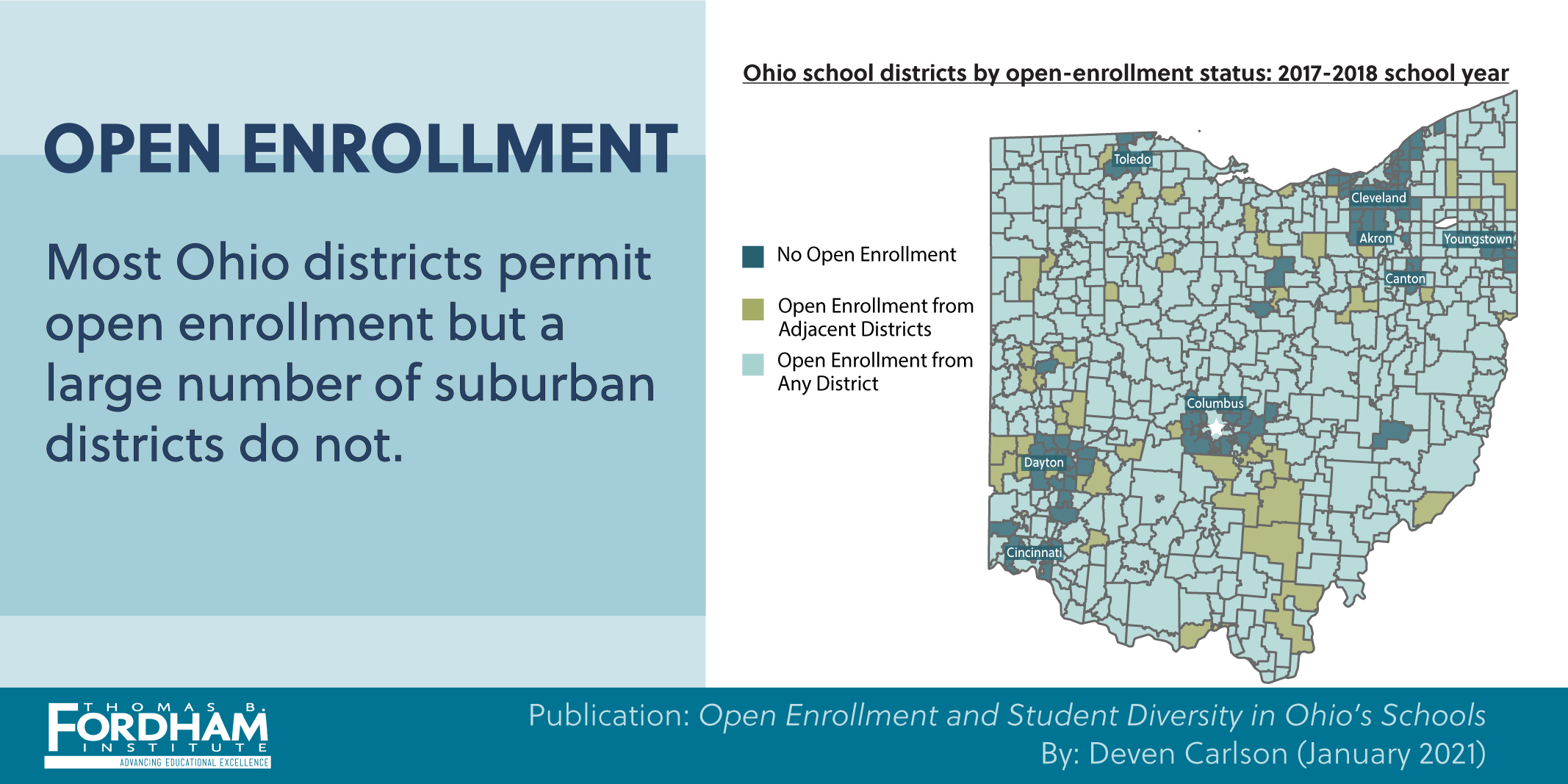
Currently, about eight in ten Ohio districts voluntarily participate in open enrollment. However, many suburban districts choose not to accept non-resident students—the map in the infographic below displays the geographic pattern of opt-outs for the 2017–18 school year. The lack of participation among more affluent districts, plus the relatively small share of the overall population represented by open enrollers, helps to explain the minimal impacts of open enrollment on student diversity.
To leverage the potential of interdistrict open enrollment as a tool for increasing access to quality public schools and to encourage more school diversity, we offer two policy recommendations: 1) all schools districts, subject to their capacity, should participate in open enrollment and 2) open enrollees should have viable transportation options. Download this report now to learn more about the analysis and to read our policy recommendations.