Mobile Navigation

  • National
    • Policy
      • High Expectations
      • Quality Choices
      • Personalized Pathways
    • Research
    • Commentary
      • Gadfly Newsletter
      • Flypaper Blog
    • Events
    • Scholars Program
  • Ohio
    • Policy
      • Priorities
      • Media & Testimony
    • Research
    • Commentary
      • Ohio Education Gadfly Biweekly
      • Ohio Gadfly Daily
  • Charter Authorizing
    • Application
    • Sponsored Schools
    • Resources
  • About
    • Mission
    • Board
    • Staff
    • Career
Home
Home
Advancing Educational Excellence

Main Navigation

  • National
  • Ohio
  • Charter Authorizing
  • About

Aaron Churchill
10.31.2025
Impractical to transport blog image
Getty Images/Bilanol
Listen to this article
Loading the Elevenlabs Text to Speech AudioNative Player...

The mundane but critical task of transporting students to school has stirred controversy over the past few years. Districts have chafed at their longstanding responsibility under state law to transport resident students who attend public charter and private schools, even though the state subsidizes their transportation. Meanwhile, charter and private school leaders—parents, too—have lodged legitimate complaints about getting the short end of the stick. Districts’ reluctance to provide reliable transportation—or any transportation at all—has caused unnecessary headaches for families choosing non-district options, and has even aggravated the chronic absenteeism crisis.

Simmering tensions erupted into public view last fall with Columbus City Schools blatantly refusing to transport hundreds of Columbus students to charter and private schools just before the year started. One school board member intimated that denying busing might be an underhanded way to get students to enroll in the district. “If you are a charter school parent and you’re struggling and your child can’t get to school, Columbus City Schools is a great option for your family,” he said. The shenanigans caught the attention of Attorney General Dave Yost who sued the district on behalf of impacted families (the case is ongoing).

State lawmakers have also noticed these long-running disputes and enacted provisions that aim to improve cross-sector relations and ensure reliable transportation. In 2021, they passed a law requiring charter and private schools to notify districts of their bell schedules well before the next year begins in order to assist with route planning. Two years later, the General Assembly authorized districts to use vans to transport charter and private school students. Lawmakers also increased state aid for pupil transportation ($519 million to $797 million from 2021 to 2025). And they even added a “weight” inside the transportation formula to send extra dollars to districts with more students attending schools of choice.  

But one area lawmakers have not yet tackled, and which remains a source of many problems, is the state’s “impractical to transport” provisions. But what are they? And why must they be addressed?

As a quick refresher, since 1965, Ohio has required school districts to provide transportation to resident students, no matter whether they attend a district or private school (and later, charters, too). The requirement makes sense. Parents, many of whom are heading to work in the mornings and at their jobs in the afternoons, rely on school systems to transport their kids safely and on time. They also pay sizeable sums in local taxes to their local districts, and some of their state taxes also subsidize district transportation. Rather than creating hardships on parents and increasing safety hazards and inefficiencies, the legislature thought it best to charge districts with busing all resident students (with the help of state funding).

There are exceptions to the general rule, however. Districts are not obligated to transport students living within two miles of their school, nor private and charter students attending schools more than thirty minutes away from their assigned public school (commonly known as the “thirty-minute rule”). Districts are also not required to transport high school students, no matter their school of choice.

Those are sensible allowances, but statute also contains a more problematic impractical to transport exception, which gives local school boards the power to deny transportation to otherwise eligible students. Here, all they must do is “consider” six factors that render it “impractical”—in their own estimation—to transport a student.[1] When this happens, the district relieves itself of transportation duties and must offer the impacted family a payment in lieu of transportation, which is a measly $607 at present, or just half the average per-pupil cost of district transportation.[2]

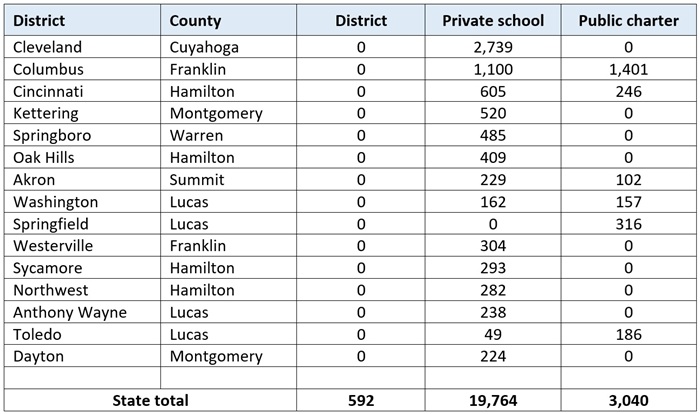
Ohio districts have used this loophole to deny transportation to thousands of public charter and private school students—and this was the way Columbus ducked their transportation responsibilities last year. Table 1 shows that statewide, almost 23,000 charter and private school students were declared impractical last year (roughly 8 percent),[3] while only 592 out of more than 1.4 million district students—a miniscule fraction—were deemed as such. In other words, non-district students were nearly 200 times more likely to be denied transportation than students attending district schools. The table also displays the fifteen districts that declared the most charter and private school students impractical. In these places, not a single eligible district student was denied busing, even though some likely attended magnet schools or resided in remote parts of the district. Meanwhile, hundreds of their peers attending schools of choice were determined to be “impractical.”

Table 1: School district “impractical to transport” declarations by the type of school students attend, 2024–25
Impractical to transport blog table 1
Source: Ohio Department of Education and Workforce

What appears to be happening in some (though not all) districts is a systemic exclusion of charter and private school students from district transportation service. This is hardly fair and arguably discriminatory. No one thinks a fire department should be allowed to ignore fires at restaurants it doesn’t like, or the police to disregard certain neighborhoods. But that’s what districts are effectively doing—denying a basic governmental service to citizens they find inconvenient to serve.

Ohio lawmakers should take action to close the impracticality loophole. A couple of options include:[4]

  1. Tighten the language and increase the payment in lieu of transportation to deter districts from impracticality determinations. Lawmakers could require districts to “prove” impracticality against measurable standards—not just “consider” factors—in order to deny transportation to a student. This might mean, for example, providing evidence that it takes more than twenty minutes to bus a student and that the cost is significantly more than the already enhanced amount the district receives to transport choice students. In addition, lawmakers could also increase the cost to districts of declaring impracticality by tying the “payment in lieu” to the state average per pupil cost of transportation—not just half of it.
     
  2. Repeal the impracticality exemption but preserve the “thirty-minute” rule. A cleaner but potentially more politically controversial approach is outright repeal of the impracticality exemption. This would clarify the state’s expectation—and strengthen the requirement—that districts provide all eligible students transportation service. If going this route (or pursuing the option above, too), legislators should preserve the existing exemption from transporting charter and private school students excessively long distances. The “thirty minute” rule should remain intact, as well the other exemptions mentioned earlier in this piece.

Pupil transportation is a nuts-and-bolts service that Ohio requires of its school districts. Rightfully so, as thousands of parents rely on school systems to get their kids to class. Many districts do provide reliable service, but an increasing number are avoiding their responsibilities, most notably to children attending schools of choice. When districts fail to fulfill their obligations, lawmakers need to step in to ensure that all students receive the busing services they are entitled to.


[1] Such factors include time/distance, cost, and whether bussing a student “disrupts current transportation schedules.”

[2] Parents may refuse payment and request mediation before the Ohio Department of Education and Workforce.

[3] This percentage includes all charter and private school students in the denominator, not a more precise number of transportation-eligible students. The percentage of charter and private school students who do receive transportation—13 and 19 percent, respectively—is also much lower than the 46 percent of district students who receive transportation (percentages are, again, relative to their total enrollments).

[4] Another possibility—perhaps limited to areas with widespread problems—is to create countywide pupil transportation systems that remove busing responsibilities (and commensurate funding) from districts. In 2023, the legislature called for pilot projects in Franklin and Montgomery counties that explore this option.
Policy Priority:
School Choice
Topics:
Charter Schools
Jeff Murray
10.31.2025
Ohio charter news logo
Listen to this article
Loading the Elevenlabs Text to Speech AudioNative Player...

Stories featured in Ohio Charter News Weekly may require a paid subscription to read in full.

Data show the “impractical” truth

Fordham’s Aaron Churchill dug into Ohio data on how many students school districts declare “impractical to transport”, breaking the numbers down by school type. Statewide, almost 23,000 charter and private school students were declared impractical last school year (roughly 8 percent of the total), while a mere 592 district students (out of more than 1.4 million) were deemed as such. Incredible. Even worse: In the top 15 districts to declare charter and private school students impractical, not one single student attending their schools were deemed impractical. Such blatant and institutionalized discrimination must end.

Kudos to an Ohio charter founder

Here’s a great profile of Jenn Bardall, a co-founder of Lakeland Academy in eastern Ohio. She was there at the beginning in 2012 with a desire to provide a different option for local students: “A lot of our kids would get lost in the shuffle, and I don’t mean that in a bad way,” she said. “We have some kids who are gifted, just so smart. But sometimes their personalities are not out there. The class sizes are so small that I feel like you can see each student better.” Today, Bardall serves as co-superintendent and she will be there when the first group of kids to go all the way through the school from kindergartners to graduates. An awesome asset to the community.

Un día en la vida

Not only is this story awesome—an hour-by-hour look at one day in the life of Nuestro Mundo—a bilingual K-8 charter school in Providence, Rhode Island—but so is the presentation. The plethora of direct, close-up photos; the time-stamped blocks of text; the detailed observations of place and activity; and the moving clock icon in the corner all clue you in as to the progress of the day with more detail than is typical of such profiles. Interesting and engrossing in every way.

A battle brewing

The elected board of Jackson (MS) Public Schools voted this week to deny the application of an established local charter school to expand into high school, citing a “significant… impact on district fiscal operations” from the competition. The leaders of Ambition Prep (an apt name) believe they don’t need the district’s approval and plan to appeal to the Mississippi Charter School Authorizer Board. In response, a spokesperson said the district will “pursue all available options at its disposal” to stop them.

A battle joined

Charter school families in Chicago are feeling the heat from the city and the school districts’ stated efforts to curtail competition via bureaucratic and fiscal constraints and many fear that their schools will soon be on the chopping block. Here’s a look at how students, staff, and parents at ChiArts and EPIC Academy are responding to the threat.

*****

Did you know you can have every edition of the Ohio Charter News Weekly sent directly to your Inbox? Subscribe by clicking here.

Policy Priority:
School Choice
Topics:
Charter Schools
Jeff Murray
10.31.2025
Gadfly Bites logo
Listen to this article
Loading the Elevenlabs Text to Speech AudioNative Player...

News stories featured in Gadfly Bites may require a paid subscription to read in full. Just sayin’.

  1. Kudos to the Akron Beacon Journal for covering the release of this year’s Ohio CTE report cards for Summit County’s various providers thereof. Man that’s a lot of stars they earned! (Akron Beacon Journal, 10/30/25) Reporter Kelli Weir also takes a deeper look into the only CTE program in the county that did not earn the full five stars overall: Akron City Schools’ program, which includes the city schools and a number of charter schools in the area. They got a 4.5 overall and seem confident of getting a 5.0 by 2027. The weak point on paper is student achievement (3 stars), but I don’t really see much talk about improving those test scores in the discussion. In fact, the discussion revisits one of my least favorite career-tech talking points: Rather than preparing students with the skills for a specific career, the talk is all about how kids “can transfer all those customer service skills no matter where they go.” Nope. Wrong. Do it better. (Akron Beacon Journal, 10/30/25)

  2. For some reason it’s school funding explainer week across Ohio. Here’s the Cincinnati Enquirer giving a full-blown primer on property taxes, including how school levies fit in to the equation. (Cincinnati Enquirer, 10/29/25) And here’s a public radio station uncovering The Truth about state lottery profits and school funding…a truth we have known since at least 1983 when James Earl Jones himself told us all about it in a PSA. (WYSO-FM, Yellow Springs, 10/30/25)

Did you know you can have every edition of Gadfly Bites sent directly to your Inbox? Subscribe by clicking here.

Policy Priority:
School Funding
Topics:
Governance
Patrick Riccards
10.30.2025
wonkathon
Listen to this article
Loading the Elevenlabs Text to Speech AudioNative Player...

Editor’s note: This essay is an entry in Fordham’s 2025 Wonkathon, which asked contributors to answer this question: “What needs to happen next—at the state, district, and school levels—for the science of reading revolution to fulfill its promise and ensure that far more children learn to read well?” Learn more.

For nearly two centuries, since the Yale Report of 1828, America’s colleges and universities have used the same models, same approaches, and similar expectations, despite what their students might need. By refusing to adapt how we deliver higher education, particularly in teacher preparation programs, we shouldn’t be surprised only a third of fourth graders today are reading proficient.

We expect novice teachers to lead in a global, digital, information economy, but we aren’t equipping them with the knowledge and skills needed to reach the most diverse student population in the history of our nation. Two decades ago, one of my mentors, Reid Lyon, stated that education schools were guilty of “educational malpractice” for failing to adequately prepare aspiring educators in literacy instruction. We should be horrified that most education schools ignored those admonishments and still rely on teacher education and preparation programs built almost exclusively on a failed philosophy, producing ill-equipped elementary school teachers.

Put simply, teacher preparation is broken. After far too many decades, education schools continue to resist the research on proven effective instruction, particularly when it comes to the “science of reading.” While educators, policymakers, parents, and communities have battled fiercely over how best to teach reading, our education schools continue to use the failed approaches once known as whole language and currently known as balanced literacy. No matter the label, though, it is a failed approach ensuring that we continue to fail those young learners in need of literacy skills.

Today, the vast majority of states are charting courses to make “science of reading” the required approach in elementary school classrooms. But few are calling for the changes necessary to ensure that science of reading is actually taught with fidelity, or even taught at all. Almost none are requiring their colleges and universities to ensure that science of reading is the foundational component of any and all pre-service teacher preparation in their states. And test scores are still reflecting this deficiency.

We do not have to accept the statistics of the past as destiny. Despite our past struggles in getting all students proficient in reading, we know what steps need to be taken. Those bold states and educators are now taking those steps, doing what is necessary to improve the learning process in our schools, close the achievement gap, and transform every child into a strong, effective reader. Despite years and years of hearing that such actions were either too hard, too controversial, or too much of a change from what has always been done, we are finally starting to do it. But the hardest challenge lays before us—changing higher education.

Twenty-five years after the release of the National Reading Panel report, its findings still stand. Despite multiple efforts to disprove scientifically based reading, it is what is proven effective with virtually all learners. While children may enter the reading continuum at different points, a strong and confident reader requires measurable skills in all five components. In building upon each other, these components provide a strong foundation on which ongoing reading proficiency is based.

The challenge many states have faced since the NRP’s completion has been to create policy that will infuse the NRP’s five proven principles into classroom instruction. It is not enough to simply identify what components of the literacy acquisition process can and should be included. We also must focus on what is being done to prepare the teachers necessary to implement such policies. That focus requires states to lead when it comes to teacher education, enacting policy that demands:

  • Ensuring that undergraduate and graduate courses in the science of reading are part of any pre-service education program and are required of all new public elementary school teachers of record.
  • Improving the pre-service and in-service training so that all teachers (in all subjects and grades), not just reading educators, at least learn the basics of evidence-based reading instruction (right now, most of our schools of education severely lack pre-service education in evidence-based reading).
  • Focusing on the instructional materials necessary to help virtually all students acquire those five skills, be it through statewide adoption processes or funding priorities, and providing educators specific pre- and in-service training in how to use them.
  • Ensuring all novice teachers are empowered with the necessary data systems and professional development supports to tailor classroom instructional practice to meet the individual needs of each student.

The data is clear that science of reading–based instructional approaches can equip nearly all learners with the skills and knowledge they need to be proficient fourth-grade readers. Those approaches, though, require classroom teachers steeped in pre-service and in-service science of reading pedagogy. To get there, we need to radically transform our teacher preparation programs, ensuring all are based on a strong foundation of SOR.

Yes, higher education is one of the hardest sectors to change, reform, and improve. It resists change like no other. But such change it is necessary if we want to break decades of failures and shortcomings and equip all learners with needed literacy skills. The future of our students, our communities, and our nation requires us to finally say no to teacher educators who continue to indoctrinate their classes with the failed instructional experiments and philosophies that they themselves learned decades ago.

Improved student reading proficiency requires the science of reading. Successful implementation of the science of reading requires committed and successful educators. And the preparation of those educators requires education schools and teacher preparation programs built on the science, the data, and proven-effective instructional approaches.

Knowing all this is not enough, though. If we are serious about closing achievement gaps and giving all children—regardless of race, family income, or zip code—the opportunity to truly succeed in school, we must translate this knowledge into action by building a commitment for a solution, mobilizing stakeholders and enacting change. And such improvement begins in our teacher preparation programs.

For science of reading to succeed in elementary school classrooms, we need to prepare aspiring teachers in what it is, how to use it, how to measure it, and how to target it to meet the needs of individual learners. If our colleges and universities aren’t up to the challenge, or refuse to accept it, we cannot make the improvements our classrooms need and deserve. No teacher education student should accept a preparation program that doesn’t actually prepare them to change lives and teach kids to read. And no school district should hire an educator not prepared in the science of reading.

Policy Priority:
High Expectations
Topics:
Curriculum & Instruction
Governance
Teachers & School Leaders
Michael W. Kirst
10.30.2025
wonkathon
Listen to this article
Loading the Elevenlabs Text to Speech AudioNative Player...

Editor’s note: This essay is an entry in Fordham’s 2025 Wonkathon, which asked contributors to answer this question: “What needs to happen next—at the state, district, and school levels—for the science of reading revolution to fulfill its promise and ensure that far more children learn to read well?” Learn more.

In a report that I authored for the Learning Policy Institute, I examined the long, winding, and often perilous journey of state reading policies and found that even well-designed policies frequently fail to translate into meaningful classroom implementation. Teachers and principals emerged as critical links in the chain between the state capitol and the classroom. Yet I found that state strategies for teacher and principal improvement are often superficial, fragmented, underfunded, and overly reliant on external vendors who are not embedded in district operations.

That research led me to a deeper question: Why do most state policies for teacher development end when a teacher and principal are certified and inducted into the profession? This approach is no longer sufficient, given the challenges in implementing science of reading.

To ensure that all students benefit from high-quality reading instruction aligned with state standards, we must rethink the role of the state in supporting educators in every grade throughout their careers. This means building a coherent, long-term system of professional learning that spans the entire teaching lifecycle—from early career to veteran educators. It also means aligning professional development initiatives with state reading frameworks, leveraging research on what works, and creating the infrastructure to support continuous improvements at scale.

Every state has an entity responsible for certifying educators and approving post-secondary preparation programs. In ten states, this function is handled by an entity separate from the state department. However, once educators are certified and complete their induction, state involvement in their professional growth largely ends. This discontinuity leaves a critical gap in the career-long development of teachers and principals to teach reading.

To address this, state legislation should expand the mandate of these certification bodies—or create new ones—to support professional learning across the entire career continuum. A logical starting point would be to extend support for early-career teachers and gradually scale up to include experienced practitioners. Crucially, this expanded role must be tightly aligned with state reading curriculum content standards and frameworks, rather than left to the sole discretion of local districts.

Such a shift would bring coherence and vision to professional development efforts, reduce reliance on one-off initiatives, and replace scattered categorical programs with a more strategic, sustained approach. The Mississippi Department of Education offers a promising example through its state-led literacy initiatives, which demonstrate how coordinated, standards-aligned efforts can support educators more effectively. Mississippi relied heavily on coaches. A new state agency and plan should include incentives for teachers to upgrade their teaching skills including compensation for micro credentials.

I have often thought of directing classroom practice from the state capitol as trying to coax a turtle toward a goal. Too often, state policies often operate at the surface—affecting the turtle’s shell—while the complex, interdependent work of operating schools and teaching students happens beneath the shell. District leaders and administrators represent the turtle’s body, responding to state nudges while managing their own complex responsibilities. But the real movement comes from the turtle’s legs—school sites and classrooms—where policy must ultimately reach to influence teachers’ subject matter knowledge and pedagogy.

My experience in California showed that deferring too heavily to local districts for professional learning led to isolated pockets of success, but more often resulted in widespread superficial implementation.

Author’s note: This essay is based on longer commentary published by the Brookings Institution in June 2025.

Linda Diamond Kelly Stuart Dale Webster
10.30.2025
wonkathon
Listen to this article
Loading the Elevenlabs Text to Speech AudioNative Player...

Editor’s note: This essay is an entry in Fordham’s 2025 Wonkathon, which asked contributors to answer this question: “What needs to happen next—at the state, district, and school levels—for the science of reading revolution to fulfill its promise and ensure that far more children learn to read well?” Learn more.

To address the issue of sustainability and successful next steps for sustained implementation of new reading laws, one must first identify why waves of previous reading reforms, many aligned to evidence, have not endured. Three factors have contributed to this failure.

  1. Educator preparation programs (EPPs) have not aligned their coursework and standards to the evidence on effective reading instruction but have still received accreditation, and new educators receive licensure often not based on evidence.
  2. Educator professional learning has been limited to knowledge training but not always aligned to the evidence, nor is it sufficiently inclusive of ongoing training and support in the effective use evidence-aligned materials.
  3. Leadership change at all levels has led to constant reform rather than sustained implementation of effective reading instruction, often because leaders themselves have little to no training in effective reading instruction to successfully lead it.

First, educator preparation programs (EPPs) must align with the evidence not only on what is necessary to develop proficient reading, but also on how reading should be taught—drawing on insights from both cognitive science about how humans learn and instructional science about the most effective teaching practices. While many universities are already revising their courses to better align to reading science, they are not also aligning to learning science. New educators may be learning about what reading content to teach but are not necessarily learning how best to teach that content. Internationally, because of rigorous preparation and ongoing professional learning, the U.K. has moved up to ninth in reading. The U.S. lags behind. The only way to ensure EPPs are preparing educators is to require changes that align evidence to licensure, licensure tests, license renewal, and accreditation. EPPs must be judged for accreditation based on course work and clinical practice that provides all educators with the knowledge necessary to ensure all students become proficient readers and writers. Currently, too many EPPs are not adequately equipping preservice educators with the necessary skills and practices to teach reading effectively but nonetheless are still receiving accreditation.  

Licensure tests should require preservice educators to demonstrate that they possess the evidence-aligned knowledge and skills to teach reading effectively. Similarly, the two main accreditation organizations, the Council for the Accreditation of Educator Preparation (CAEP) and the Association for Advancing Quality in Educator Preparation (AAQEP), must embed into their standards and their reviews the requisite knowledge for teaching reading so that EPPs are evaluated against evidence-aligned standards in both course work and clinical practice. Short of those changes, higher education will likely continue business as usual that too often relies on ideology and philosophy rather than evidence.

Second, both pre-service and in-service professional learning must go beyond knowledge training about the essential components of reading and include training on understanding how people learn (cognitive science) and therefore how best to teach. In addition, professional learning must include training on the use of actual evidence-aligned, high-quality instructional materials that build word level skills, language, writing, and deep knowledge, similar to what has been done in the successful southern states such as Louisiana, Alabama, Tennessee, and Mississippi. Professional learning should also include ongoing coaching and implementation support. Just as doctors go through internships and pilots go through simulations and co-pilot training where they learn to apply their knowledge and make expert use of their equipment, all educators must be equipped with both research-aligned knowledge and practical skills and receive ongoing coaching to mastery. Such professional learning must extend to principals who evaluate their teachers and lead systemic school efforts to improve literacy outcomes. Principals must know reading content to monitor and support implementation. To do this, they need clear systems in place for managing instruction, scheduling instructional time, delivering interventions, and collecting and analyzing class and school-wide assessment data.

Finally, a significant cause for continued reading failure, despite abundant research and despite legislation, is leadership turnover at all levels—state superintendents and policymakers, district superintendents and district line staff, and principals. Too often, new leaders bring their own ideas and beliefs about what should be the focus, despite evidence that previous leaders’ programs and policies led to strong achievement gains. However, having a common body of evidence-aligned knowledge that includes effective implementation practices that all leaders draw from would reduce and eventually eliminate this problem. Therefore, we also propose a radical change just as is done in many businesses—the use of successor plans for which state departments of education, state boards, and local school boards are accountable for developing. Successor plans can ensure that effective reading policies and practices are sustained. A successor plan facilitates smooth transitions, includes timelines and milestones to ensure continuity of effective services, operations, and expectations. Such successor plans allow a period of mentoring and support for new leaders. To achieve such a radical shift, state and district governing boards must build sustainability into their hiring plans, into their interviews, and into the evaluation of new leaders.

This idea of sustainability has been demonstrated so clearly in the Steubenville story reported by Emily Hanford; 25 years of sustained evidence-aligned programs, quality materials, ongoing professional learning, and practices produced decades of strong student results. In most school districts, reading programs change with each new superintendent or principal. Funding may dry up and priorities shift, and strong programs are replaced before they even take root. But in Steubenville, Ohio, one program—Success for All—has endured for more than twenty-five years. Why? Stability. The superintendent has led the district for over a decade and is a former principal and teacher in the district. Many teachers have attended Steubenville schools themselves. Such continuity fosters trust between teachers and administrators. Although Steubenville might not have referred to it as succession planning, the district developed this sustained succession organically. Teachers became principals; principals became district leaders. Steubenville cultivated an internal leadership pipeline that preserved values, coherence, and instructional quality. Sustainable change depends not on new mandates but on steady leadership, intentional succession, and a commitment to evidence over trends. (This vignette draws in part on reporting from “Sold a Story: Episode 13 – The List,” APM Reports (2025).)

To sustain significant progress on reading, we must ensure improvements in educator preparation, ongoing professional learning, sustained implementation support, and ultimately guard against leadership changes that disrupt or reverse gains.

Policy Priority:
High Expectations
Topics:
Curriculum & Instruction
Governance
Jeff Murray
10.30.2025
Standardized test in school
Getty Images/artisteer
Listen to this article
Loading the Elevenlabs Text to Speech AudioNative Player...

For decades, ACT has been testing students’ postsecondary readiness via two separate assessments: one aimed at measuring college readiness and a second that focuses on career-related skills and abilities. A new working paper from the nonprofit that produces both assessments compares the college-based ACT with the WorkKeys test to find out if there is some overlap among their measures. In other words, how well do the scores on a career-readiness test align with those of a college-readiness test?

Analysts from ACT’s internal research department examined a sample of almost 359,000 students nationwide who took both the ACT and WorkKeys assessments between fall 2022 and summer 2025. Data focused on each student’s most recent attempt on each, which for 68 percent of those in the sample occurred in their junior year of high school. The analysts were interested in students who took the two tests within the same academic year, wanting to limit additional learning taking place in between.

The sample group was 54 percent female and 46 percent male. Forty-nine percent were White, 30 percent Black, and 11 percent Hispanic. Students hailed from 30 states, but the majority came from just six (North Carolina, Louisiana, Alabama, Mississippi, Arkansas, and Kansas). The analysts compared their sample test takers to a reference population—specifically, all 11th grade students assessed during the school day under ACT state contracts across 22 states in spring 2025. In comparison, the two-test sample students had a larger percentage of students who are female or Black and a lower percentage of those who are male or Hispanic. Otherwise, the two were demographically similar.

The researchers began by examining correlations between ACT scores and WorkKeys scale scores. The ACT data for this analysis comprised the four section test scores (English, math, reading, and science), the English-plus-reading score (representing ELA performance), and the composite score for all students in the sample. The WorkKeys data comprised the scale scores for applied math, graphic literacy, and workplace documents tests, as well as a summed total score. All WorkKeys scale scores were compared to all ACT section scores, regardless of academic subject (thus, applied math is compared to English, graphic literacy to science, and workplace documents to reading, etc., as well as the more direct applied math to math comparison).

They found the correlations with WorkKeys scores were generally high and consistent across ACT sections, ranging from 0.59 to 0.69 for applied math, 0.62 to 0.65 for graphic literacy, and 0.55 to 0.62 for workplace documents.[1] That’s not surprising, given that both tests largely assess reading and math skills. Correlations of this magnitude suggest that students who perform well on the ACT are also likely to perform well on the WorkKeys assessments, but the two assessments also provide some unique information on student readiness.

Next, they investigated how performance benchmark outcomes—ACT’s college readiness levels and the National Career Readiness Certificate (NCRC) performance levels of WorkKeys—compared among dual test-takers. Only one in three sample students met ACT’s college-ready threshold, with another 37 percent nearly college ready. By comparison, 65 percent of sample students earned at the Silver or higher NCRC level, which means that nearly two out of every three students had the foundational skills needed for most entry-level, career-ladder jobs. The bottom line: Thirty-one percent of sample students were prepared for both college and career, while 34 percent were career ready only. And although a miniscule 2 percent were college ready only, a worrying 33 percent tested ready for neither college nor career.

About 26 percent of students in the sample performed better on the ACT than on WorkKeys, and a similar percentage better on WorkKeys than the ACT. About 47 percent performed similarly (within 9 percentage points) on the two assessments. These relative scores were compared with students’ stated postsecondary plans (derived from answers provided on additional questions asked during ACT administration), with some interesting findings. For example, students with occupation plans in skilled trades performed relatively better on WorkKeys than the ACT, while students with occupation plans in the social sciences, arts, communications, and languages performed relatively better on the ACT. Students who did not plan to go to college or who expected to earn less than a bachelor’s degree performed relatively better on WorkKeys, while those who expected to earn at least a bachelor’s degree performed relatively better on the ACT.

It is unsurprising that the folks who produce the ACT and WorkKeys exams conclude from all this that “there are potential benefits to having separate assessments and separate performance standards for college and career readiness,” and such a finding would seem to support the idea of most students taking both tests as a matter of course. But the analysis here could also indicate that there are lots of jobs out there—which are not dead ends—that are attainable for a swath of students who test ready for them via WorkKeys and who are indeed interested in pursuing them. For them, career training should be the prescription in their upper high school years, rather than enforced college prep courses and an ACT arms race.

SOURCE: ACT Research, “Multiple Measures of College and Career Readiness: What Does the Evidence Suggest?” Draft Working Paper (October 2025).


[1] The report also lists correlations between ACT scores and other readiness indicators, based on outside research. These include a 0.40 correlation between ACT scores and first-year college GPA, a 0.55 correlation with high school GPA, and a 0.89–0.93 correlation with SAT total scores.

Policy Priority:
High Expectations
Topics:
Accountability & Testing
Evidence-Based Learning
Meredith Coffey, Ph.D.
10.30.2025
Teenage student doing math
Getty Images/Liudmyla Lazoryshyna
Listen to this article
Loading the Elevenlabs Text to Speech AudioNative Player...

Careers in science, technology, engineering, and math (STEM) fields tend to pay well, offering about double the average wages of non-STEM jobs. But even with that pay advantage, several STEM careers rank among the anticipated workforce shortage areas. How can we improve the STEM pipeline, both to strengthen young people’s economic opportunities and for our broader economic and societal well-being? To help answer this question, a new study by researchers from Saint Louis University and the University of Missouri-Columbia explores the effects of a STEM career and technical education program that’s now reached millions of students in all fifty states.

Project Lead the Way (PLTW) offers rigorous pre-K–12, project-based STEM courses, including three pathways at the high school level: engineering, computer science, and biomedical science. Since its inception in the late 1990s, the program has been studied numerous times. Now, in a follow-up to their own previous work on the effects of introducing PLTW in high schools, the researchers have now analyzed what happened when the program expanded within high schools where it was already offered.

They compiled data for 68,000 students who began ninth grade in one of 501 Missouri public schools between 2010–11 and 2014–15, during which time PLTW saw rapid growth across the Show-Me State. Within the study’s 225 “treatment” schools, the number of courses available more than doubled, as biomedical science and computer science newly became available alongside the engineering pathway. Using linked data from the Missouri Department of Elementary and Secondary Education and the National Student Clearinghouse, the researchers evaluated the impact of PLTW course expansion on students overall, by gender, and by “STEM readiness” (STEM skills upon high school entry).

Among all students, PLTW expansion correlated with statistically significant changes to postsecondary outcomes. For every additional course per 100 students, college enrollment increased by 0.3 percentage points (pp), and STEM major declaration within five years of enrollment also rose by 0.3 pp. These results are more substantial than they may initially sound, given that these are pp increases among all students in the “treatment” schools, not just those who took PLTW courses.

For male and female students, the impact of PTLW was more nuanced. With college enrollment, the effect size for male students was statistically significant and larger (0.5 pp) than for their female counterparts (0.3 pp, not statistically significant). This difference could be at least partly attributable to the fact that women already tend to enroll in college at higher rates than men. For STEM major selection, different PLTW pathways had different effects. Engineering and computer science expansion was associated with a statistically significant, 0.7 pp increase in STEM majors among male students, whereas biomedical science expansion correlated with a statistically significant 1 percent increase in STEM majors among female students.

PLTW’s effects also differed among students of different STEM readiness levels. Those who started high school in the top quartile were nearly three times as likely to take PLTW courses as their peers, and they were the only quartile to have a statistically significant increase in STEM major selection (1.3 pp), a finding that was consistent for both male and female students. For those in the bottom three quartiles, on the other hand, PLTW was associated with higher rates of college enrollment.

With more Project Lead the Way access, more students overall took STEM classes, enrolled in college, and chose STEM majors—but the subgroup results don’t tell such a straightforward story. And that’s partly the point: The program may help different students in different ways. Initially lower-performing students were more likely to enroll in college, and initially higher-performing students were more likely to choose PLTW courses, and later, STEM majors. That different pathways seemed to attract students of different genders is perhaps not surprising, but it reiterates that there’s work to be done when it comes to gender messaging around STEM fields. For now, though, getting more students into STEM pathways is a win, both for those students as individuals and for all of us.

SOURCE: Takako Nomi, Darrin DeChane, and Michael Podgursky, “Increasing Applied STEM Curricular Opportunities in High School and Impacts on Early Post-Secondary Outcomes: The Effect of Project Lead the Way,” Annenberg Institute at Brown University (October 2025).

Policy Priority:
High Expectations
Topics:
Evidence-Based Learning
Curriculum & Instruction
Teachers & School Leaders
10.29.2025
schooled ad
Listen to this article
Loading the Elevenlabs Text to Speech AudioNative Player...

SCHOOLED is Michael J. Petrilli’s twice-weekly free Substack and email newsletter restarting the education-reform conversation.

Click here to subscribe for:

  • Sharp analysis of the week’s biggest K–12 debates

  • Curated commentary from across the ed-policy world

  • Lively discussion—including reader reactions and pushback

It’s quick, smart, and built to spark conversation—not echo chambers.

Stay informed. Stay engaged. Get SCHOOLED.

Jeff Murray
10.29.2025
Gadfly Bites logo
Listen to this article
Loading the Elevenlabs Text to Speech AudioNative Player...

News stories featured in Gadfly Bites may require a paid subscription to read in full. Just sayin’.

  1. Governor DeWine this week embarked on a Literacy Leaders Tour around the state, highlighting the results of districts, schools, and teachers working to implement the science of reading. Here’s a look at his visit to Emerson Elementary in Lakewood City Schools, where the governor, the First Lady, and Ohio Department of Education and Workforce Director Steve Dackin highlighted the school’s successes, including a jump in the percentage of second graders who are “on track” with their reading skills from 60.4 percent in 2023 to 71.4 percent in 2024, and their 2024 performance index score on ELA of 95.4, which is up from 85.7 the year before. Kudos! (State of Ohio, Office of the Governor, 10/28/25) Before that, the governor and his wife visited Greene County Career Center, highlighting the results of Ohio’s increasing investment in career tech education. He was mainly talking about manufacturing and heavy industry careers (“it really is fulfilling a need that we really have in the community and in society”), but both DeWines paid special attention to the career center’s natural resources program…because their granddaughter currently attends classes in that GCCC program. How lovely! (Dayton Daily News, 10/28/25)

  2. Not to be outdone, Lt. Gov. Jim Tressel was on TV in Columbus this morning, touting his signature initiative, the Team Tressel Fitness Challenge, encouraging fourth- through eighth-graders across Ohio to build healthy habits focused on fitness, nutrition, and rest. (ABC 6 News, 10/29/25)

  3. Speaking of fitness, here’s a look at the brand new strength and conditioning center at St. Ursula Academy, an all-girls Catholic school in Toledo. Looks fancy, and all the sporty students seem to love it. That big new fitness facility was needed because expanding enrollment demanded the old training room be turned into additional classrooms. The school leader pins that enrollment increase as starting in 2024, and although she doesn’t explain why it happened, I know that all 9 of you persistent and all-too-tolerant Gadfly Bites subscribers know the reason. And that reason rhymes with Zed Joyce. (Why yes, they do…) (Toledo Blade, 10/28/25)

Did you know you can have every edition of Gadfly Bites sent directly to your Inbox? Subscribe by clicking here.

Policy Priority:
School Funding
Topics:
Governance

Pagination

  • First page « First
  • Previous page ‹ Previous
  • Page 76
  • Page 77
  • Page 78
  • Page 79
  • Current page 80
  • Page 81
  • Page 82
  • Page 83
  • Page 84
  • Next page Next ›
  • Last page Last »
Fordham Logo

© 2026 The Thomas B. Fordham Institute
Privacy Policy
Usage Agreement

National

P.O. Box 110
Burke, VA 22009

202.223.5452

[email protected]

Ohio

P.O. Box 82291
Columbus, OH 43202

614.223.1580

[email protected]

Sponsorship

130 West Second Street, Suite 410
Dayton, Ohio 45402

937.227.3368

[email protected]