Industry-recognized credentials (IRCs) can validate attainment of technical skills and signal to employers that a worker is qualified to perform certain tasks. While credentials are particularly useful for adults, they can also benefit high school students by helping to build their skillsets and giving them an edge when it comes time to compete for a job.
But to open doors to great careers, the IRCs that students earn need to be rigorous and signify acquisition of skills prized by employers. This piece takes a closer a look at the credentials that Ohio students earn. Are they earning valuable IRCs that will help them stand out and advance in skilled professions? Or are they accumulating certificates that are easier to complete, and don’t yield the technical knowledge and skills that employers demand?
Before diving into the data, a bit of context is important. Recognizing the potential of IRCs, Ohio has taken steps to incentivize credentialing during high school. In this year’s state budget, for instance, legislators set aside $5.5 million per year to cover testing fees associated with credentialing, along with another $10.5 million to support the Innovative Workforce Incentive Program (IWIP), which provides schools with an additional $1,250 per credential that students earn in high-demand career fields.
The state also encourages credentialing by including it as a graduation pathway and measuring IRC attainment on state report cards. Here, we must understand that Ohio approves hundreds of credentials and certificates,[1] and the state assigns a point value to each—ranging from one to twelve—based on its rigor and perceived value to employers. Students meet certain graduation requirements when they earn at least twelve credential “points” in a single career field. Likewise, districts and schools receive credit on their report cards when students meet this twelve-point mark.[2]
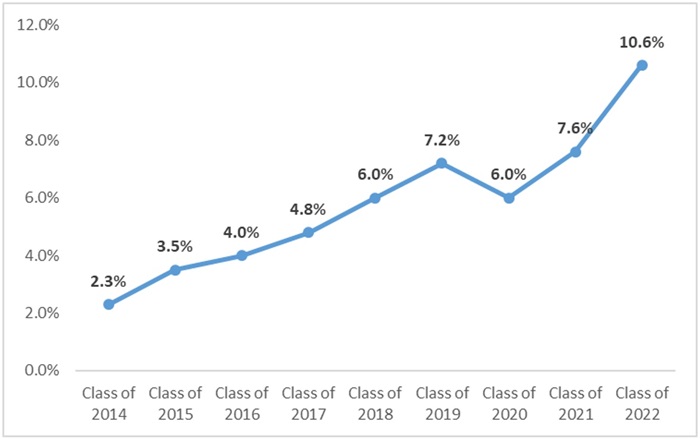
The increased attention on IRCs has pushed Ohio’s credential attainment rates upward in recent years. The figure below displays the percentage of students statewide meeting the twelve-point standard. Just 2.3 percent of the high school graduating class of 2014 met this IRC threshold, but that rate has risen to 10.6 percent for the class of 2022.
Figure 1: Credentialing rates for Ohio’s class of 2014 through 2022
At first glance, this increase in credential attainment seems to be a good thing. But things get more interesting when we look at the specific credentials earned by Ohio students. Table 1 displays the most commonly earned IRCs by Ohio’s class of 2022 (keep in mind that students can earn more than one or none at all).
Table 1: Most commonly earned IRCs in Ohio, class of 2022
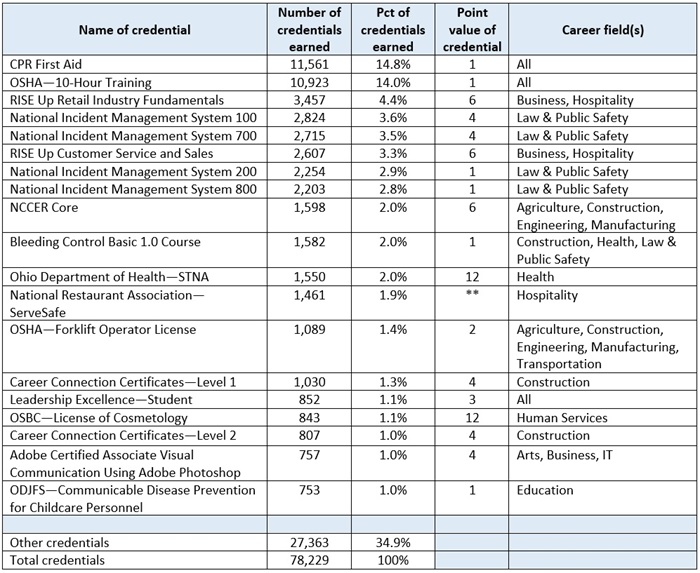
In total, students earned more than 78,000 credentials, but nearly 30 percent were CPR and a basic OSHA worker safety course. Both of these credentials can be applied to all thirteen career fields, and neither demands a serious investment of time or effort from students. A CPR course, for instance, can be finished in just two hours, while the ten-hour OSHA course can be completed in as few as two days. Other commonly earned IRCs also appear to be easily attainable. The National Incident Management System 100 and 200 courses, which introduce students to emergency response systems, only takes two and four hours, respectively, and the Bleeding Control training is a mere hour and a half. The two RISE Up retail courses, which together yield twelve IRC points, can be completed in roughly twenty-five to thirty hours. One of them—the Industry Fundamentals course—even allows students to take an untimed, unproctored credentialing exam.
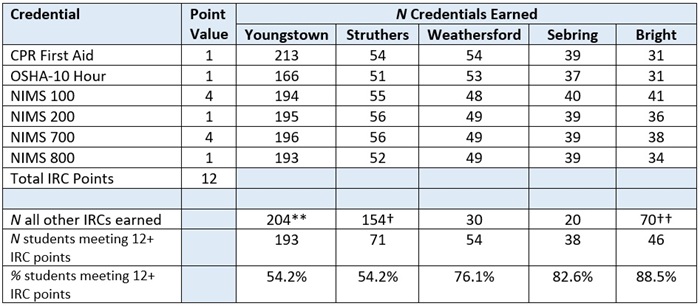
It may not be overly concerning if IRCs of more questionable value were being earned as part of a strong “core” career pathway that leads to more valuable credentials. But district-level data indicate that some students may be “bundling” lower-level IRCs to reach the twelve-point threshold for graduation. Table 2 displays the most-commonly earned IRCs for five of the six districts with the state’s highest IRC rates. In those locales, it seems that a relatively large number of students combined the CPR, OSHA-10 hour, and the various NIMS certificates to yield twelve IRC points in the Law and Public Safety career field.
Consider Youngstown where 193 students—54 percent of its graduating class, or five times the statewide average—met the twelve-point mark. Yet a sizeable proportion of those students likely did so by completing NIMS (totaling ten points), along with the CPR and OSHA certificates. To be clear, without finer-grained data, it’s impossible to know with certainty how many students achieved the twelve-point mark through this combination. But it must be noted that relatively few other credentials were earned in Youngstown—and most of those were of lower point values (only fourteen IRCs earned were worth nine or twelve points). Thus, there is little indication that students were “stacking” CPR or OSHA certificates on top of, say, a full-fledged, twelve-point EMT or firefighter certification. And it’s not just Youngstown, either; the data look similar in the other districts, as well.
Table 2: Most commonly earned IRCs in five districts with high credentialing rates
The overall picture of IRCs in Ohio gets murkier when one digs a bit deeper. Yes, credentialing rates are on the upswing. And yes, there are students earning serious credentials: in the class of 2022, for instance, 472 students earned twelve-point certifications in welding and 443 students did so in physical therapy aide. Yet students earning these more rigorous and career-specific credentials isn’t yet the norm.
There’s a lot of good that can come from IRCs. But state policymakers need keep their eye on the ball and ensure that state-approved IRCs promote rigor and mastery of technical skills. Doing so will ensure that Ohio’s IRC policy achieves its intended goal: helping more high school students gain the technical knowledge and abilities needed to pursue careers in skilled professions.
[1] Completion of certain apprenticeship or state licensing programs also qualify for points. Note also that the list of credentials that apply for graduation and report cards is much larger than the more-selective list of credentials that qualify for IWIP.
[2] Schools could potentially receive credit through IRCs on the report card in two ways: (1) via higher graduation rates if credentials are used to meet graduation requirements and (2) via post-secondary readiness component, which while not currently rated for districts, is a rated element on the CTPD (i.e., career-tech provider) report card.