Mobile Navigation

  • National
    • Policy
      • High Expectations
      • Quality Choices
      • Personalized Pathways
    • Research
    • Commentary
      • Gadfly Newsletter
      • Flypaper Blog
    • Events
    • Scholars Program
  • Ohio
    • Policy
      • Priorities
      • Media & Testimony
    • Research
    • Commentary
      • Ohio Education Gadfly Biweekly
      • Ohio Gadfly Daily
  • Charter Authorizing
    • Application
    • Sponsored Schools
    • Resources
  • About
    • Mission
    • Board
    • Staff
    • Career
Home
Home
Advancing Educational Excellence

Main Navigation

  • National
  • Ohio
  • Charter Authorizing
  • About

Kymyona Burk
11.7.2025
wonkathon
Listen to this article
Loading the Elevenlabs Text to Speech AudioNative Player...

Editor’s note: This essay is an entry in Fordham’s 2025 Wonkathon, which asked contributors to answer this question: “What needs to happen next—at the state, district, and school levels—for the science of reading revolution to fulfill its promise and ensure that far more children learn to read well?” Learn more.

Your state has checked the science of reading policy boxes. Now what?

At least 42 states and Washington, D.C., have adopted similar early literacy policies in a bold move to increase reading achievement. Although the components adopted vary by state, most laws focus heavily on building educators’ knowledge of the science of reading and identifying students who struggle with reading early so that teachers can intervene. This approach has resulted in improvements in states such as Mississippi, Louisiana, Alabama, and Indiana. In other states, however, improvement has been slow, if at all.

From 2013–2019, I led the implementation of Mississippi’s landmark science of reading law. In six years, the state improved 20 spots in the National Assessment of Educational Progress (NAEP) rankings, or the Nation’s Report Card, and met the national average in fourth-grade reading for the first time. Policymakers and advocates often reach out to me to share that they have adopted all or most of the law’s components. Then comes the question, “It’s been a year (or two) since our law passed, so why aren’t we seeing improvement?”

First, I encourage a little patience. Then I explain the best policies lay the groundwork for positive change but they don’t bring about that change on their own. Policy implementers must put the law into action, intentionally creating conditions for the law to be successful:

  • State leaders must effectively communicate the law’s requirements and provide guidance and district level support for effective implementation.
  • District leaders should regularly monitor student data to gauge improvements or gaps in teaching and learning.
  • School leaders and teachers must engage in ongoing professional development grounded in the science of reading and coaching to strengthen reading instructional practices in the classroom.
  • Advocates and parents must continue to advocate for evidence-based literacy practices beyond elementary school and seek updates to laws as is needed.

Communication matters

Too often a communications plan isn’t on state policymakers’ checklists, but it should be to ensure science of reading laws succeed and there is widespread understanding of the new law. A lack of communication can sometimes lead to anxiety and frustration; therefore, states must be proactive to help stakeholders understand the goals, the plan for achieving them, and the role they play in ensuring success.

Multiple data points are crucial

Collecting the right data is critical to accelerating progress. Because most laws target kindergarten through third grade, best practices such as universal screening three times per year usually don’t apply to other elementary grades. The lack of data in the upper grades gives an incomplete picture of how students are progressing and makes it challenging to identify students who may be regressing until end of year state summative assessment results are released. By then, it’s too late to intervene, and those students’ struggles have been carried on to the next grade. Quarterly universal screening of all students not only identifies those at risk of reading difficulties, but it also allows for course correction if instructional approaches or interventions aren’t working.

School and system leaders should view end-of-year state assessments as an opportunity to analyze data to see how students are performing against a state’s reading standards and identify bright spots or instructional gaps.

Adult learning is essential

Data collection and analysis must be paired with strong professional development in scientifically-based reading instruction and classroom-based literacy coaching. Mississippi’s law, like laws in at least 37 other states, requires the Department of Education to make evidence-based training in the science of reading and coaching widely available for teachers, but decisions and actions at the school level may impact their effectiveness.

School leaders must carve out time for teachers to participate in professional learning opportunities and create a culture that embraces job-embedded coaching and supports teachers trying new strategies or even making mistakes. Administrators should also participate in literacy-based professional development themselves. This will help to strengthen their capacity to observe reading instruction and provide feedback to teachers. For example, leaders should know that during reading instruction, students might be talking to each other, listening, or reading with a partner instead of sitting and working quietly at their desks. Leaders should also know that teaching students how to read by looking at pictures to guess what the words say is not in line with the evidence for best practices in teaching reading.

Beyond elementary school

While some state leaders are pleased at the progress happening among elementary students, there is concern about lackluster reading performance among older students. The NAEP eighth-grade and 12th-grade reading scores show adolescents and teenagers are having tremendous challenges with accessing and understanding the complex texts they encounter in middle and high school.

To this end, some states have expressed interest in expanding science of reading laws beyond third grade, and there are a few states already leading the way. Virginia lawmakers, for example, recently expanded some of their science of reading law requirements into middle school, providing evidence-based literacy training for middle school teachers, placing literacy coaches in schools, and providing interventions to adolescents struggling with reading. Alabama’s efforts to improve adolescent literacy outcomes are underway and started with a $10 million dollar commitment to create a framework and resources for implementation.

For these and other efforts to work, it will be critical for policies aimed at improving adolescent literacy to focus on strengthening core instruction across content areas for all students. For students who need additional support with reading, schools must identify age-appropriate resources that support students with advanced phonics, vocabulary, morphology, comprehension, background knowledge, and writing. It will also be important to dedicate time within the school day for students to receive interventions or enrichment without taking time away from grade-level instruction.

Reexamine your laws over time

Three years after we passed our landmark science of reading legislation, lawmakers updated it to require schools to create individual reading plans for struggling readers to document and monitor the effectiveness of the interventions being provided. For too long, we provided the same interventions for an extended period of time without knowing if they were working or not.

For states that choose to revisit and strengthen their literacy laws, policymakers should consider whether the approaches that are recommended in policy should be mandatory or if new requirements should be adopted altogether. For example, Mississippi’s law doesn’t require schools to use high-quality instructional materials. The state has made a suggested list and publicly reports the curriculum schools use, but we could go further by requiring adoption from an approved list, so schools and districts don’t use a curriculum just because it’s familiar.

Strong science of reading policies can spur progress but not without a lot of subsequent hard work. In Mississippi, our fourth graders went from 49th in the nation in 2013 to ninth in 2024 in reading. People often ask what changed. We’re still a poor state, we’re still rural, and the legacy of segregation lingers. But we put a stake in the ground, and with strong leadership and in partnership with schools and districts we continue to do the work required to ensure our landmark legislation lives up to its promise.
Policy Priority:
High Expectations
Topics:
Curriculum & Instruction
Governance
Teachers & School Leaders
David Steiner
11.6.2025
wonkathon
Listen to this article
Loading the Elevenlabs Text to Speech AudioNative Player...

Editor’s note: This essay is an entry in Fordham’s 2025 Wonkathon, which asked contributors to answer this question: “What needs to happen next—at the state, district, and school levels—for the science of reading revolution to fulfill its promise and ensure that far more children learn to read well?” Learn more.

These are halcyon days for the science of reading. Depending on what you include, up to 40 states have implemented some form of science of reading legislation. Emily Hansford’s 2022 podcast “Sold a Story,” which highlighted the harm done by whole language instruction, is quite probably the most impactful intervention in education since the passage of No Child Left Behind in 2001. The progress made in reading skills by children in Mississippi, based on implementing the science of reading, is only the second state intervention in the last half century to garner the title of a “miracle.”

Of course, there are cautions: While Mississippi’s fourth graders continue to show outsized progress, their eighth grade results have declined since 2019. The most generous description is that the state’s results were flat between 2022 to 2024. As for the nation, despite the plethora of legislation promoting the Science of Reading, 2024reading results for fourth graders were the worst in 25 years. Apparently, most states can’t (yet?) reproduce the multiple policies and careful implementation that took place in Mississippi (and in Atlanta, the only jurisdiction measured by NAEP that showed progress from the assessment two years earlier).

Hard work lies ahead. I watched as Carey Wright, then state superintendent in Mississippi, laid out (on multiple tables) her 112-point plan to boost reading achievement in the state. Strong legislation (the Literacy Based Promotion Act of 2013) proved a key launch pad; it enabled the state to hold back third-grade students who weren’t at grade level, mandate reading screenings, require professional development for teachers, and field literacy coaches. Each of these elements, however, required granular implementation. For example, specific literacy coach training programs were established, featuring a detailed curriculum that included on-site visits and virtual classrooms. 

The first lesson for the nation’s effort to teach students to read is not simply to “pass a law,” but also to get the details right at the district level. “Detailed implementation” may not be a glamorous message, but it is the mission-critical path to success.

The second lesson is that, while the science of reading constitutes the right approach to learning to read, older students need a different focus when it comes to reading to learn.

The clue to long-term reading fluency lies in one often-overlooked strand of the Scarborough Reading Rope (a visual that summarizes the science of reading): background knowledge. As E.D. Hirsch has argued for decades, the capacity to comprehend a piece of reading depends on knowing enough about the topic to make sense of any new, unknown elements. This partially explains why American 15-year-olds perform relatively better on the international PISA reading exam (where our students improved in 2022 compared to 2015, and were ranked 7th when grouped with the Chinese jurisdictions) out of 80 countries. The PISA exams provide all the required information in the questions, which primarily consist of non-fiction content based on graphics, tables, and journal articles, and ask students to use the given information to deduce the answer. The test, in other words, minimizes the need for external knowledge, and the text excerpts are short. By contrast, many of the NAEP examples require not just a greater attention span but considerably more external knowledge.

Take, for example, this excerpt from an eighth grade test: “Encompassing some 10 million square miles, the gyre is home to trade winds and circular currents that tend to keep whatever meanders into it without self- propulsion for months, years, even decades at a time.” I had to look “gyre” up (I thought it just meant “gyrate”).

Since American tests use texts students are unlikely to have read, background knowledge is everything. Unlocking the science of reading means, per Scarborough’s rope, that we stop treating science, social studies, and the arts as second- or third-class subjects. Reading, from the beginning, must be about building an ever-expanding and deepening grasp of information about the human condition (through fiction) and its cultures, together with geography, history, biology, and astronomy (among other topics).

A third and somewhat counterintuitive lesson is to reconsider the ELA Common Core Standards’ mandate to treat readers as detectives, as David Coleman, the chief architect of the standards, has maintained. Even if it sometimes makes sense to treat young readers this way, it undermines literature for the majority of older students. Great texts—especially fiction—are not a crime scene to be solved. What is required is not “finding the main idea,” but, rather, wonder and thoughtfulness.

Take this excerpt from the end of the Great Gatsby:

And as I sat there, brooding on the old unknown world, I thought of Gatsby’s wonder when he first picked out the green light at the end of Daisy’s dock. He had come a long way to this blue lawn and his dream must have seemed so close that he could hardly fail to grasp it. He did not know that it was already behind him, somewhere back in that vast obscurity beyond the city, where the dark fields of the republic rolled on under the night.

Gatsby believed in the green light, the orgastic future that year by year recedes before us. It eluded us then, but that’s no matter—tomorrow we will run faster, stretch out our arms farther. . . .  And one fine morning. . . .

What’s the main idea? Wrong question. How many of our 15-year-olds, having read the book, could think first, then discuss this passage, with its complex imagery, poetic cadences, and erotic echoes? Reading invites students into new worlds: while enlarging their knowledge, it breaks down the barriers of time, space, and familiarity. Learning to read may be a science, but reading to learn belongs to the humanities. It is time we treated it that way, lest the adventure of reading go the way of the dodo bird. 

Policy Priority:
High Expectations
Topics:
Curriculum & Instruction
Governance
Teachers & School Leaders
Rianna Saslow
11.6.2025
wonkathon
Listen to this article
Loading the Elevenlabs Text to Speech AudioNative Player...

Editor’s note: This essay is an entry in Fordham’s 2025 Wonkathon, which asked contributors to answer this question: “What needs to happen next—at the state, district, and school levels—for the science of reading revolution to fulfill its promise and ensure that far more children learn to read well?” Learn more.

America is facing a literacy crisis that threatens the futures of millions of children and the fundamental skillsets of our future workforce. The most recent National Assessment of Educational Progress revealed the lowest average 12th-grade reading scores since the exam began in 1992, with one third of children scoring below the Basic level. Millions of children are leaving high school without the ability to read proficiently, undermining their readiness for college, careers, and civic life. Parents see the consequences of this crisis every day and are demanding stronger reading instruction and schools that set them up for success. 

Such a national crisis requires a swift national response—one that stitches together federal leadership to establish a strong foundation, state action to drive innovation, and local commitment to ensure effective implementation in every classroom.

The path to stronger literacy outcomes is clear, and it’s built on strategies we’ve known for decades. Literacy outcomes improve when schools make sustained, systemwide commitments to evidence-based practices: high-quality professional development and coaching for teachers, targeted tutoring for students, and curricula grounded in the science of reading. Mississippi’s investment in these strategies, coupled with strong accountability for results, launched them from 49th in the country to the top ten in fourth-grade reading.

With such impressive results, it’s no surprise that many states across the country have attempted to replicate Mississippi’s success. Some states like Louisiana have shown early signs of growth, but outcomes vary greatly from state to state. Some states lack sufficient funding, others face resistance to changing entrenched practices, and many struggle to provide teachers with the sustained, high-quality professional learning needed to shift instruction. What families are left with is a patchwork of results. Some districts have carefully chosen new curricula and built capacity for progress monitoring and interventions, but unfortunately, most districts across the country are still waiting on the promise of the Mississippi Miracle.

This raises an important question: Do states really have the support that they need to transform literacy outcomes? While state and district leadership are essential in shaping and implementing policies to meet local circumstances, the federal government still has a vital role to play. Local control should not mean going at it alone. Washington must provide the resources, guardrails, and guidance necessary to ensure that every state can deliver on the promise of a strong public education.

In fact, Congress has already taken the first step by creating Comprehensive Literacy State Development Grants (CLSD). Established under the Every Student Succeeds Act in 2015, CLSD provides competitive grants to 26 states to develop or strengthen statewide comprehensive literacy plans. The program has earned rare bipartisan support, with neither the House nor the Senate proposing any significant cuts in their FY26 budget bills.

The CLSD program is a vital federal investment, giving states and districts the resources to advance literacy reform. The program has a rigorous definition of the science of reading. But it does not actually require states to align with them, instead asking them to merely provide “assurances” that they will use funds for those purposes—a lot of nice words but not enough to drive effective action.

Without clearer safeguards, there’s no guarantee that the grants are being used for evidence-based policies and practices. Meanwhile, states that do attempt meaningful change often face significant pushback, even for proven strategies like phonics-based instruction or bans on three-cueing. By holding states accountable for both their investments and their outcomes, the federal government can give them the political cover and incentives they need to make bold commitments to literacy reform.

Beyond its weak accountability structure, the CLSD program also limits states’ ability to lead coherent, statewide literacy reform. By requiring that 95 percent of grant funds be passed directly to districts, the program leaves states with only a fraction of the resources they need to build capacity, monitor implementation, and scale what works. Results from Mississippi and early gains in Louisiana—coming in, now, ten years after CLSD was created—show that a strong state role is essential. Both states maintain lists of high-quality, phonics-based curricula and provide incentives for districts to adopt them. They also invest in ongoing professional development and send literacy coaches to low-performing schools to ensure strong implementation. States cannot replicate these strategies if they are left with just 5 percent of federal funds.

The Comprehensive Literacy State Development program remains one of the most important (and one of the only) tools for improving reading outcomes nationwide. But it hasn’t been updated in nearly a decade, and in that time, we’ve learned far more about what works. Parents and families are calling for change. They want assurance that their tax dollars are being used to give every child access to effective reading instruction. Congress should not only preserve and fully fund CLSD, but also modernize it to reflect the lessons of the past ten years: strengthening accountability, empowering states, and ensuring that every dollar supports evidence-based literacy practices. Our nation’s children can’t afford another decade of uneven progress.

Policy Priority:
High Expectations
Topics:
Evidence-Based Learning
Curriculum & Instruction
Governance
Teachers & School Leaders
Aaron Churchill Michael J. Petrilli
11.6.2025
Leaky pipe
Getty Images/Sergei Dolgov
Listen to this article
Loading the Elevenlabs Text to Speech AudioNative Player...

America is wasting much of its human capital. That’s because many high-achieving, low-income students—we call them HALO students—fall off the education track and never reach the gates of our top colleges and universities. Regrettably, these capable young people won’t reap the benefits of a four-year degree, which remains a generator of upward mobility and career success. Their families, communities, and states won’t benefit from maximizing their capabilities. This represents a tragic loss of potential, while also leaving our best colleges and—later—our most promising occupations bereft of socioeconomic diversity and looking less like the nation writ large.

We at the Thomas B. Fordham Institute have long been troubled by this leaky pipeline from K–12 to higher education. Through various empirical studies, we have drawn attention to the disappointing outcomes of high achievers from less advantaged backgrounds. We have also worked to develop and widely share policies and practices that would help more high achievers reach their full potential.

Our latest study, The Leaky Pipeline: Assessing the college outcomes of Ohio’s high-achieving low-income students, builds on those efforts to strengthen advanced education in U.S. schools, both generally and particularly in the Buckeye State. We commissioned Ohio State University professor and Fordham research fellow Stéphane Lavertu to focus on the educational experiences and outcomes of HALO students in Ohio. His analysis addresses three main questions:

1. What does the K–12 education experience look like for Ohio’s HALO students?

2. How many of them attend four-year colleges, including more selective “top colleges”?[1]

3. What K–12 education factors best predict their college attendance?

To examine these questions, Dr. Lavertu used anonymous student-level records to study the trajectories of HALO students from elementary school into college (in and out of state).[2]

Key findings

This report presents irrefutable evidence that Ohio’s HALO students are underserved by most school systems, and that too many fail to reach college after high school. Compared to similarly scoring students from more affluent backgrounds, Ohio’s HALO students are:

  • 26 percent less likely to take advanced math—primarily Algebra I—during middle school.
  • 34 percent less likely to complete an Advanced Placement (AP), International Baccalaureate (IB), or dual-enrollment course during high school.
  • 44 percent less likely to receive gifted services (e.g., accelerated coursework or enrichment) during middle or high school.

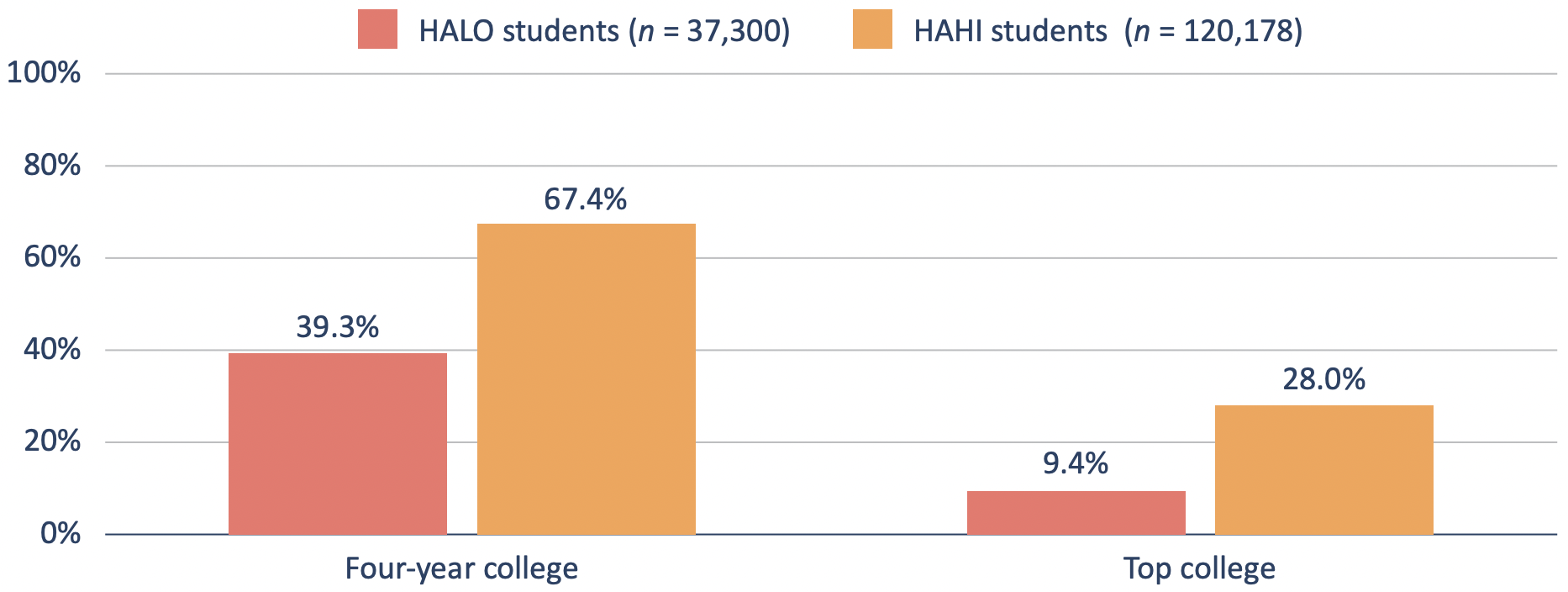
This systemic neglect has ramifications for their college-going. Figure A shows that only two in five HALO students enroll in any four-year college within two years of high school, and fewer than one in ten attends a top college. These college-going rates are far lower than those of high-achieving, high-income (HAHI) students. Specifically, Ohio’s HALO students are 42 percent less likely to attend a four-year college and 66 percent less likely to attend a top college than their similarly-scoring but more affluent peers.[3]

Figure A. HALO students attend college at much lower rates than their more affluent, similarly-scoring peers.

1

Note: The number of HALO and HAHI students identified in this analysis (37,300 and 120,178, respectively) is a combined total based on six years of third-grade test score data (2008–09 to 2013–14). Due to data limitations, the analysis was unable to track all HALO students into college (e.g., students moving out of Ohio), and thus their college-going rates are likely to be slightly understated.

Underscoring how leaky this pipeline is for HALO students, consider this: While they are outnumbered 3-to-1 by their more affluent counterparts in the top achievement quintile in third grade, a decade later they are outnumbered 6-to-1 in four-year colleges and a staggering 10-to-1 in top colleges.

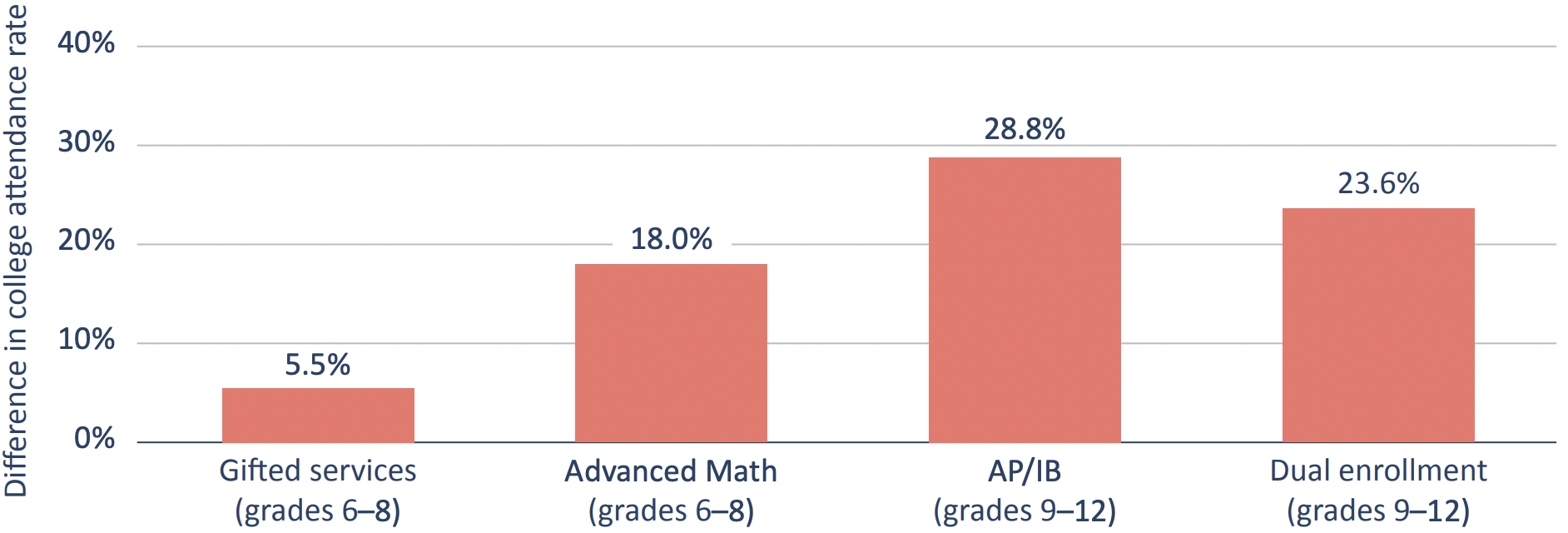
What would keep more HALO students on-track for college? Figure B shows that AP or IB and dual-enrollment course-taking during high school makes a difference in their college-going prospects, as do advanced math courses during middle school and gifted services in English language arts or math. For instance, HALO students who completed an AP or IB course had four-year college-going rates that are 29 percentage points higher than HALO students who did not complete such courses. These results provide compelling evidence that advanced learning opportunities are critical to keeping students on a college pathway.[4]

Figure B. HALO students who participate in advanced learning opportunities have higher four-year college attendance rates than HALO students who do not.

2

Note: This figure displays the differences in attendance rates at any four-year college. See Table 6 in the report for results for top colleges.

Policy implications

What should state and local policymakers do? Many solid recommendations were recently made by a national working group on advanced education, which can be found in this Fordham report. Here, let us highlight five ideas.

1. Ensure early identification of high-achieving students and provision of advanced education during elementary school. It’s hard for schools and teachers to provide advanced learning opportunities to HALO students if they don’t know who they are. Commendably, Ohio (and several other states) require universal screening in the elementary grades for gifted and talented programs (using non-state tests). Policymakers should go a step further and also require identification when students score at the highest levels on state exams—an important marker of academic ability. But identification alone won’t do students much good unless schools provide them opportunities to accelerate and advance. Here, states also have a role to play. They should require schools to provide advanced opportunities to identified students—and enforce that requirement through an audit-type process.

2. Promote automatic enrollment of high achievers in advanced middle school and high school math courses. A few states, including North Carolina and Texas, have automatic enrollment policies that guarantee placement in advanced math courses based on students’ prior-year test scores. For instance, under this type of policy, high-performing seventh graders are automatically placed in eighth grade Algebra I, which is key to more advanced math in high school. Tying course placement to objective measures of achievement ensures that HALO students are in advanced courses—far more reliable than systems that rely primarily on subjective judgments or recommendations for such placements.

3. Expand access to AP and IB coursework into more high-poverty high schools. This goal has long been on the education-reform agenda, but there’s still much to be done to bring such challenging course options into schools that serve the most HALO students (e.g., high-poverty rural or urban campuses). This can be done in many ways, including, for example, “itinerant” programs, whereby an AP teacher covers classes in multiple schools or school districts, or virtual options that bring advanced coursework into classrooms anywhere in the state. Another possibility is to offer schools or teachers financial incentives when students pass AP or IB exams, as North Carolina does. A “weighted” bonus that provides additional funds when low-income students pass these exams could further strengthen the incentive for educators to start programs in schools that have not traditionally offered advanced coursework.

4. Help more HALO students access suburban public schools. In analyses pinpointing which Ohio districts most effectively boost the college-going odds of HALO students, we find several wealthy suburban districts—Solon, Mason, and Dublin among them—topping the charts (see here). That is good news for the handful of low-income students who live in those districts. However, many suburban districts, including two of the three mentioned above, prohibit non-resident pupils from attending their schools. States should require all districts, including suburban, to participate in statewide interdistrict open enrollment, a policy that enables students to cross district boundaries to attend school. This would put suburban public schools—and the advanced opportunities they typically offer—within greater reach of HALO students residing in nearby cities.

5. Launch specialized magnet schools for high achievers. When it comes to Ohio’s best high schools for HALO students (see here for overall rankings and here for rankings focused on top colleges), this varied mix includes a handful of urban district high schools, such as Walnut Hills in Cincinnati and Cleveland School of Science and Medicine, both of which have selective admissions. Also near the top are a few non-district options, such as Dayton Early College Academy, a public charter school that Fordham authorizes, and Metro High School, an independent STEM school in Columbus. Unfortunately, such schools are rare. School districts should work to create specialized, “early college” schools for high achievers—open to students regionally—as could charter or STEM school developers. Following in the footsteps of Illinois, North Carolina, and Oklahoma, states themselves could also create, and directly fund, a residential, competitive public high school that enrolls high-achieving students from all corners of the state.

HALO students have demonstrated their potential to reach college and use it as a springboard to the American dream. Yet due to widespread neglect of their talents, our education system allows too many of them to fall through the cracks. There is a clear pathway that can better nurture HALO students. It includes early identification and acceleration in elementary school, access to advanced math coursework starting in middle school, and enrollment in high schools with strong college-prep curricula and college-going cultures. The playbook is there. Now the question is whether states and school systems can execute those plays and give HALO students the challenge and rigor that prepares them to compete for spots at our top universities.


[1] A “top college” in this report is one in which the average student scores in the top 20 percent on college admissions exams. Among Ohio institutions of higher education, this includes Case Western University, Cedarville University, College of Wooster, Kenyon College, Miami University, Oberlin College, Ohio State University, University of Cincinnati, and University of Dayton.

[2] HALO students are identified based on their characteristics in third or eighth grade, depending on the analysis. Specifically, they are students who scored in the top 20 percent statewide on math and ELA exams and who were identified as “economically disadvantaged,” which is largely based on their eligibility for free or reduced-price lunch.

[3] These college-going gaps reflect not only uneven in-school opportunities, but also factors not directly observed in this study such as college affordability and parents’ educational backgrounds, which a recent study from North Carolina indicates contributes to excellence gaps.

[4] These are not precise “causal” estimates, as unobserved factors, like an effective counselor, might have led students to take advanced courses in the first place.

Policy Priority:
High Expectations
Topics:
Evidence-Based Learning
Curriculum & Instruction
Governance
Advanced Education
Teachers & School Leaders
Chester E. Finn, Jr.
11.6.2025
Student at school
Getty Images/Yuliia Kaveshnikova
Listen to this article
Loading the Elevenlabs Text to Speech AudioNative Player...

A remarkable new data engine and provocative policy paper from the Center on Reinventing Public Education should serve to refocus the attention of policymakers and ed-reformers on the many shortcomings of special education as it has evolved over the past half-century. Yes indeed, it’s been 50 years since President Ford reluctantly signed what is now the Individuals with Disabilities Education Act (IDEA).

Back then, 8 percent of U.S. school kids were identified as “handicapped.” Today it’s 15 percent nationally, though the remarkable state-to-state variability is one of the many virtues of CRPE’s new data tool. By all means check it out, as it shows changes over time by disability category and by state, as well as for the country as a whole.

As the policy paper—by Ashley Jochim and Alexander Kurz—explains, the swelling of SpEd rolls can be traced to actions by Congress and the courts to widen eligibility, notably the statutory inclusion of “learning disabilities,” autism, and “other health impairments” (such as ADHD), all in “the wake of protracted advocacy campaigns about students’ unmet needs for support.”

As the authors also note, the current federal special-ed structure rests on two key elements. First is the existence of a government mandated right to “free, appropriate public education,” with “appropriate” expanded over time to mean assured access to a host of services and accommodations not ordinarily available to other students. And, second, exactly that “exclusionary foundation,” such that (for example), “Students whose reading struggles are associated with dyslexia are ‘in,’ whereas those whose struggles are rooted in poverty, language, or poor instruction are ‘out.’”

This structure has given rise to all manner of problems, including vast amounts of litigation, much bureaucracy, a focus on compliance rather than achievement or accountability, endless lobbying, and high costs, only a fraction of which is covered by federal funding, even though this is the second largest federal K–12 program.

These problems have been recognized for ages. Back in 2001, we at Fordham teamed up with the Progressive Policy Institute to issue a comprehensive repair manual, titled Rethinking Special Education for a New Century. We wrote then that:

Over the past 25 years, K–12 education in the United States has undergone a profound paradigm shift, from access-and-services to results-and-accountability. During the most recent decade, this change has been especially dramatic. Special education simply hasn’t kept up. It’s still an access-and-services program enveloped by a civil rights orientation. It still has more to do with combating discrimination than teaching children what they need to learn.

We itemized eight major “policy failures” and recommended a total overhaul resting on six principles:

1. Make the IDEA standards- and performance-based wherever possible, using Section 504 as the civil rights underpinning of special education but viewing the IDEA as a bona fide education program that is judged by its results.

2. Streamline the number of special education categories into a very few broad groupings, distinguished by whether the basic conditions they address are primarily in need of prevention or intervention, remediation or accommodation, or some combination thereof.

3. Focus on prevention and early intervention wherever possible, using research-based practices.

4. Encourage flexibility, innovation, and choices, allowing schools to work with students and parents to customize services and placements to meet varying needs, and foster the integration of special education into the school’s larger mission and program, while giving parents sound options for their children’s education.

5. Provide adequate funding to ensure the program’s success, assigning to Washington full responsibility for funding the education of the country’s growing population of severely disabled students.

6. End double standards wherever possible.

Perhaps I don’t need to note that not much of this happened. When IDEA was reauthorized in 2004—the last time Congress has touched it—some useful changes were made but nothing like a full makeover. And in the two decades since, the policy failures have mostly worsened, the costs have risen, lawyers and lobbyists have grown wealthy, the SpEd rolls have ballooned—and youngsters on those rolls are still not learning nearly as much as they’re capable of.

On the plus side, NCLB identified students with disabilities as a category whose achievement needed to be tracked at the school level and dinged schools that did poorly in this realm. In the early years, this accountability system plus disaggregated results yielded some gains for SpEd students. While it lasted, the Reading First program also produced improvements in the early reading abilities of some disabled youngsters. 

The biggest reform of the past quarter century that bears directly on children with disabilities, however, is that school choice has created escape mechanisms for many families, enabling them to exit the bureaucratic/legalistic precincts of traditional public schooling into private-sector alternatives. This began in a big way with Florida’s creation of the McKay Scholarship Program—piloted in Sarasota in 1999 and now part of the Sunshine State’s overarching “Family Empowerment Scholarship Program.” Today, some 20 private-school scholarship programs scattered across 14 states are designed for students with “special needs.”

Choice continues to grow, but NCLB and Reading First are both history. Congress has avoided going back to fix IDEA and no White House has pressed them to. Much of the rest of the ed-reform movement of the past quarter century seems to have bypassed special education, and today, the federal SpEd edifice is something of a sacred cow or—viewed from the other direction—“third rail” issue that nobody in high office is brave enough to tackle.

Kudos to CRPE for plunging back in. The problem—at least for me—is that the principal reform the new policy brief proposes is to give millions more kids a federally guaranteed right to the education they need. Jochim and Kurz put it this way:

A new, needs-based entitlement is the linchpin of any effort to fix today’s system of general and special education. It would establish reliable criteria (e.g., students identified at-risk for low achievement in reading or math) for identifying educationally disadvantaged students and a legal mandate to provide those students with the additional instruction and support they need to succeed in school.

Think about it. Students would still have to be “identified.” The “criteria” for doing so could be anything and everything—and we can be certain that all imaginable interest groups would do their best to qualify, from gifted students to left-handed students to trans students to artistic students to kids with unusual athletic skills or career aspirations. Meanwhile, others would continue to be left out of this “legal mandate,” thus perpetuating the “exclusionary foundation” that the authors see as the source of today’s SpEd woes.

I do not understand how this proposed remedy solves the problem. It appears to worsen it, even as the authors launch the politically fraught idea of yet more federal “rights” atop a K–12 system that is grounded in state constitutions, mandates and budgets. Is it really a good idea at this moment in time to create a “needs-based entitlement” and to spur vastly more litigation by “providing parents, the courts, and state policymakers a legal basis for adjudicating claims of inadequacy”?

Somehow, I don’t think so.

Policy Priority:
High Expectations
Topics:
Evidence-Based Learning
Career & Technical Education
Teachers & School Leaders
Robert Pondiscio
11.6.2025
Students on computers at school
Getty Images/Ridofranz
Listen to this article
Loading the Elevenlabs Text to Speech AudioNative Player...

In the spring of 2000, E.D. Hirsch Jr. published an essay in American Educator titled “You Can Always Look It Up—Or Can You?” It’s one of those pieces that distills a lifetime of insight into a few pages. Hirsch argued that the notion of teaching “learning skills” instead of knowledge was deeply misguided. To look something up, he noted, presupposes that you already know something—enough to recognize what’s relevant, to interpret what you find, to sift sense from nonsense.

The problem wasn’t that children were lazy or that teachers were inept, but that progressive pedagogy had confused knowing what with knowing how. Hirsch saw this long before most of us: The capacity to find information isn’t the same as understanding it. Skills are empty vessels; knowledge is what fills them.

A quarter century later, we face the same issue on steroids. Artificial intelligence has made “looking it up” obsolete. Why bother? ChatGPT—or whatever model you prefer—doesn’t just find information; it synthesizes, evaluates, and presents it in tidy, authoritative paragraphs, ready to be cut, pasted, and submitted for grading. What Hirsch feared might happen to students who relied too heavily on search engines pales next to the complacency invited by AI, which offers the illusion of mastery without the work of learning. It allows both students and teachers to skip the hard part—the thinking.

The seductive ease of knowing without learning

To learn anything deeply, you must wrestle with it. The effort itself—sorting, comparing, rephrasing, struggling to make sense of what you read—is where learning occurs. Cognitive scientists call this productive struggle or desirable difficulty. “There is a consensus in cognitive psychology that it takes knowledge to gain knowledge,” Hirsch wrote in 2000. “Yes, the internet has placed a wealth of information at our fingertips. But to be able to use that information—to absorb it, to add to our knowledge—we must already possess a storehouse of knowledge. That is the paradox disclosed by cognitive research.”

AI is fatal to this process. Type a question and it produces a fluent answer. The prose is confident, the reasoning plausible, the sources (usually) credible. But the user’s mind remains largely idle. Students who rely on AI to write an essay or solve a problem may submit excellent work, but they have not done excellent thinking. The polished output masks the absence of cognition behind it.

There’s nothing new about this temptation. The spellchecker made us worse spellers; calculators dulled our ability to do mental math. But those technologies automated low-level skills. AI automates higher-order thinking—the very mental operations that define a well-educated person.

This is not just a student problem. Teachers, too, are vulnerable to AI’s siren song of efficiency. AI can spit out lesson plans, differentiated materials, or essay feedback in seconds. But efficiency is not the same as expertise. Teachers become skillful through the deliberate act of designing lessons, anticipating misconceptions, reading and responding to student work. Offload those tasks to AI and you hollow out the craft. The teacher becomes an editor of machine output rather than an author of instruction. In time, that can only erode the kind of pedagogical expertise that separates a novice from an expert.

AI is not a democratizing force that will level the playing field for students and make teachers’ jobs easier. When automation replaces learning, the opposite happens: The knowledgeable become more powerful, the uninitiated more dependent.

Outsourcing judgment

When Hirsch wrote “You Can Always Look It Up,” Google was just getting started. Search engines required users to decide which keywords to enter, which links to click, and how to interpret what they found. It was still an exercise in judgment. You had to know something to get anything of value from the search results.

AI takes judgment out of the loop. It doesn’t simply retrieve information—it makes evaluative decisions about what’s relevant, what’s plausible, and how to frame and communicate it. That might not sound catastrophic—until you consider that developing judgment is the entire point of education. Hirsch’s lifelong project, from Cultural Literacy onward, has been to argue that knowledge is not merely a private good but a civic one. Yes, a shared store of background knowledge enables students to read with comprehension. But it also allows citizens to comprehend the news, participate in democratic debate, and resist manipulation.

AI, used uncritically or as a shortcut, does the opposite. It trains us to trust rather than test what we read. Its convenience invites intellectual passivity. The effect is not enlightenment but anesthesia.

Hirsch’s concern was always larger than pedagogy. The “knowledge deficit,” as he called it, weakens not just individual students but the culture itself. When people lack the background knowledge to make sense of public life, they become easy marks for demagogues and charlatans.

AI enables and accelerates that vulnerability. It substitutes the appearance of understanding for the effort and discipline needed to achieve it. The more we rely on it to summarize, paraphrase, or interpret the world for us, the less capable we become of making sense of the world ourselves.

This is not an argument for technophobia. It’s an argument for intellectual vigilance. The civic mission of education is not to make students efficient consumers of information but to form judicious minds—citizens who can weigh evidence, detect bias, and recognize coherence or nonsense when they see it. If AI makes those faculties atrophy, it will have made us not smarter but shallower.

Can schools use AI well?

The problem is not the technology itself but our disposition toward it. AI can be genuinely useful when it serves as a multiplier of existing competence. A well-informed teacher can use it to save time on tasks that don’t require much judgment, like generating examples or producing low-stakes practice materials. A motivated student can use it to clarify confusion or practice skills already in progress. A chatbot can even serve as a Socratic partner for students, posing counterarguments or probing for clarity. But these examples presuppose that the user already possesses the knowledge and judgment to recognize when the machine is wrong.

That’s the rub. The very people most likely to misuse AI—those with shallow background knowledge, weak discernment or motivation—are the ones most susceptible to its illusions. It’s a knowledge amplifier, not a knowledge substitute. Education is not a product to be delivered; it’s a transformation that occurs through effort. The problem with AI is that it can perform education’s outputs—essays, analyses, answers—without any of its inputs. In sum, it is a powerful tool in the hands of the curious and the motivated but devastating to those merely seeking a shortcut.

The teacher’s dilemma

If you’ve ever taught writing, you know that feedback is not a mechanical process. It’s an act of interpretation: discerning what the student was trying to say, identifying where understanding breaks down, and deciding how to guide improvement. It’s as much an art as a science. And it’s hard, even for accomplished writers.

AI grading tools streamline this labor and even offer useful insight to students. But a teacher who stops giving feedback herself—who stops reading with the mind of a teacher—risks losing the ability to see through her students’ eyes. Over time, and with over-reliance on the technology, her professional discernment dulls.

In this sense, AI poses to teachers the same threat that automation poses to workers in every field: deskilling. But in education, the stakes are uniquely high because what’s being eroded is not merely a job skill but a human connection. The teacher’s authority arises from her knowledge and her capacity to model it. If she becomes merely a conduit for AI-generated content, she ceases to be a craftsman. Her skills can only atrophy or fail to develop in the first place.

The danger of AI

Hirsch’s insight still holds: to make sense of the world, you must already know a great deal about it. As he wrote in his 2000 essay, “One of the most important principles of psychology is that knowledge builds on knowledge. The more you know, the more readily you can learn something new, because you have a lot more analogies and points of contact for connecting the new knowledge with what you already know.”

We should use AI as we use any powerful tool, with caution, curiosity, and a clear sense of purpose. But we should take great care—students and teachers alike—to resist substituting the efficiency of AI with the slow, irreplaceable labor of teaching and learning. Because the great danger of AI is not that it will outthink us but that it will tempt us to stop thinking altogether.

Editor’s note: This was first published on the author’s Substack, The Next 30 Years: The Future of Education Reform.

Policy Priority:
High Expectations
Topics:
Curriculum & Instruction
Governance
Teachers & School Leaders
Alicia Anderson
11.6.2025
School cellphone ban
Getty Images/SeventyFour
Listen to this article
Loading the Elevenlabs Text to Speech AudioNative Player...

Most U.S. students currently or will soon attend a school with a cellphone policy. Phone bans provide cover for teachers and administrators lamenting the constant fight for kids’ limited attention in the classroom, and most teachers support enforceable policies that limit student use during instructional time. Opponents are often parents of school-age children with concerns both dramatic (what if I can’t reach my kid in an emergency?) and practical (is there soccer practice after school today?).

Given the paucity of empirical evidence to support them, school cellphone bans are effectively policymaking by vibe. The research literature is particular sparse in the U.S. context, and existing data are both mixed and complicated by the pandemic’s disruption. Hence the value of David Figlio and Umut Özek’s new working paper on a Florida district’s cellphone policy implementation. The researchers pull demographic, testing, discipline, and attendance data to compare pre- and post-cellphone ban results, using a quasi-experimental design to determine whether there is a causal connection between policy and outcomes. The findings, though not presently peer-reviewed, provide evidence that supports cellphone ban policies generally and bell-to-bell bans specifically.

In July 2023, Florida enacted HB 379, prohibiting student cellphone use during instructional time in K–12 schools.[1] Figlio and Özek draw on data from a large urban district that went further, requiring devices to be silenced and out of sight throughout the entire school day. Using student data from the district and Advan smartphone activity data to understand cellphone use at the building level, they classify schools by high or low cellphone use before the policy implementation in 2023. They use a difference-in-differences approach to compare test scores, disciplinary records, and attendance data pre- (2022–23) and post-policy shift in the high- and low-cellphone activity schools to see whether the ban had a causal effect on student outcomes during its first two years (2023–24 and 2024–25). 

The ban successfully got kids off their phones—estimated building-level cellphone use by students dropped by about two-thirds within the first two months and remained low in the two years studied. Unsurprisingly, however, implementation presented notable challenges.

Disciplinary incident rates in the high-cellphone use schools went up in the first year of the ban relative to the low-use comparison schools, with an estimated 12 percent increase in overall suspensions and a 20 percent increase in in-school suspension rates compared to the low-use schools—both driven disproportionately by large increases among Black students. Disciplinary issues improved in the second year, but these improvements were driven by reductions in elementary school incidents; rates for middle and high schools were better than in year one but out-of-school suspensions remained elevated compared to pre-ban levels.

Academic outcomes improved under the ban. During the spring testing window at the end of the ban’s second year, scores in previously high-cellphone activity schools were up 1.1 percentiles overall relative to low-cellphone activity schools, with larger effects for boys (1.4 percentiles) and for middle and high school students who are more likely to have access to a phone (1.3 percentiles). Effects were not statistically significant for girls or elementary school students. 

Those modest but promising gains should be viewed against the backdrop of other policy changes. The 2022–23 school year marked a major shift for state assessments, with SB 1048 eliminating the Florida Standards Assessment (FSA) in favor of new thrice-annual FAST assessments, which benchmark twice and then use the spring results for higher-stakes accountability purposes. The overhaul led Figlio and Özek to start their analysis with 2022–23 data rather than merging previous pandemic-era FSA results, but it’s possible that the small improvements stem from building-level differences in adjusting to the new tests. The study measures FAST academic outcomes only for grades 3–10 (English language arts) and grades 3–6 (math).

More importantly, unexcused absences dropped 5 to 10 percent under the new policy, making it difficult to disentangle the academic achievement effects of simply attending school from effects of the ban itself. Figlio and Özek suggest that up to half of the academic gains may be attributable to better attendance, especially among middle and high schoolers.

Why are more kids showing up for class under the new policy? This question falls outside the scope of this study but has real implications for both policy formation and for school leaders trying to build stakeholder buy-in during implementation.

I asked a few teachers, parents, and teens for their take on the attendance findings, and several suggested fear of missing out when friends are engaging in person at school. Others told me with confidence that the inability to quickly text home for a pick-up without trekking to the main office to call via landline under the glaring eyes of the office staff contributes to more kids spending their school day in the classroom. June 2025 data from the NCES School Pulse survey support this theory—more than half of respondents listed “parent apathy” as a reason why middle and high school students miss too much school.

School culture doesn’t exist in a vacuum, and changing behavior isn’t easy—especially when it requires shifting parent behavior alongside student habits. It’s worth remembering that many current high school students got their first devices during the pandemic, when cellphones became one of the few ways to stay socially connected during lockdowns and were a key academic tool for students without access to computers or to reliable internet. Parents are adjusting to new norms after years of constant contact with their teens; the bans provide some cover against student and parent pushback while school leaders help their communities adapt.

Figlio and Özek show that cellphone policies can drive modest academic achievement gains and significantly boost attendance, providing empirical evidence that supports the gut feelings of many policymakers and educators. Compared to policies that limit cellphone use only during instructional time, full bell-to-bell bans may create more opportunities for student engagement but also more opportunities for infractions. To guard against bias in disciplinary actions, school leaders should monitor enforcement approaches carefully and systematically code cellphone-related infractions. As more schools implement cellphone bans, robust data collection can inform attempts to develop appropriate digital device policies and healthy shared norms among students, families, and schools.

Source: Figlio, David N. and Umut Özek, “The impact of cellphone bans on student outcomes: Evidence from Florida.” NBER Working Paper No. 34388. National Bureau of Economic Research (October 2025).


[1] In May 2025, Florida enacted a stricter bell-to-bell ban for elementary and middle school students that went into effect after the time covered in this study.

Policy Priority:
High Expectations
Topics:
Evidence-Based Learning
Teachers & School Leaders
Nina Rees
11.5.2025
Dick Cheney
Gage Skidmore/Flickr
Listen to this article
Loading the Elevenlabs Text to Speech AudioNative Player...

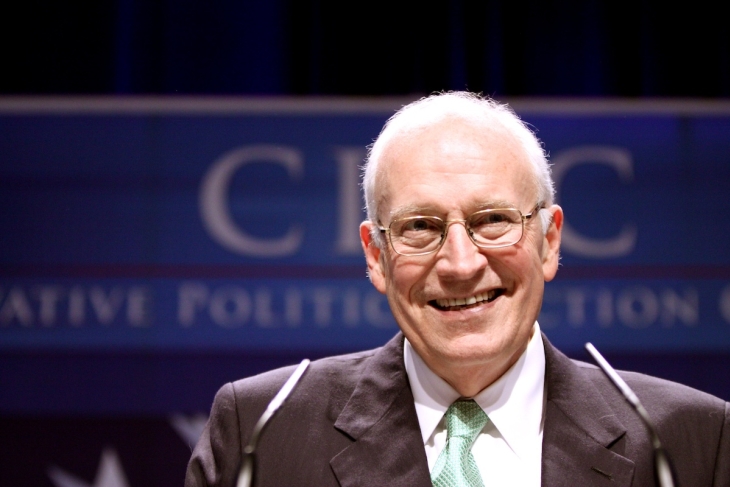
Dick Cheney passed away yesterday at the age of 84. As one of his domestic policy advisors during his time as Vice President, I was deeply saddened by the news; especially as I think about my own aging parents (my mom is 81 and my dad is 90).

I had the great fortune of serving in the Office of the Vice President during the first two years of the Bush–Cheney administration. My path to that role was equal parts luck and ambition. From the moment I moved to Washington, D.C., in the early ’90s, I dreamed of working at the White House. As an immigrant from Iran who didn’t become a doctor, lawyer, or engineer, nothing felt more like achieving the American Dream than serving there.

As an education reformer, I was especially drawn to the administration’s deep commitment to education, rooted in the “compassionate conservatism” of the time. Having worked on the Bush–Cheney transition, I first met Scooter Libby as he was assembling what became a small but mighty domestic policy team. Thanks to Cesar Conda, who led that team, I was invited to join.

At first, I wasn’t sure how my background in education policy would fit within Cheney’s portfolio. But I figured if an education policy guru like Jon Schnur could work for Vice President Gore, I could maintain my bona fides by working for Vice President Cheney while broadening my experience. I also appreciated Cheney’s deep understanding of the Middle East; an interest we shared, in my case as an Iranian American, and in his from his time at Halliburton.

The decision to join his team turned out to be one of the best of my career. Say what you will about his legacy, whether it’s his post-9/11 record or his recent endorsement of Kamala Harris, Dick Cheney stood by what he believed in. That’s a rare quality in public life today.

The role of the Vice President is a straightforward one: You do what the President asks. Education was very much President Bush’s domain, so opportunities to engage the Vice President (or his wife, who was deeply respected in education circles) were limited. Yet in our weekly domestic policy meetings, I found him to be highly engaged in understanding how No Child Left Behind, or NCLB (the first bill that was introduced in Congress), was doing. He had a dry wit (something that took me a while to get used to), and eventually, I discovered ways to engage him in the work.

One example stands out. Bill Hansen, then Deputy Secretary under Rod Paige at the Department of Education, once called asking if the Vice President might meet with the department’s senior team at Airlie Conference Center. I had no idea if Cheney would agree, but not only did he say yes, he seemed to genuinely enjoy it. We flew to Airlie Conference Center on Marine Two to talk with the team about the administration’s first 90 days and give the team a morale boost considering the news pieces at the time indicating that the White House was calling all the shots when it came to education policy (which is normal when a President makes a policy idea their priority).

Another part of my job was to help keep the conservative coalition, many of whom I knew from my time at the Heritage Foundation, aligned with the President’s NCLB goals. It was a challenging task, to say the least. Eventually, I asked the Vice President if he’d attend one of those meetings to lend his credibility. Again, his answer was a simple “yes.” Conservatives trusted him, and his presence made a real difference.

Of course, his role as President of the Senate was the most valuable. While 9/11 changed everything, Cheney’s long-standing relationships on Capitol Hill were critical as we worked to bring a very different approach to education into the Republican fold.

After 9/11, his focus naturally shifted to national security. I tried to contribute in a different way, helping in a war room designed to ensure that America’s actions in Afghanistan weren’t perceived by Muslim and Arab communities as a war against Islam. As a Muslim American who believed in coalition building, I felt called to that work. Eventually, though, I returned to my roots at the Department of Education.

Reading the vitriol directed at Cheney on social media now, even upon his death, I can’t help but wish his critics had met the man I knew. I didn’t agree with him on everything, but serving him was one of my greatest honors. Many reporters who once went after him (remember the energy task force?) now look back on him and that era with respect.

It’s hard, in hindsight, to give public leaders the grace they deserve when they’re making hard choices in real time. Leadership often means making quick decisions, staying the course, and remaining true to one’s core convictions. I’m not sure what his Vice Presidency would have looked like in today’s social media age, but I know this: For Dick Cheney, it was always about service to country—period.

Rest in peace, Mr. Vice President.

Policy Priority:
High Expectations
Topics:
Governance
Jeff Murray
11.5.2025
Gadfly Bites logo
Listen to this article
Loading the Elevenlabs Text to Speech AudioNative Player...

News stories featured in Gadfly Bites may require a paid subscription to read in full. Just sayin’.

  1. Worthington City Schools’ superintendent published an opinion piece in The 74 this week where he explains why the residents of his hamlet “still choose public schools” in an era of expanded charter and private school choice in Ohio. “Public school districts have two options,” he writes. “They can sit back and hope the pendulum of support swings back to public education, or they can use increased competition as a driving force for innovation to best serve their students’ specific needs.” He explains how his district has embraced the latter, for the benefit of their families. (The 74, 11/4/25)

Did you know you can have every edition of Gadfly Bites sent directly to your Inbox? Subscribe by clicking here.

Policy Priority:
School Funding
Topics:
Governance
Elliot Regenstein
11.5.2025
wonkathon
Listen to this article
Loading the Elevenlabs Text to Speech AudioNative Player...

Editor’s note: This essay is an entry in Fordham’s 2025 Wonkathon, which asked contributors to answer this question: “What needs to happen next—at the state, district, and school levels—for the science of reading revolution to fulfill its promise and ensure that far more children learn to read well?” Learn more.

The science of reading doesn’t start with kindergarten—it starts at birth. The science of reading revolution is a promising one that is already having a positive impact on some fourth grade reading scores. But really maximizing the impact of science of reading will require an essential practice already underway in leading states: starting before kindergarten.

The early years are a critical time for brain development—and language acquisition. States already have early learning standards that focus on language development in the pre-kindergarten years. In almost every state, more rigorous support for implementation of those standards could have a significant impact (and in some states, the standards themselves may need revisiting).

We know that too many children are not meeting the standards: While not every state conducts a statewide kindergarten readiness assessment, the data we have show that many children enter kindergarten well behind where the state standards say they should be. The science of reading can help close that gap, but there’s only so much schools can do in a given year.

That’s why it’s essential to add years. High-quality pre-kindergarten settings with a focus on the science of reading—in an age-appropriate manner—can help to improve literacy rates at kindergarten entry. That in turn can have a ripple effect throughout the system, including allowing K–3 teachers to build on a stronger foundation of reading skills.

To systematize science of reading in the pre-kindergarten years, there are a set of practices leading states, districts, and schools are already putting into place. These include:

States

  • Add years to the educational continuum by funding the expansion of preschool programs. If the state does not already have universal or near-universal approach to funding, considering focusing expansion on areas where school districts have lower reading scores.
  • If the state’s preschool program focuses on four-year-olds, consider expanding it to three-year-olds, at least in areas with lower reading scores. Instead of asking teachers to scratch and claw for additional instructional minutes in early elementary school, states can accelerate progress by adding an entire school year of instruction at a developmentally foundational time.
  • Ensure that preschool programs have the skilled teachers needed to build literacy skills and that those teachers are well-supported. This includes ensuring that the science of reading is built into teacher preparation—and then continuing to support preschool teachers with the science of reading once they’re in the classroom.
  • Include preschool programs in the state’s overall plan for strengthening literacy so that there’s true alignment between preschool and K–4. If early elementary teachers are focused solely on catching up the kids who enter behind, they’ll squander the gains made by students who came in meeting state standards.
  • Provide support for high-quality early childhood instructional materials aligned to the science of reading, and support for teachers to utilize those materials effectively.
  • Implement statewide assessments that track progress toward kindergarten readiness goals. These assessments should include a focus on essential pre-literacy and early literacy skills—helping teachers to improve their engagement with children and giving policymakers a window into what is working and what isn’t.
  • In states where different early childhood programs are overseen by different agencies, ensure that there is an empowered point person working across early childhood settings to support improvement.

Districts

  • Publicly articulate preschool as part of an overall literacy strategy.
  • Increase access to preschool.
  • Collaborate with private early childhood providers in the area—including Head Start—to align professional practices to science of reading best practices and to increase alignment across settings (including between early childhood and kindergarten).
  • Increase the focus on the quality of adult-child interactions that promote school readiness and pre-literacy skills.
  • Use flexible funds to add preschool classes in communities where reading scores are low.
  • Leverage statewide assessments—and complementary local assessments—to understand the literacy of incoming kindergartners, and build local strategies based on that data. Those local strategies should include attention to both pre-kindergarten and early elementary instruction.
  • Use data to drive decision-making, including at the resource level and instructional level.

Schools

  • Principals should include early childhood teachers in their overall strategy and in their professional development—even if those teachers work for community providers.
  • Principals should emphasize the importance of alignment across years—particularly between pre-k and kindergarten—and support early childhood and early elementary teachers to work together.

These recommendations will come as no surprise to the states that have been leading the charge on the science of reading, like Mississippi and Louisiana. They’re already including early childhood as part of their literacy strategy, with a focus on instruction and curricular materials. Importantly, that instruction can be conducted in a play-based environment; there should be no tension between the state’s literacy goals and the need for preschool-aged children to have fun while they learn.

There’s no question that a great deal more needs to be done in K–12 schools to fulfill the promise of the science of reading. But all of that work, important as it is, will spark merely marginal gains if we don’t address kindergarten readiness. The fundamental improvement needed isn’t just making the most of the four years between kindergarten and third grade; it’s making the most of the eight years between birth and third grade. Incorporating early learning into state science of reading strategies is the only way to do that.

Policy Priority:
High Expectations
Topics:
Curriculum & Instruction
Governance
Teachers & School Leaders

Pagination

  • First page « First
  • Previous page ‹ Previous
  • Page 74
  • Page 75
  • Page 76
  • Page 77
  • Current page 78
  • Page 79
  • Page 80
  • Page 81
  • Page 82
  • Next page Next ›
  • Last page Last »
Fordham Logo

© 2026 The Thomas B. Fordham Institute
Privacy Policy
Usage Agreement

National

P.O. Box 110
Burke, VA 22009

202.223.5452

[email protected]

Ohio

P.O. Box 82291
Columbus, OH 43202

614.223.1580

[email protected]

Sponsorship

130 West Second Street, Suite 410
Dayton, Ohio 45402

937.227.3368

[email protected]