Mobile Navigation

  • National
    • Policy
      • High Expectations
      • Quality Choices
      • Personalized Pathways
    • Research
    • Commentary
      • Gadfly Newsletter
      • Flypaper Blog
    • Events
    • Scholars Program
  • Ohio
    • Policy
      • Priorities
      • Media & Testimony
    • Research
    • Commentary
      • Ohio Education Gadfly Biweekly
      • Ohio Gadfly Daily
  • Charter Authorizing
    • Application
    • Sponsored Schools
    • Resources
  • About
    • Mission
    • Board
    • Staff
    • Career
Home
Home
Advancing Educational Excellence

Main Navigation

  • National
  • Ohio
  • Charter Authorizing
  • About

Kunjan Narechania Jessica Baghian
11.11.2025
Wonkathon
Listen to this article
Loading the Elevenlabs Text to Speech AudioNative Player...

Editor’s note: This essay is an entry in Fordham’s 2025 Wonkathon, which asked contributors to answer this question: “What needs to happen next—at the state, district, and school levels—for the science of reading revolution to fulfill its promise and ensure that far more children learn to read well?” Learn more.

Look closely at Louisiana, Mississippi, Tennessee, and DC, and you’ll see that the places getting reading right are the ones getting implementation right.

What’s driving the “Southern surge” is not one initiative or even a series of initiatives aimed at fixing the reading crisis, it’s that these states have built a system that drives a relentless focus on implementing the policies they pass.

People often hear the Mississippi story and say things like, “They had literacy coaches. That means we need literacy coaches and we’ll get our kids reading.” But that’s like watching professional basketball and assuming that if you had the same uniform, you could play the same game. It’s not just the uniforms, and it’s not just the literacy coaches. It’s the coordination among the players driving to one goal—the system they’ve built as a team, with all the moving pieces moving in the same direction—that helps them win.

In order for more states to get literacy right, they need to restructure their education agencies around a limited set of goals and reorient their entire system to drive toward those goals. It will mean making hard decisions not just about what to start doing, but also about what to stop doing.

In our experience, effective systems are made up of these four components:

  1. A coherent vision for an improved student experience shared among everyone in the state, along with rigorous standards that are aligned with that vision and make sense in the lives of kids and teachers.
  2. An implementation chain that names every player between the statehouse and the student, describes the most important adult behavior shifts they must make to achieve the student vision, and includes a plan for measuring the extent of these changes.
  3. A plan for using the state’s most important levers, including standards and assessments; funding; accountability, regulations and guidance; support and training; and communications, to elicit behavioral shifts from everyone in the implementation chain.
  4. Implementation data that drives improvement, specifically data about whether educators are actually changing how they do their daily work that can help shape adjustments to overall strategy.

Without this level and depth of system reorientation, we end up with states saying, “We passed science of reading policies, not sure if it’s working, but hopefully scores go up next spring.” If we want results for kids, the entire system—from the academic team, to the multilingual learners’ office, to the special ed department, to principal, teachers, and coaches—needs to move to one goal and measure progress every step of the way.

Coherent vision

The vision has to start at the classroom level: What do you want the experience to look like for a third grader sitting at a desk?

During our tenure at the Louisiana Department of Education, our goal was to ensure all students were growing their skills and knowledge as measured by our state test. But that vision wasn’t specific enough to orient our entire system around it. We had to get even more granular to arrive at a goal that was hyperspecific and observable.

Here’s what we used instead: “In all third through eighth grade classrooms, students will read complex, grade-level texts that build their knowledge of the world. They will express their ideas about those texts through writing and speaking, while teachers facilitate student learning to deepen comprehension rather than focus on isolated reading skills.”

Too often states start their vision at the statehouse or only articulate their vision in terms of percent of kids achieving proficiency, when they actually need to start at the classroom level and ripple up through the system from there.

Implementation chain

Implementing a new policy is like playing a high-stakes game of telephone with thousands of participants, where each person has to hear the message and do something new.

In any given state, there might be 50,000 teachers; 10,000 principals; and 7,000 district leaders, and in order for kids to experience something different in classrooms, all of them have to reorient their day-to-day behavior to the vision. They need to be clear on their specific roles in pursuit of the literacy goals.

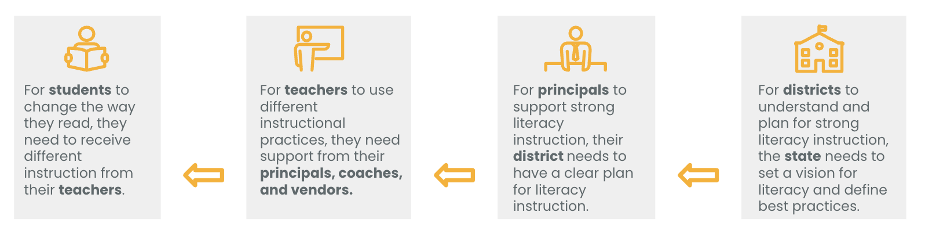
The “implementation chain” is a map of all the adults who influence what happens in classrooms, from teachers to coaches, principals, and district leaders, and the specific ways in which each of these adults needs to adjust their daily work so that students benefit from the policy's intent.
Watershed wonkathon graphic

As part of Louisiana’s literacy work, we identified not just what actions teachers needed to take, but also what supports they would need from all the other actors in the chain.

If we wanted teachers to plan and facilitate instruction using new materials, they needed professional learning, regular feedback from coaches, and planning tools to prepare units and lessons in collaboration with their peers. If we wanted principals to ensure teachers have skilled instructional coaches, they needed to set clear expectations, create time in the schedule for coaching, collect observation data to adjust their school’s approach, and so on.

Levers

Adding literacy onto a pile of pre-existing state priorities won’t help more kids read—the pile has to go. Eliminating priorities isn’t easy, but it is essential. As the saying goes, you can do anything but not everything. States must choose what they most want to accomplish, and align every lever—standards and assessments, funding, accountability structures, regulations, training, and communications—to achieve that vision. The goal is to make the right choice, the easy choice.

States that are serious about improving student outcomes should be asking themselves:

  1. How can every discretionary dollar in the agency be spent on supporting districts, principals, and coaches to make the shifts in the implementation chain?
  2. What trainings do we have to stop doing versus start doing to support the implementation chain?
  3. What department-issued newsletters, guidance, and communications do we need to stop sending out because they create distraction?
  4. In what ways are all the offices in the SEA aligned to the implementation chain–not just the academics team, but also the team thinking about students with disabilities, multi-lingual learners, and school improvement?

Here is a downloadable template we created based on what worked in Louisiana. State leaders can take this and make it their own.

Measurement and improvement

Last, but most certainly not least, the system only works if we have information about whether we're getting results — not just in terms of student achievement but also whether the actors in the system are changing. No more crossing your fingers and hoping for the best in the spring.

While student assessments are undeniably important, they are too far downstream to be the primary measure of implementation. Instead of waiting for student test results, states should measure early and often — and not just from a distance at the capitol, but on the ground in schools.

Kunjan will never forget walking into a classroom at a school that had adopted a high-quality curriculum and seeing the new materials sitting in boxes against the wall, unopened. Sometimes, the difference between implementing a new curriculum and not implementing a new curriculum begins with throwing the old stuff in the dumpster and then regularly observing that the new materials are being used. A standardized test will never be able to tell you that.

Doing this work is not glamorous. It’s not flashy. But Louisiana proves that it works. Since 2013, Louisiana has had the second-highest increase in fourth grade reading (second only to Mississippi). Overall, the state is now fourteenth in the nation. That’s not because of an initiative, or even a series of initiatives. It’s because Louisiana built and managed a system focused on classroom-level change, made it really clear what every person needed to do, pulled every lever, and never stopped measuring and improving.
Policy Priority:
High Expectations
Topics:
Evidence-Based Learning
Curriculum & Instruction
Teachers & School Leaders
Emily Freitag
11.11.2025
wonkathon
Listen to this article
Loading the Elevenlabs Text to Speech AudioNative Player...

Editor’s note: This essay is an entry in Fordham’s 2025 Wonkathon, which asked contributors to answer this question: “What needs to happen next—at the state, district, and school levels—for the science of reading revolution to fulfill its promise and ensure that far more children learn to read well?” Learn more.

We know a lot about how children learn to read. But to fulfill the promise of the science of reading revolution, we have to admit there is a lot we do not yet know about what schools need to do to help every student read proficiently.

My team and I recently searched for schools where 80 percent of fifth graders were meeting reading proficiently on their state tests, with no gaps by student demographic groups. We found four schools serving diverse student populations that are reaching this target. Four.

These four schools all use different curricula; they have different approaches to intervention; they engage parents in different ways. They seem to share an obsessive focus on tracking the needs of every student, but interviews did not reveal a straightforward recipe for achieving these currently uncommon outcomes. 

The enthusiasm of the science of reading movement and its “know better, do better” ethos has sparked real change. I have seen more change in teacher’s instructional practice over the last five years in early grades reading than I have ever seen with any other initiative.

However, I worry that the policies that have been made in its name lack the long-game, goal-oriented learning approach that is required to really impact outcomes—and are set up to disappoint expectations.

The recent energy in the science of reading movement was sold with the story that we know a lot about how students learn to read, but common teaching practices don’t put that knowledge into practice. That disconnect is real—but improving practice at scale is far from simple.

There are a set of core policy plays that have come to define state-level science of reading legislation, including requiring training for teachers, changing curriculum, changing teacher preparation training, adding reading screeners, and in places, student retention policies. I worry that policymakers’ enthusiasm about these (important, foundational) moves have unintentionally created expectations for student outcome gains that are going to be disappointed. 

Reading proficiency is extremely hard to move. As I have written about in detail elsewhere and many others in this Wonkathon will no doubt stress, foundational skills—the crux of the science of reading movement—are necessary, but not sufficient, to proficiently read a complex text. The translation of the science of reading into a set of implementation moves vastly overindexes on the outcomes those moves will make. If these moves do not produce gains on state tests (which they are unlikely to do in an obvious and immediate way), then some policy makers may be inclined to dismiss the science rather than look for the more complete solution set needed to match the problem.

More significantly, focusing on a few key strategies misses the opportunity to put us all the more productive, goal-oriented learning posture we need to really achieve these outcomes.

The win for the science of reading movement isn’t high-quality curriculum in every classroom or every teacher trained, important as all of those progress markers may be on the path to victory. The win is every student reading proficiently. And when only four schools in the country are getting the outcomes we should be able to reasonably expect across the nation, we have no choice but to all be humble learners about how to get to better outcomes. 

Reductively, for many more schools to reach reading proficiency, state, district, and school leaders need to set big goals for improvement and keep at the work until they get there. They can and should have a hypothesis on what will work but then they need to follow the data. And they need to stick with the mission even when the results are not fast or straightforward.

We have tried big goals and accountability as the core strategy for improvement before. No Child Left Behind produced some improvement in math but less in reading. I am not suggesting that “set a big goal and work to get there” will lead to scaled improvement for every student. But I know sending teachers to a science of reading training won’t get us all the way there either.

At Instruction Partners, we’ve set a big goal of helping 50 schools reach 80 percent of fifth graders reading proficiently, with no gaps by student demographic groups, with a project we’re calling the Elementary Reading Initiative. We’re designing a service to support teachers and leaders in implementing strong core instruction, intervention, tutoring, and out-of-school time around specific bundles of products. We’re focusing on building leaders’ capacity in particular to support the work. We have a research-based hypothesis about what schools need to do to reach these outcomes, but we’re holding it loosely and have formative research partners who will help us obsessively understand for whom the service is working and follow the data. We’re finding partners deeply committed to the goals and the mission. Together, we are giving ourselves five years to meet our ambitious goals, and we’re expecting slow progress in the first couple of years as the practices take hold. We are half a year in with our first cohort and we are learning a lot. 

We’ve never taken on a bigger goal or longer project, but we think that is what this moment in the science of reading movement needs. Clear goals, the best the science can offer, a learning orientation—and a lot of stamina to keep at the mission.

Policy Priority:
High Expectations
Topics:
Curriculum & Instruction
Governance
Teachers & School Leaders
Miah Daughtery
11.11.2025
Wonkathon
Listen to this article
Loading the Elevenlabs Text to Speech AudioNative Player...

Editor’s note: This essay is an entry in Fordham’s 2025 Wonkathon, which asked contributors to answer this question: “What needs to happen next—at the state, district, and school levels—for the science of reading revolution to fulfill its promise and ensure that far more children learn to read well?” Learn more.

The science of reading movement transformed how the public talks about early reading education and outcomes, spurring robust conversations between educators, policymakers, and parents. However, the movement’s most significant omission was its limited consideration of students in grades six and above. Many students—particularly those from low-income, multilingual, and historically marginalized communities—struggle to read in middle school and graduate high school nonproficient. This oversight has real consequences, as adolescents not only encounter more text, but that text is also widely diverse. Building on the early literacy momentum, the next movement’s phase must widen the aperture to assessment and instruction for adolescents, while leveraging implementation science to sustain effective practice, fulfilling the promise to students, their families, and their communities. Such change requires coordinated action across the system that catalyzes assessment into instructional change.

Better outcomes begin with better data

The future of reading assessment should move away from solely measuring reading skills in grades 3–12 and expand into secondary reading screeners and disciplinary literacy. Districts should provide secondary reading screeners. Most middle and high school reading assessments today prioritize comprehension. So, for many students, reading difficulty shows up as a comprehension problem, potentially masking ineffective decoding skills, weak reading fluency, lack of grammar understanding, a limited vocabulary, or dyslexia. That means adolescents who need targeted intervention may not be appropriately identified or supported. Additionally, state assessments can learn from the 2026 NAEP Reading Framework, which now acknowledges the criticality of background knowledge for comprehension, and disaggregates reading in literature, social studies, and science instead of by literature and informational text.

Secondary-level educators need reliable, valid assessments along with aligned coaching in how to interpret a body of data insights to inform instruction. Educators need reading screening data to determine which students need intervention and discipline-specific reading comprehension data for regular instruction. One way forward is to broaden existing screeners and interim assessments to include multisyllabic word reading and reading fluency in grades six and above. By sixth grade, students should be decoding multisyllabic words, but for many, this is arduous and impedes their ability to not just read discipline-specific texts, but also to write with increasing sophistication. Concomitant to multisyllabic word reading is reading fluency; both inform comprehension.  Without quality assessment data in both multisyllabic decoding and reading fluency, teachers are left without clear direction, targeting comprehension when students may need more fundamental support. But no amount of data will help without supporting those interpreting it with data literacy professional learning. States, districts, and schools must collaborate in building a data literacy system alongside a revised assessment one.

Adolescents still need literacy instruction

We need to foster stronger connections between reading and writing. Literacy is both a skill and a set of processes that help students comprehend and create, in increasingly discipline-specific ways. Improving reading outcomes requires teaching students to write widely with increasing sophistication. All adolescents, not just those receiving interventions, need ongoing reading and writing instruction across disciplines. If reading is a science, writing is an art: Beyond the execution of specific reading skills, adolescents also must learn how to discern meaning and shades thereof, understand nuance and tone, distinguish facts from mis- and disinformation, and write in ways that are compelling and clear. Literacy is a complex, multifaceted endeavor that necessitates active participation from both students and educators, and across educational strata.

In revising standards, states should include literacy expectations in the discipline and grade-appropriate foundational skills. Though adolescent literacy spans across the school day, in many state standards, reading standards live in Language Arts. States can learn from North Carolina, which has taken a critical step in designing a framework for Literacy Instruction Standards, setting expectations for teaching grade level literacy across disciplines. Standards for multisyllabic decoding and morphology are also warranted.  Districts assume the responsibility of understanding literacy expectations and providing ongoing literacy professional development to teachers across disciplines prepares teachers to meet the literacy expectations.

Teachers need disciplinary literacy training and support.  Teachers must be experts in their discipline’s literacy practices and facilitate students’ literacy development. While adolescent literacy is often associated with language arts, reading and writing practices underpin every discipline. Each discipline has unique practices for how experts gather, read, interpret, and present information; this should be incorporated into instruction across the school day. Reading comprehension is not a wholly transferable skill: what a reader brings to the text impacts how much information they take from the text.

Sea change requires ongoing reading and writing instruction—from poetry and prose in language arts, to primary and secondary source documents, maps, graphs and political cartoons in social studies, and graphs, data, and research in science. Many reading skills like summarization and analysis are transferable. However, discipline-specific texts require readers to take different approaches that are not easily transferable. Without reading instruction in the disciplines where they build requisite knowledge for comprehension, students will struggle to read and write with nuance and sophistication.  As students move up the grades, so does the depth and content precision of the text, requiring students to read with increasing sophistication. Reading The Old Man and the Sea is different from The Gettysburg Address, and both are different from reading a scientific article on cell division.

Finally, it’s time to bring back grammar. For years, comprehension has been two-dimensional: vocabulary and whole text.  While necessary, they are insufficient. Readers must also comprehend sentences, requiring a deft understanding of syntax—the formation of sentences and their associated grammatical rules, and the relationship between words and phrases in a sentence. Applying syntactical knowledge provides the reader access to sentence meaning, essential to paragraph and whole text comprehension. Syntax helps the reader access the semantics of a sentence. Many texts’ sentences are structurally complex; navigating such complexity requires the reader to track subjects, predicates, and modifiers. If comprehension is the destination, syntax is the roadmap.

Adolescents deserve investment

Realizing a literate future for adolescents requires adequate funding.  A landscape scan reveals scant policy and almost nonexistent funding for adolescent literacy, though the literacy demands are persistent. Patchworked, underfunded systems are resulting in uneven adolescent literacy systems across states, districts, and schools.

The proper investments will help drive much needed momentum in the secondary grades. Improved literacy outcomes require both force and momentum to evolve assessment and instruction. Yet, these alone are not enough and should be considered as part of a suite of changes. Preservice and inservice teacher preparation to include disciplinary literacy, improvement science protocols to situate research in any individual context, improved parent and community communication and resources for literacy, and a rethinking of accountability systems are also an imperative. To create lasting change across states, districts and schools, we must use implementation science to guide targeted, sustained actions that contextualize theory, research, and policy to each individual setting. This means aligning policy, leadership, and practice to ensure that all students benefit from what research makes clear about how students learn to read and write. Only through intentional, research-informed alignment can we ensure that every student graduates with the literacy skills they need to create the future they desire.

Policy Priority:
High Expectations
Topics:
Evidence-Based Learning
Curriculum & Instruction
Annie Morrison Kathy Kelly
11.11.2025
wonkathon banner
Listen to this article
Loading the Elevenlabs Text to Speech AudioNative Player...

Editor’s note: This essay is an entry in Fordham’s 2025 Wonkathon, which asked contributors to answer this question: “What needs to happen next—at the state, district, and school levels—for the science of reading revolution to fulfill its promise and ensure that far more children learn to read well?” Learn more.

We asked ChatGPT to tell us what a state education agency (SEA) does. It came back with:

  • Setting academic standards
  • Administering funding
  • Monitoring performance
  • Ensuring compliance

We’d say that’s a pretty accurate definition, but that’s not enough when it comes to creating meaningful change in education. 

For the past few years, states across the country have been passing early literacy laws to address our nation’s literacy crisis, yet far too few states are reaping the rewards of these efforts to date. The reason? These laws reflect decades-long practices of a siloed K–12 education system: the state sets the rules, the district enforces them, and teachers scramble to keep up. There’s an “implementation gap” between legislation and classroom instruction—an assumption that once state initiatives are announced, it’s “mission accomplished” and “problem solved.” Educators aren’t given what they need to achieve the goals outlined in state mandates, yet they’re being held accountable to them, which can be pretty frustrating.

The missing component is a cohesive, scalable, state-led implementation strategy encompassing multiple roles across all levels of the education ecosystem. Let's take a look at Delaware as an example.

Delaware’s blueprint

The Delaware Department of Education (DDOE) recently announced its FY2026 budget, which included $8 million for early literacy investments and $3 million in teacher-selected literacy resources. So far, this aligns with the role ChatGPT thinks a state should play: administering funding.

This investment by the DDOE is in response to the reading crisis that Delaware (like most states) faces. The state is still clawing its way back from COVID-19, with fourth grade 2024 NAEP reading results eight points below where scores were in 2019. As a result, Delaware’s Governor, Matt Meyer, has declared a “literacy emergency.”

In response, Governor Meyer and State Secretary of Education Cindy Marten launched the Delaware Early Literacy Plan. The plan isn’t a set of mandated requirements for school system and school leaders to follow, but rather a cohesive partnership between local education agencies (LEAs) and the SEA. “My team and I will be in classrooms, shoulder-to-shoulder with educators and school leaders, to celebrate what’s working and help where it’s hard. We can do this, we must do this, and we will do this—together,” said Secretary Marten. The plan includes four priorities:

  • Access to meaningful, grade-level instruction: High-quality instructional materials (HQIM) aligned to the science of reading, universal screeners, and responsive teaching.
  • Sustained, job-embedded professional learning: LETRS, AIM Pathways, Delaware’s Early Literacy Leadership Academy (ELLA), and ongoing coaching connected to teachers’ daily lessons from their HQIM.
  • Strategic staffing and enabling conditions: Team-teaching pilots, principal coaching, and DOE site visits that celebrate bright spots and tackle barriers.
  • Family engagement and student supports: Family Literacy Toolkit connecting home and school learning.

The real difference in Delaware is that the DDOE did not just announce a plan; it is already fulfilling its partnership promise by launching several initiatives to build leaders’ knowledge and skills to support strong literacy instruction. 

Here are some examples:

  • Early Literacy Coaching Program: The DDOE launched the program in 2024 to support districts and charters in implementing early literacy legislation. The state recruited and trained the coaches, deploying them in the state’s highest-need schools in the 2024-25 school year. Prior to working in their assigned schools, each coach underwent six months of training to hone their coaching skills, including student-centered coaching, to better support teachers in using their high-quality early literacy curriculum and meeting the needs of their students. 
  • Early Literacy Leadership Academy: Supporting literacy efforts requires a collective vision and intentional leadership. For this reason, Delaware’s Early Literacy Leadership Academy (ELLA) supports system-level literacy leaders, elementary building administrators, and instructional coaches in developing the knowledge, tools, and community needed to lead with confidence and make lasting change. ELLA ensures local leaders have the systems and structures to best support teachers and students in improving literacy outcomes statewide. 
  • Bridge to Practice Grants: This fall, the state is providing targeted grants to strengthen classroom instruction and improve early literacy outcomes across Delaware. These grants will support a comprehensive strategy to ensure all early literacy teachers complete LETRS or AIM training and/or receive professional learning aligned to their district’s HQIM. Grants will also fund participation in ELLA to equip district-, school-, and coach-level leaders with the knowledge and skills to provide effective feedback grounded in the science of reading and high-quality curricula. Additional supports include early literacy coaching services, professional learning for all literacy staff, and the use of Delaware’s HQIM Implementation Dashboard to monitor progress. Districts and charters may also explore innovative staffing approaches such as the Next Education Workforce™ model. Priority for funding will be given to schools that have adopted HQIM, have strong professional learning systems in place, and/or are identified for school improvement. All grant recipients will engage in continuous accountability through DDOE consultation, site visits, implementation check-ins, and data review. 

Is this working?

These initiatives all sound good—or at least different from what ChatGPT says is the norm for an SEA. But is the DDOE effort working? 

While the data shows that districts and charters have adopted HQIM aligned to the science of reading, student outcomes do not currently reflect expected gains. After consulting with other states and national partners, DDOE leaders began to reflect on how they can invest in state-wide HQIM implementation monitoring, which provides day-to-day implementation data that can be used in real time to inform changes to the state’s literacy plan.

This work led to the initial pilot of Rivet Education’s Instructional Materials Implementation Dashboard—a digital platform that tracks implementation activity at the school, district, and state levels. The Dashboard reports implementation data and trends of what is going well in implementation across the state and what needs improvement, and provides the SEA with the ability to assess implementation impact by state-led initiatives, curricula, or professional learning providers. The DDOE then uses the data in the dashboard to adjust the state’s literacy plan, resources, and initiatives. 

Our recommendation to states:

Here’s our call to action to other state leaders: roll up your sleeves! ChatGPT doesn’t know it yet, but you’re about to know all about the science of reading and how to implement it well. We call on fellow state agencies to:

  • Invest in HQIM and science of reading materials
  • Invest in job-embedded coaching, curriculum-based professional learning, and support across all levels (state leaders as well!)
  • Monitor the impact of investments and create feedback loops between the state department of education and its educators on the ground in schools. This means developing a way to actually see and track implementation activities across every district. 

There’s no denying this call to action is a pretty massive undertaking, but it’s critical if we want to see student progress in reading at last. When we ask ChatGPT next year what a state education agency does, let’s make sure its answer reflects what we already know: a partner, not a monitor, makes change possible.

Policy Priority:
High Expectations
Topics:
Evidence-Based Learning
Curriculum & Instruction
Governance
Teachers & School Leaders
Jonathan Plucker
11.11.2025
Water pipeline
Getty Images/kckate16
Listen to this article
Loading the Elevenlabs Text to Speech AudioNative Player...

Why haven’t we already solved this problem? That question popped into my head as I read the Fordham Institute’s new report authored by Stéphane Lavertu, The Leaky Pipeline: Assessing the college outcomes of Ohio’s high-achieving low-income students. I found myself nodding vigorously in agreement at his conclusions and recommendations, which build on prior work in important ways. But it also fed my growing frustration with our slow progress in this area.

But first, the study: Lavertu’s work studies educational outcomes for high-ability, low-income (HALO) students in Ohio. He focused his analyses on one set of outcomes: college-going rates (although he provides evidence that college-going correlates highly with SAT performance and college graduation).

I suspect it will be tempting for readers to overgeneralize the findings to all high-ability students, but part of the study’s power is the tight focus on HALO students. That’s important because we have decades of documentation about the long-term underperformance of these students (see this good example, among many others).

The report is detailed, reporting results down to the district level, which is a real strength. For example, Stéphane notes the exact number of students impacted by certain policies (or lack thereof). That approach grounds the report in the proper context: We’re talking about real students and their educational trajectories here, not just complex statistics.

But even with the careful, sophisticated analyses, my take-aways are straightforward:

  1. Peer achievement matters.
  2. Advanced coursework matters in high school.
  3. Advanced coursework also matters in middle school.

These results track with previous research and my own personal experience. When I worked at Indiana University, the administration asked my team to examine several years’ worth of student data to determine the extent to which dual-enrollment and AP predicted college GPA and graduation. Long story short: They mattered a little for higher-income students, but they mattered a lot for lower-income students. This made sense to us: Higher-income students likely had a range of advanced learning opportunities in their K–12 experiences, causing dual-enrollment and AP to have a significant but relatively minor value-added; for lower-income students who likely don’t have those opportunities, dual-enrollment and AP can be lifelines.

Lavertu also found evidence that HALO college-going rates often vary significantly. As he notes, “…Columbus City Schools has the highest number of HALO students residing within its boundaries, and these students’ rate of college-going is 18 percentage points lower than the state average for [similar] students…in third grade. That’s 40 HALO third graders in Columbus alone, every year, who won’t go to college but would have if they resided in an Ohio district of average quality (where HALO students’ college-going is still significantly lower than that of their wealthier high-achieving peers)” (p. 42).

At first glance, 40 students may not seem like a lot, but that represents potential impact in only one grade level in only one district (the state’s largest, but still). Extrapolate that number to all grades and other underperforming districts, and you have a lot of students whose talents are not being developed. And that would be 40 more students if the district were only average, not if the district were high-performing regarding HALO students.

Lavertu also surmises that, “Grouping high-ability students together and offering advanced coursework requires enough high-achieving students to make it financially viable, and it requires access to a supply of teachers with the requisite expertise. Many HALO students reside in districts that don’t meet these conditions” (p. 42). His analyses didn’t examine this feasibility issue directly, and I’m not sure it’s completely accurate. The teacher expertise issue is definitely a factor (it appears to be the major limiting factor for implementation of automatic enrollment policies, for example), but I have become skeptical about the financial viability argument. Same number of students and same number of teachers, right?

From my perspective, the key question is not, “Why are some districts not seeing positive HALO student outcomes to the degree of similar districts?” Such a question validates the “this is so hard to do” bias against advanced services that pervades K–12 schools. The question we should be asking instead is, “What do the underperforming districts need to do to improve outcomes for their HALO students?”

In that vein, the report concludes with recommendations that include expanding advanced services for HALO services and facilitating open enrollment so HALO students can access advanced education in other public districts if their current district does not provide those services. In a separate preface, the Fordham Institute’s Aaron Churchill and Mike Petrilli suggest several interventions inspired by both this study and other recent Fordham work: expanding advanced education at every level, especially for younger students to prepare them for advanced work in middle and high school; expanding open enrollment; using automatic enrollment to ensure HALO students receive advanced services; and creating more specialized magnets located in communities with large concentrations of HALO students.

These are all commonsense recommendations with solid empirical support. So to return to the question with which I started this essay: Why haven’t we already solved this problem? We know these strategies work. We know how to implement them. If done well, they do not need to cost substantially more than not doing them. Do we just lack the will to address the needs of HALO students? We don’t have to call a plumber. We can fix this leaky pipeline ourselves!

Policy Priority:
High Expectations
Topics:
Evidence-Based Learning
Curriculum & Instruction
Governance
Advanced Education
Teachers & School Leaders
Jessica Poiner
11.10.2025
Career pathways going forward blog image
Getty Images/Olena Zagoruyko
Listen to this article
Loading the Elevenlabs Text to Speech AudioNative Player...

During his two terms in office, Governor DeWine has prioritized expanding and improving career pathways. Under his leadership, Ohio has established initiatives like TechCred, the High School Tech Internship Program, the Innovative Workforce Incentive Program, and the Industry Sector Partnership Grant. The Department of Education and Workforce launched a communications campaign designed to provide students and families with better information about career-technical education (CTE) opportunities. And in 2023, DeWine persuaded the legislature to invest hundreds of millions to strengthen and expand access to CTE.

In short, it’s been a busy few years for career-connected learning in the Buckeye State. But will that progress continue? Next fall, Ohioans will vote for a new governor—one who will have to decide if and how to sustain DeWine’s efforts.

A recent nationwide poll of registered voters[1] indicates that maintaining and expanding these efforts has significant public support. Let’s take a closer look at three key takeaways that candidates—gubernatorial and otherwise—should keep in mind as they craft their policy agendas.

1. Voters believe that better preparing students should be a top priority.

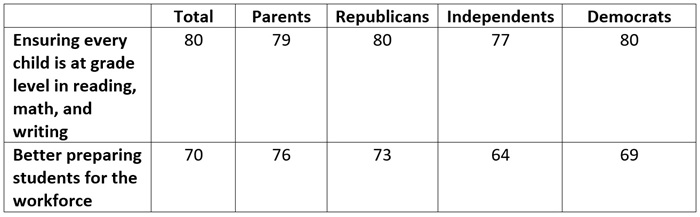
When asked how to improve education in their state, 70 percent of voters said that better preparing students for the workforce should be a “very important” priority. The only option to receive a larger share of support was ensuring that every child performs at grade level in reading, math, and writing, while improving school safety registered as equally important to workforce preparation. Collectively, these results suggest that a strong majority of voters would approve of efforts to improve student preparedness. Parents, in particular, would be supportive, as more than three-fourths of those surveyed (76 percent) rated better preparing students for the workforce as very important. These priorities are also bipartisan, as they have significant support across the political spectrum.

Table 1. Percentage of voters who believe that student preparedness should be a top priority

Career pathways going forward blog table 1

2. Voters want students to have access to career-connected learning.

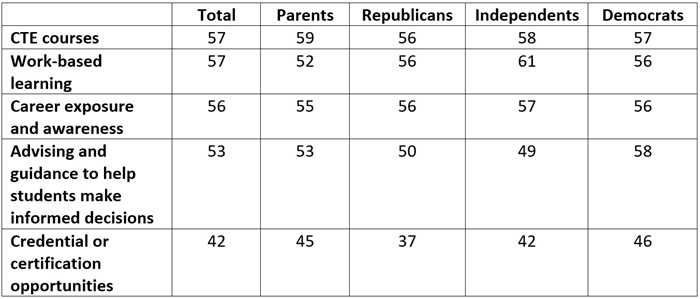
A majority of voters across the political spectrum believe students should have access to career-connected learning opportunities. Table 2 identifies several options and their levels of support. The most popular are CTE courses and work-based learning, both of which clock in at 57 percent overall. Career exposure and awareness isn’t far behind at 56 percent. Meanwhile, credential or certification opportunities have the least amount of support—perhaps a sign that efforts to improve how Ohio identifies credential value are crucial.

Table 2. Percentage of voters who believe students should have access to career-connected learning opportunities

Career pathways going forward blog table 2

3. Voters value individualized career planning.

According to poll results, there’s overwhelming support for ensuring that every student has “a path and plan that prepares them with the academics and job skills they need for careers.” A whopping 86 percent of voters approve of the path-and-plan idea, with 52 percent indicating that they strongly support it. These sky-high numbers offer ample proof that DeWine was on the right track with his career planning proposal, despite lawmakers failing to include it in the final version of the recent state budget. Ohio’s next governor would be wise to pick up where DeWine left off.

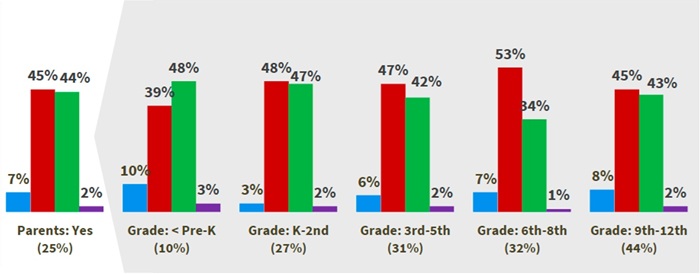
Candidates should also consider calling for career exploration and planning efforts to begin in middle school. Poll results indicate that 47 percent of voters believe that career exploration programming should begin in high school, compared to 40 percent in middle school. But Chart 1 indicates that parents—who are arguably the most invested in kids being prepared—are more supportive of starting in middle school. The parents of middle school students, in particular, seem to recognize the value of offering programming earlier.

Chart 1. When parents believe career exploration programming should begin

Career pathways goin forward blog chart 1

***

A hallmark of the DeWine administration has been its emphasis on career pathways. As a result, Ohio has established several promising policies aimed at expanding and improving career-connected learning. Building on those efforts will help kids—and recent polling indicates it’s popular with voters, too. Here’s hoping Ohio policymakers seize the opportunity.


[1] The poll is a national survey of 1,015 registered voters conducted by UpONE Insights and Impact Research between August 21-27.

Policy Priority:
School Funding
Topics:
Career & Technical Education
Lisa Wyatt Kelsey Hendricks
11.10.2025
Wonkathon banner
Listen to this article
Loading the Elevenlabs Text to Speech AudioNative Player...

Editor’s note: This essay is an entry in Fordham’s 2025 Wonkathon, which asked contributors to answer this question: “What needs to happen next—at the state, district, and school levels—for the science of reading revolution to fulfill its promise and ensure that far more children learn to read well?” Learn more.

The science of reading (SoR) revolution has achieved something rare in education: bipartisan consensus and measurable shifts in policy and practice. As of October 2025, forty states have enacted legislation requiring evidence-based reading instruction, teacher preparation programs are being retooled, and publishers have developed high-quality instructional materials (HQIM) aligned to the research base.

Yet progress has not consistently followed policy enactment. Too many classrooms still struggle to translate the science into consistent results. Teachers know what to do but lack the time, structure, and support to do it for every child. In most K–2 classrooms, one teacher is responsible for diagnosing, instructing, differentiating, and intervening with twenty or more students—each on a unique literacy trajectory.

If the SoR movement is to fulfill its promise, we must modernize the delivery model of early literacy. We must move from solo teaching practice to team-based teaching practice, pairing high-quality curriculum and emerging AI tools with the human capacity to use them well.

A mismatch between science and structure

The SoR tells us that effective reading instruction requires explicit, systematic teaching of foundational skills; frequent progress monitoring; and differentiated support for students who struggle to master those foundations. Each of these elements takes time, educator skill, and sustained attention.

But the structure of most early elementary classrooms—one teacher, one room, twenty-five (plus or minus five or so) learners—was never designed for such precision. It is as if we asked a single physician to treat thirty patients at once, all with different needs and rates of recovery.

This is not a question of teacher effort; it is a question of system design. The next chapter of the SoR revolution must be about re-engineering the conditions under which literacy instruction happens.

The case for team-based models

Team-based models distribute the work of teaching across multiple adults who collaborate around a shared group of students. A well-structured literacy team can include:

  • Lead teachers who design and oversee the instructional arc, ensuring fidelity to the science and coherence across lessons;
  • Certified educators or interventionists who provide small-group or Tier II supports;
  • Paraeducators and high-impact tutors who deliver targeted practice using HQIM-aligned materials;
  • High school students in CTE Education Professions programs, trained in the SoR, who support early learners while gaining hands-on experience and exposure to teaching careers.

Together, these teams can create instructional capacity that mirrors what the SoR requires—consistent, data-informed teaching with frequent opportunities for feedback and reinforcement.

A single teacher can implement elements of the science of reading. A team can implement all of it, for every child.

Integrating HQIM: The curriculum infrastructure

High-quality instructional materials (HQIM) aligned to the science of reading are the backbone of implementation. They provide the “recipe” and sequence—structured phonics, decodable texts, built-in assessments, and aligned supports—that ensure consistency across classrooms and teachers.

But HQIM alone are not enough. Even the best materials fail without the time, coordination, and shared expertise that team-based models provide. Conversely, team-based models without HQIM risk inconsistency and improvisation.

The most effective systems will integrate team-based staffing with HQIM so that each member of the team plays a distinct, complementary role:

  • Lead teachers and other certified educators internalize and model lessons directly from the HQIM scope and sequence.
  • Paraeducators, high-impact tutors and high school CTE students deliver intervention and practice sessions using decodables and routines drawn directly from the same materials.
  • Interventionists monitor data dashboards embedded within HQIM platforms to track student growth and identify additional support needed.

Lead teachers also have a key role to play in supporting the training and implementation of team-based models.

When everyone works from the same instructional blueprint, coherence replaces fragmentation, and powerful instruction becomes possible.

Leveraging AI tools powered by HQIM

Artificial intelligence, when carefully designed and paired with HQIM, offers a promising next step. Rather than replacing teachers, AI can act as an amplifier of high-quality instruction. We anticipate the most promising tools to support improved student outcomes will be the ones that:

  • Provide real-time progress monitoring and speech recognition to assess phonemic awareness and decoding accuracy;
  • Suggest targeted small-group or one-on-one interventions using formative data;
  • Generate customized practice activities aligned to the specific phonics patterns or comprehension skills being taught;
  • Support tutors and paraeducators by providing just-in-time guidance on prompts, corrections, and pacing.

AI tools, powered by research-aligned content, give teams the diagnostic precision the SoR demands, and with team-based models, data becomes actionable: one adult can monitor progress while another adjusts instruction in real time.

What needs to happen next

At the state level: Build capacity, not just compliance

  1. Fund staffing innovation grants. States should pilot and scale team-based literacy models that integrate SoR-aligned HQIM and AI tools.  
  2. Incentivize adoption of HQIM ecosystems. Move beyond material reviews to create marketplaces of approved HQIM that include digital and AI-enabled tools vetted for research alignment and privacy standards.  
  3. Create flexible licensure pathways. Allow paraeducators, tutors, and CTE students to earn micro-credentials in early literacy practices aligned to the SoR, building a talent pipeline for future teachers.  
  4. Measure implementation quality. Develop indicators that track not only whether districts have adopted the right curriculum but also whether they have the team-based staffing and professional learning structures to deliver it.

At the district level: Align structures and supports

  1. Redesign schedules for collaboration. Protect shared planning and reflection time for teams to review literacy data, co-plan lessons, and coordinate interventions.  
  2. Reallocate funding toward team staffing. Use state innovation grants or Title funds to provide lead teacher stipends and to staff reading specialists, tutors, and paraeducators strategically rather than uniformly across schools.  
  3. Integrate data systems. Connect HQIM platforms, progress monitoring tools, and AI dashboards into a single view so educator teams can respond to data together.  
  4. Invest in ongoing professional learning. Focus on practice-based coaching tied directly to the district’s HQIM and the specific routines used in team-based literacy blocks.

At the school level: Create literacy teams

  1. Establish enabling conditions. Principals should act as “chief literacy officers,” ensuring that time, staffing, and professional learning align to the science of reading rather than to tradition or convenience.  
  2. Form dedicated literacy teams for K–2. Each team should include a lead teacher and other certified educators – including a special education teacher – on the core team, with paraeducators, high-impact tutors, and/or CTE Ed Professions students contributing as extended team members.  
  3. Define clear roles and routines. Each adult contributes differently—small-group instruction, progress monitoring, phonics practice, comprehension discussions—but all work from the same HQIM and student data.  
  4. Use AI-informed data to drive instruction. Weekly team meetings should review dashboards from HQIM and aligned AI tools, identifying which students need what support next.

Conclusion: Building the system our children deserve

The science of reading revolution has given us the “what” and the “why.” The next phase must focus on the “how.”

We must modernize the structure of early literacy instruction. The science is ready. The tools are ready. The next revolution is about teams who provide care.

Policy Priority:
High Expectations
Topics:
Evidence-Based Learning
Curriculum & Instruction
Teachers & School Leaders
Munro Richardson
11.10.2025
wonkathon
Listen to this article
Loading the Elevenlabs Text to Speech AudioNative Player...

Editor’s note: This essay is an entry in Fordham’s 2025 Wonkathon, which asked contributors to answer this question: “What needs to happen next—at the state, district, and school levels—for the science of reading revolution to fulfill its promise and ensure that far more children learn to read well?” Learn more.

We want children to learn to read well across a range of contexts—from literal (e.g., how-to guide to build a butterfly garden) to deep (e.g., article about changes in Monarch butterfly populations in National Geographic). Too many children don’t develop sufficient skills to move beyond shallow comprehension.

Over the past 20 years, researchers have discussed a key insight about reading skills. Two types of skills are involved in becoming proficient in reading. Both types are vital but develop differently. A review of data over the past 25 years strongly implicates one of these skill types as the bottleneck to improved reading scores. This insight has not yet made its way from academic journals into mainstream conversations about helping more children learn to read.

Two types of skills, two developmental pathways

Constrained skills are learned mostly in classroom settings. They involve limited amounts of information with clear, universal benchmarks for mastery. These skills are relatively straightforward to teach and assess. Unconstrained skills develop more slowly and are learned both inside and outside of school. They involve broad amounts of information. There are no universal benchmarks for mastery; there is always room to learn more. These skills are not as straightforward to teach and assess.

Current reading science identifies four interactive clusters of skills that support reading comprehension: executive function, word recognition, listening comprehension, and knowledge. One of these skill groups—word recognition—is constrained. The other three groups are unconstrained.

Constrained Skills

Unconstrained Skills

Word Recognition Skills: Letter knowledge, Print concepts, Phonological awareness, Phonemic awareness, Rhyming, Phonics, Decoding, Sight Words, Reading Fluency

Comprehension Skills: Oral Language, Vocabulary, Grammar, Syntax, Inference, Reasoning, Comprehension Monitoring, Perspective Taking, Listening Comprehension, Reading Comprehension

Executive Skills:[1] Working Memory, Attention Switching, Attention Control, Inhibition Control, Monitoring, Social Understanding, Organization, Planning

Knowledge:[2] World, Domain, Content, Text structure, Cultural, Linguistic, Principled, Strategic, Multimodal, Multiple text use, Conditional

Strong readers develop capacity across all four skill clusters. Constrained skills develop from direct instruction. Unconstrained skills develop from direct and indirect instruction and experiences. On the whole, constrained skills receive much more attention in efforts to improve reading. Viewed through the perspective of skill type, the next steps in the science of reading movement lead down a different path than what otherwise might be expected.

A key challenge: unconstrained skills

Skill is the capacity to think and act in an organized way in a specific context.[3] “Context” means many things at once: the physical environment, emotional state, social support, domain or subject area, and the specific task involved. Motivation is important. Up-close skill building is messy. It’s a cycle of building, collapse, and rebuilding. Change the context, change the skill. Skills learned in one context are relearned in another. Over time, skills become learned, overlearned, integrated with other skills, and mastered across multiple contexts.

A review of national data over the past 25 years finds most children appear to master constrained reading skills in elementary school. The major challenges are reducing skill gaps at school entry and shortening the time it takes some children to reach proficiency. Good, early instruction and intervention can accelerate mastery of these skills.

Unconstrained skills pose a greater challenge. Gaps in unconstrained skills do not appear to close in elementary or middle school. In fact, these gaps appear to widen. On average, proficiency in unconstrained skills appears lower than constrained skills across all student groups. We can’t solely point to screens and technology as the cause. These trends precede what Jonathan Haidt calls the rise of the phone-based childhood. Researchers have long called for greater focus on unconstrained skills.

What researchers have discovered

Researchers explicitly studied the impact of increased instructional focus on unconstrained skills. They find achievement gaps could be reduced in pre-K classrooms by more exposure to unconstrained language (and math) instruction. This echoes experimental research in elementary classrooms which finds optimizing the balance between word reading (constrained) and comprehension (unconstrained) instruction by individual students needs dramatically increased third grade reading results.[4]

Outside the classroom, researchers find more frequent engagement by parents and caregivers in unconstrained language (and math) activities at home contributed to classroom gains in pre-K classrooms. (They find no benefit from additional time in constrained skill activities at home.) This is reinforced by multiple studies over many years that find shared reading at home (an unconstrained learning activity) has positive benefits on children’s reading outcomes in elementary school.

Community organizations have an important role to play. Experimental studies find well-designed experiences in “everyday places and spaces” such as zoos, aquariums, and museums can develop unconstrained skills like vocabulary and knowledge. In general, researchers find active learning and “supervised practice” help children learn and apply new skills.

Many popular extracurricular activities—sports, arts, theater, music, dance, gymnastics, Scouting—have these skill building traits. These activities routinely build skills in a manner that is sequenced, active, focused, and explicit. Researchers find after school and summer programs that exhibit these “SAFE” characteristics are effective in building a range of skills that impact motivation, behavior, grades, and standardized test scores.[5]

What needs to happen next

Both constrained and unconstrained skills are critical for reading success. Yet, the bottleneck for increasing the number of children who read well is mainly found in unconstrained skills. The challenge for states, districts, and schools is to orchestrate opportunities for development of both types of skills inside and outside of the school building.

School age children in the United States average roughly 30 hours each week in school. Setting aside time for sleep and meals, this leaves another 60 hours outside of school every week. To ensure far more children learn to read well, we need to leverage as much of the entire 90 hours as possible to build unconstrained skills inside and outside of school. 

This solution is both hard and simplistic. Schools have to do part of the work but can’t succeed entirely on their own. Education systems must partner with families and community groups to develop a skill building agenda across the classroom, community, and home. The challenge and opportunity is to build child-serving systems that strategically align formal education with informal learning.

Alignment means integrating and leveraging the best parts of both worlds to intentionally accelerate children and youth’s development of constrained and unconstrained skills simultaneously. This means connecting learning in formal classroom settings with hands-on and experiential learning activities in informal settings driven by students’ interests and curiosity. The Forum for Youth Investment’s QuEST theory of change and Policy Studies Associate’s Out-of-School Time (OST) Observation Instrument may be helpful resources for design and implementation.

The potential benefits from such an effort extend beyond reading. Many of the unconstrained skills that support reading also support mathematics. (Math has its own domain-specific unconstrained skills, as well.) These foundational unconstrained skills are the building blocks for the more complex, deeper-learning, durable, and transportable skills encapsulated in state- and district-level portraits of a graduate. While schools have a key role to play, so do families and community organizations.


[1] This list of executive skills comes from Cartwright, K. B. (2023). Executive skills and reading comprehension: A guide for educators. The Guilford Press.

[2] This list of types of knowledge comes from Hattan, C., & Lupo, S. M. (2020). Rethinking the role of knowledge in the literacy classroom. Reading Research Quarterly, 55, 283–298.

[3] This definition comes from Immordino-Yang, M. H., & Fischer, K. W. (2010). Neuroscience bases of learning. In V. G. Aukrust (Ed.), International encyclopedia of education (3rd Edition, pp. 310–316). Elsevier.

[4] After three years, the students in this study on average were reading at a fifth grade level by the end of third grade.

[5] Durlak, J. A., Weissberg, R. P., & Pachan, M. (2010). A meta-analysis of after-school programs that seek to promote personal and social skills in children and adolescents. American Journal of Community Psychology, 45(3), 294–309.

Policy Priority:
High Expectations
Topics:
Evidence-Based Learning
Curriculum & Instruction
Governance
Teachers & School Leaders
Emily Shisler
11.10.2025
wonkathon
Listen to this article
Loading the Elevenlabs Text to Speech AudioNative Player...

Editor’s note: This essay is an entry in Fordham’s 2025 Wonkathon, which asked contributors to answer this question: “What needs to happen next—at the state, district, and school levels—for the science of reading revolution to fulfill its promise and ensure that far more children learn to read well?” Learn more.

At Bellwether, I coach district leaders, principals, and teachers on improving reading instruction. A few weeks ago, I visited an eighth grade English classroom at a school we’re working with—one that is truly invested in research-backed approaches to teaching reading. The class was reading “Song of Myself.” Section 6 of the poem—my favorite—lay open on the table in front of each child, tantalizingly waiting. Class began with laboring through vocabulary words: dispositions, handkerchief, remembrancer, designedly. Students sat as stenographers, copying down the teacher’s thinking aloud about the first lines. On the edge of my seat, I waited for students to experience the majesty of the idea that “all goes onward and outward, nothing collapses.” And students never—NEVER—actually read section 6 of the poem.

I see similar scenes play out in K–12 classrooms with dispiriting frequency. They are cautionary tales for anyone (including me) who cares about making the science of reading stick. Amid the admirable focus on adapting the way we teach students HOW to read, particularly in the early grades, we can’t lose sight of everything else that’s required to grow students as lifelong readers. Decoding the words that other people have written is mostly a science. But fully appreciating those words is a uniquely human ability, one that is, at its deep heart’s core, an art. The science of reading taught us how children learn to read. The art of reading reminds us why we do. We need both.

Students must receive explicit instruction in reading foundational skills. Most states have made this mandate explicit and put correlative training dollars behind research-aligned curriculum and training. Students must also build knowledge across topics as they grapple with increasingly complex texts, and they must speak and write in response to those texts. The problem is, you can do all of that without ever asking kids to truly read. And there is a chasm between students spending 45 minutes a day with excerpted texts (most of which is read aloud by the teacher) and students reading an entire novel or memoir or play or poetry collection cover to cover. Reading a full book—an actual book—is a dimension of reading that’s key not just to academic success, but also to growth as humans.

Humans invented reading. We do language. Programmed from inception for spoken language, we had to create new neural pathways to evolve the art of reading. Let baser things devise / To die in dust; humans immortalized our species through the written word.

Through our singular focus on the components of how, we have lost sight of why we read in the first place. Like Icarus whose fall makes a splash quite unnoticed, we have forgotten what his wings were for. If kids aren’t taught to understand and appreciate art for art’s sake, they may learn to read, but they won’t learn to love it. They’ll know the words, but not the world they open. And so: We have lost the plot.

To fulfill the promise of the science of reading, states, districts, and schools must also reclaim the art of reading—ensuring that every child not only learns to decode and comprehend but also learns to love and live in books.

At the state level: Fund the full experience of reading, not just the mechanics.

Allocate textbook/materials funding that allows districts to purchase real books for classroom libraries and read-aloud sets, not just consumables or digital licenses. Dozens of studies show students comprehend and retain more from print than from screens. Moreover, the art of reading is a sensory experience. Physical books enable readers to feel the text—the weight of the art in their hands, the page-turning rhythm, the mental map of where ideas occur: this is the experience of reading that has people coming back for more.

States should also dedicate a portion of state literacy funding to revitalize school and classroom libraries. The science of reading begins with brain pathways, but it’s nourished by books—real, plentiful, high-interest books within every child’s reach.

At the district level: Adopt curriculum and training that honor both the science and the art.

Choose and adopt a curriculum that scopes for and empowers students to read books in full.

Require that high-quality instructional materials (HQIM) include explicit guidance on reading modalities: who reads, how often, and why. In many/most classes, teachers read aloud the majority of any Tier 1 texts or play an audio recording. Typically this is done with the best of intentions or considerations for below grade-level readers. And yet, this is counter-productive. Students must be centered as the readers.

Pair science-of-reading professional development with ongoing support for read-alouds, reading modalities and routines, discussion, and independent reading practices.

Build accountability systems that track not only foundational-skills outcomes but also access to rich and complex texts—number of books per classroom, time allocated for independent reading, etc.

At the school level: Create a culture where students are readers, not just decoders.

Establish daily teacher read-alouds at every grade. Let teachers drive the book selection from approved texts. Empower them to use read aloud to connect with students, share their interests, and delve into a wide range of topics.

Replace “consumables” and photocopies with physical books.

Ensure every student has daily time to read a self-selected print book at school. Celebrate wide, independent reading with displays, book talks, and peer recommendations—signals that reading isn’t just for tests, it’s for life.

—

After decades of denying or ignoring the science, we are finally on the right track there. Now we must teach students to be readers—with books in their hands, curiosity in their hearts, and stories that remind them why words matter.

If you have read this far, I applaud you. You embraced your uniquely human ability to appreciate the art of the written word. And now I’m heading into a school to read with students. “—You come too.”

Policy Priority:
High Expectations
Topics:
Curriculum & Instruction
Governance
Teachers & School Leaders
Emilie Raczek
11.10.2025
Wonkathon banner
Listen to this article
Loading the Elevenlabs Text to Speech AudioNative Player...

Editor’s note: This essay is an entry in Fordham’s 2025 Wonkathon, which asked contributors to answer this question: “What needs to happen next—at the state, district, and school levels—for the science of reading revolution to fulfill its promise and ensure that far more children learn to read well?” Learn more.

Over the past few years, more than forty states have passed laws requiring that literacy instruction align with the science of reading. These policies represent a major step toward ensuring that all students receive the evidence-based instruction they deserve. But legislation alone does not teach a child to read.

The success of this movement depends on what happens after the bills are signed and how we prepare and support the educators who make the learning happen. At KIPP, we have seen that when teachers, principals, and regional leaders receive sustained, high-quality professional learning and coaching, the promise of the science of reading becomes a reality for students.

Building a system that invests in every educator

Most teachers did not learn to teach reading using science of reading approaches, so we cannot expect them to make this shift on their own. They need the time, coaching, and community to master new techniques, and they deserve systems that make that possible. When educators are given the opportunity to deepen their expertise, they meet the challenge with the same curiosity and dedication they bring to their students every day.

At KIPP, every K–2 teacher participates in LETRS training, a rigorous course that grounds instruction in the research on how children learn to decode, comprehend, and make meaning from text. But we know that learning about the science of reading is not the same as teaching it.

Our teachers also receive in-classroom coaching from their principals, assistant principals, and regional literacy leads. Coaches observe and model instruction and provide feedback rooted in student work. The KIPP Foundation deepens this support by sending literacy experts to our schools regularly to coach the coaches—observing classrooms, joining feedback sessions, reviewing data, and helping leaders refine how they support their teachers.

Regional literacy leads also engage in a national community of practice, collaborating with counterparts from across the country to share strategies, work through challenges, and strengthen their leadership. This layered system builds capacity at every level: teachers grow through classroom coaching, leaders grow through Foundation support, and regional experts grow through national collaboration. Together, they form an ecosystem where adult learning drives student learning.

Evidence of progress

The results of this effort are clear. At the end of the 2024–25 school year, 75 percent of KIPP kindergarteners met or exceeded literacy benchmarks on DIBELS assessments, surpassing the national average of 67 percent. KIPP students in every elementary grade outgained their peers nationally. We’re seeing promising growth on state ELA exams as well, with the benefits of this multi-year effort starting to show up among students in the upper elementary grades.

In Nashville, for example, KIPP educators have spent several years implementing science of reading-aligned instruction, and the results show the impact. Eighty-five percent of kindergarteners, 84 percent of first graders, 75 percent of second graders, and 77 percent of third graders met benchmarks—well above national averages in every single grade. In New York City, KIPP schools are also showing exceptional results, with 93 percent of kindergarteners, 85 percent of first graders, 82 percent of second graders, and 78 percent of third graders meeting or exceeding grade-level expectations on DIBELS. KIPP NYC schools also outperformed both the city and the state on annual exams and achieved proficiency rates well above those of schools serving similarly situated students.

These numbers are encouraging, but behind them are real children whose lives are being changed.

From policy to practice: What success looks like

One multilingual learner in Nashville began third grade several years behind grade level expectations. State projections predicted she would earn a 2 on her end-of-year assessment—a critical gap because students who cannot read by third grade are four times more likely to drop out of high school.

Instead, with support from talented educators well versed in the science of reading, this student finished third grade meeting expectations and earned a 4 on her state exam, the highest possible score. Her progress reflected not only effective classroom instruction but also a system of aligned adult support. Her teacher implemented a new evidence-based curriculum with coaching from the region’s literacy directors, who in turn partnered closely with the KIPP Foundation team through year-round collaboration, walkthroughs, and strategy sessions. These coordinated efforts ensured that this young student was supported by a system built to make literacy success the norm, not the exception.

What states should do next

To make the science of reading stick, states should build support for professional learning directly into their legislation, ensuring that implementation is both mandated and fully resourced. That means:

  • Sustained funding for professional learning. Provide multi-year investments in coaching and training for educators at all levels—combining formal study with ongoing coaching that enables teachers to apply what they are learning in their classrooms.
  • Standards for coaching and support. Ensure that every school implementing new curricula has trained literacy leaders with the time and capacity to observe instruction, model lessons, and support growth.
  • Use data to drive improvement. Continuous improvement depends on feedback loops that help educators refine their practice and adjust systems in real time. Track both student outcomes and educator proficiency in key practices, using these insights to identify what is working and where course corrections are needed.

When states measure and fund high-quality educator learning, they create the conditions for student learning to flourish.

What districts and schools can do

Districts and charter networks can strengthen these reforms by protecting time for teachers to plan and practice together. They can establish cohesive coaching cycles that connect lesson planning, internalization, observation, and data review. Principals and assistant principals should take part in the same formal learning as their teachers to ensure they are equipped to lead effective instructional conversations.

Regional and school leaders must also be learners themselves. Through communities of practice, they can share data, troubleshoot challenges, and maintain consistency across classrooms and campuses. In KIPP regions that have embraced this approach, literacy improvement is built into the culture and is delivering results for students.

When teachers succeed, students succeed

The science of reading explains how children learn. The science of implementation reminds us that adults learn the same way—through deliberate practice, feedback, and reflection.

At KIPP, that focus has meant more students reading on grade level, more teachers confident in their practice, and more leaders equipped to sustain improvement. The progress we’ve seen demonstrates what is possible when professional learning is continuous, collaborative, and connected to classroom practice.

Passing a law can mandate change. Sustaining it requires building the capacity of the people doing the work. When we invest in educators—teachers, coaches, and leaders alike—we make the science of reading more than a policy movement, we make it a lasting commitment to every child’s right to read.

Policy Priority:
High Expectations
Topics:
Evidence-Based Learning
Curriculum & Instruction
Teachers & School Leaders

Pagination

  • First page « First
  • Previous page ‹ Previous
  • Page 72
  • Page 73
  • Page 74
  • Page 75
  • Current page 76
  • Page 77
  • Page 78
  • Page 79
  • Page 80
  • Next page Next ›
  • Last page Last »
Fordham Logo

© 2026 The Thomas B. Fordham Institute
Privacy Policy
Usage Agreement

National

P.O. Box 110
Burke, VA 22009

202.223.5452

[email protected]

Ohio

P.O. Box 82291
Columbus, OH 43202

614.223.1580

[email protected]

Sponsorship

130 West Second Street, Suite 410
Dayton, Ohio 45402

937.227.3368

[email protected]