Mobile Navigation

  • National
    • Policy
      • High Expectations
      • Quality Choices
      • Personalized Pathways
    • Research
    • Commentary
      • Gadfly Newsletter
      • Flypaper Blog
    • Events
    • Scholars Program
  • Ohio
    • Policy
      • Priorities
      • Media & Testimony
    • Research
    • Commentary
      • Ohio Education Gadfly Biweekly
      • Ohio Gadfly Daily
  • Charter Authorizing
    • Application
    • Sponsored Schools
    • Resources
  • About
    • Mission
    • Board
    • Staff
    • Career
Home
Home
Advancing Educational Excellence

Main Navigation

  • National
  • Ohio
  • Charter Authorizing
  • About

Jeff Murray
11.13.2025
Road with dollar sign
Getty Images/kody king
Listen to this article
Loading the Elevenlabs Text to Speech AudioNative Player...

A new study published in The Economic Journal in the United Kingdom attempts to untangle the intertwined influences of cognitive skills and human capital development on adult wages over a person’s lifetime. It’s an ambitious effort that sheds some light on a perennial issue but raises additional questions in the end.

Researcher Uta Bolt from the University of Bristol utilizes longitudinal data from the National Child Development Study (NCDS), which has followed the same cohort of individuals—nearly all people born in the U.K. during a single week in March 1958—for almost 60 years. They were first surveyed via their parents at birth, and followed up at ages 7, 11, 16, 23, 33, 42, 46, 50, and 55. Detailed survey data include information on the circumstances of individuals while growing up—such as parental education and household size—as well as circumstances during adulthood, including wages, occupational choice, and periods of unemployment. Importantly for Bolt’s study, extensive cognitive testing was conducted with individuals at ages 7, 11, and 16, as well as at age 50. Her analytical cohort comprised all those NCDS participants who took part in cognitive testing at age 16 (1974) and at 50 (2008).

It is worth noting, as my Fordham colleague David Griffith does in his podcast review of this report, that the singular term “cognitive skills” is a simplification of a complex comparison. “The measures of adulthood cognitive skills are clearly not identical to the measures of childhood cognitive skills,” Bolt herself writes. “In particular, the age-16 cognitive skills are primarily based on learned concepts (e.g., doing algebra), whereas the age-50 cognitive skills do not require knowledge of any particular learned concept.” The age-50 tests included things like recalling 10 common words read out to them several minutes earlier and a “letter cancellation exercise” where participants were asked to cross out as many “Ps” and “Ws” as they could from a page of random letters within one minute. These test “attention and mental speed” generally, rather than specific verbal or mathematical skills. But Bolt ran additional tests on the two sets of results and ensured their comparability to her satisfaction, writing that her concerns that the tests capture completely different skills were alleviated. She still suggests keeping the variation in testing types in mind when considering the conclusions, which we shall do.

Here are the main regression analysis results: First, childhood cognitive skills persist strongly into adulthood. That is, individuals were likely to show the same skill level—relatively speaking—at 50 as at 16. Second, wages at age 50 are better predicted by cognitive skills at 16 than by cognitive skills at 50. These two findings imply that human capital development may operate on different tracks for cognitive skills versus wages, and the final three findings clarify this. To wit, additional education predicts higher cognitive skills and higher wages, while occupational choice predicts wages, but not cognitive skills at 50. Periods of time spent out of the labor market (a.k.a. unemployment) lower wages but not cognitive skills at 50.

While some of this seems counterintuitive—surely workers get paid in relation to the value of skills they possess—it would make more sense if it is true that cognitive skills and workplace skills operate on separate trajectories. As researcher Bolt puts it, “wages and cognitive skills capture distinct dimensions of adulthood human capital—adulthood investments that predict higher wages do not necessarily predict higher cognitive skills. In fact, education is the only investment which predicts both higher wages and higher cognitive skills at age 50.” All of this is predicated on the cognitive skills measured by the NCDS project at age 16 being the same as those measured at age 50, which we have already suggested may not be the case, despite the robustness checks conducted on the skills test data.

We are left with some interesting information that points to more questions than answers, such as how to best prepare young people for a prosperous future based on their cognitive starting points and how much those cognitive starting points can realistically be boosted if needed.

SOURCE: Uta Bolt, “Cognitive Skills Beyond Childhood,” The Economic Journal (October 2025).

Policy Priority:
High Expectations
Topics:
Accountability & Testing
Evidence-Based Learning
Meredith Coffey, Ph.D.
11.13.2025
Teacher in a classroom
Getty Images/Jupiterimages
Listen to this article
Loading the Elevenlabs Text to Speech AudioNative Player...

Much has been said about teacher pay: It’s adequate or it’s definitely not enough, it impacts teacher retention or maybe it doesn’t, and it should or should not correlate to student performance, to name just a few hot-button topics. Recently, there’s been more exploration of pay policies to incentivize teachers to work in hard-to-staff roles or schools. Now, researchers from Texas State University have released a study that provides a remarkably broad view of this existing work, examining teacher compensation trends in hard-to-staff schools nationally over the course of three decades.

The analysis relies on the theory of “compensating wage differentials,” or the idea that workers want higher wages to perform less-desirable jobs. Being an oil rig worker, for example, is isolating and extremely dangerous; that’s why experienced oil rig workers can earn well into the six figures. Teaching isn’t nearly so hazardous, yet some teaching roles appear less desirable than others. Research shows that, unfortunately, teachers don’t prefer working in schools with a high percentage of low-income students, in schools with a high percentage of students of color, or in rural districts. Although the evidence indicates that teachers leave these schools due to poor working conditions, rather than student characteristics, the reality remains that such schools are more likely to face chronic teacher shortages. According to the theory of compensating wage differentials, teachers in these schools should earn salaries that compensate for the relative undesirability of their jobs. But do they?

To find out, the researchers use data from the 1988–89 to 2017–18 administrations of a public-school teacher survey conducted by the National Center for Education Statistics. Their statistical models account for factors including teacher characteristics (like demographics and years of experience), school characteristics (like average class size and grade levels taught), and socioeconomic factors (like collective bargaining rules). Their findings address wage differentials at high-poverty, high-minority, and/or rural schools, among teachers overall and among teachers with a B.A. in science, technology, engineering, or math (STEM). They define “high-poverty” schools as those with at least 50 percent of students who qualify for free lunch and “high-minority” schools as those with at least 50 percent enrollment of Black, Hispanic, Native American, Asian, Native Hawaiian/Pacific Islanders, and/or multiracial students.

The researchers found that teaching at high-poverty and at rural schools largely correlated with statistically significant wage penalties, even when controlling for cost of living. (The sole exception to this trend was high-poverty, high-minority schools in non-rural areas.) At high-poverty schools, if the share of minority students was held constant at zero in their statistical model, each percentage-point increase in poverty correlated to an average 0.17 percent wage penalty annually. Teachers at a school with 70 percent of kids qualifying for free lunch, then, would earn an average 3.4 percent less annually compared to their colleagues at a school where 50 percent of kids qualify for free lunch. For high-poverty schools in rural settings, the penalties per percentage-point increase ranged from 0.07 percent (if not high-minority) to 0.1 percent (if high-minority).

Conversely, teachers earned a wage premium at high-minority schools and at high-minority, high-poverty schools (as long as the schools were not rural). In high-minority schools with no students receiving free lunch, teachers earned an average 0.07 percent more annually for each percentage-point increase in minority students. In a high-minority and high-poverty school, each additional percentage point of both student poverty and minority was correlated with a 0.04 percent increase in wages. So teachers at a school with 80 percent of kids qualifying for free lunch and 80 percent identifying as students of color would earn an average 1.2 percent more annually compared to their colleagues at a school with 50 percent low-income students and 50 percent students of color.

These patterns were generally consistent for teachers overall and for teachers with a B.A. in a STEM subject, although the latter consistently out-earned their peers with non-STEM degrees.

In short, working at a rural school put teachers at an earnings disadvantage across the board; working at a high-poverty school also correlated to wage penalties, unless it was also a high-minority school; and working at a high-minority school gave teachers a slight earnings edge. Still, given that high-minority schools’ teacher turnover rate remains two-and-a-half times higher than that of schools serving fewer students of color, the theory of compensating wage differentials would suggest that teachers at all these school types still need to be paid more to offset the working conditions that make these jobs less competitive. A few hundred or even a few thousand dollars more just doesn’t cut it.

Additionally or alternatively, structural changes to improve working conditions at hard-to-staff schools could boost retention without requiring more fiscal expenditure. And further research could dive deeper into variations in these trends over time, including in the wake of more recent efforts to compensate teachers for filling harder-to-staff positions. Enduring teacher shortages make clear that what we’ve been doing isn’t working—and using compensating wage differentials as a lens for teacher pay policy could well be another tool for researchers, policymakers, and advocates to add to their kits.

SOURCE: Jieon Shim and Li Feng, “Estimating Compensating Wage Differentials for Public School Teachers in High-Poverty and High-Minority Schools: Evidence from U.S. National Data, 1988–2018,” Annenberg Institute at Brown University (October 2025).

Policy Priority:
High Expectations
Topics:
Evidence-Based Learning
Governance
Teachers & School Leaders
Stephanie Dowlearn
11.12.2025
wonkathon
Listen to this article
Loading the Elevenlabs Text to Speech AudioNative Player...

Editor’s note: This essay is an entry in Fordham’s 2025 Wonkathon, which asked contributors to answer this question: “What needs to happen next—at the state, district, and school levels—for the science of reading revolution to fulfill its promise and ensure that far more children learn to read well?” Learn more.

Is joy the missing ingredient?

What if the secret to stronger literacy outcomes was keeping kids happily engaged, using their natural curiosity and playfulness to build foundational skills? The science of reading gives us the structure, but joy is the spark. As neurologist Judy Willis explains, ‘When students are engaged and enjoying themselves, dopamine is released, which increases motivation and builds stronger memory pathways.

Teachers know that play is essential to early learning. In a global survey by the LEGO Foundation and Boston College, 97 percet of educators agreed it supports development, yet only 17 percent felt they had time and support to use it meaningfully.

As a former teacher of third graders and, most recently, kindergarteners, I’ve seen firsthand how mandated curricula, tedious documentation, and relentless state testing have drained joy from classrooms. Now, in my role as an education consultant, I hear the same frustrations nationwide, and we all agree: It’s time to make play a priority.

Less testing, more teaching

Playtime is often the first casualty of policy decisions. However, stronger literacy outcomes emerge when curiosity and play drive learning, supported by the science of reading. The push for accountability too often translates into more time testing at the expense of purposeful play. States must set clear standards and provide proper funding while trusting the knowledge teachers have built through extensive science of reading training. Since Covid, classrooms have changed. Student behaviors are more challenging, and teachers are struggling under the weight of mandates and assessments. What they do not need is another layer of oversight that questions their expertise.

Districts can show accountability without piling on standardized assessments that drain time and energy. States should trust teachers to use formative assessments that guide instruction in real time. Proper funding should prioritize resources teachers know work, not massive curriculum adoptions that promise the world but fall short in practice.

I challenge policymakers to step into an early childhood classroom, for more than a photo-op or storytime. Drop in to volunteer often, with no pomp and circumstance. Only then can they witness the resilience, creativity, and love that teachers bring to the unbelievably demanding task of educating our future. Teacher burnout is real. We need understanding that leads to better legislation that positively impacts the future.

Clear the clutter, listen to teachers

When states focus on testing, districts must comply or lose funding. Districts do their best with the resources available, but more can be done to empower teachers. To support teachers, districts must protect literacy blocks as sacred instructional time, reduce redundant documentation, and prioritize smaller teacher-student ratios by ensuring that coaches and specialists work alongside classroom teachers, not just central offices. Teachers should have the autonomy to choose evidence-aligned materials they actually want to use. Give teachers access to ongoing professional development and the time and compensation to complete it. Provide practical assessment tools that deliver real-time data without increasing teacher workload. Teachers would love more family support. District initiatives could provide simple parent guides, workshops, and take-home activities to help create family engagement in learning. When districts listen to teachers and align resources with classroom realities, literacy reform becomes not just possible but powerful.

Where policy meets practice

Policy sets the stage, but it’s in classrooms where literacy either comes alive with play or gets buried under mandates. Even with the proper district support, the true test of the science of reading happens in schools. It’s at the campus level where policy meets practice, and where leadership can make or break implementation.

The strongest campuses have leaders who are visible in classrooms. They are there to support, protecting instructional time from distractions, not to critique. Jump on social media, and you will find Principals like Gerry Brooks (@gerrybrooksprin), Jared Lamb (@principal_lamb), Principal Mo (@principal_mo), and others reminding us that leadership is not about micromanaging; it’s about creating conditions where teachers feel trusted, valued, and equipped to succeed.

When administrators really listen, provide feedback, take action, and celebrate small wins, fidelity to the science of reading stops feeling like compliance and becomes a common goal.

Begin early, ensure equity

Ages 0–5 are the most critical years for brain development and language growth. As the National Scientific Council on the Developing Child at Harvard notes, “Positive early experiences, including joyful interactions, shape brain architecture by strengthening neural connections critical for learning and development.” Yet too many children, especially in underserved communities, enter school without strong foundations.

Playful, multisensory experiences at home or in childcare build language, print awareness, and confidence. Families are essential partners, but they cannot shoulder this alone. States must fund early literacy programs that expand access to high‑quality pre‑K, provide families with resources, and ensure every child, regardless of zip code, arrives at school with more than just a chance to succeed. By beginning early and sustaining support through the primary grades, we can ensure that all children start their education journey with strong foundations and genuine excitement for learning.

And this responsibility doesn’t rest solely on schools and families. Communities, including corporations and small businesses, have a stake in literacy. The workforce they will depend on tomorrow is being shaped in classrooms and childcare centers today.

When literacy feels like play

That playful foundation shouldn’t stop at the school door. The same curiosity and engagement in early learning must be sustained in classrooms. In my kindergarten classroom, I used Letters alive, an interactive program that blends augmented reality with literacy instruction, and watched authentic engagement unfold. The dynamics of the room shifted with the introduction of a 3D zoo animal named Sergio Seal. Cheers erupted, and attention was captured. Students encouraged one another, patiently waiting for their turn to interact with the animals and leaning into the experience together. They were learning fascinating facts about animals while building background knowledge, expanding vocabulary, and actively using language to share experiences. The room was filled with conversation and discussion, not boredom and disengagement.

This classroom moment reflects what researcher Sayan Maitra highlighted in his 2024 study, The Influence of Interactive Digital Tools on Early Childhood Learning and Cognitive Development: “Interactive digital tools foster engagement, problem‑solving, and early literacy development by offering personalized pathways and sparking curiosity.” Programs like Letters alive show how meaningful, evidence‑based resources, whether apps, e‑books, or augmented reality tools, can elevate Tier 1 instruction into a fun and interactive adventure rather than a chore.

The future depends on joy

It’s a fact that joyful engagement strengthens memory and motivation, and I’ve seen it firsthand in my classroom experience. If we want literacy reform to last, we must invest in programs that foster joy. That means reimagining early learning not as a race to meet benchmarks but as a joyful journey fueled by curiosity, connection, and trust. Stronger literacy outcomes begin when we trust teachers, prioritize play, and reimagine early learning as a joyful, curiosity-driven journey. So let’s fund what works and listen to educators who masterfully create classrooms where curiosity thrives and literacy grows. The future of reading and our communities depends on whether we choose to protect and prioritize joy in every classroom.

Policy Priority:
High Expectations
Topics:
Curriculum & Instruction
Governance
Teachers & School Leaders
Jenn Vranek Ila Deshmukh Towery
11.12.2025
wonkathon
Listen to this article
Loading the Elevenlabs Text to Speech AudioNative Player...

Editor’s note: This essay is an entry in Fordham’s 2025 Wonkathon, which asked contributors to answer this question: “What needs to happen next—at the state, district, and school levels—for the science of reading revolution to fulfill its promise and ensure that far more children learn to read well?” Learn more.

“The Mississippi Miracle.” In an era of discouraging reading results, Mississippi’s fourth grade reading gains have earned nationwide attention, and the state deserves the recognition. But we agree with Dr. Carey Wright, who shepherded the state in its transformation, that it wasn’t a miracle—it was a marathon.

State reading legislation is the right start, but educators will put in the hard work to get results. In our work with states across the country, we see well-intentioned leaders hit three common implementation challenges: a proliferation of assessments, incoherent instruction and random acts of coaching.

There can—and should—be many more Mississippis. A recent review of the reading research “clearly indicates that approximately 95 percent of all students can be taught to read." In other words, it’s not the kids; it’s the way we’re teaching them to read.

To deliver on the promise of the science of reading, literacy best practices must take root in around half a million classrooms across the country. We recommend state education leaders focus on three core ideas as they run their own reading marathons.

1. Smarter screening to measure the right reading component at the right time.

1

In action: When Delaware required its local education agencies (LEAs) to assess all students K–3 for reading three times a year with both screeners and diagnostic measures, the assessments proliferated. The state’s approximately 30 LEAs recently reported that they use more than 60 different literacy assessments! Going forward, Delaware will recommend a short list of quality assessments that align to the science of reading’s key domains for language acquisition.

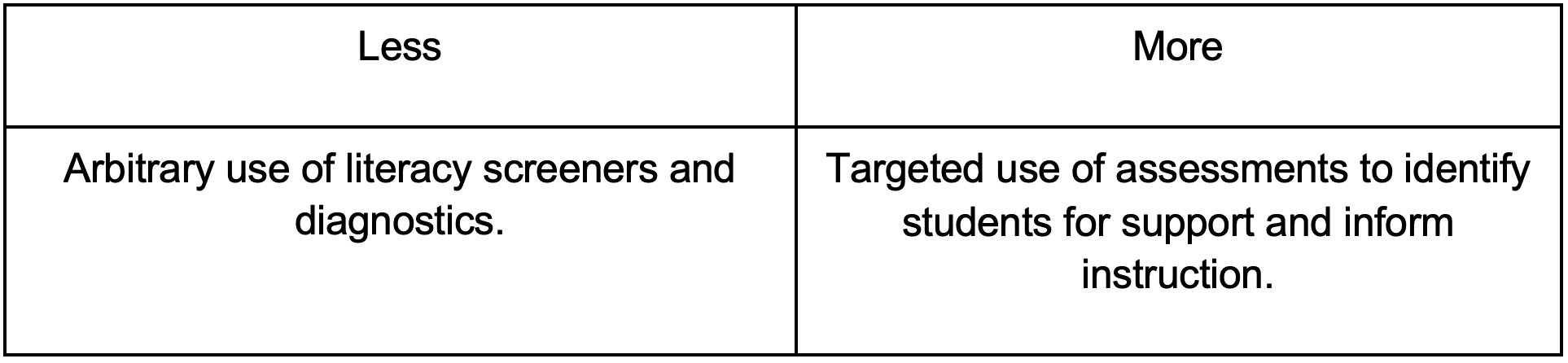
We’ve found nationwide that there is widespread confusion between universal screeners (which identify who is at risk for not acquiring key reading skills) and diagnostics (which pinpoint exactly what skills kids need to learn and when they need to learn them).

Across the country, brief universal screeners (like DIBELS) are intended to identify who may need additional support. Many districts stop there and assign students to intervention groups purely based on these scores (a practice we don’t recommend). Many districts administer a different diagnostic assessment (like iReady) to the subset of students identified by the screener, to provide in-depth information about an individual learner’s needs. This can be a helpful practice, but it can lead to a lot of extra assessment when done with the wrong instruments or with too little understanding of what is being measured.

We are working with Delaware to streamline the approved list of screening and diagnostic measures. An early, important finding: Commonly-used tools of good technical quality do not each measure all of the key reading acquisition domains. For instance, many screeners do a good job of assessing phonemic awareness and alphabet knowledge, but a smaller number fully assess for comprehension. States also have an opportunity to create evidence-driven definitions of the core components of the reading domains they seek to assess and help districts understand what these tools do and don’t assess.

Better guidance can help districts collect better data—and know how to use it—which should directly inform coherent literacy support for students and systematic coaching for teachers.

Key levers:

  1. Clarify the purpose of universal screeners versus diagnostics, what information each assessment provides, and how those data should inform student support.
  2. Define the criteria for literacy assessments, both in terms of quality (reliability, validity, classification accuracy) and which assessments capture which science of reading domains.
  3. Streamline the number of tools in use so that states can compare results across districts and identify trends in aggregate.

2. Coherent literacy instruction in all learning settings.

2

In action: When Tennessee adopted literacy best practices in K–3 classrooms, intervention settings still used a wide range of supplemental programs and did their own thing. “English language learners were pulled for an hour a day,” explains a kindergarten teacher in Knox County Schools. “We just assumed that they were working on the same sounds.”[1] In 2022, the state updated its Response to Intervention (RTI) guidance to encourage more consistent student support.

The science of reading articulates the building blocks of the English language, such as phonemes (sounds), graphemes (letters), and morphemes (the smallest unit of meaning in a word). But core teachers can struggle to connect those concepts to their daily lessons, and many specialists—like those working with English language learners or students with disabilities—never get trained at all.

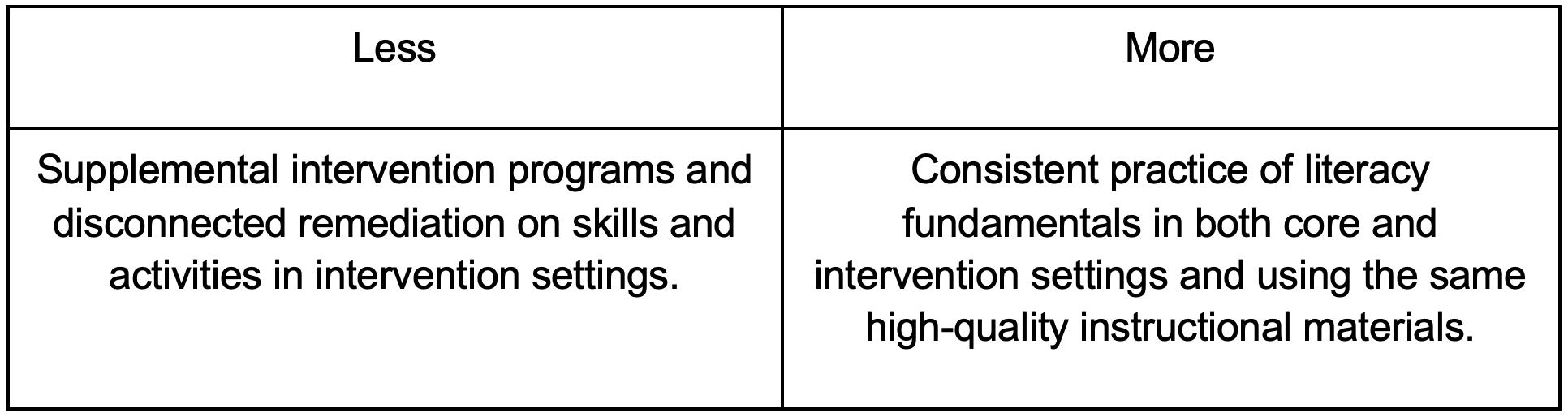
As a result, students who struggle with reading tend to receive fragmented support. For example, a kindergartener might practice identifying the “short A” vowel sound in “cat” in their core class, learn a nursery rhyme in their English language development block, and practice high-frequency words (“I” and “like”) in their small group time. Those are valuable exercises, but students struggle to connect the dots.

School systems spend millions of dollars on supplemental intervention programs that are fully disconnected from the core curriculum. They can stop spending these dollars and instead train all educators K–3 to use the core instructional materials for just-in-time intervention that is aligned to what’s being taught in each student’s main classroom.

When literacy instruction is coherent, core classes and intervention work together to prepare students for grade-level work. Intervention focuses on just-in-time instruction that connects to the core materials and prepares students for what they will read in an upcoming class.

Key levers:

  1. Use high-quality instructional materials in all student learning settings! These should blend foundational literacy skills and rich texts.
  2. Train all staff who support students in reading—interventionists, tutors or specialists for English language development or special education—on literacy fundamentals.
  3. Dedicate time in the school schedule for core teachers and specialists to internalize these concepts, co-plan upcoming lessons, and align their support for students.

For more details, watch for an upcoming paper on Instructional Coherence from the Council of Chief State School Officers (CCSSO), which we helped write.

3. Skilled literacy coaches to build teacher capacity.

3

In action: When Dr. Carey Wright, the former State Superintendent of Education for Mississippi, moved to the same role in Maryland, she found that the state’s 25 LEAs employed 650+ instructional coaches. Her team retrained at least 250 of them on how to be a literacy coach. 

Research tells us that coaching can be an effective professional learning strategy—but, in RAND’s recent AIRS surveys, most teachers say they only see a coach 1–3 times per year. For years, school districts have used Title II dollars to hire general instructional coaches, usually former teachers, who may work with a broad set of teachers across a range of subjects. Too often, they provide only general feedback during their infrequent visits. 

Supporting literacy requires a specific body of knowledge and an ability to model best teaching practices for teachers. With help from some of our colleagues at Education First, Maryland defined the essential knowledge and skills for a literacy coach and four core coaching competencies: foster strong partnerships, develop data-driven goals, implement consistent coaching cycles, and design and deliver effective teacher professional development. The state department of education offered free training to the LEAs’ coaches on the science of reading and to implement these competencies. In addition to this intensive training, the state organized a community of practice training for nearly every district’s LEA literacy specialists on the science of reading.

With clear expectations and focused training, skilled literacy coaches serve as implementation champions for evidence-based literacy practices.

Key levers:

  1. Define an explicit job description for literacy coaches, including deep knowledge of the science of reading and adult learning, and the skills to coach shoulder to shoulder
  2. Assign coaches to a consistent group of teachers. Ensure they are in the building frequently, that they have a deep understanding of the HQIM in that building, and can participate in the teachers’ collaborative planning time.
  3. Give coaches the capacity to advise teachers over time and hold coaches accountable for improving teacher practice. Replace or retrain coaches who don’t meet their goals.

In sum, meaningful progress isn’t about miracles—it’s about sustained, thoughtful implementation. Streamlined assessments, coherent instruction, and skilled coaching capacity can help turn science of reading legislation into results. When these elements come together, we will see many more Mississippis—and many more students who can read.


[1] Council of Chief State School Officers. (Forthcoming). Making Sense of Instructional Coherence at the State Level.

Policy Priority:
High Expectations
Topics:
Evidence-Based Learning
Curriculum & Instruction
Governance
Teachers & School Leaders
Lisa Coons
11.12.2025
wonkathon
Listen to this article
Loading the Elevenlabs Text to Speech AudioNative Player...

Editor’s note: This essay is an entry in Fordham’s 2025 Wonkathon, which asked contributors to answer this question: “What needs to happen next—at the state, district, and school levels—for the science of reading revolution to fulfill its promise and ensure that far more children learn to read well?” Learn more.

The “science of reading” has become the latest buzz in literacy reform, the top priority of state legislators and policymakers who have been further emboldened by recent news of dramatically declining NAEP scores. These relationship between “SoR” and has been hotly debated in every major newspaper in recent weeks; most anyone with skin in the game has weighed in on what policymakers and practitioners should do to improve literacy results.

Multiple studies have highlighted significant progress in four southern states, a trend often referred to as “the southern surge.” As many look to Mississippi, Louisiana, Alabama, and Tennessee for answers, three critical questions keep popping up for me:

  1. How did the components of policy drive comprehensive change?
  2. Who ensures that strong policy translates statewide implementation into classroom practice?
  3. How has the state created a long term and systematic focus on student outcomes?

Much attention has been paid in recent years to instructional materials. This is an enormously welcome shift, for curriculum has been, historically, left out of such debates. It drives what happens in the classroom—and I have long been one of the most vocal proponents of its critical importance in driving instructional change.

When I was chief academic officer in the state of Tennessee, I oversaw the work to get “the list” of quality curriculum being used in our districts right (and, for the most part, we succeeded with 139 of 147 districts not only adopted materials from the list, but also purchasing materials to be used in every teacher’s classroom). But the presence of a list alone did not change classroom practice. Statewide curricula adoption is not a stand-alone solution. High quality curricula is a critical component and it must be paired with much more—with training, screening, and educator support.

Many legislators have made science of reading training the centerpiece of their efforts to improve student outcomes. Yet “phonics-based” online training minimizes district and teacher investment and doesn’t truly cover the entirety of science of reading transformations needed. As a result, this narrow approach to training too often devolves into a compliance checklist with little impact on student learning. Or even worse, opt-in training allows districts and teacher preparation programs to create and choose your own adventure at what evidence-based instruction should look like. Ultimately, training alone, even strong training, cannot move the needle for kids.

Many states have also launched expensive and isolated coach initiatives where coaches get the training and are then supposed to be the catalyst that changes district practices. These individuals are expected to go back to their district, be the expert for systems change helping district leaders shape their vision and budget prioritization, define principal’s expectations of strong classroom practice, and support the daily instruction of hundreds of teachers. It’s an almost more impossible task that the one we laid on teachers of writing and delivering curriculum!

Literacy screeners are another oft-mentioned silver bullet. And, don’t get me wrong, they’re an important part of the formula. But, as we well know, testing for testing’s sake doesn’t change behavior. (Cholesterol screenings anyone?) Training and understanding how to use data, developing communication tools to share solutions with families, and laser like interventions must be included in screening or it becomes “just another test.”

In other words, there are no quick fixes or singular solution policies that will change student outcomes.

As I look back at my experiences in Tennessee, we had several waves of fragmented efforts. It really wasn’t until our state passed the Tennessee Literacy Success Act and the Tennessee Learning Loss Remediation and Student Acceleration Act, spearheaded by Commissioner Penny Schwinn, that we were able to outline a comprehensive implementation initiative and included deep accountability measures at the district, teacher, and student level.

Tennessee did not take an opt-in or online approach. Tennessee’s training married professional learning in the science of reading with curriculum-specific support. It was delivered through an in-person, cohort-based based model that allowed teacher preparation, school leaders, and teachers to learn and apply what they’d learned together. Additionally, training completion was required for educators to renew their licenses; and thus, this strong implementation model was paired with accountability.

Who ensures that strong policy translates statewide implementation into classroom practice? State education chiefs and their teams usually hold the authority to translate policy into practice, and therefore, they must serve as the key drivers of success. State teams can look to the southern surge states and to models of strong implementation design that include the comprehensive screening approaches, embedded curricula, and training that includes support for school leaders and teacher preparation providers so that they can apply systematic implementation design to their own state context.

And because change is hard, accountability must be effectively paired with implementation. In other words, “high support, high expectations.”

In Tennessee, systematic accountability required districts to post transparent literacy plans published on state and local websites, transparent screening and intervention requirements for K–8 students, educator licensure tied to successful completion of coursework, and ultimately, a third grade retention law. Third grade retention can also not be a stand-alone accountability measure. A comprehensive approach to accountability creates transparency at every level of the educational system.

In Mississippi, Carey Wright, one of the first state chiefs to launch the Literacy-Based Promotion Act in 2013, launched one of the earliest and strongest “science of reading” approaches to transform reading instruction. Mississippi’s ongoing NAEP success can be traced to the sustainable focus of deep implementation and accountability that Carey created over a decade ago.

In Louisiana, John White initiated major literacy reforms in 2012 through the Louisiana Believes initiative that include comprehensive science of reading reforms, and Cade Brumley later reinforced and expanded that work through enacting accountability legislation in 2021 and 2023—creating more than a decade of coherent, continuous focus on improving student outcomes.

In Alabama, State Superintendent Eric Mackey and his academic team have led comprehensive literacy and math reforms since 2018, pairing increased standards with strong statewide intervention programs. Their work resulted in largest jumps in fourth grade math in the country and notable literacy progress.

These state chiefs have demonstrated the challenging leadership required to develop deep and sustainable change in reading instruction. These states have created a reading revolution that has transferred from state policy to teacher leadership that is changing classroom practice for every child. They leveraged comprehensive accountability that ensured families had accurate information, ensured schools had implementation levers to change practice, and empowered teachers to actually use science of reading to focus on student learning.

Penny Schwinn, John White, Carey Wright, and Eric Mackey all embraced a comprehensive strategy in their states. My answer to the question of what’s next for the science of reading movement all comes down to the leadership:

  • Who’s going to create a statewide movement and how will a strong and comprehensive implementation drive change in the classroom?
  • Who’s will track its progress and hold the system accountable to sustainable change?
  • Who’s going to spark a revolution that empowers teacher to use a comprehensive science of reading approach to change student outcomes?
Policy Priority:
High Expectations
Topics:
Evidence-Based Learning
Curriculum & Instruction
Governance
Teachers & School Leaders
Clifford Jones Lee James
11.12.2025
wonkathon
Listen to this article
Loading the Elevenlabs Text to Speech AudioNative Player...

Editor’s note: This essay is an entry in Fordham’s 2025 Wonkathon, which asked contributors to answer this question: “What needs to happen next—at the state, district, and school levels—for the science of reading revolution to fulfill its promise and ensure that far more children learn to read well?” Learn more.

Across the nation, the momentum behind the science of reading has ushered in a new era of urgency and clarity around literacy. States are rewriting policies, districts are refocusing instruction, and communities are rallying around foundational reading skills. Yet as the Fordham Institute and other national observers have made clear, the success of this movement will not be determined by legislation alone. It will be determined by what happens in classrooms, how progress is measured, and whether students, educators, and families clearly see whether children are learning to read and reading to learn.

In Horry County Schools, South Carolina’s third-largest district, this commitment takes shape through our #RiseWithReading movement, a comprehensive effort to ensure that 95 percent of students are reading at or above grade level by 2030. This ambitious goal unites teachers, families, and community partners around one shared purpose: that literacy is the foundation of opportunity. Through systematic instruction aligned with the science of reading, transparent progress reporting, and community partnerships, we are transforming how literacy is taught, measured, monitored, and celebrated across every classroom and neighborhood in Horry County.

Despite decades of reform, only about one-third of fourth graders in America read at or above proficiency according to the National Assessment of Educational Progress (NAEP). Persistent literacy gaps across socioeconomic and demographic groups reinforce the reality that slogans and mandates are not enough. What students need, and what educators and families deserve, is visibility, accountability, and shared ownership of progress. One of the most powerful tools to achieve this is the consistent use and public reporting of Lexile® measures and grade-level Lexile® bands.

Lexile scores provide a common language for reading development. Unlike broad labels such as “below grade level,” a Lexile measure provides precise information about the complexity of text a student can read independently and the level of support they need to stretch and grow. Grade-level Lexile bands translate these scores into clear expectations: a third grader progressing toward 645L–809L, a sixth grader toward 925L–1185L, and high school students moving toward the 1205L+ range. These targets matter because vocabulary development and exposure to increasingly complex text are non-negotiable drivers of reading success. Research from Chall and Jacobs (2003) demonstrated that when students stagnate in text complexity by late elementary school, the gap widens dramatically in middle and high school, contributing to what is often called the “fourth-grade slump.”

Lexile research from MetaMetrics further confirms that students who read consistently within their optimal Lexile range, approximately 100L below to 50L above their measured level, grow significantly faster than those reading below their ability or without targeted text support. This aligns with Vygotsky’s Zone of Proximal Development, which emphasizes learning that is challenging, supported, and intentionally scaffolded. Data-driven text selection, therefore, is not simply good practice. It is evidence-based acceleration.

The long-term stakes are equally clear. ACT College Readiness Benchmark research shows that students reading at or above approximately 1295L by graduation are far more likely to succeed in college courses, technical training, the military, and modern workforce environments. If we say our goal is for every student to graduate future-ready, then the 1295 Lexile benchmark must be more than a number; it must be a public commitment. Every family and student deserves to know where they stand relative to that goal and how to get there.

This is why, in Horry County Schools, our #RiseWithReading initiative prioritizes transparent Lexile reporting and growth monitoring across the system. Students, teachers, and families deserve a clear picture of reading progress. Our strategy is to include multiple Lexile checkpoints, public reporting on district and school dashboards, and family-friendly reports that show current levels, grade-band expectations, and growth goals. Teachers currently receive support in using Lexile data to guide text selection, plan small-group instruction, and build stamina with increasingly complex reading materials. Families receive guidance on choosing “right-fit” books and supporting reading at home.

Importantly, we are extending this work beyond the school system and into the community. In partnership with the Horry County Memorial Library system, Lexile levels will be included on the binding of children’s and youth books so families can easily select texts aligned to their child’s reading level and growth goals. When a parent walks into a public library and can immediately identify books in their child’s Lexile range, literacy becomes a community-wide effort rather than a school-only responsibility. This collaboration reinforces a powerful message to families: reading matters everywhere, not only during the school day.

This approach aligns with the broader elements of effective science of reading implementation: explicit instruction, systematic phonics, vocabulary development, comprehension strategies, and structured practice with real texts. It also reflects the research consensus that monitoring progress and providing timely feedback are among the highest-yield strategies in education (Hattie, 2017). Simply put, what we measure consistently improves. What we share publicly builds trust and invites community partnership.

This work is also fundamentally about equity. The “Matthew Effect” in literacy, articulated by Stanovich (1986), shows that strong readers accelerate over time while struggling readers fall further behind unless targeted intervention occurs early and consistently. Transparent Lexile reporting ensures that we do not lose sight of students who need more support. Equity is not merely saying “all means all.” It is building systems where every student’s reading growth is visible, supported, and celebrated.

But districts cannot do this alone. For science of reading policies to fulfill their promise, states must invest in high-quality literacy assessments, teacher training, time for data-driven planning, and clear reporting frameworks. Without fidelity and sustained focus, policy becomes poster-board rhetoric rather than student-level change. Fordham and other national voices are right to caution that laws do not teach students, teachers do. And teachers need actionable tools, clarity, and aligned systems to succeed.

Transparent Lexile reporting including clear grade-level bands, the 1295 graduation benchmark, and community alignment with the public library is more than an accountability strategy. It is a promise: Every student will leave us with the power, confidence, and opportunities that strong literacy provides.

That is how we honor the science of reading, not only with policy, but with practice, precision, partnership, and visible progress for every child.

References

Chall, J. S., & Jacobs, V. A. (2003). Poor Children's Fourth-Grade Slump. Colorín Colorado. https://www.colorincolorado.org/article/poor-childrens-fourth-grade-slump

Hattie, J. A. C. (2017). 250+ influences on student achievement: Final effect size list [PDF]. Visible Learning Ltd. https://visible-learning.org/wp-content/uploads/2018/03/VLPLUS-252-Influences-Hattie-ranking-DEC-2017.pdf

Stanovich, K. E. (1986). Matthew effects in reading: Some consequences of individual differences in the acquisition of literacy. Reading Research Quarterly, 21(4), 360‑407. https://doi.org/10.1598/RRQ.21.4.1

Policy Priority:
High Expectations
Topics:
Evidence-Based Learning
Curriculum & Instruction
Governance
Teachers & School Leaders
Sarina Sande
11.12.2025
wonkathon
Listen to this article
Loading the Elevenlabs Text to Speech AudioNative Player...

Editor’s note: This essay is an entry in Fordham’s 2025 Wonkathon, which asked contributors to answer this question: “What needs to happen next—at the state, district, and school levels—for the science of reading revolution to fulfill its promise and ensure that far more children learn to read well?” Learn more.

When I was nine, my fourth-grade teacher told my parents I would “fall through the cracks.” My family found me extra help, and with consistent, structured support, everything changed. That early experience stayed with me through the years as a teacher, policy advocate, and now nonprofit leader. I’ve seen the literacy crisis from the inside of classrooms and the outside of statehouses—and I know that fixing it will take more than good intentions or new laws.

Across the country, the “science of reading” movement has ushered in the most significant literacy reforms in decades. More than 40 states have passed legislation requiring evidence-based instruction, new teacher training, and curriculum overhauls. It’s a promising start. But laws alone can’t ensure implementation with fidelity or build the trust needed to sustain change. If we’ve learned anything from past waves of reform, it’s that policy can create compliance but not competence.

The problem: Policy momentum without practice alignment

America’s literacy problem isn’t new. Only one in three fourth graders reads proficiently, and rates for Black, Latino, and low-income students are far lower. The pandemic deepened those gaps. States have responded with energy, but implementation is uneven. Teachers trained under older instructional models face steep learning curves; teacher-prep programs often add a short phonics module and call it reform; and district leaders, pressed by shifting mandates, are struggling to manage professional development, curriculum adoption, and staffing at once.

The result is a familiar pattern: new laws, new materials, and the same classroom practices. In too many schools, “science of reading” has become a label rather than a transformation. As a former teacher and someone who now supports schools implementing structured literacy, I’ve seen how easy it is to mistake activity for progress. What’s missing is coherence—between policy, preparation, and daily instruction.

Reading reform is not a policy problem; it’s a practice problem. Policy sets the stage, but people deliver the story.

The opportunity: Build a literacy ecosystem

To make the science of reading real, we need a shared architecture that connects every level of the system. That means three things: shared understanding, shared responsibility, and shared accountability.

Shared understanding

Everyone—from state officials to classroom volunteers—needs a baseline grasp of how children learn to read. The science of reading is not a curriculum or a fad; it’s a body of evidence about the cognitive processes that make reading possible. Policymakers must fund training that moves beyond compliance modules and creates lasting professional communities of practice. Families, too, need accessible information about what effective reading instruction looks like so they can advocate for it and embrace it with their students.

Shared responsibility

Literacy outcomes belong to everyone. State leaders create policy conditions, districts manage schedules and staffing, unions advocate for professional learning and manageable workloads, and community partners extend literacy beyond school walls. The most successful systems I’ve seen treat this as collective work. Principals, reading specialists, and nonprofits share data and adjust strategy together so students experience consistency, not contradiction.

Shared accountability

Accountability should drive improvement, not fear. Instead of tracking only proficiency rates, states and districts should monitor the conditions of instruction: Are students receiving daily, structured literacy time? Are teachers getting coaching? Are interventions frequent and targeted? Data that illuminate these questions are more actionable—and more honest—than test scores alone.

What needs to happen next

The science of reading movement will falter if it remains a top-down mandate. Here’s how each level of the system can anchor reform in lasting practice.

State level: Fund capacity, not just compliance

  • Strengthen standards through fifth grade: Early literacy policies often stop at third grade. States should publish a K–5 continuum for decoding, fluency, and comprehension to prevent students from aging out of support before they master foundational skills.
  • Invest in implementation infrastructure: Fund substitutes, coaching, and instructional materials—real costs that determine fidelity. Require districts to show how those dollars build sustainable capacity.
  • Reform teacher preparation: Mandate supervised clinical practice in evidence-based classrooms and tie program approval to graduates’ demonstrated readiness.
  • Define intervention quality: Set parameters for group size, frequency, and staffing so “intervention” doesn’t become a catch-all.
  • Publish growth data families can understand: Transparent, visual dashboards tracking reading progress by grade and subgroup help communities focus on learning, not politics.

States like Mississippi and Tennessee show what’s possible when structured literacy is paired with strong coaching and stable funding. The lesson: Coherence drives results.

District level: Align time, training, and trust

  • Protect instructional time. Reading blocks and intervention periods must be sacred. Leadership teams should audit schedules to eliminate fragmentation.
  • Choose coherence over patchwork: Adopt one aligned suite of curriculum and screeners; train every educator to use it with fidelity.
  • Invest in coaching: Continuous feedback—not one-off workshops—transforms practice.
  • Empower teachers through labor-management collaboration: Joint literacy task forces can solve problems faster and build buy-in.
  • Partner with communities: Align after-school tutoring, libraries, and family workshops with school-day instruction so students experience reinforcement.

When districts treat teachers as learners and partners, implementation stops feeling like compliance and starts feeling like growth.

Federal level: Incentivize consistency and accountability

  • Expand Title II funding for structured-literacy professional learning.
  • Require teacher-prep programs to report graduates’ impact on reading outcomes.
  • Reward cross-sector partnerships—districts, unions, and nonprofits working together to build literacy ecosystems rather than standalone programs.

From policy to practice

The science of reading will not succeed through mandates alone. It will succeed when every level of the system—state, district, and school—shares a clear vision of what excellent reading instruction looks like and the capacity to deliver it. The next phase of reform must be about durability: stable funding, coherent training, and leadership that outlasts election cycles and pedagogical trends.

The real test will be whether this movement reaches the students who have been least served by past reforms. Achieving that will take coherence, courage, and time. State leaders must keep the work funded and focused. Districts must protect the conditions that make quality instruction possible. And schools must stay centered on students—on the confidence that comes when reading becomes a source of strength and possibility.

When those commitments hold, the promise of the science of reading becomes something deeper than policy. It becomes a culture of practice: steady, evidence-driven, and shared across every classroom, where literacy is not a privilege or a reform goal but a given.

Policy Priority:
High Expectations
Topics:
Evidence-Based Learning
Curriculum & Instruction
Governance
Teachers & School Leaders
Jeff Murray
11.12.2025
Gadfly Bites logo
Listen to this article
Loading the Elevenlabs Text to Speech AudioNative Player...

News stories featured in Gadfly Bites may require a paid subscription to read in full. Just sayin’.

  1. I’m not sure which is more impressive in this opinion piece: Buckeye Institute research fellow Greg Lawson’s scorching rhetoric as he demolishes the dissembling, sour grapes mindset behind which voucher grouchers are hiding in their ridiculous, expensive, and benighted legal crusade against EdChoice, or the fact that anyone on this side of the argument is still able reach this level of righteous dudgeon after all the fakery and disingenuity we have had to endure. I guess the only thing I can say is kudos on both, sir. Kudos on both. (Columbus Dispatch, 11/12/25)

Did you know you can have every edition of Gadfly Bites sent directly to your Inbox? Subscribe by clicking here.

Policy Priority:
School Funding
Topics:
Governance
Sara Kerr Heather Boughton
11.11.2025
wonkathon banner
Listen to this article
Loading the Elevenlabs Text to Speech AudioNative Player...

Editor’s note: This essay is an entry in Fordham’s 2025 Wonkathon, which asked contributors to answer this question: “What needs to happen next—at the state, district, and school levels—for the science of reading revolution to fulfill its promise and ensure that far more children learn to read well?” Learn more.

In the last three years alone, 26 states have passed science-of-reading (SoR) style laws, marking a historic shift in how literacy instruction is approached across the country. This wave of reform was inspired in large part by Mississippi’s remarkable and sustained gains in early literacy. Once ranked near the bottom nationally, Mississippi now leads the pack in fourth-grade reading growth, a transformation that has captured the attention of policymakers, educators, and advocates nationwide.

This momentum is both timely and necessary. Nationally, only about one-third of fourth graders read proficiently, according to the most recent NAEP scores. The consequences of poor literacy are profound: students who struggle to read by third grade are four times more likely to drop out of high school, and those without a diploma face steep barriers to earning a living wage, securing stable housing, and pursuing postsecondary education. In short, reading is not just an academic skill—it’s a gateway to opportunity.

We know what works. Decades of research have shown that explicit instruction in phonics, phonemic awareness, fluency, vocabulary, and comprehension—hallmarks of the science of reading—are essential for developing strong readers. The recent surge in SoR-aligned laws is a promising first step. But already, headlines are questioning their impact, pointing to stagnant test scores and uneven implementation. Mississippi leaders have cautioned that this work is a “marathon, not a miracle,” yet the pressure for rapid results is palpable.

While it might be fair to speculate, it is far too soon to declare the SoR movement a failure. Asking “Why didn’t it work?” just a few years into implementation risks triggering a familiar and damaging cycle: defunding, shifting priorities, and abandoning promising reforms before they’ve had a chance to take root. Instead, we must ask better questions—questions that help us understand what’s working, what’s not, and what needs to happen next.

What are reasonable expectations for how quickly we’ll see impact on students? What early indicators suggest we’re moving in the right direction—or not? And where progress is slower than expected, what adjustments can we make to change course? These are the questions that lead to meaningful, sustained improvement. Adopting an evidence-based spending framework is a powerful but underutilized way to consistently prompt the questions that drive change.

Evidence-based spending: A framework for impact

Evidence-based spending is more than just choosing programs that “work.” It’s a disciplined approach to using data and research at every stage—from budgeting to policy design and initial implementation to continuous improvement, replication, and scaling. The SoR laws passed in recent years are a strong start. They reflect what we know about effective literacy instruction and signal a commitment to equity and excellence. But passing a law is not the finish line—it’s the starting gate.

To deliver on the promise of these laws, states must take advantage of critical levers that are often overlooked. At Results for America (RFA), we refer to these as “evidence-based spending strategies.” They include:

  • Using data to guide investments: States should allocate resources to districts and schools based on where the need is greatest and where evidence shows the greatest potential for impact.
  • Clearly defining desired outcomes at the outset: States should clearly lay out what success looks like, what data they'll track, how often they'll measure progress, and what early signs they’ll watch to see if things are on the right track.
  • Building evidence through evaluation: States should invest in ongoing evaluations to understand how well their SoR programs are working and for whom. States can do this by setting us a small portion—say 1percent—of program budgets to study both implementation and impact.
  • Establishing strong performance management practices: Once outcomes are defined, states should set up systems for tracking progress regularly and use what the progress data shows to improve implementation—and they should expect and support their districts to do the same.
  • Aligning performance management with evaluation: States should strive for coherence across their performance management and evaluation plans, so that the performance management plan is generating information that can be used in service of both formative and summative evaluation plans.

When these strategies are applied consistently, systems become more responsive, more transparent, and more effective. They help avoid the pitfalls of impatience and misalignment between policy authorizers and policy implementers that often derail promising reforms. And importantly, they create the conditions for student-level impact.

A decade of discipline: Lessons from Mississippi

Dr. Carey Wright, former Mississippi State Superintendent of Education (now leading Maryland’s education system) and a key architect of the state’s literacy transformation, is clear: The so-called “Mississippi Miracle” was no miracle at all. It was the result of a decade of disciplined, evidence-driven work. Mississippi used data to determine where to invest funds, continuously improved implementation, and made a compelling case for sustained investment in early literacy. The results speak for themselves.

If other states want to replicate Mississippi’s success, they must embrace the same mindset. That means resisting the urge to chase quick wins or abandon reforms prematurely. It means committing to the long haul, using evidence not just to justify spending but to guide investments and implementation. And it means asking better questions—questions that lead to actionable answers, thoughtful decisions, and improved outcomes for kids.

Proof in practice

There are states taking a cue from Mississippi—putting in place not just SoR laws, but a system for support that draws from the evidence-based spending framework and will foster conditions for continuous improvement. While it’s too soon to see the full impact on student outcomes, these states are seeing promising signs of impact:

  • Tennessee invested heavily in teacher training and coaching aligned with SoR, while building robust data systems to monitor progress. Early results show gains in foundational literacy and stronger alignment between state and district efforts.
  • North Carolina launched a multi-year initiative to train all K–3 teachers in SoR-aligned practices, paired with ongoing coaching and evaluation. The state’s commitment to continuous improvement has helped maintain momentum and build educator trust.
  • Georgia has seen an increase in reading scores in its lowest performing elementary schools as a result of investing in evidence-based teacher training and literacy coaching and is actively tracking and transparently reporting on literacy results via its public-facing Reading Readiness dashboard which ensures schools, districts, parents, and communities have a common framework for improvement.

These examples demonstrate that evidence-based spending isn’t just a theory—it’s a practical strategy for turning policy into progress.

The road ahead

The science of reading movement is one of the most promising developments in American education in decades. But its success will depend not just on what laws are passed, but on how they’re implemented, supported, and sustained. Evidence-based spending offers a roadmap for doing that well.

If we follow it, we won’t just improve reading scores—we’ll change lives. And that’s a goal worth committing to.

Policy Priority:
High Expectations
Topics:
Evidence-Based Learning
Teachers & School Leaders
Victoria R. Haberman
11.11.2025
wonkathon banner
Listen to this article
Loading the Elevenlabs Text to Speech AudioNative Player...

Editor’s note: This essay is an entry in Fordham’s 2025 Wonkathon, which asked contributors to answer this question: “What needs to happen next—at the state, district, and school levels—for the science of reading revolution to fulfill its promise and ensure that far more children learn to read well?” Learn more.

“He volunteered to read for the class today! It was like a lightbulb went off—you could see his confidence grow word by word.” The student’s teacher flagged me down in the hallway to share the good news and ask more about what we were doing in reading intervention. This sophomore had struggled throughout his school career, both academically and behaviorally, and many educators had lost faith in their ability to adequately support him. This part of his story is painfully like many American adolescent students growing in their reading skills. Secondary reading interventions often leave students with too little, too late.

Policy for teaching reading to younger students, primarily in grades K–3, has seen a shift in the last decades. Across the nation, state policies have looked toward the body of reading research, now known as the science of reading, for a light in the dimness of reading achievement data. According to a 2022 EdWeek analysis, forty States and the District of Columbia passed laws requiring their reading instruction and systems to align to these evidence-based practices. Many looked to a surprising source of inspiration, dubbed the “Mississippi Miracle,” as the state saw significant NAEP Score gains after implementing similar practices in 2013. However promising these gains were in states like Mississippi, reading results for older students continues to decline nationwide and now demands policy attention.

“The lightbulb was the kind of innovation that comes together over decades, in pieces. There was no lightbulb moment in the story of the lightbulb.” —Stephen Johnson, Author of the book and PBS series, How We Got to Now

Johnson’s reflection on the invention of the lightbulb illuminates the gradual progress of adjustments in policy and practice that have led to reading growth—it took decades to see the growth now being attributed to the shift in policy. Now that a lightbulb is lit, we need to keep the light shining toward all of our readers and reflect on the multifaceted components of policies that were found to be significant. Several states in the South have recently been highlighted for their “surge” in reading and math improvements that were decades in the making. Targeted investments were made in those states in teacher reading training, screening and selection of high quality instructional materials, instructional coaching, and summer reading tutoring. Additionally, Natalie Wexler, author of The Knowledge Gap, notes that it would be a misrepresentation of these policies to oversimplify them as a focus on phonics. Instead, she points to those states’ selection of and teacher training in knowledge-building curriculum as a critical component of those states’ success over time. After all, the Reading Rope is a common framework in the science of reading community and serves as an important reminder that reading policies will require a multifaceted approach.

As an educator working directly with teachers and students alongside their school leaders, I reflect on the momentum I have seen over the last fifteen years starting to shift practice. Students and staff in our secondary schools are navigating the higher expectations of rigorous and expansive curriculum - at various levels of confidence and support. Educators often struggle to implement new materials with fidelity while differentiating for the various needs of their students, using strategies aligned to the research. Educators also value the support of parents and the public who are generally left out of the action planning, beyond promoting phonics. As states, districts, and schools continue to develop their science of reading initiatives, they need to bring two essential stakeholders to the front of their strategic planning: secondary teachers and the public (especially parents and guardians).

Secondary Teachers: Provide more guidance and support for teachers in secondary education to bridge the gap between students’ current reading skills and more rigorous secondary curricular materials.

Teachers are often given new curricular materials with little to no intensive training or practice with the materials beforehand. And districts or schools facing staffing and funding shortages have the hardest time supporting teachers in this area. Therefore, the teacher-facing materials of a new curriculum are critically important and must be simplified, clearly structured, and contain multiple models of what internalization best looks like for teaching all students—especially those that are still developing reading skills. The starting point to ensure teachers are able to easily translate those materials into practice is to require curriculum companies to include scaffolded thinking questions and reading strategies that help students build on all components of the Reading Rope.

Currently, teachers have to build in those layers of scaffolding on their own to draw out concepts in rigorous text for all learners—often without effective training on how to take students through close reading strategies and often lacking the personal experience of applying the science of reading research. Additionally, the most frequent barrier secondary teachers face with their older struggling readers is the students’ lack of self confidence in reading that is masked with a lack of engagement and motivation. A teacher’s long-term relationship building can inspire courage and effort in a student, but the quickest way to build a student’s confidence is feeling curious and successful with that text. Curricular annotations that include engagement and motivation strategies for challenging areas of each text should be embedded in all lessons.

Having pre-annotated materials with these scaffolds, at least as a starting model for all teachers, would be a massive support for schools and districts who are already struggling to allocate resources and whose administrators are also learning the research and shifts that need to be made to instruction. In the short term, states can require curriculum companies to include scaffolds in their curriculum to make them easier to internalize and implement well. And to see growth over time, states should apply what has worked to the secondary grades by providing training and coaching to build teacher capacity. Let’s continue to apply what has worked in supporting elementary teachers to the secondary grades.

The Public (especially parents and guardians): Bring the public more actively into the process and understanding of the research and how to support our students.

Competing priorities and the all-encompassing job of teaching our students can feel like an already full plate with no room to engage the public. However, educators and policymakers alike know the support of the public in education is necessary for communities.

Recent positive press coverage of the growth being made in states like Mississippi certainly inspires hope. However, we have to be sure that this does not also disguise the need for continuing resources and support of those in the long-term work. If educators and supporters of education like ourselves continue to share positive and balanced information, we can spread accurate and action-oriented information about ways to support students and encourage more involvement in our schools. Community engagement is a full-time job in many successful organizations, yet it is one of many demands that administrators manage at schools. State leadership teams could support districts and schools by setting targets and integrated support for community events like literacy nights and social media engagement around reading strategies that families can use.

Additionally, state agencies compile and create incredibly helpful resources that are sometimes not publicly shared or often used in practice. Public access and use of these resources, like all forms of information sharing, is more complicated than it seems. But the opportunities to track traffic to those sites and raise awareness of family and educator resources through social media campaigns is certainly possible and standard practice at successful organizations. Let’s raise the bar in the way education operates in the public realm - to shine a bright light on what’s working and what still needs to be done to ensure that far more children learn to read well.

Policy Priority:
High Expectations
Topics:
Evidence-Based Learning
Curriculum & Instruction
Teachers & School Leaders

Pagination

  • First page « First
  • Previous page ‹ Previous
  • Page 71
  • Page 72
  • Page 73
  • Page 74
  • Current page 75
  • Page 76
  • Page 77
  • Page 78
  • Page 79
  • Next page Next ›
  • Last page Last »
Fordham Logo

© 2026 The Thomas B. Fordham Institute
Privacy Policy
Usage Agreement

National

P.O. Box 110
Burke, VA 22009

202.223.5452

[email protected]

Ohio

P.O. Box 82291
Columbus, OH 43202

614.223.1580

[email protected]

Sponsorship

130 West Second Street, Suite 410
Dayton, Ohio 45402

937.227.3368

[email protected]