Mobile Navigation

  • National
    • Policy
      • High Expectations
      • Quality Choices
      • Personalized Pathways
    • Research
    • Commentary
      • Gadfly Newsletter
      • Flypaper Blog
    • Events
    • Scholars Program
  • Ohio
    • Policy
      • Priorities
      • Media & Testimony
    • Research
    • Commentary
      • Ohio Education Gadfly Biweekly
      • Ohio Gadfly Daily
  • Charter Authorizing
    • Application
    • Sponsored Schools
    • Resources
  • About
    • Mission
    • Board
    • Staff
    • Career
Home
Home
Advancing Educational Excellence

Main Navigation

  • National
  • Ohio
  • Charter Authorizing
  • About

Jeff Murray
12.19.2025
Ohio charter news logo
Listen to this article
Loading the Elevenlabs Text to Speech AudioNative Player...

Stories featured in Ohio Charter News Weekly may require a paid subscription to read in full.

Letter and spirit

The elected board members that run Columbus City Schools voted unanimously this week to demolish four buildings that they previously voted to close due to underutilization. While there is no firm date for any closures, the lame duck elected board president said the demo order was necessary because the buildings—which are currently serving students and will continue doing so until the day they shut down—would somehow become immediate neighborhood eyesores as soon as the last student leaves. He also asserted they are in such bad shape (send a prayer for the unfortunate Columbus Schools teachers who still have to work in them!) that no charter operator would want them. Thus, despite both the letter and the spirit of state law that requires districts to offer unused facilities for sale to charter and private schools, the board believes they are justified in demolishing these buildings without doing so. Fordham’s Aaron Churchill and United Schools’ Andy Boy are quoted in the coverage explaining why the elected board members are acting in bad faith.

Kudos

Kudos to Black Enterprise for this super awesome profile of GEO Schools, the high-performing charter network operating in Indiana and Louisiana. The report touts the long-running successes of their schools, profiles several amazing graduates, and notes that network leaders are working on expanding to Cleveland in the next couple of years. In fact, it’s such a good piece that we are able to overlook the fact that it mistakes Cleveland for the largest city in Ohio.

Retiring

Here is a detailed profile of the career of Susan Schaeffler, founder of the KIPP DC Public Schools network, who is retiring after 25 years at the helm there. There’s as much coverage of charter school evolution and the ups and downs of charter/district coexistence in the District over time as there is of Schaeffler’s specific work. But rehashing all the drama is indeed one way to highlight her vital role through the years.

Digging deep

Penn Live this week published the eighth (!) in an ongoing series digging deeply into the growth, operation, and impacts of Commonwealth Charter Academy, Pennsylvania’s fastest growing virtual charter school. This one focuses on testing and accountability, and it reports, among other findings, that less than 30 percent of the school’s students take state assessments.

Concerned charter leaders

The Columbus Dispatch covers reports of federal Immigration and Customs Enforcement activity in the capital city this week. The geographic focus appears to be the Northland neighborhood, home to a number of campuses in the Horizon Science Academy and Zenith Academy charter networks. Concerned leaders of both networks are quoted in this coverage from yesterday.

Once more unto the breach...

Peter Greene examines the recent West Virginia circuit court ruling that prevents the authorization of any new charter schools by the state charter board without the approval of voters in the county where the school wants to locate. He explains that the current case is actually a refiling of a previous lawsuit, which had resulted in a similar injunction later tossed out by the West Virginia Supreme Court. Greene is sure this one will end up in the same place for a final verdict…but stops short of predicting the outcome.

*****

Did you know you can have every edition of the Ohio Charter News Weekly sent directly to your Inbox? Subscribe by clicking here.


Policy Priority:
School Choice
Topics:
Charter Schools
Jeff Murray
12.19.2025
Gadfly Bites logo
Listen to this article
Loading the Elevenlabs Text to Speech AudioNative Player...

News stories featured in Gadfly Bites may require a paid subscription to read in full. Just sayin’.

  1. This is subscriber-only content (just like the disclaimer says), but it’s just too awesome for me not to tell you about it, even if you can’t read it all. It’s discussion of Ohio Senate Bill 328 which would help build on existing momentum in the state to ensure high-quality career-connected learning for students prior to high school. As quoted in the Gongwer/State Affairs piece, my colleague Jessica Poiner recently analyzed the bill’s provisions with her usual rigor and, happily for you all, that blog post is freely available here. Here’s hoping for a swift hearing process for SB 328 when legislators return to work after the holidays. (Gongwer Ohio/State Affairs, 12/15/25)

  2. At least three of the universities whose teacher prep programs were reported this week as failing their science of reading implementation audits say they have already eliminated the problems discovered—namely using textbooks and curricula which included banned teaching practices. This piece details those responses from Wright State and Central State. (Dayton Daily News, 12/17/25) This piece documents Bowling Green State University’s declaration that they are also already in compliance and states that the other seven delinquents have also done so…although I’d like to hear/see/read more from the birthplace of Reading Recovery myself. Just sayin’. (Bowling Green Independent News, 12/17/25)

  3. Implementation of a four-day week, increasing the number of magnet schools, and numerous program cuts are still on the table for the long term, but Toledo City Schools’ budget deficit (due to ongoing enrollment losses) is so large and so pressing that the elected school board was forced to vote in emergency session last night to make cuts in their biggest line item: staffing. 115 positions were eliminated via unanimous vote, effective immediately, with more to come. “The district does not have a choice,” explained the deputy superintendent before the vote. “We must be in solvency” before the district can even begin to get assistance from the state. (Toledo Blade, 12/18/25)

  4. To end the week on a high note, Bio-Med Science Academy, one of my beloved independent STEM schools, is on the move in the very best way. The school’s two elementary-grade buildings will merge into one and relocate to the campus of Kent State University. In this win-win partnership, Kent gets a rent-paying tenant for some of its underused space, and the STEM school students get access to a fully equipped lab facility and attend school on the campus of an actual higher ed institution. Fantastic news! The new site should be open by fall 2027, by which time I reckon that Bio-Med’s reported “900 students from 45 school districts in the region” will also be on the move—upward! (Cleveland.com, 12/18/25)

Did you know you can have every edition of Gadfly Bites sent directly to your Inbox? Subscribe by clicking here.

Policy Priority:
School Funding
Topics:
Governance
Michael J. Petrilli
12.18.2025
2025
Getty Images/peshkov
Listen to this article
Loading the Elevenlabs Text to Speech AudioNative Player...

2025 will be remembered for a lot of bad—no, terrible—news outside of education, but inside our little sandbox of ed-reform, there’s plenty to be grateful for.

Let’s start with the nice before getting to the naughty:

Pros

  • It’s the year that opinion elites woke up to America’s educational malaise, blamed it on more than the Covid pandemic, and pointed to counterexamples from Mississippi and the rest of the surging South as proof that we can do better. Here’s a sample of what I’m referring to:

    • David Brooks, “America’s New Segregation,” New York Times, August 14

    • Matthew Yglesias, “American students are getting dumber. It started before Covid, and it keeps getting worse,” Slow Boring, September 22

    • Kelsey Piper, “Illiteracy is a policy choice. Why aren’t we gathering behind Mississippi’s banner?” The Argument, September 25

    • David Brooks, “Why Are the Democrats Increasing Inequality?” New York Times, October 9

    • Idrees Kahloon, “America Is Sliding Toward Illiteracy,” The Atlantic, October 14

    • Andrew Rice, “The Big Fail: Public Education Is Crumbling,” New York Magazine, November 20

    • Megan McArdle, “The signs of educational decline are now impossible to ignore,” Washington Post, November 23

    • Jonathan Chait, “Why the Left Stopped Talking About Achievement Gaps,” The Atlantic, December 8

    This matters, I believe, because it’s the first step in getting policymakers to care about education again. And if a presidential candidate makes education reform a key issue in 2028, these opinion-makers will deserve much of the credit.


  • The backlash to grade inflation, cheating, and phones in school is here (and was itself reflected in the many opinion pieces mentioned above). We learned, for example, that an overwhelming majority of teachers oppose “no zeros” policies and other grading “reforms” that result in lower expectations.


  • The science of reading continued its march through the state legislatures, with even California enacting a decent law, and practitioners embracing the importance of implementation. If we can get this one right, and help millions of students learn to read effectively, everything else we’re trying to do will be a whole lot easier.


  • Houston keeps crushing it under state-appointed superintendent Mike Miles, and now the Texas Education Administration is preparing to work its magic with Fort Worth’s schools, too.


  • The reform movement dodged a bullet on religious charter schools. A victory for St. Isidore could have splintered the charter sector, but we were rescued by Amy Coney Barrett’s recusal. (Unfortunately, we might not be so lucky next time.)


  • Both Texas and Alabama enacted historic school funding reforms, with the Lone Star State in particular demonstrating a creative path forward on teacher compensation reform via its expanded Teacher Incentive Allotment.


  • Indiana made strides towards a huge breakthrough for charter schools, with plans underway for facilities and transportation in Indianapolis to be managed independently of the school district, putting charters on equal footing with traditional public schools. As Jed Wallace argues, this is an excellent “North Star” for charter advocates everywhere.


  • Some large districts finally got serious about closing underenrolled schools, which is never a happy process but is essential if our system is going to focus its resources on serving students best. (Of course, plenty of other districts still have their heads in the sand.)


  • The teacher shortage all but evaporated, thanks to rising unemployment for college graduates. This is the one silver lining of a weak job market, given that teachers hired during downturns like this tend to be more effective than their peers.


  • The U.S. Scholarship Tax Credit in the One Big Beautiful Bill could open the door to better schools for millions of students. This one is definitely TBD, as a lot depends on implementation, which is just now getting underway. And the initiative’s lack of accountability for results is a big miss. (Same goes for Texas’s big new program.) But if lots of low-income kids in cities like New York, Denver, Los Angeles, and Chicago gain access to Catholic schools and other high-quality options, it will be beautiful indeed.

Cons

  • President Trump’s immigration raids scared families and children, and contributed to our ongoing chronic absenteeism crisis.


  • Kansas and other states lowered their thresholds for what it means for a student to be “proficient” in reading and/or math this year, adding to the growing list of states that are returning to the soft bigotry of low expectations and widening the “honesty gap.”


  • DOGE bulldozed the Institute for Education Sciences, putting at risk our sector’s R & D infrastructure, as well as the Nation’s Report Card. Stay tuned, we hope, for our colleague Amber Northern’s recommendations on how to put Humpty Dumpty back together again.


  • Too many schools embraced dubious instructional uses of AI—at the very time we’re seeing the disastrous results of incorporating phones and other devices into our classrooms.


  • Socialists are now in charge in NYC and Chicago. Maybe Zohran Mamdani will surprise us reformers and embrace charter schools and other smart policies, but if Chicago is any indicator, the Big Apple is in for a rough four years.

It’s close, but to my eye, that adds up to more light than darkness for 2025—and reason for hope as we enter 2026.

Policy Priority:
High Expectations
Topics:
Evidence-Based Learning
Curriculum & Instruction
Governance
Teachers & School Leaders
Emily Freitag
12.18.2025
Student using a tablet
Getty Images/AnnaStills
Listen to this article
Loading the Elevenlabs Text to Speech AudioNative Player...

This year, I am conducting the AI in Action Learning Tour to see student-facing AI solutions in classrooms and to learn about what the product developers are wrapping around the large language models in the design of the apps. I am doing this because I believe, though educators will always be instrumental in teaching and learning, student-facing AI can make it easier for teachers to be great. Earlier this year, I shared early patterns from what I am learning and committed to sharing more as I go.

After completing another round of product conversations, I see more clearly three defining instructional choice points that I predict will drive trends in the year to come.

1. Product designers either presume teacher autonomy or design for common implementation at a district or school level. The products that presume teacher autonomy are largely selling to teachers with freemium models, then encouraging districts to purchase enterprise accounts. Teacher-facing tools include functions like lesson planning, text selection, and materials development. The student-facing sides of these products are designed for flexible use-cases. Other products presume that districts are giving teachers direction about what materials they should be using, with day-by-day or week-by-week pacing expectations. Their products are designed to become part of that model. They are selling, not classroom-based, but district-wide solutions. Products are designed to fit into a defined instructional model; they intentionally do not add features that would encourage modification. Currently, more AI products on the market are designed around teacher autonomy than common implementation.

2. Product designers either design features to “meet students where they are” or anchor to grade-level instruction. Many educators and parents hold the belief that good teachers target instruction to the student’s current academic level. Fueled by reports like the Opportunity Myth and analysis of the difference between acceleration and remediation, many state and district leaders have been trying to replace that belief with the idea that all students can meet high expectations and will make more academic progress if they’re given access to grade-level instruction. Product developers seem to subscribe to one belief or the other—those designed to support teachers in “meeting students where they are” offer tools like text releveling. Those designed to provide grade-level instruction steer away from such choices and launch all instruction from a grade-level starting point. There are currently more products that try to “meet students where they are” than anchor to grade-level instruction.

3. Products are either built to do a single instructional job or designed to have multiple coherent touch points. Some products try to do one job well, usually across grades and subjects—for example, nailing exit tickets. Other solutions try to help with a full stack of instructional jobs—for example, using Tier I instruction and assessment with teacher PL in middle school ELA. Most products start with a lean design but end up adding more functionality.

In 2026, I predict that student learning gains will correlate with the quality and specificity of instructional leadership and teacher support more than product selection; however, it will be a year that shapes AI’s future role in teaching and learning. Here is what I suspect we will see:

1. I predict that the teacher autonomy tools will win the early adoption surge but will begin to lose market share to products designed for district-wide use. It will be much harder for teacher autonomy tools to prove impact than common use solutions—and the more comprehensive instructional model-based tools will start to show outcomes more clearly. AI has some superpowers in analysis and personalization that can improve coherence when used across classrooms. Common applications can also give leaders visibility into what students are doing and learning across the school or system. Districts will only be able to leverage those insights if everyone is using the same products in similar ways. Ultimately, districts hold the power of the purse. I suspect we will see more muscular district guidance on what tools they expect teachers to use and which tools they don’t want to see influencing instruction.

2. I predict that existing curriculum, assessment, and intervention providers will start offering AI-powered features. I sense that  many companies have been waiting to see how AI unfolds, but they’ll begin increasing pressure to implement their own AI solutions—as well as a sense of possibility about how AI can improve their services. They will have a leg up with an existing client base, but I don’t know how much districts will trust evolutions versus purpose-built products. I predict some will allow for the “meet students where they are” functionalities, while others will resist demand for these features and this, eventually, becomes a flash point in selection.

3. I predict that instructional super products will begin to emerge that transcend categories (e.g., serving as curriculum, assessment, and intervention with embedded PL all in one). I predict that district and state leaders will get most excited about the way these superproducts can improve coherence, reduce the volume of testing, and displace cost categories rather than just adding more log-ins or budget line items.

4. I predict that some districts, teachers, and parents will opt out of AI entirely. The pressure against screen time is real, and the risks of cheating that come with access to any browser will likely lead to bifurcation of interest and use. I think some parents will choose schools based on technology use or disuse. I predict this will become a factor in teacher job interest—some teachers will favor districts that give them access to AI tools, and others teachers will favor districts where they can teach “old school.” Ultimately, I do not think this will be a large group because the benefits of strong tools to student learning and the teacher job will be so evident and significant.

My record of predictions is wrong as often as it is right. Either way, I look forward to learning more together in 2026. I wish you and your families a healthy and happy holiday season.

Editor’s note: This was first published by Instruction Partners.

Policy Priority:
High Expectations
Daniel Buck
12.18.2025
Student portrait
Getty Images/Raja J
Listen to this article
Loading the Elevenlabs Text to Speech AudioNative Player...

For my first four years in the classroom, I taught English as a second language to Somali refugees and Latin American immigrants in a small city in Wisconsin. I offer my experience teaching these children not as an omniscient viewpoint but as an informative sliver of a perspective.

Which immigrants should we let in or remove? On what criteria? What benefits should we provide or not? While important, answering those questions is not this article’s focus.

Instead, I’m interested in how many immigrants interact with our institutions once they’re here. What do they learn about our country? How do we shape them or not? For many young immigrants, their first experience with America is the public education system, an experience that is terribly flawed.

The primary issue was chaos. Students were in constant conflict across cultures. They expressed verbal hatred toward one another, and that animosity spread to violence in the hallways. I still recall talking one Hispanic student down from choking a Somali student unconscious. You don’t quickly forget the sound of a 12-year-old gagging and wheezing.

Unfortunately, the district administration was too sheepish to enforce order. Who were they to impose their cultural norms? What were the optics of suspending a refugee? They instead tried various restorative circles and listening sessions to build community. At one listening session, a mother said that her children feared other students, yet seemingly no one was ever punished.

The tribal hatreds from their home countries didn’t suddenly disappear once they came to my classroom at the end of the hall. Warring factions threatened to disrupt the school. And without school leaders enforcing rules, these conflicts festered. Instead of softening, the hatreds hardened.

The kumbaya strategies failed, and so these refugee students walked into a Hobbesian building where only strength and clannishness could protect them from bullying and fights. What is their primary, formative experience with America then? A public education system flush with resources — they previously attended small shack schools in refugee camps — but terribly violent. A place where rules went unenforced and strong-arm tactics were tolerated.

The second biggest issue I encountered, which led to the first, was the progressive pedagogical mindset among the teachers. Grammar instruction, memorization of new vocabulary, rote practice, and explicit, systematic phonics instruction were shunned. Should we really be forcing them to learn English, anyway?

Instead, we encouraged students to learn content in their first language. All reading and writing was “taught” through exploration and self-expression. For spoken language, such “learning by osmosis” can work, but it fails dramatically when learning how to write. As a result, these children didn’t learn English, didn’t learn any other academic content, and were forever on the peripheries of the school. Without English, they were always “other.”

Third observation: Immigrant students received a very negative perspective on their adoptive country. More than an honest account of history, they heard a narrative that cast America’s story as one of slavery, impoverishment, and evil. Any suggestion that gratitude is an appropriate emotion, that America is a great country, or that they should adopt the ideals in our Constitution was anathema.

It’s important to note that many of these were deeply troubled students who had come from traumatic and unstable circumstances. While that observation may offend some, it’s a reality that schools cannot ignore. They have to reckon with it whether they like it or not. I had many students whose parents were brutally murdered by cartels or whose fathers were missing limbs from a warlord’s machete.

As a result, these students were more prone to violent outbursts and volatile emotions. It made a school full of them difficult to manage, let alone any efforts at acculturation or assimilation. It was even harder as new students came to our classrooms unexpectedly in the middle of the school year, often with little English and sometimes no paperwork to confirm their age.

One veteran teacher contested these policies. She is herself a Latin American. She saw that students needed explicit instruction, that they needed to learn English first, that they needed strong behavioral systems, and that America was a good country. But eventually, the stressors of teaching in this environment and her unheeded calls for improvement overwhelmed her. She checked into a mental health institution sometime around spring break and never came back.

I have nothing but sympathy for these students. They are innocent of their country’s lawlessness and don’t deserve the hardships they’ve endured. We cannot return to a forced assimilation that beats students for speaking their home language, but we cannot then spurn helping them adopt different behavioral norms, learn a new language, or develop an appreciation for their new home. To do so only compounds their hardships.

Editor’s note: This was first published by the Washington Examiner.

Policy Priority:
High Expectations
Jill Hoppe
12.18.2025
Student going to school
Getty Images/Tatiana Metelskaia
Listen to this article
Loading the Elevenlabs Text to Speech AudioNative Player...

In the 1990s, Sweden overhauled its public education system. Previously run almost entirely by local governments, public schools could now be operated either by districts or by private providers—similar to U.S. charter schools. Unlike the United States, Sweden’s compulsory schooling lasts 10 years, followed by an optional three-year high school program. Students rank their preferred high schools and are admitted based on their grade 7–9 GPA rather than residential zoning. By 2023, nearly half of Stockholm high school students attended charter-like schools, and roughly 80 percent of them were enrolled in for-profit providers.

In a new study, Petter Berg of the Stockholm School of Economics examines long-run economic outcomes for Stockholm’s high school students who attended for-profit or non-profit charter schools. He links data from roughly 20,000 students who enrolled in 158 high schools between 1995 and 2008 with administrative data on their graduation, college enrollment, field of study, and labor earnings at ages 23 and 30.

Using a value-added regression framework that controls for observable differences in students’ prior achievement and family background, Berg estimates three effects on long-term outcomes: school value-added (school-wide features such as teacher quality), program value-added (market-wide returns associated with different fields of study), and the school-program match (how well a specific school delivers a certain program). To understand why students choose certain schools, he also analyzes rank-ordered school applications from 2013–2015, which reveal how location, programs, and admissions constraints shape demand for for-profit and non-profit charters.

The topline finding is that Swedish charter schools reduce on-time high school graduation by 2.3 percentage points and reduce college enrollment by 3.2 points. Charter attendance also lowers long-run earnings by 1.11 percentiles (roughly 2 percent) relative to traditional public schools, with non-profit charters producing larger losses (1.5 percentiles) than for-profits (0.8–0.9 percentiles).

The mechanisms underlying these losses differ sharply by sector. For-profit charters losses are driven by weak school value-added. Despite offering higher-return vocational programs, cost-cutting practices such as hiring younger, less-credentialed teachers reduce overall quality and diminish student earnings. For non-profit charters, earnings reductions stem from a disproportionate focus on programs, such as art, that yield lower labor-market returns than the academic or vocational tracks offered in public schools or for-profit charters. When program type is held constant, non-profits yield similar or even slightly better school-value added compared to traditional public schools.

Given these outcomes, why do students choose charters? Berg finds that choices are largely driven by location and program availability rather than effects on long-term outcomes, with students showing little willingness to travel farther for higher-value schools. Low-GPA students often end up in for-profits not by choice but because GPA-based admissions and capacity limits in nearby public schools leave them with fewer options. Though top-tercile students typically attend their first or second choice school and bottom-tercile students attend their fifth or sixth, low GPA students in for-profits enroll in higher-return programs than their public-school peers. The reverse is true for high-GPA students. As a result, for-profit charters are nearly as effective as public schools at boosting long-run earnings for students lower GPA students but are significantly worse for top performers.

So what are the implications for charter schools in the United States?

Sweden and America’s charter sectors differ in countless ways. Far fewer American charter schools are run for profit compared to the Swedish system. Most U.S. charters use lotteries for admission, whereas students in Sweden are admitted largely based on GPA. In fact, Swedish “high schools” may have more in common with America’s for-profit colleges as they do with U.S. charter networks like KIPP or IDEA.

Some important questions are difficult to answer. Would students in non-profit arts schools have chosen these low-return programs without expanded choice policies? If not, school choice reforms may be reshaping long-term career trajectories by increasing access to programs with poor labor-market returns. If students would have selected these programs regardless, then the issue may not lie with non-profit charters themselves but with program demand.

The Swedish case underscores that school choice must be paired with careful attention to program quality and outcomes, a major lesson for the U.S. charter sector.

SOURCE: Petter Berg, “Schooling for Profit: Long-run Effects of Private Providers in Public Education,” Stockholm School of Economics (November 2025).

Policy Priority:
Quality Choices
Topics:
Evidence-Based Learning
Charter Schools
Governance
Jeff Murray
12.17.2025
Gadfly Bites logo
Listen to this article
Loading the Elevenlabs Text to Speech AudioNative Player...

News stories featured in Gadfly Bites may require a paid subscription to read in full. Just sayin’.

  1. Despite explanations of the intent of state law from local charter school leader Andy Boy and Fordham Institute research director Aaron Churchill, elected school board members in Columbus voted yesterday to approve demolition for the four school buildings they previously voted to close. The demolition order had “nothing to do with charter schools,” quacked lame duck elected board president Michael Cole by way of response to Boy and Churchill’s concerns over why none of them were going to be offered for sale to other education entities prior to demolition—as the law requires. Cole went on to explain that these four buildings will instantly become neighborhood blights as soon as they are closed, despite the fact that they are all currently serving students and will continue to do so until they are officially closed—which may not actually happen for two years or more. Despicable. (Columbus Dispatch, 12/16/25)

  2. Staying on topic, Canton City Schools has suddenly discovered that it too is facing a multi-million-dollar deficit due to continuing student enrollment losses and lack of right-sizing following therefrom. (Canton Repository, 12/17/25)

  3. Cuyahoga Falls City Schools, also facing a deficit, is taking a slightly different tack toward “right-sizing”. They have been deliberately shrinking the number of students admitted via interdistrict open enrollment over the last couple of years—specifically getting rid of some “problem students”, we are told here—and using those lower numbers to justify eliminating staff. It’s gone so well, they’re now thinking about ending interdistrict open enrollment entirely. How clever of them. (Signal Akron, 12/17/25)

  4. From closing borders to blowing them wide open: Laura Hancock continues her exploration of proposals from “the left-leaning New America’s Education Funding Equity initiative” (as she likes to phrase it) that redraw school district boundaries in three different ways, all of which are intended to bolster economic and racial heterogeneity among them in whichever new configuration may be chosen. This time, she looks at actual efforts to effectuate related changes in Wisconsin and Pennsylvania. As you might have suspected, the Wisconsin plan (passed in the lower chamber and now sitting in the state senate) offers a big fiscal incentive for any districts that do consolidate. Meanwhile, Pennsylvania lawmakers are proposing a feasibility study on the topic. This feels like an opportune time for me to repeat my favorite saying—be careful what you advocate for report on wish for—but I know that all seven of you dedicated Gadfly Bites subscribers (Merry Almost Christmas, you crazy elves!) already sensed that would be the theme of my commentary in this matter. And I know none of us think it’s going to end here! (Cleveland.com, 12/16/25)

  5. Because this piece is otherwise super awesome—touting the long-running successes of charter school network GEO Schools, profiling several amazing graduates, and noting that they are working on expansion to Cleveland in the next couple of years—I will graciously overlook the fact that the reporter erroneously states that CLE is the largest city in Ohio. (Black Enterprise, 12/16/25)

  6. As part of the comprehensive effort to install the science of reading in Ohio schools, teacher prep programs in all colleges in the state were required to undergo audits of the ways they educate their teacher candidates to teach reading. The results of those audits were released yesterday, and one distressing aspect of the findings actually caused Gov. Mike DeWine to swear on the record during the press conference: Ten universities—including many of the largest institutions in Ohio—failed their audits because they had “one or more violations for banned teaching practices” such as three-cueing. (Not sure why anyone is surprised that the state that birthed Reading Recovery would have a hard time letting go of it, but here we are.) These schools now have another year to correct these violations (even though they are already a year beyond the original deadline for complying) or face the loss of certification for their teacher prep programs. (Columbus Dispatch, 12/16/25)

Did you know you can have every edition of Gadfly Bites sent directly to your Inbox? Subscribe by clicking here.

Policy Priority:
School Funding
Topics:
Governance
Chad L. Aldis
12.16.2025
Toledo should pass on a four day school week blog image
Getty Images/franz12
Listen to this article
Loading the Elevenlabs Text to Speech AudioNative Player...

When school districts run short of money, the temptation to cut corners is strong. Toledo City Schools, staring down a projected $68 million budget shortfall, is now “having a conversation” about moving to a four-day school week, with longer days on Mondays through Thursdays to meet Ohio’s minimum-hours requirement.

This idea is not new. It’s spreading (mostly in rural areas). And it’s a bad idea—especially for a large, urban district serving many disadvantaged students who already lost far too much instructional time during the pandemic.

Let’s be clear about what’s happening. A four-day week is not a proven educational reform. It’s a labor-management strategy masquerading as concern for “mental health,” pitched as a morale booster for adults and a cost-saving device for districts. Don’t believe me? Let’s look at the data.

The fiscal mirage

Start with the money because that’s often where these conversations begin. District leaders routinely suggest that a four-day school week will produce meaningful budget relief by lowering transportation, utility, and hourly staffing costs. The research shows otherwise.

The most comprehensive national analysis, conducted by RAND, finds that districts typically save between 1 and 5 percent of total operating costs after switching to a four-day week. Studies in Oklahoma put average savings at around 2 percent, with reductions concentrated in areas like busing and food service that make up a relatively small share of district budgets. A 2 percent savings in Toledo, given its $439 million budget last year, would generate only $9 million—far short of what’s needed.

Put plainly: A four-day week is not a serious fiscal strategy. It doesn’t come close to solving structural budget problems, especially in large districts like Toledo, where costs like salaries, benefits, special education services, facilities, and debt dominate spending and are mostly unimpacted by the proposed shift.

The recruitment and retention promise falls flat

If the fiscal case is weak, proponents pivot to staffing, arguing that shorter weeks are attractive to educators, and thus can reduce shortages. Here, too, expectations outrun evidence.

A new CALDER working paper examining Missouri, where almost one-third of districts operate on a four-day schedule, finds no evidence that four-day weeks improve teacher recruitment or retention—overall or in hard-to-staff fields like STEM and special education. Using rigorous, multi-year administrative data, the researchers show that adopting a four-day week does not meaningfully reduce teacher turnover or increase the number of new teachers hired.

This finding echoes RAND’s conclusion in an earlier study that, while teachers often like the four-day week, it rarely drives employment decisions and any recruitment advantage tends to disappear as more districts adopt the same calendar.

There’s a lesson here: Districts are substituting a popular perk for harder, more effective solutions—competitive pay, better working conditions, strong leadership, and instructional coherence. The four-day week may make jobs feel nicer at the margins, but it does not fix the underlying labor-market challenges districts face.

Achievement suffers, and Toledo’s students can’t afford that

Even if four-day weeks delivered real fiscal relief and staffing gains—which they don’t—the academic tradeoff would still matter. And here the evidence is clearer.

RAND found that four-day districts typically provide fewer instructional hours over the course of the year, despite longer school days, and that students in those districts experience slower achievement growth, particularly in math and reading. A study of four-day school weeks in Oregon found even more pronounced impacts on academic achievement.

That should give Toledo particular pause.

The district already struggles with low proficiency rates, high chronic absenteeism, and persistent achievement gaps—problems that predate Covid and were exacerbated by it. Large numbers of students are already behind grade level and need more time on task, not less.

A four-day week doesn’t just reduce instructional time on paper. It pushes learning into longer, more exhausting days, disproportionately harms younger students, and leaves many children—especially those without stable childcare—without academic support on the fifth day.

For a district like Toledo, this isn’t trimming fat. It’s cutting into muscle.

Who really benefits

Advocates rarely hide the appeal. As Toledo superintendent Durant reflected to the Blade, “The four-day school week is in the ‘conversation stage’ currently. We are thinking of both staff and students’ mental health status. When you come back to work after a three-day weekend, don’t you feel more refreshed? We think we will have better employees, teachers, and students.”

Why stop there? It’s a safe bet that a four-day weekend would make everyone feel even more refreshed. Sure, teachers like the longer weekends. Administrators hope it eases staffing pressures. Some families enjoy the flexibility—if they have it.

But many don’t. As Toledo’s union leadership has acknowledged, a four-day week raises concerns. “What happens to students who have working parents? What do they do on the fifth day? The addition of time on the other four days also disrupts families. There are more questions than answers.”

The uncomfortable truth is that four-day weeks shift costs from districts to families, with the heaviest burden falling on those least able to absorb it.

The bottom line

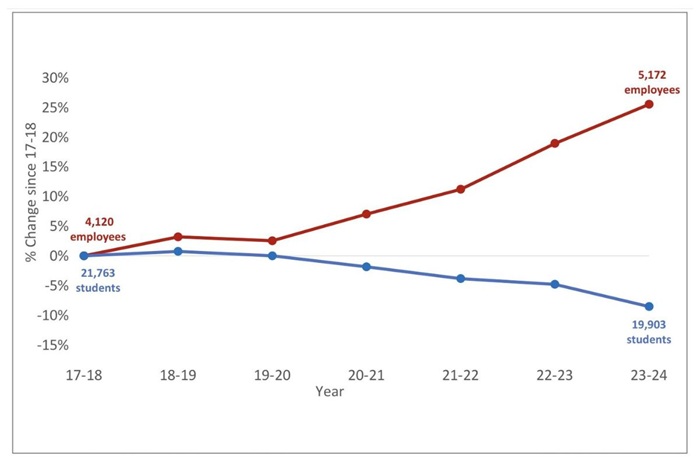
Toledo’s leaders are right about one thing: They face hard choices. They may well need to go the route of Columbus and Cleveland and explore school closures. And they definitely need to revisit staffing levels as Figure 1 below from the Edunomics Lab at Georgetown makes clear. Toledo added more than 1,000 employees since 2017-18 while enrollment fell by 1800 students.

Figure 1. Toledo staffing versus enrollment trends, cumulative percentage change since 2017–18

Toledo should pass on a four day school week blog figure 1
Source: Edunomics Lab Staffing & Enrollment Trends analysis. Via X.

Four-day school weeks are popular—at least at first. They make adults happy. They sound modern and flexible. But the evidence shows that they don’t save much money, don’t solve staffing problems, and harm student learning—especially for the students who need schools the most.

Ohio’s goal should be more learning, not less. More consistency, not clever calendar tricks. And policies that put students—not adult convenience—first.

Toledo should take a hard pass on the four-day school week.

Policy Priority:
School Funding
Topics:
Governance
Jeff Murray
12.16.2025
Automated writing evaluation SR image
Getty Images/koga
Listen to this article
Loading the Elevenlabs Text to Speech AudioNative Player...

Concern is growing over the impacts of AI use on students’ ability to write complete, coherent, logical essays on their own and to learn from the recursive process of drafting, reviewing, and rewriting. But what if AI’s role is limited to that of the editor, rather than the author or assistant? A new report looks at the impact of an Automated Writing Evaluation (AWE) program on students’ writing performance.

Nine researchers, led by Joshua Wilson of the University of Delaware, use a randomized controlled trial to compare outcomes for middle school students using an AWE system called MI Write to those of a similar group of students who learned via more traditional methods. (Note: MI Write was developed by Measurement Incorporated, a firm that sells numerous assessment and evaluation services to schools nationwide, and two of its staffers are included on the research team that produced this report.) Data come from three unnamed school districts in the mid-Atlantic and southeastern regions of the United States during the 2021–22 school year. One is suburban, one is urban, and one is rural. All three were chosen because they serve a population in which at least 50 percent of students belong to one or more “priority populations”—that is, Black, Hispanic, and/or low-income students, determined by eligibility for free or reduced-price lunch—as defined by the priorities of the Gates Foundation, who funded the study. A total of 37 seventh- and eighth-grade English language arts teachers across those districts opted to participate, and 19 were randomly chosen as the treatment group (n = 1,260 students), while 18 teachers were randomly assigned to the control group (n = 1,277 students).

Control group classrooms experienced “business as usual” ELA instruction. In one district, this consisted of an in-house curriculum that taught one type of writing per quarter and included narrative writing, expository research, and literary analysis. The other two districts used a web-based curriculum called StudySync whose writing component covered a number of writing styles—including argumentative, informative, explanatory, literacy analysis, and narrative—at various times throughout the year.

Treatment group classrooms incorporated MI Write, which uses AI to guide students through recursive cycles of planning, drafting, revising, and editing and can be tailored for any style of writing. Students draft essays in response to MI Write prompts, and while the platform facilitates peer and teacher review, its central feature is an automated feedback system designed to provide almost-immediate analysis of submitted essays across multiple drafts.

Feedback reports include a score of 1.0 to 5.0 on each of six writing traits (development of ideas, organization, style, word choice, sentence fluency, and conventions of a given style), descriptive evaluation and feedback statements, questions for consideration ahead of revision, recommended interactive lessons based on the score for each trait, and text-embedded feedback on grammar and spelling to support editing. There’s much more to it, and interested readers should check out this video demo for additional details.

The researchers examined how students using MI Write compared to their control group peers based on the various grading processes connected to the differing curricula, and whether MI Write students reported greater self-efficacy, greater enjoyment of writing, and more positive beliefs about writing as a recursive process. The two groups of students were broadly similar in grade level (more eighth- than seventh-graders) and gender breakdown (slightly more girls than boys), were plurality Hispanic (more than 42 percent of both groups), and comprised more than 77 percent of “priority population” students.

Overall, the regression analysis showed no statistically significant impact of treatment on students’ writing quality when measured either by human raters or via the MI Write scoring system. Same for all of the survey-based outcomes. However, additional analysis indicated that the three districts implemented MI Write with varying levels of fidelity and frequency. In the district identified as rural, for example, every lesson that research team members observed used MI Write. In that district, small but significant positive impacts were seen on all outcomes. The other two districts were classified as “rarely used” (suburban) and “intermittently used” (urban) and registered null or slight negative impacts (although still significant) across the board. Even in the most-committed district, the report provides the anecdote of a teacher who “routinely struggled with classroom management, reducing effective writing time,” with concomitant lower scores than other classrooms in the same district. Meanwhile, some control group students “seldom wrote beyond brief worksheet answers, and no essays were observed to be drafted” during class. There are more such anecdotes included.

What does all this tell us? Anyone hoping for AI-powered curricula to be a revolution in education is going to run into the same implementation problems that have plagued the much more well-regarded (and much more traditional) science of reading revolution. As Robert Pondiscio puts it: even the highest quality curriculum doesn’t teach itself. And even with the highest fidelity, a revolution is unlikely to occur. Teachers and students are not machines—even when working and learning with machines.

SOURCE: Joshua Wilson et al., “Impact of Automated Writing Evaluation (AWE) on Middle School Students’ Writing Outcomes,” American Educational Research Journal (November 2025).

Policy Priority:
Standards & Accountability
Topics:
Curriculum & Instruction
Jeff Murray
12.15.2025
Gadfly Bites logo
Listen to this article
Loading the Elevenlabs Text to Speech AudioNative Player...

News stories featured in Gadfly Bites may require a paid subscription to read in full. Just sayin’.

  1. Just in case you had the silly idea that getting out of their massive budget hole was the guiding purpose of Columbus City Schools’ building closure and consolidation effort—18 months long and counting—here’s the proof that that is (mostly) not the case. It’s a long-overdue update on the four school buildings (and one optimally-located downtown office complex) that the elected school board voted to close more than a year ago. In it, we learn that the district plans to keep hold of all five properties rather than selling them…should any of them even close. As far as I can ascertain, the downtown office complex is still active (last board committee meeting held there on December 8 of this year) with no plans to shutter despite the 2024 vote to immediately do so—and the super high price it would fetch if put on the market. And now we learn if the four school buildings ever close—one will perhaps shutter in 2026, but the others have no dates at all—they will all likely be immediately demolished so as not to “contribute to community or neighborhood blight.” That is, if the lame-duck elected board votes to do so at its meeting tomorrow. So, rather than sell the buildings to charter or private schools—or non-education entities or deep-pocketed developers—to actually earn millions of dollars that would help to stop the fiscal hemorrhage, the district will instead spend more of taxpayers’ money to demo them all AND still more money to maintain the lots in perpetuity. Classic bait and switch, I reckon. When will it ever stop? (Columbus Dispatch, 12/15/25)

  2. Some similar vibes in this op-ed from the Akron Beacon-Journal, in which retired magazine publisher Steve France laments the lack of institutional will for districts across Ohio to properly teach young children to read. Specifically, he talks about The Summit Education Initiative, which has been working for nearly 30 years (!?!) to “improve educational attainment in the various Summit County school systems”. France says he engaged with the group starting in September, 2024, the height of the state’s effort to instill the science of reading in all Ohio schools, in order to help improve third grade reading. He said the meetings were “tightly scripted” by the group, “focusing primarily on process, procedure and statistical information.” He goes on to say that they “never got to the hard work of examining the weaknesses in the county’s poorest performing primary grade school systems, including Akron, and to the even harder work of fashioning and recommending solutions then mustering the will and the resources to implement them.” The group’s meetings were canceled in April, 2025, with nothing at all to show for them. France longs for the day that “our local political establishment, business leaders and the community at large recognize” the danger that illiteracy represents and truly takes action to ensure that “the poorest performing school systems…make the hard changes needed to dramatically improve third-grade reading performance.” Sad to think that we’re still not on that road after all these years and millions of dollars spent. (Akron Beacon Journal, 12/13/25)

Did you know you can have every edition of Gadfly Bites sent directly to your Inbox? Subscribe by clicking here.

Policy Priority:
School Funding
Topics:
Governance

Pagination

  • First page « First
  • Previous page ‹ Previous
  • Page 64
  • Page 65
  • Page 66
  • Page 67
  • Current page 68
  • Page 69
  • Page 70
  • Page 71
  • Page 72
  • Next page Next ›
  • Last page Last »
Fordham Logo

© 2026 The Thomas B. Fordham Institute
Privacy Policy
Usage Agreement

National

P.O. Box 110
Burke, VA 22009

202.223.5452

[email protected]

Ohio

P.O. Box 82291
Columbus, OH 43202

614.223.1580

[email protected]

Sponsorship

130 West Second Street, Suite 410
Dayton, Ohio 45402

937.227.3368

[email protected]