Mobile Navigation

  • National
    • Policy
      • High Expectations
      • Quality Choices
      • Personalized Pathways
    • Research
    • Commentary
      • Gadfly Newsletter
      • Flypaper Blog
      • Events
    • Scholars Program
  • Ohio
    • Policy
      • Priorities
      • Media & Testimony
    • Research
    • Commentary
      • Ohio Education Gadfly Biweekly
      • Ohio Gadfly Daily
  • Charter Authorizing
    • Application
    • Sponsored Schools
    • Resources
    • Our Work in Dayton
  • About
    • Mission
    • Board
    • Staff
    • Career
Home
Home
Advancing Educational Excellence

Main Navigation

  • National
  • Ohio
  • Charter Authorizing
  • About

National Menu

  • Topics
    • Accountability & Testing
    • Career & Technical Education
    • Charter Schools
    • Curriculum & Instruction
    • ESSA
    • Evidence-Based Learning
    • Facilities
    • Governance
    • High Achievers
    • Personalized Learning
    • Private School Choice
    • School Finance
    • Standards
    • Teachers & School Leaders
  • Research
  • Commentary
    • Gadfly Newsletter
    • Flypaper Blog
    • Gadfly Podcast
    • Events
  • Scholars Program
High Expectations

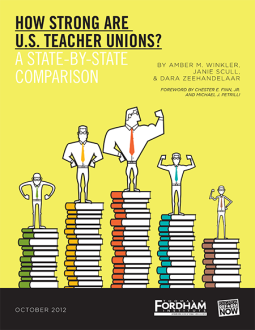
How Strong Are U.S. Teacher Unions? A State-By-State Comparison

Amber M. Northern, Ph.D.Janie ScullDara Zeehandelaar Shaw, Ph.D.
Foreword by:
Chester E. Finn, Jr.
Michael J. Petrilli
10.29.2012
10.29.2012

This timely study represents the most comprehensive analysis of American teacher unions’ strength ever conducted, ranking all fifty states and the District of Columbia according to the power and influence of their state-level unions. To assess union strength, the Fordham Institute and Education Reform Now examined thirty-seven different variables across five realms:

1) Resources and Membership

2) Involvement in Politics

3) Scope of Bargaining

4) State Policies

5) Perceived Influence

The study analyzed factors ranging from union membership and revenue to state bargaining laws to campaign contributions, and included such measures such as the alignment between specific state policies and traditional union interests and a unique stakeholder survey. The report sorts the fifty-one jurisdictions into five tiers, ranking their teacher unions from strongest to weakest and providing in-depth profiles of each.

Download the state profiles (Click your state to download):

TEACHER UNION STRENGTH BY RANK AND TIER

Tier 1 Strongest

Tier 2 Strong

Tier 3 Average

Tier 4 Weak

Tier 5 Weakest

STATEOVERALL RANKSTATEOVERALL RANKSTATEOVERALL RANKSTATEOVERALL RANKSTATEOVERALL RANK
Hawaii1Vermont11Massachusetts21Kansas32Louisiana42
Oregon2Ohio12Maine22District of Columbia33Oklahoma43
Montana3West Virginia13Maryland23South Dakota34Texas44
Pennsylvania4Minnesota14North Dakota24Colorado35Georgia45
Rhode Island5Alaska15Nevada25Idaho36Mississippi46
California6Michigan16Nebraska26New Mexico37Virginia47
New Jersey7Connecticut17Iowa27Missouri38Arkansas48
Illinois8Wisconsin18Kentucky28Utah39South Carolina49
New York9Delaware19Wyoming29North Carolina40Florida50
Washington10Alabama20New Hampshire30Tennessee41Arizona51
    Indiana31    

Policy Priority:
High Expectations
Topics:
Governance
Teachers & School Leaders
DOWNLOAD PDF

Amber Northern is senior vice president for research at the Thomas B. Fordham Institute, where she supervises the Institute’s studies and research staff.  She has published in the areas of educational accountability, principal leadership, teacher quality, and academic standards, among others. Prior to joining Fordham, she served as senior study director at Westat. In that role, she provided evaluation services…

View Full Bio
Janie Scull

Dara Zeehandelaar Shaw was the national research director at the Thomas B. Fordham Institute, where she oversaw Fordham’s research pipeline, designs and executed new studies, managed ongoing projects, and conducted quantitative and qualitative research until the beginning of 2017. Her areas of study include education governance and school boards; finance and teacher pensions; policy design and implementation (…

View Full Bio

Related Resources

view
High Expectations

Halting a Runaway Train: Reforming Teacher Pensions for the 21st Century

Mike Lafferty 10.20.2011
NationalReport
view
High Expectations

Undue Process: Why Bad Teachers in Twenty-Five Diverse Districts Rarely Get Fired

Victoria McDougald, David Griffith 12.8.2016
NationalReport
Fordham Logo

© 2020 The Thomas B. Fordham Institute
Privacy Policy
Usage Agreement

National

1016 16th St NW, 8th Floor 
Washington, DC 20036

202.223.5452

[email protected]

  • <
Ohio

P.O. Box 82291
Columbus, OH 43202

614.223.1580

[email protected]

Sponsorship

130 West Second Street, Suite 410
Dayton, Ohio 45402

937.227.3368

[email protected]