High Tech, Low Standards: High School in the Age of Distraction
A new national survey finds that school-issued devices, AI misuse, and grade inflation are undermining learning and leaving many students feeling unprepared for the future.


Many of the qualities that will matter most for students going forward are those that cannot be automated: judgment, self-command, compassion, and courage. They are also traits that Catholic schools have spent generations cultivating. In an age hungry for meaning, Catholic schools understand what humans need to flourish.
In early 2025, the National Center for Education Statistics (NCES) was largely dismantled.
Education is rarely accused of being ahead of the curve. We’re usually the last to get the memo. Just consider how K–12 education delivery has been one of the few large sectors of the American economy not really disrupted by technology—it’s an open question whether that will even happen in the AI era. We treat things that are long settled in the literature as “who knows” jump balls.
Contracted or purchased services (tutoring, professional development, after-school care, etc.) constitute the second-largest category of school district expenditures after staff compensation. They add up to tens of billions of dollars each year.
Mississippi’s ongoing early literacy success was originally dubbed a miracle. Now we’re calling it a marathon. That’s a more accurate description, but it still doesn’t do justice to the years and years of sustained work it’s taken to catapult the state from the back of the pack to leading on reading—and to keep those results going strong.
New York State is replacing its Regents high school exit exams with a yet-to-be-defined “portrait of a graduate” framework. It’s a terrible decision, as it exchanges clear academic standards for mush.
More than a dozen states now require that third graders who can’t read at grade level repeat the grade rather than advance to fourth, where every subject assumes literacy. The theory is sound. But in state after state, exemptions meant for a narrow set of students are being granted so widely that the policies aren’t benefiting the students they were designed for.
Most educators agree that there should be some guardrails regarding how students use AI in their independent work. Here, I argue for this guiding principle: Students should only use AI for things that they already know how to do well.
“If you build it, they will come” makes a great tagline for a mythical baseball movie but a poor strategy for educational improvement. Markets are not magic and are shaped by external factors that encourage or discourage participation.
Programming note: The Education Gadfly Show is taking a short end-of-summer
Echoing Alexandria Ocasio-Cortez’s sentiments distancing herself from wokeness, a common sentiment among reformers seems to be that the bipartisan education reform era was “craazzy.” Standardized testing pep rallies, the glorified grant writing beauty pageant called Race to the Top, No Child Left Behind, guarantees of
There’s an old adage that it’s better to build a sturdy fence at the top of a cliff than station an ambulance at the bottom.
Approximately half of American adults read at a sixth-grade level or below, according to the Barbara Bush Foundation. The consequences of poor literacy skills are profound: higher unemployment rates, lower-paying work, and struggles with routine tasks such as reading prescriptions or bills.
New York City Schools piloted an external qualitative review (QR) in a subset of its schools for the first time in 2005, intended to expand the definition of school quality via a school inspection-type model and to broaden the scope of educational accountability.
Third-grade proficiency is one of the most consequential milestones in a child’s academic career. Around this time, students transition from learning foundational skills to using those skills to engage with more complex content.
The past century has seen enormous developments in virtually all areas of life, from medicine to transportation to living standards and even to social and cultural attitudes. Yet our education system has not followed suit. One of the greatest illustrations of this is in the continued emphasis on age as the primary determinant of educational placement.
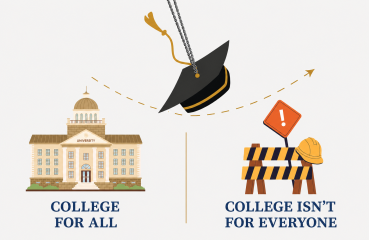
Mike Petrilli is solo on the podcast once again to revisit the college-for-all debate and consider whether the backlash has become an overcorrection.
For those of us who have long pushed for charter schools to receive fair funding, progress has been slow, uneven, and hard-won. That’s why we at the Thomas B.
Defense Secretary Pete Hegseth has called the CLT the nation’s new “gold standard.” USA Today’s blockbuster investigation, published today, suggests a more accurate label would be “boondoggle.” In Florida, the state that has done more than any other to
College is on my mind because of two recent tidbits.
Andrew Camp and Collin Hitt join Mike Petrilli and David Gr