Mobile Navigation

  • National
    • Policy
      • High Expectations
      • Quality Choices
      • Personalized Pathways
    • Research
    • Commentary
      • Gadfly Newsletter
      • Flypaper Blog
    • Events
    • Scholars Program
  • Ohio
    • Policy
      • Priorities
      • Media & Testimony
    • Research
    • Commentary
      • Ohio Education Gadfly Biweekly
      • Ohio Gadfly Daily
  • Charter Authorizing
    • Application
    • Sponsored Schools
    • Resources
  • About
    • Mission
    • Board
    • Staff
    • Career
Home
Home
Advancing Educational Excellence

Main Navigation

  • National
  • Ohio
  • Charter Authorizing
  • About

National Menu

  • Topics
    • Accountability & Testing
    • Advanced Education
    • Career & Technical Education
    • Charter Schools
    • Curriculum & Instruction
    • ESSA
    • Evidence-Based Learning
    • Facilities
    • Governance
    • Personalized Learning
    • Private School Choice
    • School Finance
    • Standards
    • Teachers & School Leaders
    • Think Again
  • Research
  • Commentary
    • Gadfly Newsletter
    • Flypaper Blog
    • Gadfly Podcast
  • Events
  • Scholars Program

The Education Gadfly Weekly

Sign Up to Receive Fordham Updates

We'll send you quality research, commentary, analysis, and news on the education issues you care about.
Thank you for signing up!
Please check your email to confirm the subscription.

The Education Gadfly Weekly: We are squandering the talents of too many low-income high achievers

Volume 21, Number 39
9.30.2021
9.30.2021

The Education Gadfly Weekly: We are squandering the talents of too many low-income high achievers

Volume 21, Number 39
view
High Expectations

We are squandering the talents of too many low-income high achievers

Far too many high-achieving children are drifting through middle and high school. Despite their potential, they don’t end up taking AP exams, achieving high marks on their ACTs, or going to four-year colleges. This limits their ability to move up the social ladder, threatens U.S. economic competitiveness, and derails our aspirations for a more just society. We must stop buying into the false assumption that high-achieving kids will do fine on their own.

Aaron Churchill, Michael J. Petrilli 9.30.2021
NationalFlypaper

We are squandering the talents of too many low-income high achievers

Aaron Churchill | Michael J. Petrilli
9.30.2021
Flypaper

Use pandemic recovery funds to empower both schools and families

Bruno V. Manno
9.30.2021
Flypaper

Voucher critics are at it again

Jessica Poiner
9.23.2021
Ohio Gadfly Daily

Measuring the social, emotional, and academic toll of remote learning

Amber M. Northern, Ph.D.
9.30.2021
Flypaper

Education Gadfly Show #789: Too many lost Einsteins

9.30.2021
Podcast

Cheers and Jeers: September 30, 2021

The Education Gadfly
9.30.2021
Flypaper

What we're reading this week: September 30, 2021

The Education Gadfly
9.30.2021
Flypaper
view

Use pandemic recovery funds to empower both schools and families

Bruno V. Manno 9.30.2021
Flypaper
view
Voucher critics at it again blog image

Voucher critics are at it again

Jessica Poiner 9.23.2021
Ohio Gadfly Daily
view

Measuring the social, emotional, and academic toll of remote learning

Amber M. Northern, Ph.D. 9.30.2021
Flypaper
view

Education Gadfly Show #789: Too many lost Einsteins

Michael J. Petrilli, Scott Imberman, David Griffith, Ph.D., Amber M. Northern, Ph.D. 9.30.2021
Podcast
view

Cheers and Jeers: September 30, 2021

The Education Gadfly 9.30.2021
Flypaper
view

What we're reading this week: September 30, 2021

The Education Gadfly 9.30.2021
Flypaper
view

We are squandering the talents of too many low-income high achievers

Aaron Churchill | Michael J. Petrilli
9.30.2021
Flypaper

Most agree that America must increase the racial and socioeconomic diversity of its selective high schools and colleges, as well as participation in its top professions. Yet debate rages over how best to achieve that praiseworthy goal. In K–12 education, the impulse has often been to relax standards or even give up on notions of academic excellence or giftedness in the name of equity and inclusion. While this approach appeals to some, it risks lowering the ceiling, holding back many young people who are ready to zoom ahead, and in the long run, diminishing the country’s competitiveness.

A surer approach is to increase the supply of top-notch education offerings in order to help more high-potential kids from disadvantaged backgrounds compete successfully with others of the nation’s best and brightest. That’s a tall order and one that U.S. education has long struggled to achieve. Studies by Johns Hopkins professor Jonathan Plucker and others have documented stark “excellence gaps” between high- and low-income pupils. A groundbreaking analysis of patent data by Harvard’s Raj Chetty and colleagues revealed that high-achieving children from low-income backgrounds rarely become inventors—what they call America’s “lost Einsteins.”

We at the Thomas B. Fordham Institute have also sounded the alarm about a meritocratic ladder with missing rungs and too narrow a top, as well as the inadequate attention given by U.S. schools to academically talented children. In 2011, we released a study that examined a national sample of third-grade high-achievers and found that a sizable number “lost altitude” by eighth grade. More recently, we published an analysis showing that Black and Hispanic students participate in gifted programs at lower rates than their peers (a phenomenon we termed the “gifted gap”). Our team also published a book showing that, while Black and Hispanic students have been participating in larger numbers in Advanced Placement classes, their passing rates on AP exams show the effects of weak preparation in elementary and middle schools.

Despite widespread exposure of these problems and valiant efforts by advocates, our nation’s most-able students continue to be overlooked—and if they come from poorer homes and neighborhoods the overlooking is almost certain to be worse. According to the National Association for Gifted Children, twenty states don’t even bother to report the number of students identified as gifted, twenty-three states fail to provide any funding for gifted education, and thirty-two states do not require universal screening for giftedness. At the federal level, the sole program dedicated to supporting gifted students is the tiny Jacob K. Javits Gifted and Talented Students Education Program.

Our home state of Ohio has gotten a couple of key policies right. For one, it has long required school districts to identify students as gifted and talented using a broad definition and a variety of metrics. More recently, the Buckeye State adopted a universal screening policy for giftedness. Ohio incorporates measures of achievement and growth among gifted students in its school accountability system, and it provides modest funding for identification and services. All good, as far as they go. But are they enough?

We decided to dig deep into the outcomes of high-achieving students in Ohio. How are smart kids there doing? Are they staying on top from elementary through high school? Are most of them acing their college exams and heading to four-year universities? Do we see disparities by race and socioeconomic status, even among students who had done well on their third-grade exams? And what about being formally identified as gifted—does that provide an extra boost?

To examine these questions, we turned to Scott Imberman of Michigan State University, a first-rate economist whose work includes a widely-cited study on the effects of gifted programs. We’re pleased to present his comprehensive study, Ohio’s Lost Einsteins: The inequitable outcomes of early high achievers, which relies on Ohio’s longitudinal databases containing anonymous student-level records. The focus of his analysis is the academic trajectory of the state’s “early high achievers,” defined as students who scored in the top 20 percent on third-grade exams in math or English language arts (ELA).

The first part of the report documents the basic outcomes of these early high achievers. Regrettably—but consistent with previous national studies—we see “excellence gaps” emerge by economically disadvantaged status and for Black students.

  • On state exams in grades 4–8, economically disadvantaged early high achievers lost ground to their nondisadvantaged, high-achieving peers, indicating that excellence gaps tend to widen over time. In similar vein, Black early high achievers made less progress over time on state tests than their peers from other races.

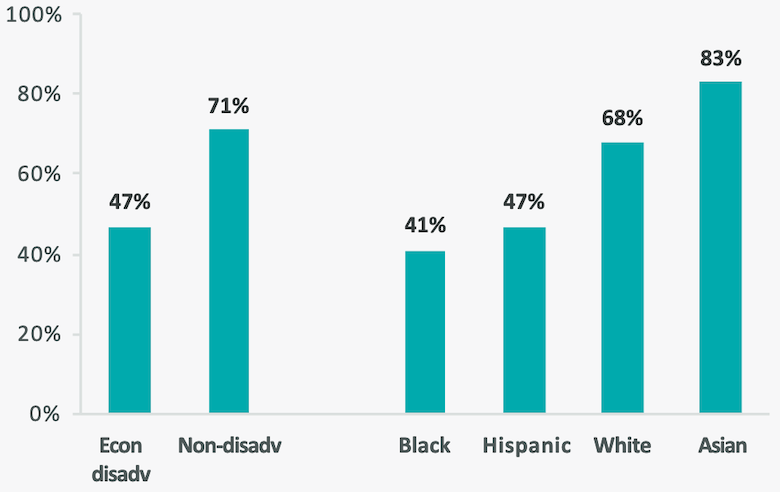
  • Less than half of economically disadvantaged and Black early high achievers took the ACT—47 and 41 percent, respectively—which is the predominant college entrance exam used in Ohio. This compares with 71 percent of non-disadvantaged high achievers. (During the period of this study, ACT or SAT participation was voluntary in Ohio.)

  • The average ACT math and reading scores of economically disadvantaged and Black early high achievers fell short of their more advantaged peers. For instance, the average ACT math score for economically disadvantaged high achievers was 23, while the average score for non-disadvantaged high achievers was 25.

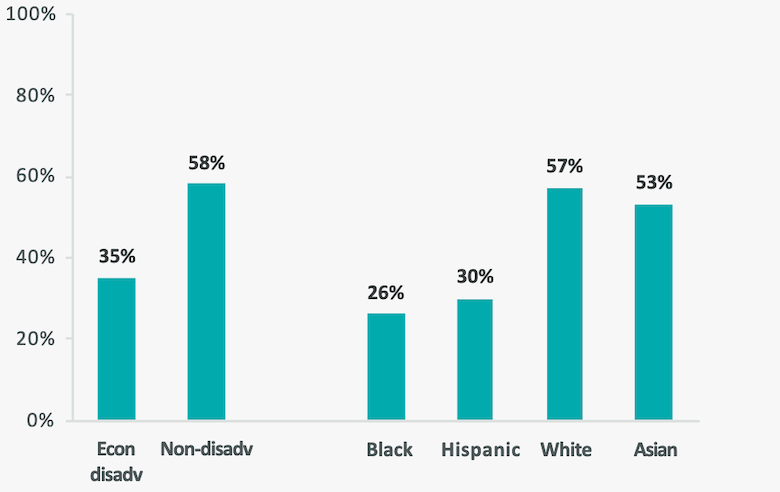
  • Just 35 percent of economically disadvantaged and 26 percent of Black early high achievers went on to enroll in four-year colleges. This compares with 58 percent of non-economically disadvantaged high achievers who enrolled in such institutions.

Figure A: ACT test participation (top) and 4-year college enrollment (bottom) among early high achievers

a2

b2

The report then turns to questions of gifted identification. Here we see that fewer than half of Ohio’s early high achievers are formally identified as gifted by eighth grade, reflecting either a high bar for identification or perhaps uneven application of the criteria for identification.[1] Thus, the terms “early high achiever” and “gifted student” are not interchangeable—and the raw outcomes data show that those high achievers who are identified as “gifted” outperform their non-identified peers.

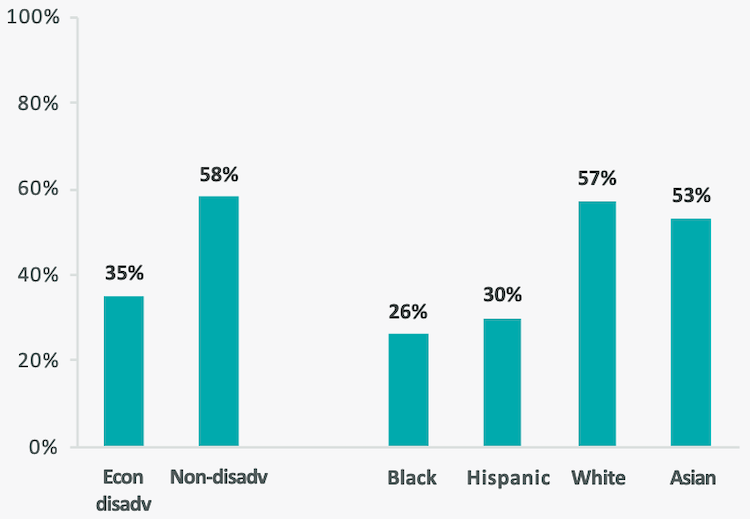
Economically disadvantaged and Black students were less likely to be identified. By eighth grade, 34 percent of economically disadvantaged high achievers were identified as gifted, compared to 53 percent of their nondisadvantaged peers. Meanwhile, 30 percent of Black early high achievers were identified as gifted versus 52 percent of White and 71 percent of Asian high achievers. Note that, during the period of this analysis, Ohio did not have a universal screening policy—that changed in 2017—possibly explaining some of the disparity in identification rates.

Figure B: Gifted identification by grade 8 among early high achievers

c

Rigorous causal analyses indicate that gifted identification itself provides a small boost to early high achievers from all backgrounds on state math and ELA exams, but the gains are more substantial for Black students, particularly in math. Though not causal evidence, Black high achievers who are identified as gifted outperform non-identified Black high achievers on ACT and AP performance and college-going outcomes.

Due to data limitations, this study cannot answer questions about whether receiving gifted services drove the results—Ohio does not mandate such services, just identification—or even which specific types of service benefitted children most. The state does not produce systemic data about the sorts of gifted services that students receive—if indeed they receive them—so we don’t know whether gifted students are mostly receiving meager hour-a-week “enrichment” or more intensive programming with specialized curricula and classrooms. What happens after a student is identified remains hidden inside a black box.

Nevertheless, it’s clear from the research—this study included—that more needs to be done on behalf of America’s high achieving kids, especially those from low-income backgrounds. What to do? Start by placing the needs of high-ability kids on the policy agenda. Consider just a few starter ideas:

  • Screen all children at least once in elementary school for academic giftedness, ideally using the state assessment rather than a separate exam.

  • Ensure that high-achieving (but not formally gifted) pupils have access to gifted programs and work to build sufficient capacity to make that possible.

  • Include data about gifted students’ achievement and growth on annual school report cards.

  • Require schools to provide gifted services and report pupil outcomes by the type of service received.

  • Identify all students in the state who show potential for success in selective colleges by requiring high schoolers to take the ACT or SAT at least once.

  • Remove barriers to AP or IB exams by fully covering test fees for low- and middle-income students.

  • Ensure that all students are well-versed in higher education opportunities, including information about financial aid and which colleges might be an appropriate match.

  • Empower parents of high-achieving children with options if their local school doesn’t offer satisfactory gifted programs or advanced coursework.

  • Create specialized schools that cater specifically to the needs of gifted students and high achievers.

—

Thousands of early high-achieving children—including smart kids of poor and working-class parents from places like Cincinnati, Dayton, and Mansfield, Ohio—are drifting their way through middle and high school. They don’t end up taking AP exams, achieving high marks on their ACTs, or going to four-year colleges, as one might expect. This not only limits these kids’ opportunities to move up the social ladder, but also threatens the nation’s economic competitiveness and derails our aspirations for a more just society where children from all backgrounds can become inventors, doctors, and business leaders. Rather than buying into the false assumption that high-achieving kids will do fine on their own, we need to do a better job of making sure that all high achievers, including those from low-income backgrounds, get the education they deserve.


[1] To be identified as gifted in math, students must score at the ninety-fifth percentile or higher on an approved nationally normed test; the same bar applies for identification in reading, science, and social studies. Slightly different criteria apply for identification in superior cognitive ability, visual or performing arts, and creative thinking, the remaining categories of giftedness in Ohio. For more on Ohio’s gifted identification policies and practices, see Ohio Department of Education, Assessments Approved for Gifted Identification and Prescreening (2021).

view

Use pandemic recovery funds to empower both schools and families

Bruno V. Manno
9.30.2021
Flypaper

Covid-19 school shock disrupted our way of doing education, unbundling the familiar division of responsibilities among home, school, and community organizations.

Nearly every parent of school-age children had to create from scratch a home learning environment using online technology and rebundling school services to meet their needs.

Most parents accepted whatever education services their district offered, supporting their child’s learning as best they could. But others sought new learning options.

A study from Tyton Partners calculates that, during the 2020–21 school year, 15 percent of parents changed their child’s school, a rate 50 percent higher than pre-pandemic levels. Overall, 2.6 million students exited district and private schools, enrolling in charter schools, home-schooling, micro-schools, and other options. Thirteen percent of families also enrolled their children in small learning pods, supplementing what was provided by their traditional schools.

In doing so, these parents exercised their agency to work with like-minded community members, many of whom were outside the current K–12 system—call them civic entrepreneurs—to create new organizations or expand existing ones to meet this demand.

There is now an unprecedented amount of K–12 federal dollars—around $190 billion and counting from three new pandemic-related programs—for people and programs to remedy the huge academic, social, and emotional toll that Covid-19 imposed on young people and their families. Ninety percent of that huge sum, $171 billion, is going to school districts—which, says the Congressional Budget Office, may not exhaust the stimulus dollars until 2028.

As John Bailey, an American Enterprise Institute nonresident senior fellow, points out, this doesn’t include other flexible federal recovery benefits going to state and local governments that can be used for many purposes, including education. He counts in this the American Rescue Plan’s Child Tax Credit, now going to 35 million families and totaling some $15 billion. He notes that 10 percent of families reporting that they’re using these funds for education, including tutoring, tuition, afterschool programs, and school supplies.

How should K–12 stakeholders and other community members think about using this unparalleled flood of new dollars to support students and families?

I believe that states and localities have two ways to mobilize their local communities, beginning now and continuing into the future. The first way may be termed bureaucratic mobilization, the second family mobilization.

While these two approaches aren’t mutually exclusive, they imply different starting points, actors, and directions.

The first approach focuses on the usual K–12 stakeholders—e.g., state departments of education, local school districts, superintendents, teachers unions, etc. They’re programmed to do what they usually do, especially in a time of crisis, when they get additional money: preserve their vested interests.

The Center for Reinventing Public Education says as much in its review of initial plans for Covid emergency relief spending in one hundred districts: “Districts appear to be doubling down on what they know: more time [on task for students], more staff, more capital spending.”

The second approach has some of the traditional stakeholders, but many more who are not—for example, parents seeking new schooling alternatives, nonprofit and community leaders, as well as other concerned citizens. They are driven to do something different to achieve a common goal. They’re mostly K–12 outsiders who come together voluntarily to expand or develop new capabilities and capacities, either through an existing organization or by creating a new one. And sometimes what they do is messy and coordinated badly, if at all, with the traditional K–12 bureaucracy.

A new analysis by Bellwether Education Partners gives initial insight into one category of these civic actors, the parents of what it calls “the overlooked”: an estimated 10.8 million students—one in five of the nation’s school children—whose families didn’t get what they wanted from their children’s schools over the last eighteen months. These comprise three distinct groups, dubbed the movers, the missing, and the muted. In short, these are, respectively, parents who moved a child to a new schooling option; chose not to enroll a child in formal schooling, making them missing from school; or were muted because they couldn’t access the educational setting they preferred.

Movers + Missing + Muted = The Overlooked.

Covid-19 shock threw longstanding arrangements among home, school, and community institutions into disarray. As states and communities begin to use their new federal resources, they should employ both mobilization approaches as they work to support families and students. This effort reflects a distinctive American understanding of politics: local civic engagement across the entire community supporting collective action for the common good.

This opportunity is not lost on K–12 leaders. Deborah Gist, superintendent of schools in Tulsa, Oklahoma, says, “None of us...ever wanted to go through this. [But] we have a chance now to make it something that will change teaching and learning forever for the better.”

Editor’s note: This is a lightly edited version of an essay that was first published by The 74 Million.

view
Voucher critics at it again blog image

Voucher critics are at it again

Jessica Poiner
9.23.2021
Ohio Gadfly Daily

It’s been a banner year for private school choice in Ohio. Senate Bill 89, which became law this spring, wisely decoupled the state’s EdChoice Scholarship Program from school report card ratings and expanded eligibility to more middle-income families. The state budget built on these improvements by creating a new school funding model that directly funds choice programs, expanding eligibility provisions even further, and increasing scholarship funding amounts.

These changes are a big win for everyday Ohioans who are searching for the best educational fit for their children. But for public school advocates who view choice as a threat, the state’s actions appear to represent yet another harbinger of doom. Their disdain for EdChoice, in particular, is clear in their comments from a recent piece published by the Columbus Dispatch, which purports to take a look at how vouchers gained popularity in Ohio. Amidst the history lesson there are some inaccurate, misleading, and downright troublesome assertions made by voucher critics. Let’s take a look at three of the most egregious.

Claim 1: Private school scholarships drain money from public schools

This is one of the most common arguments against private school choice—and choice more generally—so it’s no surprise that it shows up in the Dispatch piece. In fact, the total cost of educational vouchers during the 2021–22 school year (approximately $628 million) is referenced more than once. Ohio Federation of Teachers president Melissa Cropper even goes so far as to say there is “something wrong” with the state spending so much. She adds: “Even though the money might not be directly taken from a school district right now, there is still only so much state money allocated for education.”

It’s true that the state has a finite amount of money to devote to education. But acting as though EdChoice carries a burdensome price tag that taxpayers wouldn’t have to shoulder if vouchers disappeared isn’t accurate. If a student opts to attend a private school using an EdChoice scholarship, the state money designated for that student simply follows them to the school that’s doing the work of educating them. That’s how student-centered funding works. Moreover, taxpayers don’t pay more when students use vouchers. In fact, for years, Ohioans have actually saved money when students use a voucher. That’s because voucher amounts add up to far less than the overall taxpayer support required to educate a student who attends a district school. Even with scholarship amounts increasing under the new budget, vouchers will still be funded at far more modest amounts than the statewide average per pupil expenditure.

It’s also unfair to claim that voucher programs rob districts of money. First and foremost, no school—district, charter, private, or otherwise—is entitled to students. Families have the right to choose where to send their children to school, and schools are allocated money based on students they actually teach, not students they could have taught. To do otherwise would be to prioritize systems—one specific system—over students.

Second, it’s important to remember that schools are funded by state and local dollars. On average, 45 percent of elementary and secondary public school revenues are from local sources. For the most part, these dollars aren’t tied to student enrollment. Districts receive tax payments from their residents regardless of whether those residents have children that attend the district. And contrary to widespread claims that school choice results in lost funding, Ohio data show that per-pupil funding actually increased between 2000 and 2019 in districts where charters and private schools have historically been the most prevalent.

Finally, although districts’ complaints about losing money might have been understandable when the state funded voucher programs through deductions to districts’ state aid, that’s no longer the case. The recently passed state budget included a complete overhaul of the school funding formula. As Cropper noted above, money is no longer “directly taken” from districts. There is, quite literally, no loss of funding for districts when a student opts to use a voucher.

Claim 2: School choice is at odds with improving public schools

This is another anti-choice talking point that’s mentioned in the Dispatch. The piece notes that the “thorough and efficient system of common schools” promised by the Ohio Constitution is a mandate to “fix” underperforming public schools. The underlying implication is that rather than paying for families to “escape” to private schools, we should be focusing all our money and attention on improving public schools. This is always framed as an either/or. Policymakers and advocates can either focus on improving traditional public schools, or they can focus on expanding choice programs. They can’t do both.

But that’s a false dilemma. There’s no reason that traditional public schools can’t improve and thrive alongside private and charter schools. In fact, one of the great arguments in favor of choice is that it can spur change and innovation in nearby districts. Cleveland is proof positive of that. The district was recently named one of the fastest-improving school districts in the country. It is one of only three districts in a nationwide sample that succeeded in improving from negative to positive NAEP impacts between 2009 and 2019. And all of this was accomplished despite the fact—or perhaps because of the fact—that Cleveland students have had access to private school scholarships since 1995 plus a burgeoning charter school sector. A portfolio of school options can breed competition between different types of schools, but it can also lead to collaboration if adults are willing. In either case, students benefit. That’s all that should matter.

Claim 3: If parents want their children to attend private schools, they should pay for it

This argument makes an appearance courtesy of Senator Teresa Fedor, who told Dispatch reporters: “I went to private schools, I taught at private schools, I sent my son to a private school, and it was by my choice...I did not expect the public to pay for it.”

There’s a lot wrong with this way of thinking. First and foremost is the Senator’s assumption that, just because she can afford to attend and send her children to private schools, everyone in Ohio can. But according to the 2021 State of Poverty in Ohio report, nearly 3.5 million Ohioans—more than three out of every ten—live below 200 percent of the federal poverty line. That translates to an annual income of $53,000 for a family of four. Meanwhile, average private school tuition in Ohio clocks in at just over $7,000. Without assistance from the state, low-income parents with two kids would need to spend more than a fourth of their annual income just to afford private school tuition. Spending that much isn’t feasible.

Of course, Senator Fedor and others would argue that every Ohio student has access to free public schools. And that’s true. But free doesn’t always equate to good. Consider Toledo, which is part of the district that Senator Fedor represents. On the 2018–19 report card (the last report card with graded components), Toledo Public Schools (TPS) earned an F in achievement and a D in progress. Value-added grades for students with disabilities and the lowest-performing 20 percent of students were F’s. And the four-year graduation rate was only 79 percent compared to the state average of 85 percent.

Parents of students in TPS could wait for the district to turn itself around and improve. That is, after all, what voucher opponents advocate for when they say that state leaders should focus on improving public schools rather than giving families access to other options. But what if families—families just like Senator Fedor’s—aren’t willing to risk their child’s future on a potentially empty promise that their neighborhood school will suddenly improve? Districts like TPS have nearly a decade of poor report card results under their belts, in addition to high remediation rates and low ACT and SAT scores. What if families dare to want something better for their children now?

Unlike their senator, most Toledo parents can’t afford to pay private school tuition. Of the nearly 23,000 students TPS educates, 87 percent are considered economically disadvantaged. The median household income in Toledo is just below $38,000, which means the average annual private school tuition bill would amount to almost a fifth of a household’s annual income. Moving to a nearby district is likely out of the question, considering the average home price in neighboring, higher-performing districts like Perrysburg ($274,877) and Ottawa Hills ($333,571). Open enrollment isn’t an option either, since most of the districts that surround TPS have closed borders. There are charter schools, of course, but seats are limited.

The upshot? Without private school scholarships, lower- and middle-income families who want a different or better option are out of luck. That seems like a problem Senator Fedor should be working to solve. Instead, she’s calling for these programs to be eliminated or scaled back.

***

When it comes to debates over school choice, misrepresentations are nothing new. Given the wide variety of choice-friendly provisions in the budget, it’s not surprising that the establishment is hitting back. But the complaints refuted here—and several others that appear unchallenged in the Dispatch piece—are inaccurate at best. Ohioans deserve better.  

view

Measuring the social, emotional, and academic toll of remote learning

Amber M. Northern, Ph.D.
9.30.2021
Flypaper

After more than eighteen months of pandemic-induced commotion to education, data continue to roll in regarding various negative impacts on young people. A recent report by Angela Duckworth and colleagues examines how high school students were adversely impacted—socially, emotionally, and academically—in the first seven months of disruption. They point the finger for the troubling downswing squarely at attending school remotely versus in-person.

The analysts gleaned data from a large (unnamed) district that participates in Duckworth’s Character Lab Research Network. The sample includes over 6,500 high school students who completed a self-report questionnaire assessing various aspects of their well-being at two points in time. The first was pre-pandemic—data collected in February 2020 when students were in grades eight through eleven—and the second was in October 2020 when they were in grades nine through twelve.

At time two, roughly 4,200 kids had opted to attend school remotely and roughly 2,300 opted for in-person attendance. Duckworth and colleagues measured three separate domains of well-being. The social dimension included questions like “In your school, do you feel like you fit in?” and “Is there an adult in school who you can turn to for support or advice?” The emotional domain included questions like “How happy have you been feeling these days?” and “How sad have you been feeling these days?” And the area of academic well-being included questions like “Compared with other things you do, how important is it to you to do well in your classes?” and “Do you feel like you can succeed in your classes if you tried?”

The analysts controlled for baseline measures of well-being collected from time one as well as factors such as gender, race and ethnicity, grade level, free- and reduced-price-lunch status, English learner status, special education participation, overall GPA and core subjects GPA, home language, and enrolled school. The large number of variables available as controls proved critical because the researchers observed baseline differences between students attending remotely and in person—for instance, in-person students were more likely to be males, White, and ineligible for free or reduced-price lunch—consistent with the non-random assignment to the two learning modes.

This short study yielded one key finding: High school students who attended remotely reported lower levels of social, emotional, and academic well-being with effect sizes ranging from 0.10 to 0.07 standard deviations, as compared to classmates who attended school in person—differences which were comparable across gender, race, ethnicity, and socioeconomic status. However, the differences were significantly wider among tenth to twelfth graders than among ninth graders. The analysts theorize that ninth graders who never experienced high school in person prior to the pandemic were less prone to missing their classmates or teachers. Or perhaps the need to maintain close relationships with peers might increase in later adolescence, meaning that older students are more vulnerable to social isolation. But they were unable to test these hypotheses.

Various researchers have thus far found myriad negative outcomes for young people as a result of pandemic-disrupted education, mostly attributable to mandatory remote learning (versus optional, as was the case here). Analysts somberly observe that emergency-room visits in April through October 2020 by twelve- to seventeen-year-olds for mental-health related issues increased by 31 percent compared to the same time in 2019, which could have been exacerbated by remote learning and the decimation of the academic status quo. Let’s hope that we are moving out from under the dark cloud of non-optional remote learning and the negatives it has engendered. How we will help our kids already impacted by those negatives to regain their balance and momentum requires far more work.

SOURCE: Angela L. Duckworth et al., “Students Attending School Remotely Suffer Socially, Emotionally, and Academically,” Educational Researcher (July 2021).

view

Education Gadfly Show #789: Too many lost Einsteins

9.30.2021
Podcast
 

On this week’s podcast, Scott Imberman, professor at Michigan State University, joins Mike Petrilli and David Griffith to discuss the new study he conducted for Fordham exploring the inequitable outcomes for early high achievers in Ohio. On the Research Minute, Amber Northern examines how admission to a high-quality charter school affects students’ voting patterns later in life.

Amber's Research Minute

Sarah Cohodes and James J. Feigenbaum, "Why Does Education Increase Voting? Evidence from Boston’s Charter Schools," NBER Working Paper #29308 (September 2021).

view

Cheers and Jeers: September 30, 2021

The Education Gadfly
9.30.2021
Flypaper

Cheers

  • Doug Lemov’s new book, Teach Like a Champion 3.0, shows that equity begins with excellence and seeks to “cure the weak teaching that infects our schools.” —Jay Mathews
  • “What Ted Lasso can teach about schooling.” —Education Week
  • Tracing the college gender gap back to elementary schools, and the lackluster literacy instruction boys receive there . —Richard Whitmire

Jeers

  • “Nearly 40 cents of every education dollar in Illinois goes to pensions.” —Illinois Policy Institute
  • The New Mexico Public Education has let districts off the hook from testing kids, and are now refusing to release the test data it does have. —Santa Fe New Mexican
view

What we're reading this week: September 30, 2021

The Education Gadfly
9.30.2021
Flypaper
  • A study by Jay Greene and James Paul finds that courting Democrats has been a lost cause—and a costly one—for school choice legislation. —Education Next
  • The demographics and economic disparities of suburban communities are beginning to mirror those of large cities, but suburban schools aren’t keeping pace. —New York Times
  • Some wonder whether future U.S. Supreme Court rulings could permit religious charters. —The 74
  • As students return to classrooms after a traumatic pandemic year, teachers are struggling to manage increases in disruptive and aggressive behavior. —Chalkbeat
  • The Dallas school district had made strides before the pandemic interrupted everything. Now it’s hoping to bounce back. —Dallas Morning News
Fordham Logo

© 2026 The Thomas B. Fordham Institute
Privacy Policy
Usage Agreement

National

P.O. Box 110
Burke, VA 22009

202.223.5452

[email protected]

Ohio

P.O. Box 82291
Columbus, OH 43202

614.223.1580

[email protected]

Sponsorship

130 West Second Street, Suite 410
Dayton, Ohio 45402

937.227.3368

[email protected]