Mobile Navigation

  • National
    • Policy
      • High Expectations
      • Quality Choices
      • Personalized Pathways
    • Research
    • Commentary
      • Gadfly Newsletter
      • Flypaper Blog
    • Events
    • Scholars Program
  • Ohio
    • Policy
      • Priorities
      • Media & Testimony
    • Research
    • Commentary
      • Ohio Education Gadfly Biweekly
      • Ohio Gadfly Daily
  • Charter Authorizing
    • Application
    • Sponsored Schools
    • Resources
  • About
    • Mission
    • Board
    • Staff
    • Career
Home
Home
Advancing Educational Excellence

Main Navigation

  • National
  • Ohio
  • Charter Authorizing
  • About

National Menu

  • Topics
    • Accountability & Testing
    • Advanced Education
    • Career & Technical Education
    • Charter Schools
    • Curriculum & Instruction
    • ESSA
    • Evidence-Based Learning
    • Facilities
    • Governance
    • Personalized Learning
    • Private School Choice
    • School Finance
    • Standards
    • Teachers & School Leaders
    • Think Again
  • Research
  • Commentary
    • Gadfly Newsletter
    • Flypaper Blog
    • Gadfly Podcast
  • Events
  • Scholars Program

The Education Gadfly Weekly

Sign Up to Receive Fordham Updates

We'll send you quality research, commentary, analysis, and news on the education issues you care about.
Thank you for signing up!
Please check your email to confirm the subscription.

The Education Gadfly Weekly: Traditional public schools aren’t open to everyone

Volume 26, Number 24
6.18.2026
6.18.2026

The Education Gadfly Weekly: Traditional public schools aren’t open to everyone

Volume 26, Number 24
view
Caution tape
Quality Choices

The Education Freedom Tax Credit could blow up in our faces

The Education Freedom Tax Credit could be an utter disaster, argues Buck. The greatest risk is that, in time, the program will become a stick that the federal government can wield to thwack private schools into submission. But that’s not the only problem.

Daniel Buck 6.18.2026
NationalFlypaper

The Education Freedom Tax Credit could blow up in our faces

Daniel Buck
6.18.2026
Flypaper

The case for including early childhood education in education choice programs

Elliot Regenstein | Theresa Hawley | Katie Reed
6.18.2026
Flypaper

Fact check: Traditional public schools aren’t open to everyone

Jessica Poiner
6.11.2026
Ohio Gadfly Daily

The “science of learning” is less controversial than it used to be

Robert Pondiscio
6.18.2026
Flypaper

Instructionally-aligned tutoring and student literacy outcomes

Jeff Murray
6.18.2026
Flypaper

Better NAEP news than you think | Episode 1022 of The Education Gadfly Show

6.17.2026
Podcast
view
Preschool classroom

The case for including early childhood education in education choice programs

Elliot Regenstein, Theresa Hawley, Katie Reed 6.18.2026
Flypaper
view
Public schools open to all blog image

Fact check: Traditional public schools aren’t open to everyone

Jessica Poiner 6.11.2026
Ohio Gadfly Daily
view
Student reading

The “science of learning” is less controversial than it used to be

Robert Pondiscio 6.18.2026
Flypaper
view
Tutoring

Instructionally-aligned tutoring and student literacy outcomes

Jeff Murray 6.18.2026
Flypaper
view

Better NAEP news than you think | Episode 1022 of The Education Gadfly Show

Michael J. Petrilli, David Griffith, Ph.D., Amber M. Northern, Ph.D. 6.17.2026
Podcast
view
Caution tape

The Education Freedom Tax Credit could blow up in our faces

Daniel Buck
6.18.2026
Flypaper

They say don’t bury the lede, so here goes: The Education Freedom Tax Credit (EFTC) could be an utter disaster.

The EFTC is a new federal program that passed through the reconciliation bill last year. It allows donors to provide a $1,700 donation to a scholarship-granting organization (SGO) and receive that money back through a tax credit. Those SGOs can then provide scholarships to students to pay for various educational goods and services: after-school tutoring, tuition at private schools, curricular materials, education therapies for students with disabilities, and other such expenses.

More simply, you can give $1,700 to an SGO and receive that money back (in the form of an income-tax credit), while the SGO gives out scholarships for various educational purposes.

Ideally, this program will create a funding stream to allow struggling Catholic and Lutheran schools to prosper, homeschools and microschools to flourish, and public schools to offer a litany of new, supplemental services.

How could it go wrong? Let me count the ways.

Most likely, this program becomes a glorified slush fund for public schools. They have the infrastructure to make it work: marketing teams, pre-built contact lists, and a bureaucracy. A public school district can mass email every single family and run campaigns to encourage donations to their preferred SGO. Homeschooling co-ops? Not so much.

A few public-school superintendents that I’ve spoken to have gotten wise to this reality. Writing about a promotional event at the Treasury Department last week, the New York Times framed the program as functionally equivalent to vouchers for public schools. And along with this likelihood is simple waste: spending a bunch of money and thereby contributing to our national debt, without getting anything in return by way of student learning or academic outcomes. We’ll see new bureaucrats, new programs, and the same mediocre outcomes.

Another risk, which Deputy Assistant Secretary for Tax Policy Kevin Salinger acknowledged in his remarks at Treasury, is fraud and abuse. The possibilities are endless: family members hired as “consultants,” huckster educational services, “education purchases” that are personal goods, the list goes on.

Of all the ways this could go wrong, fraud and abuse ranks low for me. Other school choice policies rein in such misconduct. For example, Jason Bedrick never tires of pointing out that Arizona’s ESA program has fraud, yes, as any system will, but the extent of it is functionally a rounding error. Moreover, Salinger’s remarks imply that Treasury is taking seriously the risk of such malfeasance. That being said, conservatives need to be ready to have the next “Quality Learing Center” debacle land in their laps.

The greatest risk in my mind is that in time this program will become a stick that the federal government can wield to thwack private schools into submission. Were private schools to adjust their budgets or expand such that they come to depend on funds through this program, it then becomes a point of leverage for antagonistic administrations.

It wouldn’t be the first time. At the level of higher education, administrations have leveraged grants and Title IV funds to force universities into compliance—from eradicating DEI to Title IX compliance. The same could happen here. Any time an institution accepts public monies, it invites regulation. As others have said, “he who pays the Piper calls the tune.” At the state level, there have already been initiatives to place regulations on private schools that accept public funds. Exploiting this program for regulatory control is most certainly on the minds of at least some Democrats and perhaps also some Republicans.

As it’s currently written, the federal law regulating the EFTC has only a few requirements for participating SGOs: They must devote 90 percent of their income to scholarships, serve more than 10 students who do not all attend the same school, and provide moneys only to students from households earning less than 300 percent of the area’s median income. Furthermore, the guidance that Slinger presaged seems to indicate that states will not be allowed to place further requirements on SGOs.

That said, were a President Alexandria Ocasio-Cortez to come into office, there’s little to prevent her from politicizing standards of compliance or approval for SGOs: for example, excluding SGOs that fund religious schools that deny trans students an ability to use the bathroom of their choice. Such a change would mostly certainly trigger a court case on First Amendment grounds. While that litigation winds through the courts, a Catholic school has a difficult choice to make if 20 percent of its budget is tied up in EFTC.

As a final risk, might I simply point to the graveyard of failed federal education policies? Reading First, School Improvement Grants, Race to the Top—if past is prologue, this EFTC could prove to be just another failure. There are surely countless other ways that this program could falter beyond the concrete possibilities above.

I want this program to succeed. I want struggling private schools to find a lifeline that allows them to compete with the free alternative of public education. I want students in failing schools to have the resources necessary to escape and secure a quality education. I want new educational models—co-ops, microschools, part-time homeschools, unique charter and private schools—all to flourish. I want blue states to have the benefits of a school choice policy. Were I advising a governor, I’d still recommend they join the program regardless of my reservations.

But if conservatives aren’t careful, in 20 years, the EFTC could be just another chapter in a book penned by some policy wonk warning of failed federal school reforms.

view
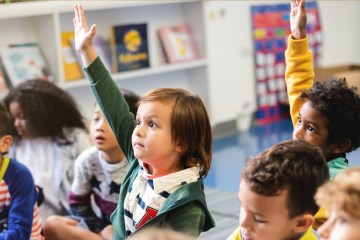
Preschool classroom

The case for including early childhood education in education choice programs

Elliot Regenstein | Theresa Hawley | Katie Reed
6.18.2026
Flypaper

Lately there has been a lot of discussion about whether states should opt in to the federal “Education Freedom Tax Credit”—a dollar-for-dollar federal tax credit for individual contributions to nonprofit scholarship granting organizations that distribute funds to eligible K–12 students. This conversation comes at a time when many states are expanding support for their own educational choice investments, including through the use of education savings accounts (ESAs)—which last year received $10.6 billion in state funding, according to EdChoice. So far, most of the discussion has focused on the K–12 years, which prompts us to ask: Why hasn’t early childhood been a bigger part of the education choice movement?

We are not here to opine on whether governors should opt into the federal tax credit or if their states should enact or expand ESAs. Those decisions involve multiple considerations that vary across the political spectrum. We are here to say to education choice advocates that, if you are serious about expanding educational opportunity, you cannot afford to ignore the pre-kindergarten years. Here’s why:

  • The case for impact—and return on investment—is strong. From an educational standpoint, the pre-kindergarten years are developmentally critical. If your goal is to improve student outcomes, the ceiling on what is realistically possible to accomplish is a lot lower if you don’t start early. That’s part of why the return on investment for early childhood programs with high standards is potentially quite high.

  • Many children under the age of five are completely unserved and need options. In K–12, all of the children who would benefit from education choice funds are already guaranteed an education at a local public school. That is not the case in early childhood.
    • The federal government supports subsidies for child-care funding, but for the most, part those subsidies are available only to working parents—and roughly a third of families have at least one parent who isn’t working. Even among families with both parents in the workforce, the subsidies reach only a small percentage of eligible families. And the amount of the subsidy is usually insufficient to support standards-based education.

    • When it comes to pre-kindergarten education, more than half of four-year-olds and more than 80 percent of three-year-olds aren’t in a publicly funded program. Funding levels for early childhood vary widely across states, and there are major inequities across the system. 

Because publicly funded pre-k is limited and private options are expensive, families with lower incomes are most likely to go without. Many of the children who miss out on pre-k for financial reasons are the same ones who later struggle in K–12. Targeted funding that gives those families access to quality early education is one of the highest-leverage interventions in the choice toolkit.

  • The early childhood system is already built on choice. Early childhood is already delivered through a variety of provider and program types. This “mixed delivery system” incorporates both traditional K–12 schools and private providers (including religious providers). Many private and parochial schools start with a pre-k program, and in some cases, it’s much easier for a child to gain admission to those schools if they start at age three or four. For the schools, education choice funds that can be used for pre-k might allow them to expand their offerings in those years, and at the very least should make it easier to fill the classrooms they already have. For those who support educational pluralism, the early childhood system already has implemented many of the principles that are driving the choice movement.

  • There’s an opportunity to drive policy coherence across systems. Both the ECE and K–12 systems value parental choice and access to high quality experiences to at least some degree, but these values are implemented very differently in the two systems. Having policies that reinforce the separation of early childhood and K–12 makes for incoherent public policy, which is frustrating for families. Flexible funding through education choice programs could serve as a bridge between the two systems, reflecting how families actually make decisions about their children’s education. And if choice advocates really believe in providing public resources to support parents’ education choices, why should they place artificial limits on when families can use those resources?

Where the policy stands and where it falls short

Few choice advocates have paid attention to the pre-k years—and the results are visible in their recent successes. At the federal level, the Education Freedom Tax Credit created in the One Big Beautiful Bill applies to children “eligible to enroll in a public elementary or secondary school.” While many elementary schools offer pre-k classrooms—and increasingly private and charter schools do, too—pre-k programs do not appear to be included in the statute. Similarly, the Trump administration’s executive order focused on education choice uses the term “K–12” and does not say anything about early childhood. The Department of Health and Human Services has issued guidance on how to use child care subsidy funds to support the goals of the executive order, but barring an unexpected twist when the Treasury Department issues final regulations, this tax credit will not include early childhood.

At the state level, most private education choice programs do not include early childhood. Education savings accounts are rooted in service for children with disabilities—but as these programs have expanded to serve broader populations in K–12, they have not seen a similar expansion into early childhood, though there are a few exceptions: Arizona and Florida allow ESA funds to be used for early childhood special education, and some Texas families can use vouchers for pre-k. Wyoming deserves credit for including early childhood as part of its ESA program, which was a priority for Governor Mark Gordon. The Equality State’s model is worth examining and expanding.

What advocates should do

Include early childhood! The educational benefits are substantial, the need is strong, and the politics are likely to be favorable. At the state level, any new ESA legislation or expansion should include ages three and four as eligible years, not just kindergarten and above. At the federal level, early childhood could be added to the existing tax credit or any new supports for education choice that emerge. Early childhood education is not an issue that cleaves neatly along party lines, as evidenced by existing investments in the “Southern Surge” states.

As education choice advocates push for policy change at the federal and state level, we encourage them to remember that education begins before kindergarten—and to work toward policies reflecting that reality. While some choice advocates and early childhood advocates may struggle to find common cause, others will turn out to be natural allies. It’s at least worth a conversation. We encourage policymakers and advocates working on educational choice to get that conversation started.

view
Public schools open to all blog image

Fact check: Traditional public schools aren’t open to everyone

Jessica Poiner
6.11.2026
Ohio Gadfly Daily

In 2022, a coalition of traditional public school districts filed a lawsuit that aimed to eliminate the EdChoice Scholarship, Ohio’s largest private school choice program. As part of their argument, the plaintiffs claimed that, while a traditional public school “accepts all comers,” scholarship-accepting private schools don’t. Taxpayer dollars, they said, should only go to schools that are required to take all students who want to enroll. 

It would be a compelling argument if true. But, as I pointed out in this 2022 piece, it’s not.

Nearly four years later, a lot has changed. An initial ruling in the EdChoice lawsuit sided with the plaintiffs. The case is now before an appeals court. Despite the pending lawsuit, the 2023 state budget established near universal eligibility for the program. And the number of families participating continues to climb.

One thing that hasn’t changed is the establishment’s claim that unlike private schools, everyone has equal access to public schools. It’s just as hypocritical now as it was then. But in our current economic climate, where it’s even harder for many families to afford homes in communities with excellent public schools, that hypocrisy has become even more appalling. In an effort to cut through this freshly-claimed falsehood, let’s revisit my initial rebuttal with some updated data.

***

In many places in Ohio, traditional public schools aren’t open to everyone. Most of those places are suburbs, which are only open to students who live within their district boundaries. These boundaries are rooted in real estate redlining that’s had a lasting effect on American society. They don’t require an application for entry like private schools, but they do require proof of residency. And instead of tuition, they require payment in the form of a hefty mortgage and property taxes, or sky-high rent, a price tag that’s often far out of reach for low- and middle-income families.

Consider how this works in the Columbus metro area. Columbus City Schools (CCS), the largest district in the state and one of the named plaintiff districts in the EdChoice lawsuit, served over 46,000 students during the 2024–25 school year. On the most recent state report card, it posted an overall rating of two out of five stars. That’s the same overall rating it earned during the 2023–24 and 2022–23 school years. Ratings on individual measures have also been flat: Achievement, Progress, and Gap Closing have remained at two stars for three straight years, while Graduation and Early Literacy have stayed consistent at one star.

One- and two-star ratings are clear indicators that a district and its schools aren’t meeting state expectations. But a closer look at individual ratings shows just how bad things actually are. Even in an era of lackluster graduation standards and grade inflation on school report cards, the 2025 state report card shows that just 83 percent of CCS students graduated “on-time” (in four years). Nearly 65 percent of the class of 2024 took the SAT, but only 6 percent earned remediation-free scores on the reading, writing, and math sections. [1]Twenty percent of students took at least one Advanced Placement course, but less than 5 percent earned a score of three or better on their exams. And while nearly 97 percent of third graders were promoted to fourth grade, only 36 percent proved they could read proficiently on the state ELA exam. Just 16 percent of K–3 students who were off track in reading progressed to being on track by the end of the school year.

Now, imagine you’re a parent living in Columbus. You want to make sure your child has the best education possible, and the data above—likely combined with your own experience—have convinced you that CCS isn’t the best option. You still want your child to attend a public school, though, so you start looking around. Ohio’s school district map shows that there are over a dozen districts that share borders with CCS, and because you have reliable transportation, they’re all viable options. A close look at 2024–25 report cards reveals that seven of the identified districts had overall ratings of three stars or higher and no one- or two-star ratings on the primary measures of Achievement, Progress, Graduation, or Early Literacy. Those districts are Bexley, Dublin, Gahanna-Jefferson, Grandview Heights, Hilliard, Upper Arlington, and Worthington.

You decide to focus on these seven districts. Your first move is to look into open enrollment because, even though your assigned district is academically low-performing, you like your neighborhood and you’d rather not move. Unfortunately, open enrollment isn’t an option. None of these seven districts allow students who live outside their borders to enroll in their schools.

If you want to enroll your child at one of these higher-performing districts, you’ll have to move. But that’s easier said than done. In fact, purchasing a home in the districts that surround Columbus is financially out of reach for many city residents. The table below lists the median household income in 2024 dollars and the typical home value in each district as of this writing. Every single one has a significantly higher median income than Columbus. The smallest difference—between Columbus and Gahanna-Jefferson—is nearly $43,000. The same is true for typical home values. The closest difference, also between Columbus and Gahanna-Jefferson, is over $131,000. In districts like Bexley, Dublin, Grandview Heights, and Upper Arlington, the typical home now costs more than a half-million dollars. For all but the wealthiest Ohioans, it’s become a pipe dream to buy a path into excellent public schools.
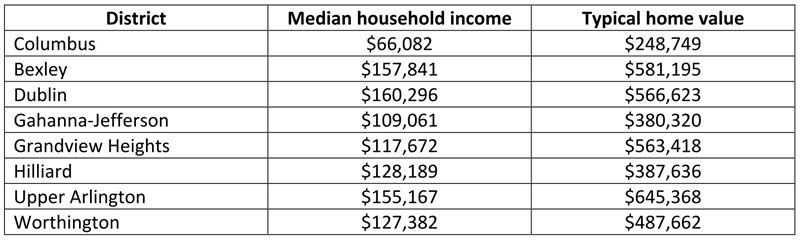
Public schools open to all blog figure 1

It’s important to keep in mind that this table shows median incomes. There are thousands of Columbus households that make far less than $66,000 a year. The same is true for typical home values. Wealthier enclaves within Columbus—neighborhoods like Clintonville and Victorian Village—are driving up the average home value for the rest of the city. And don’t forget, thousands of Columbus residents are renters, not homeowners. That means they don’t have any home equity to help with a down payment on a new house. To make matters worse, many signs point to homes in central Ohio getting even more expensive over the next few years.

It’s possible that these families could rent, rather than buy, their way into these communities. After all, renting is now cheaper than buying a home in every major U.S. city. But as the table below shows, average rents at the time of this writing are also higher in the suburbs. And remember, the same factors driving up real estate prices are also driving up rent. Luxury apartments downtown boost the city’s median rent and make it seem a lot closer to suburban averages than it actually is.
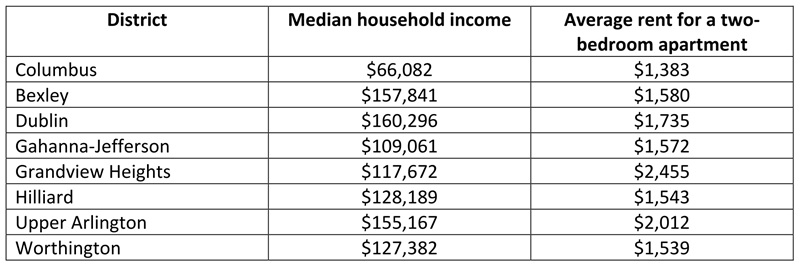
Public schools open to all blog figure 2

As a last resort, you look for family and friends who are living in the districts you prefer but can’t afford. Your loved ones are residents, and they pay taxes, so maybe your children can list those addresses as their proof of residency. But a quick Google search reveals that’s a really bad idea. Apparently several of the districts on your list hire private investigators to tail parents and make sure they’re actually residents. In other parts of the state, parents have been sent to jail for enrolling their students in districts where they don’t reside. Much as you want your kids to have a better education, doing jail time is a steep price to pay.

The upshot? You’re stuck. The public schools that claim they’re open to all aren’t actually open because you don’t make enough money to live there. You can’t send your children to temporarily live with family or friends because districts have teams of lawyers and private investigators to hunt you down. And although Ohio has a statewide open enrollment policy that approximately 80 percent of districts participate in, the affluent, high-performing districts that surround cities like Columbus are almost exclusively closed.

What makes the establishment’s “we’re open to all” argument particularly galling is that they already know all of this. They know not all districts are open. They know that only certain kids are fortunate enough to attend the high-performing districts that they hold up as exemplars of public education. They just don’t care. Not about families, anyway. All they care about is protecting their interests—adult interests—and maintaining their monopoly. Public schools, they say, are a public good. And when something is a public good, it should be protected at all costs.

For readers who are unfamiliar, public good is an economic term that refers to services that are available to all members of society and are often paid for via tax dollars. To qualify as a public good, a service must meet two criteria. First, it must be non-excludable—the availability of the service can’t be limited to only certain people, like those who can afford to pay. Second, it must be non-rivalrous. That means when one person uses the service, it can’t prevent someone else from doing so.

EdChoice opponents are quick to point out that private schools fail to meet these criteria, as they can exclude certain students and have limited seats available. But as the central Ohio data outlined above clearly demonstrate, public schools often fail to meet these criteria, too. Yes, there are school buildings where kids are provided with an education. But is it the same education? Does everyone in the public have access to this public good, or do those who are richer get a better version? Are we really going to tell the parents of a Columbus third grader who can’t read, or a sixth grader struggling with basic math, that their child is receiving the same education as the kids in higher-performing districts that, just like private schools, exclude thousands of families?

That’s where school choice comes in. Rather than asking families to trust that districts with decades of poor performance are suddenly going to take improvement efforts seriously, charter schools and private school vouchers give families a lifeline to another option. But instead of asking why families might be so desperate for other options, districts like Columbus are pouring millions of dollars—money that could definitely be used elsewhere—into destroying all competition.

You see, it’s not enough for districts to close their borders and be hypocrites. They also want to prevent kids from attending any and every school that’s not under their control. That’s why they’re so outraged by data demonstrating that urban charter schools outperform local districts. That’s why they’ve filed a lawsuit to eliminate the EdChoice program. And that’s why, when parents dared to express concern over a lawsuit that could upend their lives and their kids’ futures, the callous response from the plaintiff districts was that families “do not have sufficient knowledge about either the Ohio Constitution or the EdChoice Voucher Program to be of any use to the Court in deciding this case.”

The bottom line is this: If you’re rich enough to buy or rent a home in a high-performing district, your kid gets to go to an excellent school. The world is your oyster. If, however, you can’t afford to pay your way into one of these districts, then most—if not all—high-performing public schools are closed to you. You can either resign yourself to the assigned district that, for myriad reasons, doesn’t work for your child, or you can take advantage of school choice programs. But beware—if you put your child’s interests above those of the adults running your district, the establishment will brand you as a traitor. Because after all, your kids are really their kids.


[1] Results on the ACT were similarly abysmal: 9 percent of students took the ACT and less than 2 percent earned a remediation-free score on the English, math, and reading sections.

view
Student reading

The “science of learning” is less controversial than it used to be

Robert Pondiscio
6.18.2026
Flypaper

More than a decade ago, I reviewed the The Science of Learning, a slim report published by the then-new advocacy group Deans for Impact. At the time, it felt like an intervention, nearly an epiphany. Teacher preparation had long been dominated by progressive education theory and pedagogy, and many of the report’s core claims—that memorization matters, prior knowledge shapes learning, practice improves retention, and “skills” like critical thinking depend on what you know—were far from universally accepted. A newly released second edition arrives under very different circumstances.

What’s striking is not how much the report has changed, but how little. It’s nearly doubled in length, but its organizing questions—How do students learn and retain new information? What motivates them to learn? What are some common misconceptions?—remain largely intact. Core insights about knowledge, memory, motivation, transfer, and learning endure. The report has been expanded, updated, and refined, but it hasn’t been fundamentally rewritten.

That’s precisely the point. The durability of its original framing suggests that the field has (or ought to have) learned something important over the last decade: The science of learning is not another fad or passing enthusiasm destined to be replaced by the next education trend. The central insights remain as relevant and enduring today as they were when Deans for Impact first published the report in 2015.

In some respects, its greatest achievement may be that it no longer feels especially controversial. Ten years ago, many educators derided “rote memorization” as a relic of an earlier era, to be replaced by student-directed projects and discovery learning. Knowledge was often subordinated to skills. “Critical thinking” was frequently discussed as though it were a transferable skill that could be taught independently of content. On the contrary, one of the central findings of cognitive science is that students cannot think critically about what they do not know—and that deep understanding rests on a foundation of effortlessly retrieved knowledge that’s stored in memory. Broadly speaking, though, cognitive science remained a boutique concern for nearly a decade, occupying a relatively small corner of the education conversation.

Today, concepts such as cognitive load theory, retrieval practice, prior knowledge, and worked examples are widely discussed among educators. The science-of-reading movement has brought many of the report’s core assumptions into the mainstream, and knowledge-rich curricula continue to gain traction. Explicit instruction is no longer something educators feel compelled to whisper about or embarrassed to champion.

No single organization deserves credit for these shifts. But at least some credit should go to Deans for Impact, which played an important role as an early translator of cognitive science research, helping bring key findings to teacher preparation programs.

The second edition reflects the organization’s maturation. It places greater emphasis on common misconceptions about learning and spends more time addressing implementation pitfalls. If the original report was a concise introduction to what cognitive science tells us about learning, the new edition reads more like a field guide informed by a decade of watching educators attempt to put those ideas into practice. That evolution reflects a larger shift in the field itself. When the first edition appeared, the challenge was changing minds. Today, the challenge is changing institutions.

That remains uphill work. If you prefer to see the glass half full, the National Council on Teacher Quality has just reported that the share of elementary teacher preparation programs aligned with scientifically-based reading instruction has doubled since 2023. More than half such programs now earn top marks for preparing future teachers to teach reading using methods grounded in research. That’s no small accomplishment.

Half-empty? That means nearly half of teacher preparation programs still fall short, with one-in-five earning a failing grade from NCTQ. That’s a lot of bad training still finding its way into American elementary classrooms. Many programs continue to devote insufficient attention to foundational content knowledge in subjects like science, social studies, and mathematics. They spend more time on pedagogy than on the content teachers are expected to teach.

The challenge facing education is not a lack of evidence. In many cases, we know more than ever about how students learn. The challenge is translating that knowledge into the routines, systems, and structures that shape teachers’ daily work.

The second edition of The Science of Learning inadvertently highlights this reality. It repeatedly emphasizes principles that few serious observers would dispute: students learn by connecting new information to prior knowledge; memory is essential to understanding; practice strengthens learning; and expertise develops gradually through sustained effort.

The more daunting question is why institutions often resist acting on those insights. Fordham’s recent survey of teachers found something both surprising and sobering: Teachers who relied most heavily on their pre-service preparation for their knowledge of the science of reading demonstrated weaker knowledge of it than peers who credited professional development, classroom experience, or curriculum-based learning. The science is gaining ground, but many aspiring teachers still appear to learn its lessons despite their teacher-prep programs, not because of them.

Suffice to say that Deans for Impact’s project remains unfinished. The first edition of The Science of Learning arrived when the challenge was persuading educator-preparation programs to take learning science seriously. The second arrives when the challenge is ensuring that these ideas are embedded deeply enough in enough institutions that they become the norm rather than the exception.

view
Tutoring

Instructionally-aligned tutoring and student literacy outcomes

Jeff Murray
6.18.2026
Flypaper

While we are now several years removed from the pandemic, work continues to remediate its inadequate substitutes for in-person teaching and learning. Tutoring emerged as a favored response from schools. But the type, amount, and quality matter if academic outcomes are going to rebound. A recent study focuses on a specific aspect of tutoring quality to determine its value to students: the instructional and curricular alignment between tutoring and the classroom.

Researchers Cara Jackson and Ayman Shakeel, from the Center for Outcomes Based Contracting and Abt Global, respectively, conducted a randomized control trial in a single school district in Tennessee during the 2024–25 school year at the request of district leaders. In a new Chalkbeat article, those leaders explain that their schools had been providing literacy tutoring to hundreds of students for years in hopes of boosting academic achievement, but their data showed that “students were not exiting intervention” and were instead becoming “intervention lifers”—running in place just to keep from falling further behind. Believing that the culprit was instructional misalignment between tutoring and the regular school classroom,[1] the district spent the last of its pandemic relief funding to purchase as many instructionally-aligned tutoring materials as they could afford, tried them out on as many kids as they could accommodate, and hired Jackson and Shakeel to evaluate the results.

The trial was a small one: 296 total students in grades K through 3, all of whom scored below the 40th percentile on the aimswebPlus literacy diagnostic administered at the start of the 2024–25 school year. Of these students, 179 were randomly assigned to the instructionally-aligned treatment group (the most that could be accommodated) and 117 to the business-as-usual control group. Tutoring took place either in the classroom or in a separate room of their school building, with tutoring group size regularly varied for both treatment and control students. Some control group students used a computer for their tutoring from time to time, but no treatment group students ever did. As was typical in the district, control group tutoring could be led by paraprofessionals or teachers. Treatment group tutors were exclusively teachers, in order to maximize alignment between tutoring and classroom instruction. Sessions for both groups were intended to occur daily, but teacher and student absences throughout the year lessened the true dosages. Session lengths were not prescribed and varied daily, averaging around 41 minutes per session for both groups.

Jackson and Shakeel find that treatment group students scored an average of 0.12 standard deviations higher than students in the control group on end-of-year aimswebPlus testing, which is statistically significant. They also find a positive impact for instructionally-aligned tutoring of 0.17 standard deviations on the state’s standardized ELA exam, though that effect falls below statistical significance. Treatment effects are strongest for boys and for the lowest-performing students at the start of the year. More interestingly, students do better when tutoring sessions are conducted by adults who did not hold a master’s degree, be they licensed teachers or paraprofessionals. The researchers surmise that these younger, less-experienced tutors stuck more closely to the curricular expectations of the tutoring materials than their older, more-experienced peers. Additionally, tutoring group size appeared to matter—all else being equal—with the highest impacts seen in tutoring groups comprising four students; no more, no less. No explanation is proffered for this curious finding.

In the end, the researchers urge a cautious interpretation of their findings (instructionally-aligned tutoring might be a way to boost students out of “intervention lifer” status) and more investigation. They would love to have more specific data on absenteeism, more details about which adults were conducting which tutoring sessions, and of course, more students in both groups. The district in question, they write, was immediately “working to expand the instructionally aligned tutoring,” although their Covid funding has long run out and the resulting expansion is going to be far more ad hoc than their initial effort as studied here. None of which bodes well for district students, regardless of how long the remediation effort continues.

SOURCE: Cara Jackson and Ayman Shakeel, “Creating Coherence: Does Instructional Alignment Affect the Impact of Tutoring?” Annenberg Institute at Brown University (November 2025).


[1] In this report, “alignment” is defined as curriculum, instruction, and assessment—including tutoring—acting as “a unified system for common learning goals.” In the district, alignment was actualized by purchasing tutoring materials from the same company from which they sourced their English language arts curricula.

view

Better NAEP news than you think | Episode 1022 of The Education Gadfly Show

6.17.2026
Podcast
 

Mike Petrilli flies solo to discuss the latest Long-Term Trend NAEP results and why the bounce-back among nine-year-olds deserves more attention. While America’s education recovery is far from complete, especially for older students, Mike argues that the rebound in reading and partial recovery in math suggest that federal dollars, tutoring, economic trends, and perhaps science of reading reforms may be helping younger students regain lost ground.

Then, on the Research Minute, Amber Northern examines new evidence from Michigan on which school attendance strategies are associated with better student outcomes.

Recommended content:

  • A Surprising Sliver of Hope in New NAEP Scores for the Lowest-Performing Kids —Chad Aldeman, The 74
  • Declining NAEP Scores Are Flashing Red Lights for the Covid Generation —Michael J. Petrilli, EducationNext
  • Anatomy of a ‘Learning Recession’: Academic Losses Began in 2013, Report Finds —Kevin Mahnken, The 74
  • Experts say schools could recover pandemic losses by 2028. What then? —Jay Mathews, The Washington Post
  • The Learning Legacy of Randi Weingarten —The Editorial Board, The Wall Street Journal
  • Imperfect Attendance: Toward a fairer measure of student absenteeism —Jing Liu, Ph.D., Thomas B. Fordham Institute (2022)
  • Identifying Effective Attendance Strategies in Michigan —Jeremy Singer, Sarah Winchell Lenhoff, and Angela Lyle, EdWorkingPapers (2026)

Feedback Welcome: Have ideas for improving our show? We would love to hear them. Send them to [email protected]

Fordham Logo

© 2026 The Thomas B. Fordham Institute
Privacy Policy
Usage Agreement

National

P.O. Box 110
Burke, VA 22009

202.223.5452

[email protected]

Ohio

P.O. Box 82291
Columbus, OH 43202

614.223.1580

[email protected]

Sponsorship

130 West Second Street, Suite 410
Dayton, Ohio 45402

937.227.3368

[email protected]