Charter schools are independently-run, public, open-to-all, tuition-free schools that serve thousands of students across Ohio. Their ranks include a variety of educational models such as no-excuses, classical education, and arts-themed schools, as well as schools that serve students with special needs. Most are located in urban communities and serve predominately low-income and minority students. Research studies show that Ohio’s brick-and-mortar charters outperformed nearby districts just prior to the pandemic and immediately after.
This post examines the most recent round of school report card data to gauge Ohio charter performance in 2024–25. Spoiler alert: Urban charters once again outperformed their local districts. The question ahead may no longer be whether charters can beat district schools down the street—they’ve proven as much—but whether they can narrow the achievement gap and dramatically increase the number of students achieving proficiency. It’s a tall task, no doubt. But as discussed in the conclusion, there are ways that state and local leaders could propel Ohio charters to the next level.
Charter school performance in 2024–25
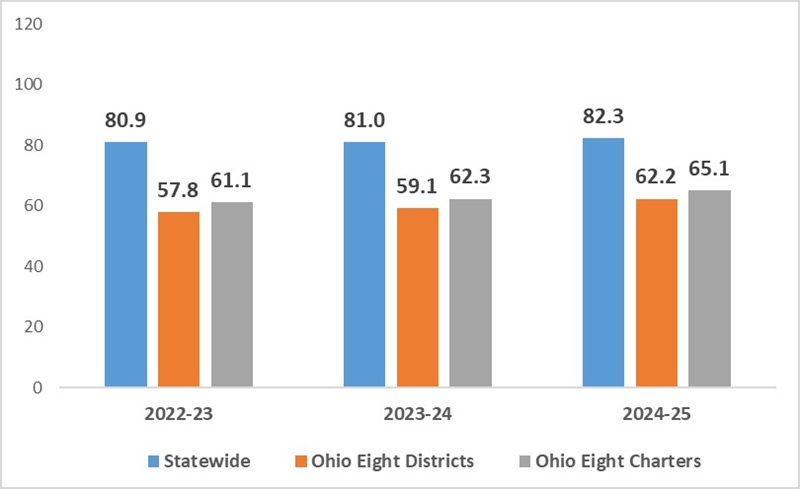
Let us first begin with a look at student achievement numbers, as measured by the state’s performance index. This is a weighted measure of proficiency on state exams, which awards schools more credit when students score at higher performance levels. Figure 1 reveals that, as a whole, urban charter schools located in the Ohio Eight[1] outperformed their district counterparts on the performance index: In 2024–25, the charter school average score was 65.1 versus 62.2 for districts. This is the third straight year urban charters outperformed districts on this measure. Compared to the statewide average, however, charter and district performance fell substantially behind, reflecting chronic achievement gaps between urban students typically from disadvantaged backgrounds and their more affluent peers.
Figure 1: Urban charter versus district school performance index scores, 2022–23 to 2024–25
Following a similar pattern as last year, student achievement among charters in Cleveland, Columbus, Dayton, Toledo, and Youngstown outpaced district results while charter achievement in Akron, Canton, and Cincinnati lagged behind.
Table 1. Ohio Eight district-charter comparisons, performance index scores, 2024–25

The performance index provides an important point-in-time snapshot of where students stand academically. But it’s also influenced heavily by demographics, which may obscure the true educational impacts of districts and schools. Here, the state’s value-added growth measure (a.k.a. Progress) helps us understand whether schools are improving achievement over time regardless of where students begin the year. In turn, these ratings provide a clearer picture of schools’ effectiveness without being unduly influenced by demographics.
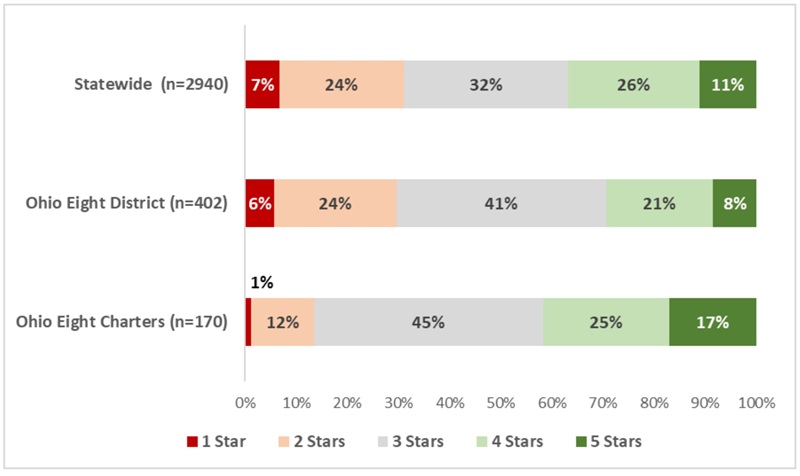
On this measure, Ohio’s urban charters also demonstrate superior performance. Of the state’s 170 urban charters, 17 percent earned five-star Progress ratings and another 25 percent received four-stars. These percentages outpaced urban district schools and statewide performance on this measure. At the other end of the spectrum, we see fewer urban charters receiving one- and two-star ratings than their district counterparts.
Figure 2: Urban charter versus district school Progress ratings, 2024–25
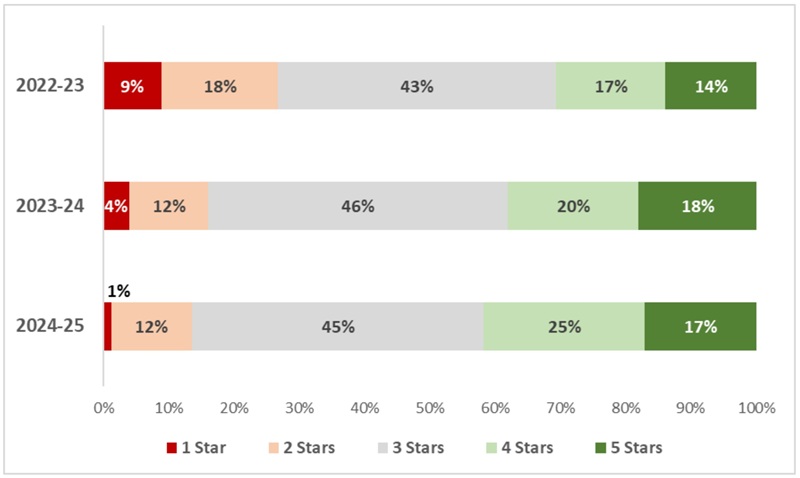
When comparing urban charters’ recent performance on value-added, we find signs of improvement there as well. In the 2022–23 school year, 31 percent of Ohio’s urban charters received four- or five-star Progress ratings. By 2024–25, 42 percent of urban charters did so.
Figure 3: Ohio Eight urban charter school Progress ratings, 2022-23 to 2024-25
Can Ohio’s urban charters take it to another level?
Charter school advocates should be heartened by these results. They show that urban charters continue to provide families with higher-quality options than big-city districts do. They also reveal signs of sector improvement on both achievement and growth measures. But with proficiency still falling well below the statewide average, Ohio charters still have plenty of work to do. Can they take it to another level, one in which the average charter student achieves on par with students statewide? It’ll be a big lift, but the work can be lightened with many hands. Let us consider a few ways that local and state leaders could give urban charters another boost.
How local leaders can support charters: Despite their well-documented success, charters often receive little to no support from local policymakers, who tend to favor district-run schools instead. While changing the minds (or composition) of elected school boards is likely a pipe dream, mayors, city council members, county commissioners, and philanthropy and business leaders, could more easily advocate for charters. These local leaders are supposed to represent all citizens in their communities, including the sizeable share of parents and students who choose charter schools.
How to advocate on behalf of charters? Here are six ways:
- Urge districts to sell or lease vacant and underutilized buildings to high performing charter schools.
- Demand that all students in the community have access to safe, reliable, and free transportation to school.
- Call for charter schools to receive a share in local property tax revenues, as already partially occurs in Cleveland.
- Support school navigators and impartial school information resources for families.
- Create a centralized application and enrollment system for parents to make it easier to find a great school regardless of sector.
- Include charter students in community-wide initiatives such as college scholarship and enrichment programs.
How state leaders can support charters: State policymakers on both sides of the aisle have strong reasons to support public charter schools. Conservative policymakers see charters as a way to empower Ohio families with more educational choice, and as a market-oriented solution that enhances competition in an otherwise district-monopolized system. Progressives, too, can get on board, given the preponderance of evidence that charter schools effectively educate Ohio’s most disadvantaged students, whom they have historically stood up for and often represent. And no matter the partisan allegiances, all lawmakers can agree that every Ohio student deserves a good education, something that charter schools have proven they can provide.
What might a bipartisan effort to boost charters look like? For starters, state leaders should fully bridge the persistent funding gaps that have held back charters’ ability to serve more students. Additional state aid (or alternatively, requiring local dollars to follow children) could push high-performing charters further up the ranks while also helping other charters move from good to great. Alongside equitable funding, state leaders should also maintain the strict accountability measures that helped turnaround Ohio’s charter sector. This means maintaining the pressure on charter sponsors to authorize effective charter schools, continuing to close chronically poor performers, and implementing state interventions in charter (and district) schools that are underperforming. Overall, equitable funding paired with forceful accountability from the state is a winning formula that can keep charters moving in the right direction.
This year’s report card shows again that Ohio’s urban charter schools are providing families with quality options. With ramped up support from local and state leadership, charters will be poised to compete not only with their local districts, but also with the finest schools in Ohio.
[1] The Ohio Eight refers to Akron, Canton, Cincinnati, Cleveland, Columbus, Dayton, Toledo, and Youngstown. A large majority of Ohio charters operate in these cities.