Last month, Franklin County Judge Jaiza Page issued her long-awaited decision on Ohio’s EdChoice Scholarship lawsuit. Brought forward by a group of school districts—government entities with a vested interest in crushing educational choice—the litigation seeks to abolish the program, uproot more than 100,000 private school students, and force them to attend their assigned public schools. Alas, the judge, an elected Democrat and former Columbus City Council member, sided with the educrats and denounced the program as unconstitutional. Given the certainty of appeal, Judge Page stayed her own decision, which allows EdChoice to continue operating until the case works its way through the system.
Her decision reads more like a left-wing harangue bashing private school choice than serious legal analysis. It parrots absurd talking points about how choice will lead to the “downfall” of public schools, blames the scholarship program (rather than dysfunctional bureaucracy) for districts’ inability to educate students, and accepts a factually deficient narrative that districts are “underfunded.” The judge also ignores hard evidence, presented in her court, that EdChoice has improved public education by introducing healthy competition. Last—and perhaps most troublingly—she dismisses the rights and responsibilities of parents in raising their own children, rights that the nation’s highest court has affirmed for 100 years.
Let’s take a closer look at where Judge Page went so wrong.
Disregards parental rights and responsibilities in education
At a basic level, the judge misses the overarching point of EdChoice—that it exists to empower parents to choose a school that best meets the needs of their children. For many Ohio families, their local public school is a great fit. And following the state constitution, the legislature continues to ensure that all Ohio families have a public school option. Yet no single school—whether public or private—can be all things to all people. For some parents, a private school simply fits better, and EdChoice helps ensure that option is financially viable.
But is empowering parents with choice constitutional? The Ohio Constitution contains no prohibition on private schools or programs that support them. Moreover, we have clear case law affirming their legality. A landmark U.S. Supreme Court case in the area of parental rights in education is Pierce v. Society of Sisters (1925), in which the justices unanimously struck down an Oregon law forbidding private education. There, they famously declared that the “the child is not the mere creature of the State; those who nurture him and direct his destiny have the right, coupled with the high duty, to recognize and prepare him for additional obligations.”
Years later, in Zelman v. Simmons-Harris, the Supreme Court upheld the Cleveland Scholarship—the forerunner of EdChoice—and cleared the way for other states to launch private school choice programs. Closer to home, the Ohio Supreme Court also affirmed the constitutionality of the Cleveland program in state litigation (Simmons-Harris v. Goff, 1999). It also upheld the state’s public charter school law, another form of educational choice, in Ohio Congress of Parents and Teachers (2006).
In sum, the judge’s ruling is out of step with decades of legal precedent that honors parental rights and responsibilities in raising their children, including initiatives that support their ability to choose the best school for their child.
Misconstrues the “no aid” clause of the Ohio Constitution
Staying in the legal realm, the plaintiff school districts argue that EdChoice violates a so-called “no aid” clause in the Ohio Constitution: “no religious or other sect, or sects, shall ever have any exclusive right to, or control of, any part of the school funds of this state.” The judge agreed, but there are two significant problems with this interpretation.
- As Zelman and Goff recognized, private schools are not the direct recipients of public funds, but are an indirect beneficiary only through the choices of parents. As the Institute for Justice explains, “As a matter of law, EdChoice Program scholarships belong to the families and students who receive them.... Only through their choices does a single scholarship dollar flow to a private school, religious or otherwise.” Thus, because parents must make an affirmative choice, private schools do not have an “exclusive right” and are in no way “controlling” the “school funds of this state.”
- The Ohio Constitution’s “no aid” language likely runs afoul of the U.S. Constitution. In two recent U.S. Supreme Court cases, Espinoza v. Montana (2020) and Carson v. Makin (2022), the Court has invalidated the infamous Blaine Amendments found in many state constitutions and which Ohio’s “no aid” clause closely resembles.[1] These provisions, which have a shameful history in anti-Catholic bigotry, have been invoked to cripple private school programs and/or discriminate against faith-based schools seeking to participate in them. The Supreme Court has rightly declared these discriminatory provisions a violation of the First Amendment’s free exercise clause.
Makes a hash of school funding
In a tale as old as time, plaintiff districts complain that they don’t have enough money—and that EdChoice is to blame for their self-perceived financial woes. Completely ignoring basic school funding data, and demonstrating a lack of understanding of Ohio’s funding system, the judge concurred, declaring that EdChoice results in unconstitutional public school funding.
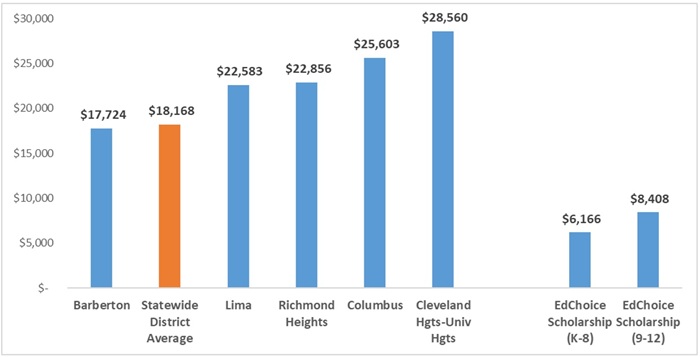
Let us first look at the overall funding levels—not cited anywhere in her opinion—of all named plaintiff school districts. Figure 1 shows the total per-pupil revenue (state, local, federal) received by Barberton, Lima, Richmond Heights, Columbus, and Cleveland Heights-University Heights school districts in FY24—data that are readily accessible on the Ohio Department of Education website. Four of the five districts received more than $20,000 per pupil last year, well above the average district in Ohio and multiples above the current maximum EdChoice scholarship (many recipients receive far less than the maximum amount). Only Barberton—a mixed-income suburban district—received slightly less than the state average, but even its per-pupil funding still far exceeds the scholarship amounts.
Figure 1: Overall revenue per pupil for plaintiff school districts, FY24
In Judge Page’s opinion, she wrote this of Cleveland Heights-University Heights:
Inadequate funding has caused CH-UHCSD to lay off or suspend teachers and other staff members resulting in overcrowded classrooms and insufficient support for special education and English as a second language children.
That’s plain nonsense. The district receives an astronomical—by Ohio standards—$28,560 per student, the tenth highest in the state. That’s “inadequate”? Really? If indeed there are “overcrowded classrooms” and “insufficient support” for special-needs students, the fault lies with district administration, not EdChoice.
What does the judge focus on in her discussion of school funding? Rather than looking at the total funding picture—what really matters for educating students—she cites only state funding, which in turn allows her to decry that some districts’ state aid falls below the scholarship amounts.
This analysis is both simple and wrong. Ohio has long had a “hybrid” system whereby the state and local districts share responsibility for funding education. Under state law, districts must levy a minimum 20 mill (2 percent) property tax to help meet basic funding requirements.[2] Recognizing that wealthy districts have more tax capacity, the state rightly sends them less state aid. It’s a “progressive” system. As a result, wealthier districts like Columbus—one of the state’s most prosperous in terms of property values—receives relatively modest state aid ($4,800 per pupil in FY24). Focusing only on state dollars alone—while ignoring local funds, including the state-required millage—betrays either a poor understanding of school funding or (more deviously) an intentional misreading of the policy to arrive at a predetermined decision.
Last note on funding: Judge Page engages in some distasteful revisionist history when it comes to Ohio’s current funding formula. She faults state lawmakers for not fully funding the Cupp-Patterson formula over the past four years. It’s true—due to its exorbitant price tag—the formula has been phased in. But what the judge fails to acknowledge is that the legislative architects of the plan, and the districts and unions that supported it, agreed to the phase-in. But now, in a bizarre twist, she declares EdChoice unconstitutional because of the formula phase-in for public schools.[3]
Ignores the empirical evidence on EdChoice
As a final swing and miss, the judge chose to ignore evidence refuting districts’ claims that EdChoice has done them harm. Consider the research findings, much of which were included in expert testimony and a Fordham report by Professor Stéphane Lavertu of The Ohio State University.
- EdChoice has had no discernable impact on districts’ per-pupil spending over time. As Dr. Lavertu concluded, “the plaintiffs’ claims of negative trends in inflation-adjusted funding before and after the introduction of the EdChoice program are demonstrably false.”
- While academic results have not been a central issue in this case, research by Lavertu and other respected scholars have found that EdChoice has led to slight improvements in school district performance. Heighted competition from private schools is the mechanism likely driving those gains in the public school sector.
- Again, though indirectly relevant to the case at hand, a recent study from the Urban Institute shows that EdChoice has given scholarship students a substantial boost in attending four-year colleges and completing degrees.
The evidence makes clear the negative consequences of following the judge’s opinion. Without EdChoice, Ohio would have a weaker K–12 education system, one in which complacency in the public school sector is acceptable and where Ohio students have diminished opportunities. Is that the “thorough and efficient” education system our constitutional framers sought?
* * *
Amped up by the education establishment and liberal media, private school choice has become one of the left’s favorite scapegoats. But the rhetoric falls far short of the reality. Sadly, Judge Page bought into the political theater while trampling on parents’ rights, court precedent, basic facts about school funding, and evidence showing that EdChoice improves public schools. With any luck, the appellate courts will put a quick end to this sad show. The sooner the better.
[1] A U.S. Commission on Civil Rights report cites thirty-eight states (including Ohio) as having a Blaine Amendment: https://www.usccr.gov/files/pubs/docs/BlaineReport.pdf (p. 53).
[2] Districts can, and many do, tax above that minimum rate with voter approval.
[3] The underlying assumption is that, if EdChoice had not existed, the legislature would have fully funded Cupp-Patterson from the start. But that’s a stretch, as the legislature could have simply used scholarship funds for other purposes (e.g., higher education, roads, parks, Medicaid, etc.). Moreover, the amount spend on scholarships was well below the spending required to fully fund Cupp-Patterson.