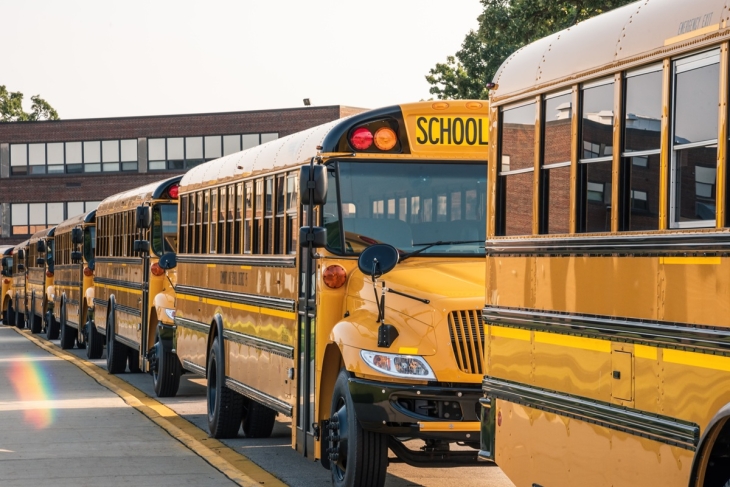
For over a half century, Ohio has sought to ensure that every student who needs a ride to and from school gets one—no matter their school of choice. Under longstanding state law, districts must offer transportation to all resident K–8 students, with only a few exceptions such as students who live within two miles of their school or more than thirty minutes away.
This requirement helps working families—all taxpayers—as they can count on the district for morning and afternoon busing. It also promotes efficiency and safety. Instead of multiple vehicles passing through, a single, yellow bus—the safest form of transportation—can serve a whole neighborhood. The state provides generous subsidies to support busing, currently amounting to $825 million, up from $602 million just four years ago. This is on top of local funds, which include a state-required minimum property tax.
Unfortunately, some districts are making transportation a headache for families choosing public charter and private schools. Columbus City Schools is the most egregious example. It has used an “impractical to transport” loophole to duck busing responsibilities (provoking lawsuits), and it has provided service so poor to others that the state has imposed millions in fines. Columbus isn’t the only one giving choice students the cold shoulder: Some 23,000 charter and private school students from 342 districts were denied busing last year, while only 600 district students were refused.
The shabby treatment of private and charter school students has not gone unnoticed. In an effort to further examine the situation and unearth potential solutions, the state legislature created a transportation workgroup last summer. With its report due June 30th, it’s worth weighing in with suggestions on how Ohio could make the transportation work better for students attending schools of choice. The following would all strengthen the current law, though it should be noted that the state must at a baseline preserve the expectation that districts offer all resident students transportation.[1]
1. Tighten the “impractical to transport” loophole. As noted above, districts can and do deny busing through a poorly-written provision that allows districts to declare students “impractical to transport.” The ongoing abuse of this provision to discriminate against choice students must stop. To this end, state lawmakers should strengthen the language of this section, so that districts have to “demonstrate” or “prove” that at least three of six factors set forth in statute make a student “impractical” to transport.[2] This would require districts to provide clearer evidence that it cannot bus a student, and help limit impracticality to truly exceptional cases.
2. Increase the “payment in lieu of transportation” and ensure that parents receive it right away. When districts refuse busing on impracticality grounds, they must offer parents a payment in lieu of transportation.[3] The current amount is a measly $607, or just half the statewide average per-pupil transportation expenditure. For low-income families who may not own a vehicle, this amount is wholly insufficient, amounting to less than two bucks for each trip to or from school. For others, the payment helps but won’t cover the time and out-of-pocket expense to give rides 180 days a year. State lawmakers should increase the minimum payment to the statewide average ($1,214 this year) and require full payment to families within 30 days of a declaration. This would better assist parents who must bear the responsibility of transportation. Just as importantly, a higher payment would deter districts from making impracticality declarations in the first place.
3. Require high school transportation in districts with severe chronic absenteeism. Ohio does not require districts to offer busing to high school students, though many do provide this service and receive state aid to assist. However, an increasing number of districts are slashing high school bus routes—Youngstown and Dayton being notable examples. The lack of district-operated busing compounds the attendance problems in many high schools, as it makes it more challenging, complicated, and less safe for students to get to school. It also means that students attending private and charter high schools no longer receive busing. In sum, cutting high school busing is a lose-lose all around, especially in areas with serious attendance challenges. Lawmakers should require districts with chronic absenteeism rates above 40 percent (roughly 1.5 times the state average) to offer busing to all students in their community—including those in high school.
4. Strip transportation responsibilities (and funding) from a district in cases of serious noncompliance. The state has issued millions in fines when districts regularly fail to meet basic state transportation laws, such as making sure busses actually arrive to pick up students and drop them off on-time. In fact, last year, the state levied $9.8 million in fines, of which $7.6 million were against Columbus. It’s not known how many violations affect private and charter school students versus district, but the bottom line is that a few districts are simply not getting the job done. When fines aren’t enough, the state should charge another entity with assuming responsibility for busing in that district. The chosen entity should receive the state and local funds that would have gone to transport those students. While this may sound abstract, Ohio could look toward the governance changes happening in Indianapolis. There, an appointed body—independent of the district school board—will soon be tasked with overseeing transportation, facilities, and more, with the goal of creating a more level playing field between district and charter schools.
5. Increase the state aid charter schools receive when they provide transportation. Under state law, charters may provide their own transportation and receive state funding in support. Given the lack of cooperation from districts, more charters are going this route. In FY25, they bussed 7,973 students, while in FY26, they are now transporting 9,611 students, or slightly more than 10 percent of all brick-and-mortar charter students. Charters currently receive the statewide average transportation expenditure when they take on this responsibility, but that amount doesn’t fully cover the busing expense in higher-cost urban areas, much less the startup costs of purchasing vehicles and equipment. The state should increase charters’ transportation subsidy to 1.5 times the state average, a multiplier that is actually used in the district transportation formula when they provide transportation to charter school students.[4]
Transportation for charter and private students isn’t a new “burden” on districts, as several news reports have erroneously suggested. Ohio has required district busing for more than five decades, including a time past when schools (public and private) educated far more students than today. This longstanding law has served millions of Ohio families and students, but it’s being undermined by school officials who seem to want to make life hard for private and charter school families. That’s not right, and it’s time for state lawmakers to step in and ensure fair busing for all.
[1] There are rumblings about weakening current law, such as limiting transportation to students who attend charter and private schools located within their home district. This proposal should be rejected, as it would cut busing for students who attend nearby schools (within the 30-minute rule) but located across a district border.
[2] Current law requires districts to merely “consider” six factors (e.g., time, distance, cost, etc.) that might make it “impractical” to transport a student.
[3] Though rare, parents can reject the payment and request mediation from the state.
[4] The district formula counts a district student receiving transportation as 1.0 students, a charter student as 1.5 students, and a private school student as 2.0 students.