Two years ago, Governor DeWine and the General Assembly worked together to establish a statewide early literacy initiative aligned with the science of reading. Their collective effort was prompted by lackluster reading achievement: Approximately 40 percent of Ohio third graders weren’t proficient in reading.
Given all the research pointing to worrisome outcomes for struggling readers, policymakers were right to act. And it’s good news for students and families that the state’s science of reading initiative is now well underway. But reading isn’t the only subject that needs an overhaul. In fact, Ohio’s achievement results in math are actually worse than the reading scores that prompted an all-hands-on-deck statewide initiative. Consider the following:
- Based on 2024 state test results, nearly 47 percent of students aren’t proficient in math (whereas 39 percent aren’t proficient in reading).
- Between 2023 and 2024, Ohio’s math proficiency rate increased by only half a percentage point, and still falls well below pre-pandemic marks.
- Math proficiency rates appear to decline as students grow older. In 2024, proficiency rates went from 61 percent in third grade to 57 percent in fifth and 49 percent in seventh. Algebra I scores were slightly better than middle school tests results (56 percent proficient), but geometry scores were abysmal (40 percent).
Just like with reading, math achievement has a big impact on students’ long-term outcomes. And while there isn’t an official “science of math,” experts have identified key elements that should guide math instruction in schools. Moreover, Ohio’s early literacy initiative includes several promising practices that could apply to math. But collectively, lawmakers have yet to prioritize numeracy like they did early literacy. They had an opportunity to do so during the budget cycle that wrapped up a few weeks ago, but most math proposals got axed in conference committee.
The good news is that the state budget isn’t lawmakers’ only opportunity to pass legislation. Here are three numeracy policies they should consider enacting when they return this fall.
1. Supporting teachers with rigorous pre-service training and ongoing professional development.
Teachers matter more to student achievement than any other element of schooling. If state leaders are serious about improving math outcomes, then ensuring that both prospective and current teachers receive high-quality training is crucial. Lawmakers could accomplish this in three ways.
First, Ohio needs to bolster the math content training that teacher candidates receive before they enter the classroom. A recent report from NCTQ found that more than a third (36 percent) of Ohio’s elementary teacher preparation programs earn a grade of D or F for failing to provide sufficient instruction in math content. To fix this, lawmakers should take a page out of their early literacy book: Establish teacher preparation standards that encourage effective and consistent math content training and require periodic audits to verify that programs are following state standards.
Second, Ohio should raise expectations for teachers’ content mastery. As part of state licensure requirements, middle and high school teachers must pass math-specific content knowledge exams. Doing so signals that they’ve mastered the content they will be expected to deliver to students. But Ohio doesn’t require elementary teachers to pass a math-specific test. Instead, they take a composite content knowledge exam that combines math with other subjects. Because teachers are only required to achieve an overall passing score, high performance in other subject areas could easily mask math deficiencies. To ensure math content mastery, state leaders need to establish a minimum passing score for the math subsection of the elementary licensure content exam and require prospective teachers to meet or surpass that score before they can teach math. Teacher candidates who don’t meet the required minimum score can still earn their license. They just won’t be permitted to teach math until they pass the math subsection of the exam.
Third, policymakers should invest state resources in boosting the content knowledge and skills of current math teachers. Research indicates that when professional development (PD) is aligned to high-quality curricula, it better supports teachers. That, in turn, can lead to improved student outcomes. Ohio already has a PD blueprint thanks to our statewide reading initiative. Enacting a similar effort in math would be wise.
2. Prioritizing high-quality instructional materials.
Research demonstrates that high-quality instructional materials (HQIM) can improve student learning and achievement. That’s why a key feature of Ohio’s early literacy initiative is its emphasis on state-approved HQIM. It’s time to do the same for math. Lawmakers should take a two-pronged approach.
First, they should focus on identifying HQIM in math. Just as they did with reading, they should require the Department of Education and Workforce (DEW) to review K–12 core math curricula that are currently on the market and identify those that are high quality based on their alignment with state math standards and evidence-based practices. Unlike reading, however, districts should not be required to adopt math materials from DEW’s list (at least not yet). For now, the focus should be on identifying high-quality options so that districts aren’t flying blind when it’s time to update their curricula and materials.
Second, lawmakers should improve transparency. Current law requires public schools to report to the state the core curricula and instructional materials they use in English language arts in grades PK–5. Schools should also be required to report this information for math. Once reporting requirements are in place, state report cards should identify the reading and math curriculum used in each school and whether it’s been designated by DEW as high-quality. Not only would this effort improve transparency with the public, it would provide an incentive for districts to use high-quality materials.
3. Requiring interventions for students who are struggling in math.
When students take Ohio’s state exams, their results fall into one of five performance levels: limited, basic, proficient, accomplished, and advanced. The top three levels (proficient, accomplished, and advanced) are considered passing scores. A student who scores at the accomplished or advanced level is considered on track for college and career readiness.
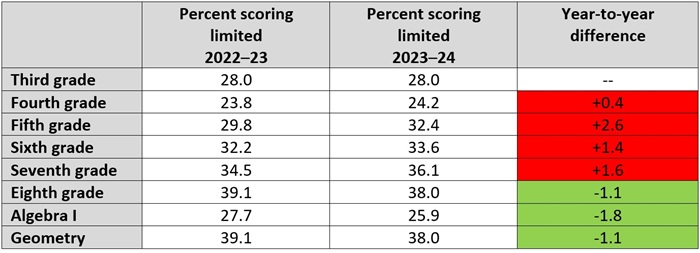
Unfortunately, data from the two most recent school years show that a significant percentage of Ohio’s students are scoring at the lowest performance level (limited) in math. Between 2023 and 2024, the percentage of students scoring in the limited category increased in grades four, five, six, and seven. The percentage of students scoring limited in eighth grade and high school math decreased, but the overall number in those grade levels remains staggeringly high—more than a fourth in Algebra I, and more than a third in eighth grade and geometry.
Chart 1. Percentage of students scoring limited in math
To their credit, some lawmakers have tried to tackle this issue. The Senate, for example, incorporated into its version of the proposed budget a previously separate bill that would have required public schools to provide academic intervention services to students who score limited on math and reading state tests. Schools also would have been required to develop an improvement and monitoring plan for each student who qualifies for intervention services in math, to involve parents in developing that plan, and to continue implementing it until a student achieves current grade-level skills. Unfortunately, none of those provisions made it into the final budget. Given how many students are scoring in the limited range, lawmakers would be wise to revive the effort.
***
Ohio policymakers deserve praise for their early literacy efforts. The statewide initiative that’s currently underway could help thousands of students achieve better short- and long-term outcomes. But numeracy matters, too. State data are clear that far too many students are struggling in math, and districts and schools need help to bolster their instruction and boost intervention efforts. Now is the time for state leaders to act—and teacher training, high-quality instructional materials, and a statewide intervention policy for struggling students are the best places to start.