Mobile Navigation

  • National
    • Policy
      • High Expectations
      • Quality Choices
      • Personalized Pathways
    • Research
    • Commentary
      • Gadfly Newsletter
      • Flypaper Blog
    • Events
    • Scholars Program
  • Ohio
    • Policy
      • Priorities
      • Media & Testimony
    • Research
    • Commentary
      • Ohio Education Gadfly Biweekly
      • Ohio Gadfly Daily
  • Charter Authorizing
    • Application
    • Sponsored Schools
    • Resources
  • About
    • Mission
    • Board
    • Staff
    • Career
Home
Home
Advancing Educational Excellence

Main Navigation

  • National
  • Ohio
  • Charter Authorizing
  • About

Louise Baigelman Shira Engel
11.14.2025
wonkathon
Listen to this article
Loading the Elevenlabs Text to Speech AudioNative Player...

Editor’s note: This essay is an entry in Fordham’s 2025 Wonkathon, which asked contributors to answer this question: “What needs to happen next—at the state, district, and school levels—for the science of reading revolution to fulfill its promise and ensure that far more children learn to read well?” Learn more.

For older students who are still learning to read, every moment of instructional time is precious.

In the current system, reading intervention and core curriculum are siloed: Foundational skill-building is addressed in a way that is entirely distinct from grade-level content. Student achievement is measured based on grade level standards. If they are not proficient readers by fourth grade, their instruction becomes disconnected, creating a catch-22 for middle and high school students who are not able to read texts at grade level, and for their educators.

We are at a crucial crossroads for adolescent literacy progress, with a major opportunity to accelerate learning and foster meaningful, lasting progress for striving readers in grades 3–12. So, how do we seize the moment to enact transformative change here?

On the state level, we need to look at enacting policy and offering incentives to address the Science of reading beyond third grade. There has been a promising movement in literacy policy in recent years, but it is almost exclusively focused on K–3. Given that close to 70 percent of today’s middle and high school students lack key foundational literacy skills, this policy needs to extend to students who have already moved past third grade without yet being able to read. This would include policy that not only assesses schools based on the number of students achieving alongside grade level standards, but also those showing movement and growth in foundational literacy skills.

At the district level, we need to find ways to give students credit for their intervention classes. So often, intervention does not happen during the school day because students need to attain a set number of credits to graduate. To incentivize both students and teachers to show up for foundational skill interventions, schools need to make them credit-bearing. The main argument against doing this is that interventions historically haven’t addressed interdisciplinary grade level standards. When districts choose high-quality instructional materials (HQIM) for Tier 1, they also need to look at HQIM for Tiers 2 and 3, selecting intervention materials that can reinforce and add to what students are learning in their core subjects.

At the school level, we need to focus on programming—on making time in the school day for interventions to take place. It is imperative to schedule in blocks of time when students can get the support that meets them where they are at and takes them to where they need to be. This can be very challenging to do in departmentalized settings, but it can also be an opportunity for flexibility and creativity with WIN (What I Need) periods or strategic ways to do independent reading. Additionally, we need to provide secondary educators with the training and resources they need to address foundational literacy skills alongside grade level content.

Why connect reading intervention with core curriculum?

  • Maximize student engagement: When literacy skills are taught alongside interdisciplinary content that interests students, learners are far more likely to see reading as relevant, and motivation increases. Struggling readers, in particular, need to connect their skill development with real-life meaning and grade-level goals.
  • Accelerate skill transfer: Isolating phonics, fluency, or vocabulary practice can make it difficult for students to apply new skills beyond isolated drills. By embedding these skills in the context of core subjects, students have repeated, authentic opportunities to transfer and reinforce their learning.
  • Bridge opportunity gaps: Many struggling adolescent readers have endured years of fragmented instruction. Bringing foundational skill development into the heart of the core curriculum is a powerful equity move. It ensures all students, regardless of starting point, are included in rigorous learning and not left behind or pulled out from meaningful content.
  • Build background knowledge: Research is clear—comprehension improves when students have a strong base of background knowledge. Teaching word study, morphology, and decoding within the context of science, history, and literature simultaneously builds students’ vocabulary, content knowledge, and analytical skills.
  • Foster independence: When students see the direct relationship between what they're learning in intervention and what they need in their other classes, they are more likely to develop independence and confidence as readers and learners.

How to connect intervention and core curriculum

  • Select authentic, connected texts: Choose decodable books and instructional passages that are thematically or topically linked to grade-level curriculum—such as texts on Ancient Greece when studying mythology or high-frequency word practice that mirrors the language of foundational documents like the U.S. Constitution.
  • Integrate vocabulary and knowledge-building: While teaching decoding, also introduce key vocabulary words from content classes. For example, teach the Greek and Latin roots that will appear in both intervention texts and social studies lessons. This dual exposure builds both linguistic flexibility and academic readiness.
  • Use content-driven fluency practice: Have students practice fluency with passages that reinforce science or social studies standards. Fluency practice becomes purposeful when students can connect the text to their broader learning.
  • Teach analytical skills across levels: Text analysis—such as identifying main ideas, analyzing plot, or using context clues—should not be reserved for high-level literature alone. These critical thinking skills can and should be taught with accessible, decodable texts, as well, paving the way for success with grade-level materials.
  • Apply backward design: Start with the end in mind. Identify the grade-level skills and standards students are expected to master, then plan step-by-step instruction and scaffolded support that brings every student closer to accessing and mastering those goals.
  • Collaborate across teams: Encourage interventionists and core content teachers to co-plan and communicate regularly. Align interventions with upcoming class topics and share strategies for reinforcing skills across settings.
  • Monitor and celebrate progress: Use formative assessments that measure not only foundational reading growth but also students’ increasing ability to comprehend and analyze grade-level content. Celebrate when students can contribute confidently to mainstream classroom activities.

At Storyshares, this integrated approach is core to our programs, like LIFT (Literacy Intervention for Teens). Our model deliberately blurs the line between intervention and core curriculum so that all students, regardless of their current skill level, are growing toward grade-level standards. Our lessons build decoding and fluency skills within knowledge-rich, relevant contexts, showing students that foundational skills are not an end in themselves, but a bridge to understanding and engaging with the world around them.

In summary, while it may be tempting to see reading intervention and core curriculum as separate endeavors, the most transformative and equitable instruction purposefully connects the two. When foundational skill-building is woven through meaningful, grade-level content, we empower students not only to catch up but to truly thrive—both as readers and as learners.

Want to learn more about our groundbreaking solution for adolescent literacy intervention? Discover LIFT.
Policy Priority:
High Expectations
Topics:
Evidence-Based Learning
Curriculum & Instruction
Governance
Teachers & School Leaders
David Wakelyn
11.14.2025
Wonkathon
Listen to this article
Loading the Elevenlabs Text to Speech AudioNative Player...

Editor’s note: This essay is an entry in Fordham’s 2025 Wonkathon, which asked contributors to answer this question: “What needs to happen next—at the state, district, and school levels—for the science of reading revolution to fulfill its promise and ensure that far more children learn to read well?” Learn more.

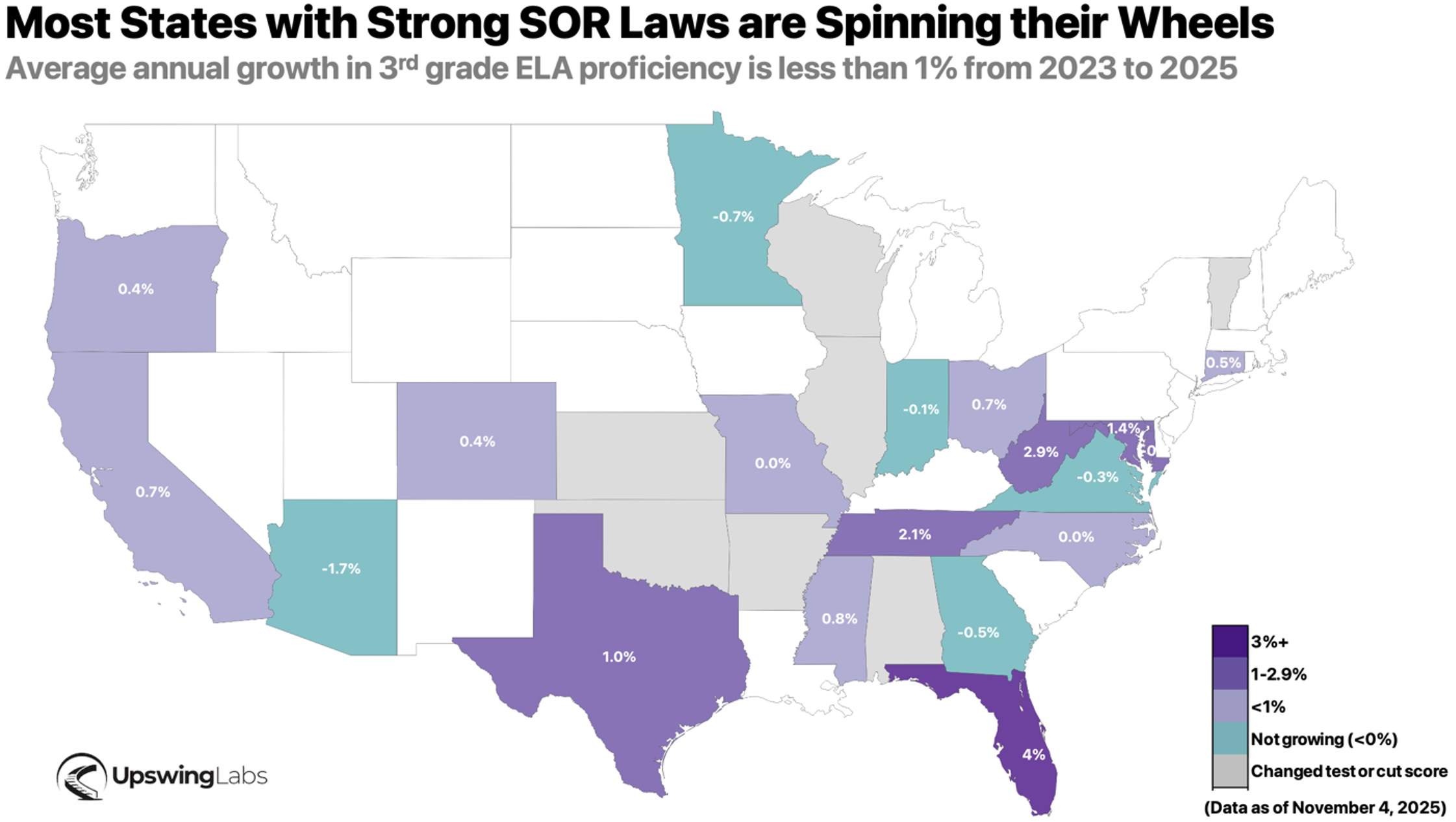
Nineteen states have passed strong science of reading laws. Most are spinning their wheels over the last three years, growing third grade English language arts achievement by less than 1 percent. The sharpest decline, as the map below shows, has been in Arizona, which has long borrowed from Florida’s playbook on education policy. Laws are necessary but insufficient for progress.

1

Three things state superintendents and board members can do now to get more robust results: get the feedback right, create the right supports for students, and set the right goals.

Other essays in this collection will likely offer valuable recommendations on the early years, curriculum, assessment, professional support, leadership and parent involvement. But for state leaders these three “do nows” are low-hanging fruit.

First, offer clear feedback to parents and students. Eighty nine percent of parents think their kids are reading at or above grade level, according to a national survey by 50CAN. But in the states that have published 2025 data, only 48 percent of third graders are reading proficiently. 

To correct the disconnect, states can offer guidelines about grades. Too many kids get A’s and B’s that are about effort, not literacy achievement. Kentucky recently crosswalked grades for fifth grade students and their scores on the state exam. More than half (56 percent) of students who had A’s and B’s in class were not reading at proficiency on the state test. 

Mississippi also has been a pioneer in how to communicate with parents when their kids are struggling to learn to read. The state’s reading law requires that parents are notified in writing within 10 days of a screening assessment revealing a deficiency. A letter to parents explains what interventions will be provided the student and how progress will be monitored. Susan Neuman and colleagues writing for the Albert Shanker Institute also hold up Alaska as an example of how to make parents active participants in a child’s literacy improvement plan.

Both states have a read-at-home guide that recommends what parents can do to help improve their child’s reading skills. See more about how Mississippi communicates with parents at the state’s website: “Know Your Child’s Reading Score.”

Parents can only respond to the problems they see. Their trust in schools erodes the longer states permit the gaps between perceptions and reality to exist.

Second, create the right supports for students. Targeted, small-group tutoring can add three to four months of extra learning for struggling readers. But most states didn’t scale it well during the pandemic. Programs grew too fast, sessions after school led to spotty attendance, groups were too big, and providers couldn’t coordinate with teachers. 

Louisiana is a promising model of how a state can continue to support funding for high-dosage tutoring. They’ve partnered with virtual models such as Air Reading, Open Literacy, and Teach For America’s Ignite. They run daily, small-group sessions staffed by college students or certified teachers and require an on-site facilitator to keep the work matched to student needs. Despite being virtual, the daily interactions allow tutors to build meaningful connections with students, while operating at a lower cost than in person tutoring. They tweak their designs based on what they learn in each new round of program implementation.

Finally, states need to set the right goals. Both Maryland and Utah have goals to grow ELA achievement by 6 percent annually. These are too hard. The leading states on the map, West Virginia and Florida grew at 3–4 percent annually since 2023. 

Isn’t it better to be “hairy and audacious” even if we fall short??? Some state leaders will argue that anything less than 100 percent abandons our most vulnerable students. But decades of experience with Goals 2000 and NCLB show us that unreachable targets don't consistently inspire—they demoralize and eventually lead to gaming the system.

The leading scholars of goal setting, Edwin Locke and Gary Latham find that goals should be meaningful and difficult, but achievable. If teachers and school leaders believe the goals set for them are unreachable, Locke and Latham warn that the entire organization can easily become demoralized and disengage. 

Meaningful goals need a rationale. States should match their reading proficiency aspirations to the number of people who need to be college and career ready in the next decade. In their report, After Everything, Anthony Carnevale and colleagues at Georgetown University predict that by early next decade, 72 percent of the jobs will require at least some college, while 55 percent will demand an associate degree or more.

Setting goals at these levels—55 percent as the initial target for every student group to reach, and 72 percent or higher as the ultimate destination—would require 2–3 percent annual growth for most states that have rigorous ELA standards. As management expert Peter Drucker advised: “The results should be hard to achieve—they should require stretching, but they should also be within reach. To aim at results that cannot be achieved—or that can be under the most unlikely circumstances—is not being ambitious; it is being foolish.”

State education agencies don’t have the resources large districts do, but these recommendations don’t require massive funding. They are modest and immediately actionable, and they require strategic choices and resolve. More children will learn to read and write well if state leaders improve the signaling to parents, enable smartly structured supports for students, and set goals that are meaningful and difficult but achievable.

Policy Priority:
High Expectations
Topics:
Evidence-Based Learning
Curriculum & Instruction
Governance
Teachers & School Leaders
Where

Virtual

Share

Many high-achieving, low-income students—sometimes called “HALO” students—fall off the education track and never reach the doors of top colleges and universities. Despite the enormous potential these students show in the early grades, they often lack access to advanced classes and other accelerated learning opportunities. This results in a tragic loss of promise, while also leaving our best colleges and—later—our most promising occupations bereft of socioeconomic diversity and looking less like the nation writ large.

Jamila Newman
11.14.2025
wonkathon
Listen to this article
Loading the Elevenlabs Text to Speech AudioNative Player...

Editor’s note: This essay is an entry in Fordham’s 2025 Wonkathon, which asked contributors to answer this question: “What needs to happen next—at the state, district, and school levels—for the science of reading revolution to fulfill its promise and ensure that far more children learn to read well?” Learn more.

The question, “What needs to happen next for the science of reading revolution to fulfill its promise?” appears straightforward. But it inherently assumes that there is one “next step,” a single lever that any system can pull to improve reading outcomes at scale. Questions framed like this can move systems toward an action-first mode: adopt this curriculum, mandate this training, change this assessment. Reform becomes a checklist.

But the problem in U.S. literacy isn’t a shortage of actions and evidence-based best practices. It’s that we continue to move to action without a shared discipline for how to design, sequence, and implement change. We “do” before we agree on “how we think about” doing. The field doesn’t have a shared mental model for strategy—not at the federal, state, district, school, or community level. Instead, we have a patchwork of preferences, slogans, and inherited, performative habits.

So when we ask “What needs to happen next?” we risk repeating the oft-copied reform cycle: new mandates, new magic bullets, new materials, new trainings—same results. The next phase of the science of reading movement, really any holistic education reform effort, requires pausing the reflex to do more and act quickly. Instead, the success of literacy and young people depends on developing a shared understanding of how change is designed, staged, and carried out.

Before we decide what to do next, we must learn how to think together about how change works.

The first barrier is structural: The field lacks a common understanding of strategy. We use the same terms—implementation, capacity, coherence, scale—but we mean different things by them. When strategy’s raw elements are understood differently across actors, even strong reforms fracture upon contact with reality.

In the absence of a shared strategic model, states issue mandates, districts purchase materials, schools schedule professional development, and classrooms attempt to adjust instruction—all necessary actions, but not necessarily strategy. This produces activity without accumulation—movement without progress.

This is why literacy reforms feel familiar: not because they lack new ideas but because they are executed through the same fragmented implementation patterns that undermined the reforms and change efforts before them. Interrupting this pattern requires normalizing a shared discipline and mental model for strategy design and implementation.

Strategy, at its core, is not a list of priorities, initiatives, or tasks. Strategy is a logic model—a living hypothesis that links a system’s collective reasoning, specifying:

  1. The intended outcome(s) and impact(s).
  2. The problem(s) or barrier(s) preventing it.
  3. The beliefs, knowledge, skills, and conditions that must shift.
  4. The sequence of actions that will cause those shifts at each layer of the system.
  5. The early indicators that signal whether the strategy is working.

Without this early, shared logic blueprint, reforms resemble a collection of components rather than systems of cause and effect. And without a logic model, a strategy cannot be improved, passed down, or collectively shared. It can only be repeated, defended, or abandoned.

Beyond having a logic model and before systems decide what to do next, they must first answer three foundational questions with clarity and consensus:

  • Purpose: What outcome are we accountable for achieving, and why does this matter now?
  • Problem: What is the specific barrier preventing us from achieving it?
  • Positioning: Where does the barrier actually live in the system? Is this system or this layer of the system currently positioned to make this change, given its capacity, structures, or the time horizon?

Many literacy initiatives falter not because the idea is flawed, but because the system is not positioned to execute it. For example, high-quality instructional materials (HQIM) cannot produce impact without protected planning time, instructional leadership capacity, and structures for educator learning and collaboration. The change collapses under the weight of missing conditions. The curriculum wasn’t bad; the system’s positionality was.

Even when strategy is well-intended and well-designed, a second pattern consistently undermines literacy reform: misplaced universalism—the tendency to universalize actions rather than outcomes and reasoning.

Misplaced universalism assumes that what works in one system—both the discrete action and the logic model—can and should be replicated everywhere. Systems copy visible practices and “steps”—adopt curricula, conduct PD, use this walkthrough template—without reconstructing the reasoning and enabling conditions behind them. The result is predictable:

Two districts adopt the same materials. One sees improvement. The other doesn’t.

It isn’t the curriculum’s fault—it is whether both systems had the conditions required to make the materials meaningful. System one had a well-crafted, organic, nimble strategic ecosystem. The other system had what I call initiative mannequins—the appearance of true strategic initiatives, but hollow replicas in reality.

Initiative mannequins occur when we universalize actions or activities instead of outputs, outcomes, and logic.

This is the central implementation trap of most reform or change efforts, including the “science of reading” movement. We try to install coherence instead of building coherence. To correct this, we must place universality at the right levels of the strategy. The table below illustrates this placement.

Table 1: Where universality belongs inside a strategy

1

When universality is placed correctly—impact, logic, and leading indicators (outputs)—systems build coherence without demanding uniformity.

This requires coordination, communication, and capacity building across the “vertical spine of the system.” A clear, coherent vertical spine articulates the lane or role each layer of the system must stay in. In other words:

  • Federal levels must prize and incentivize evidence-based practice, stable investment, and continuous learning.
  • States (SEAs) must define how evidence-based research and practice will be contextualized, enacted, supported, and monitored across the system.
  • Districts must build and sustain leadership and instructional capacity, rigor, and educative supports.
  • Schools and classrooms must enact coherent daily literacy practices.
  • Communities must extend and reinforce literacy beyond the classroom.
  • Parents and families must advocate for their child, support education, and demand transparency and clarity.
  • No layer can skip its part.
  • No layer can substitute action for logic.

This is Strategic Systemic Universalism: the discipline of establishing universal outcomes, a shared causal logic, and common early indicators across the system and within each layer, in highly contextualized ways.

This extends the core insight of Targeted Universalism, as developed by John A. Powell and Berkeley’s Othering & Belonging Institute, which argues that systems should pursue universal goals through differentiated strategies. Strategic Systemic Universalism applies that principle across every layer of the system, not just to the final impacted group (students).

In other words, Strategic Systemic Universalism attends to both:

  • The outcomes and experiences of the Ultimate Impact Group (in this case, students), and
  • The specific efforts, results, outputs, and decision-making behaviors (or logic) of the ecosystem’s vertical spine or System Actor Layer(s) (in this case, the state, district, school, classroom, student, parent/family, and community).

It holds constant the ultimate impact, logic, and early indicators, while differentiating, attending to, and monitoring how each layer contributes to these outcomes based on its role, capacity, and context.

Strategic Systemic Universalism, therefore, isn’t merely a conceptual correction. It’s a practical way of organizing how systems design, stage, and support literacy improvement over time. Once universality is placed at the levels of impact, logic, and leading indicators, the question becomes:

How should each layer of the system carry out its part of the causal chain?

This is the role of the vertical spine: the coordinated set of responsibilities across federal, state, district, school, classroom, and community levels that ensures strategy accumulates rather than fragments.

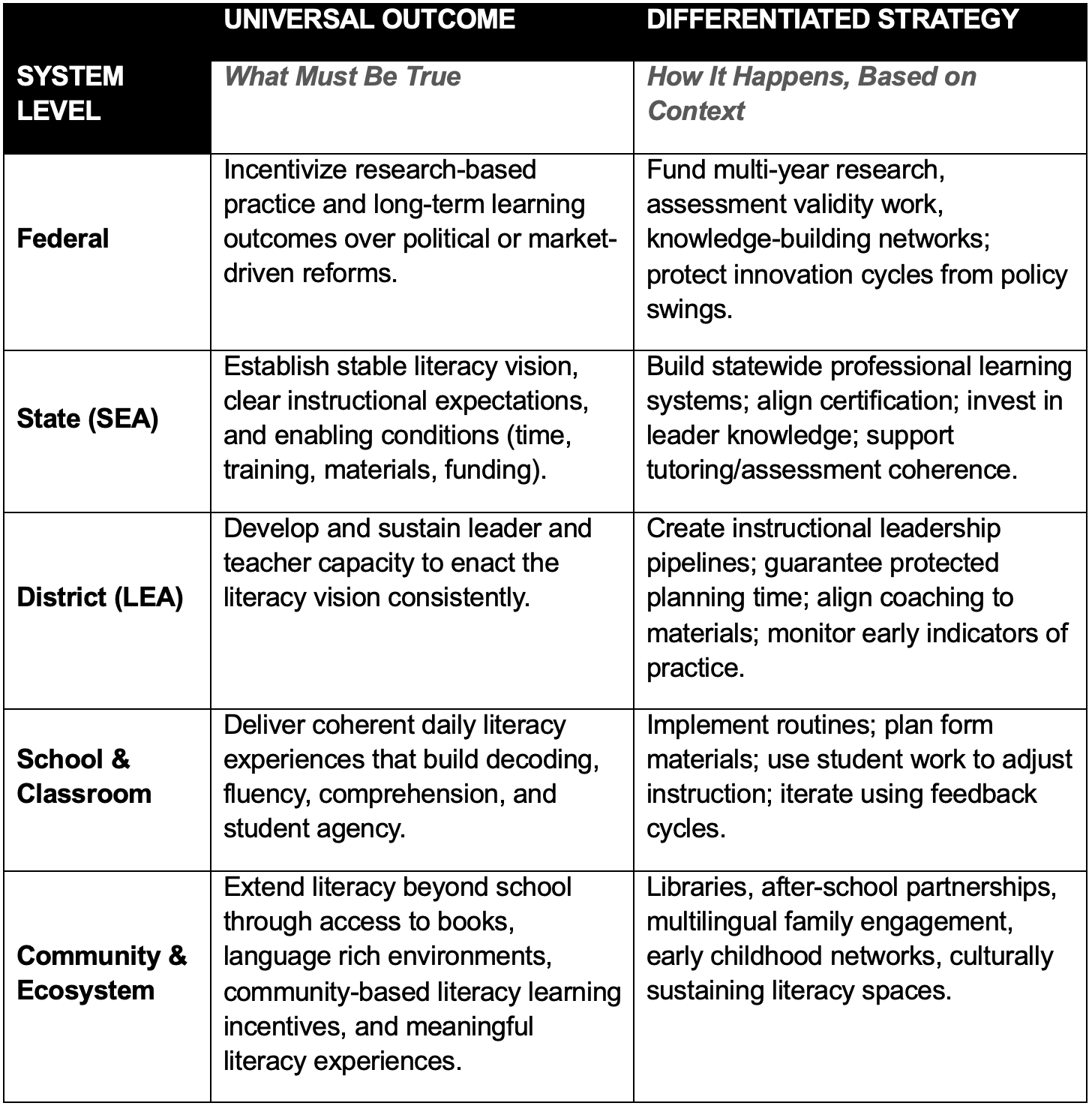
Each layer contributes to the same universal outcomes and shared reasoning—but each does so in ways that reflect its authority, time horizon, constraints, and capacity. In other words, the outcome and logic are shared. The work is differentiated. The table below illustrates how Strategic Systemic Universalism translates into action across the system.

Table 2: How that universality plays out across the layers of the system

2

When systems adopt Strategic Systemic Universalism, they stop treating literacy as something to be “fixed” at the classroom level and start treating it as the product of a coherent system. They begin considering how adopting one practice within a particular level of the system will shape, depend on, and ripple across other levels of the system—like shifting tectonic plates whose movement affects the entire terrain. Here, strategy becomes an act of coordinated alignment, not isolated intervention.

If we fail to build a shared strategic discipline, we’ll continue to repeat the reform cycle—adopting new programs, retraining educators, reorganizing systems—only to watch the work dissolve again. But when systems share a common mental model for strategy, when universality sits at the levels of impact, logic, and early signals rather than isolated actions, improvement becomes cumulative. Learning deepens. Practice stabilizes. Coherence becomes systemic and engineered rather than accidental or siloed.

This is how systems stop performing change and begin producing it.

The promise of the science of reading was never just that all students could learn to read. It was that systems could learn to change and transform. We already know what to do. The challenge now is learning how to do it together.

Policy Priority:
High Expectations
Topics:
Evidence-Based Learning
Curriculum & Instruction
Governance
Teachers & School Leaders
Windy Lopez-Aflitto
11.14.2025
Wonkathon
Listen to this article
Loading the Elevenlabs Text to Speech AudioNative Player...

Editor’s note: This essay is an entry in Fordham’s 2025 Wonkathon, which asked contributors to answer this question: “What needs to happen next—at the state, district, and school levels—for the science of reading revolution to fulfill its promise and ensure that far more children learn to read well?” Learn more.

Only a third of America’s fourth graders read proficiently—the lowest number since 2005. As states embrace the science of reading (SoR) to strengthen literacy outcomes, their success will depend on more than reshaping curriculum or retraining teachers. Together, we must also ensure that families are valued and engaged to partner with teachers. Without this, SoR policies risk falling short of their promise.

As a parent in a “balanced literacy” district, this topic is personal. My oldest daughter, now a sixth grader, has always been a strong reader. But my youngest has struggled in her reading journey—affected, I believe, by the lack of explicit and systematic literacy instruction. While she is now on the path to being on grade level (and loves to read), we are still playing catch up. I am grateful to her third grade teacher who has embraced me as a partner—having honest conversations and checking in regularly on our plan to help fill foundational gaps.

Parents are the experts of our kids but we can’t fix a problem we don’t know we have. At Learning Heroes, we’ve spent a decade understanding parent and educator mindsets about the home-school connection. We know that parents need—and want—an accurate and actionable understanding of how their kids are progressing.

For literacy reform to truly take hold, we need stronger school–home partnerships focused on student learning. This requires intentional action from states, districts, and schools, each playing a distinct but connected role.

What states can do: Build a vision and infrastructure for partnership

State education leaders have the unique responsibility to establish the vision, expectations, and structures that make school–home partnership part of literacy reform—not an afterthought.

  • Prioritize family engagement in policy and funding. Educators can’t make this shift alone—they need a team to maximize learning in and outside of the classroom. Literacy laws can require schools to share student data with families and create individualized at-home reading plans. This kind of meaningful change in schools and classrooms is what will lead to student gains.
  • Translate the science. SoR is filled with jargon—phonemic awareness, orthographic mapping, and decodable texts can leave families in the dark. State education agencies can create family-friendly guides and videos that show what’s expected of students and how parents can support them at home. Learning Heroes partners with states like Virginia, Texas, and Arkansas to provide families with clear and accessible information about their child’s grade-level achievement and communicate new literacy legislation.
  • Promote family feedback loops at all levels. States can encourage districts to collect and report data on how effectively they engage families as partners in literacy reform, and can incorporate those indicators into accountability and continuous improvement frameworks. Importantly, measuring engagement can be more than a compliance exercise—it can be a policy lever to improve student outcomes.

What this looks like in action: Mississippi has garnered national headlines for its meteoric rise in reading achievement, climbing from 49th to 7th on the National Assessment for Educational Progress in 4th grade scores. But what some may not know about the “Mississippi Miracle” is that family engagement was a key driver of their success. The state literacy plan required that parents receive clear updates on their child’s reading progress and access to activities that mirror classroom practices. When a child struggled, families were notified, and schools had access to model letters, K–3 guides, and communications toolkits so that every family knew why it mattered and how to help.

What districts can do: Bridge state vision and local practice

Districts serve as the crucial middle layer between state mandates and school-level action. They can play a pivotal role in helping families experience SoR shifts as coherent, accessible, and meaningful.

  • Build educator capacity. Principals need support to create the infrastructure (e.g. time, budget, training) that enables teachers and families to partner around student learning. Teachers need support to communicate student data effectively, navigate hard conversations, and share evidence-based reading strategies. Districts can invest in training that is embedded as part of SoR professional learning.
  • Leverage community partners as trusted messengers. Libraries, early learning providers, and after-school programs can help amplify SoR efforts. Districts can align messaging and provide shared materials so families see consistent practices across settings. Districts can encourage schools to partner with organizations to host family literacy sessions in community spaces to meet families where they are.
  • Communicate clearly with families. Parents deserve to understand why reading instruction is changing and how it benefits their children. Districts can develop simple and actionable messages to share through FAQs, social media posts, and translated materials that let families know what’s expected of their child, how to support at home, and what resources are available.

What this looks like in action: In rural southern Illinois at Unity Point Consolidated School District 140, students and their families participate in tailored planning meetings with their educator at the start of the school year to set academic and personal growth goals and assess academic needs, including reading proficiency. The meeting serves as an early touchpoint to build trust and guide collaboration throughout the year.

What schools can do: Build daily, trust-based partnerships

Teachers, principals, and staff are the ones who can turn policy into partnership—or to reinforce the status quo of educational change happening without families’ voices.

  • Treat family engagement as an instructional strategy. Many teachers were trained without strong preparation in either the science of reading or family engagement. Schools can integrate family engagement training into SoR professional learning communities, helping teachers share strategies for partnering with families around literacy development. They can redesign school events to include more 1:1 with families—showing and practicing SoR-based activities. Events should also be culturally responsive—featuring bilingual materials, diverse books, and families sharing their own literacy traditions.
  • Build trust and transparency. Principals, teachers, and parents agree that building trust between school and home is an essential ingredient for real partnership to take hold. With trust in place, teachers and parents can have more candid conversations about progress and move toward co-creating learning plans based on student data, teacher observations, as well as parent and student input.
  • Celebrate progress in big and little ways. Finally, schools can celebrate literacy progress as a shared point of pride—helping to sustain the work over time. Highlighting student reading growth, family perspectives and experiences, or sharing “family literacy champions” stories reinforces the message that reading success is a community effort.

What this looks like in action: Prodeo Academy, a charter network in Minneapolis, is taking steps to build trust and transparency—prioritizing candid conversations, improving data-sharing practices, and redesigning family conferences so that teachers and parents can co-create action plans.

Conclusion: A shared responsibility for literacy

Families are children’s first and most important teachers, and their role is indispensable in any effort to improve reading outcomes. As decades of research has shown and new research is further validating, children thrive when educators and families team up on learning. The science of reading can fulfill its promise when we match research with relationships—uniting educators, families, and communities around every child’s reading success.

Policy Priority:
High Expectations
Topics:
Evidence-Based Learning
Curriculum & Instruction
Governance
Teachers & School Leaders
Louisa Moats
11.14.2025
wonkathon
Listen to this article
Loading the Elevenlabs Text to Speech AudioNative Player...

Editor’s note: This essay is an entry in Fordham’s 2025 Wonkathon, which asked contributors to answer this question: “What needs to happen next—at the state, district, and school levels—for the science of reading revolution to fulfill its promise and ensure that far more children learn to read well?” Learn more.

Thirty years ago, I wrote a paper, titled The Missing Foundation in Teacher Education: Knowledge of Spoken and Written Language, to vent my frustration at the inadequacy of teacher preparation. The paper was published in Annals of Dyslexia and then picked up by the American Federation of Teachers, who—to my surprise—were in tune with the chord I had struck. Subsequently, many of my colleagues in the research community validated my initial observations with high quality research that a) validated the knowledge gaps in most licensed teachers, b) documented the same gaps in the teachers of those teachers (e.g., university faculty), c) recorded the paucity and inadequacy of the textbooks used for teacher training, d) showed that teacher knowledge affects teaching behavior, and e) linked teacher knowledge of language to growth in student achievement.

So is there evidence that the “science of reading” campaign has caused a noticeable improvement in the way language-based skills are taught in the average classroom? My take is that we still have a long way to go before typical instruction capitalizes on the lessons of reading and language science. Ultimately, to achieve alignment between science and practice, the field will have to reconceptualize what should be taught to developing readers and writers, develop a science of teacher learning on which to base pre-service and in-service training programs, and develop much better-informed standards for the instructional programs and materials prioritized for classroom use.

What is the central idea that is missing from current reform initiatives? It is that reading is language. “Oral language” is not just a component of literacy instruction that was overlooked by the National Reading Panel and sometimes added onto the list of the five essential components (phoneme awareness, phonics, fluency, vocabulary, comprehension). Almost all factors shown to affect literacy development are dependent on and facilitated by language. Early language development before age three predicts reading achievement more reliably than any other developmental variable. Early intervention targeting language development from birth onward is the most well-validated approach to successful prevention of reading disability. Multi-linguistic word recognition instruction has the strongest research support; when we show students that our orthography represents sound, meaning (morphology), word history (etymology), and a word’s syntactic role, English spelling can make sense. Comprehension of text is primarily dependent on two linguistic capabilities: knowledge of the meaning of the words and the ability to rapidly decipher the complex syntax in academic writing.

Given that reading is bootstrapped onto language, are teachers getting the message? If so, what are they able do to ensure that their students can read, spell, write, and comprehend? This very central issue—that literacy instruction is language instruction—has yet to receive the attention it needs. Let’s consider what is typical for early elementary classrooms that I and many colleagues have observed. The “five components” of the National Reading Panel are taught without connection to one another. Teachers in the early grades are given a manual for teaching phoneme awareness that has no connection to the phonics lesson. A separate list of “sight” words is to be memorized by rote. The readings given to students do not provide enough practice applying the taught patterns to meaningful text reading. Spelling is taught as a visual memory exercise, without the information about word structure that would help students make sense of the way words are written.

Certainly, the inclusion of phoneme awareness and phonics components in most instruction is a step in the right direction. What we want, however, is an integrated, multi-linguistic approach that helps students understand that the written language represents sound, meaning, word origin, and usage, and to recognize that our orthography has many patterns and letter order constraints. Phoneme awareness exercises should enable students to distinguish confusable words such as met and meant or half and have so that those words can be mapped to print. Phoneme awareness instruction should draw students’ attention to both the sounds in words and the articulatory gestures that are producing those sounds. Phonics lessons should include more than phoneme-grapheme correspondences. The spellings of many words seem obscure or illogical until word history and word meaning are invoked. Irregular words are not learned “by sight”; they are learned by the same process of orthographic mapping as more transparent words. We can help students by exploring every reason why the word is written the way it is. Do, done, and does, for example, and go, goes and gone are words of Old English origin that each comprise word families with the same base. A word like exciting should be taught as three morphemes (ex + cite + ing) along with other “cite” words like recite and incite that take Latin prefixes and suffixes. Yet at present, we are very likely to see vocabulary like this taught in isolation.

As we read, not only must we decipher the words and connect them to meaning, but we must group words into phrase units and process the underlying syntactic structure of each sentence. Comprehension occurs one sentence at a time. Yet in our work with teachers, we find that very few are comfortable alluding into grammar and syntax by way of extracting meaning from text. Very few can recognize or anticipate when sentence structure may be interfering with comprehension. Yet, without explicit instruction on features such as passive voice, logical connectors and subordination, or the identity of a sentence’s subject, many students are stymied by the demands of linguistically complex material.

In my view, knowledge of language is still the missing foundation in the education of the educators, even though three more decades of evidence has accrued showing that reading is dependent on language. When we finally act on the science, we will prepare every teacher with required courses on language development and language structure, show them how linguistically informed instruction is carried out, and equip them with programs of instruction that address all aspects of language in an integrated and comprehensive manner. Certification requirements of speech/language therapists and reading/literacy teachers will have considerably more overlap. Every teacher of literacy will think of themselves as a teacher of language.

Policy Priority:
High Expectations
Topics:
Evidence-Based Learning
Curriculum & Instruction
Governance
Teachers & School Leaders
Van Schoales
11.14.2025
Denver
Getty Images/KathyKafka
Listen to this article
Loading the Elevenlabs Text to Speech AudioNative Player...

Last week’s Denver school board election made clear that 2030 will likely be the next real opportunity for Denver Public Schools (DPS) to chart a new course. While the election was a major setback for education reform in Denver (and further evidence that blue-state ed reform is over), I believe there’s still a silver lining. The challenges facing students and public education have only deepened. Sometimes it’s better to let the old structure burn down than to keep patching a collapsing house.

Many observers, myself included, expected a close race for the four contested board seats. Reform candidates were well-funded (with two to four times the amount of money as the union), but the teachers union candidates were stronger than usual. Observers figured most of the reform candidates would eke out a win. But almost no one anticipated that the union-backed slate would win all four seats so decisively.

Why did this happen, and what lessons can we take from it?

1. Blurred lines between candidates. In 2025, it was often hard to distinguish reform candidates from teachers-union-backed ones. Nearly everyone ran on similar messages—support for increased school funding, more mental health resources, and higher teacher pay. Only careful observers could discern subtle differences: Reformers were slightly more open about supporting public school choice or school autonomy, while union candidates leaned toward limiting both. This lack of contrast gave voters little reason to engage deeply.

2. Low voter engagement. Turnout told the story. Twice as many voters skipped the school board section of the ballot compared to 2023. Without the reform candidates highlighting controversies—like board dysfunction, student safety, or growing achievement gaps—many voters simply tuned out. The district’s “Green” state rating, despite dismal proficiency among low-income students, likely lulled voters into complacency.

3. Sharper teachers union strategy. The union learned from its past missteps. It fielded better candidates, launched campaigns earlier, and maintained a disciplined, teacher-centered message. Notably, it abandoned two incumbent board members viewed as ineffective or toxic—even by union insiders—and replaced them with more appealing newcomers. The result was a stronger, cleaner campaign that resonated with voters.

4. Reform money backlash. The union’s messaging against out-of-state “dark reform money” (City Fund, Republican contributors, e.g., Bruce Benson, former head of the Colorado Republican Party), and Republican party endorsements for reform candidates likely impacted some voters, especially in liberal Denver with so many attacks (on immigration and other issues) coming from Trump. The main backer of reform candidates, Denver Families, did little to counter these attacks, not disclosing their local board leadership and any specific objectives for the district other than claiming to be the voice of the community. Some earlier groups that backed reform candidates like Democrats for Education Reform received similar critiques from opponents but were transparent about their board, objectives, and clear Democratic credentials. This time, reformers appeared evasive and less connected to the city’s political and community leadership, giving the union an easy narrative advantage.

5. No clear reform agenda. Reformers ran on competence, not ideas. Their pitch, “We’re the adults in the room,” worked in 2023 amid voter concerns on school safety and the board dysfunction reminiscent of a Jerry Springer show. But in 2025, without a distinctive vision for improving academic outcomes, it didn’t resonate. Voters heard two nearly identical messages about supporting teachers and predictably chose the candidates actually backed by the teachers union. Reformers’ misunderstanding of why they won in 2023 seemed to lead to strategic complacency in 2025.

6. The “big blue” political wave. National politics also played a role. Though all candidates were Democrats, union-backed contenders appeared more authentically progressive. Reformers’ associations with Republican donors—however tenuous—hurt them in a deep-blue city where Trump-era polarization still looms large. The union candidates benefited from being perceived as “true blue.”

In short: The union took advantage of the big blue political wave (and likely a more active teachers union base) with better candidates than usual, while reformers ran generic campaigns with paid workers and spent lots on flyers, TV, and social media. When Denver voters were asked to choose between “teacher lite” and “teachers union,” they chose the true-blue teachers union candidates.

What’s next for Denver

The new seven-member board now has a solid teachers union majority, with only one or two reform-minded members remaining. This board will likely act more cohesively—and more effectively—than the fractious union-led boards of recent years.

Their first major decision will be whether to renew Superintendent Alex Marrero’s contract for another three years or to replace him if he takes a Chicago job, where he’s now a finalist. Marrero’s leadership style has been traditional and hierarchical, moving DPS away from many of the school portfolio practices of former Superintendents Bennet and Boasberg.

If Marrero stays, expect continued erosion of school-level decision-making and charter collaboration. Innovation Schools (traditional public schools with some charter-like autonomy) are most at risk. Also expect a roll-back of student-based budgeting, a key equity policy that directs more funds to low-income students. Charter schools will survive due to state protections, but operating a charter or any autonomous district-managed school in Denver will become increasingly difficult.

It is hard to say what a new superintendent will focus on if Marrero leaves except to prioritize Denver’s teachers union objectives: raising teacher salaries, reducing workdays, lowering class size, and curbing charter and innovation schools.

Ironically, Marrero’s recent approach to addressing declining enrollment by closing low-performing schools mirrors the reform strategies of predecessors like Tom Boasberg, proof that some realities of running an urban district are inescapable. Shuttering failing schools, utilizing school choice, and using school performance data for critical management decisions may not be favored by teachers unions. But these practices work, including now, when districts are forced to close schools because of declining enrollment. Denver’s centralized choice system, despite some controversy, remains deeply valued by families and is unlikely to be rolled back, though I would expect some change. Reforms like the universal choice system and charter schools have remained sticky and will likely endure despite political shifts.

Lessons for school improvers in blue states nationwide

1. Understand the cultural and political terrain. Reformers must engage with the cultural and sociological realities of urban education politics. As Paul Hill and Ashley Jochim argue in Making Politics Work: Practical Lessons for Would-Be Education Reformers, successful change requires long-term political strategy, not just good problem framing or policy ideas.

2. Be transparent. Hidden donors and vague agendas erode trust. Denver voters will not support movements perceived as opaque or Republican-adjacent.

3. Rebuild a broad coalition for a movement. The reform movement of the 2010s thrived on diverse civic, business, parent, and community alliances. Today’s reform scene feels insular and disconnected. Reviving it will require true grassroots and grass-top coalitions around shared goals. Movements require a diverse set of activists sharing some common goals, sometimes working together and sometimes using different strategies to achieve a set of goals. Having a centrally managed “harbormaster,” while seemingly efficient, makes for an easy target from the opposition, especially if funded by non-community sources, and can be blind to changing landscapes. Not to mention having an opposition “movement” fueled by one organization, however well-funded, is a recipe for disaster for long-term change.

4. Connect reform to teachers and families. Progress in a blue city demands partnership, not polarization. Reforms must resonate with educators’ daily experiences and families’ aspirations, not just technocratic ideals. And the district itself must define what an “effective school” is. Without a shared compass, improvement stalls, and it becomes difficult for the district, city or community to design a plan for district improvement.

5. Rethink school board elections. Denver should consider reforms that level the playing field—perhaps public financing for school board races—to attract a broader pool of candidates and reduce the dominance of special interests on all sides.

A path forward

All is not lost. Sometimes it takes a big loss to reset and rebuild. Reformers, new and grizzled, should use this moment to reflect, regroup, and reimagine how Denver Public Schools can better serve its 90,000 students with more than half of them struggling to meet basic academic requirements for success. We know a great deal about what works. The challenge now is organizing people, politics, and power to make it happen.

As I reflect on two decades of progress and missteps, I think less of Camus’s Sisyphus (often my patron saint) and more of Tyack and Cuban’s Tinkering Toward Utopia. The road to improvement is long and uneven, but Denver is making progress with better schools for low-income students and far more students being prepared for college and work then when I started this journey in the city in the last century. 

Education reform may be dead for now in Denver, but there are still plenty of things to do. We are, in the end, still tinkering toward some utopia—or at least improvement.

Policy Priority:
High Expectations
Topics:
Charter Schools
Governance
Teachers & School Leaders
Aaron Churchill
11.14.2025
CTE and academics blog image
Getty Images/Narongrit Sritana
Listen to this article
Loading the Elevenlabs Text to Speech AudioNative Player...

Introductory economics teaches students to distinguish between complements and substitutes. Complements are interdependent goods: things like hot dogs and buns. Substitutes, on the other hand, are products that can replace each other, like coffee and tea.

In the education world, academics and career-technical training should be viewed as complements, not substitutes. That’s exactly how federal law describes career-and-technical education, which says that it “provides individuals with rigorous academic content and relevant technical knowledge and skills.” The “and” is pivotal. Career-tech—the serious kind that opens doors for young people—includes both strong academics and technical content. It’s not career-tech at the expense of academics.

Unfortunately, Ohio policy too often views career-tech and academics as substitutable. This is nowhere more evident than in graduation requirements. Recall that Ohio’s main graduation pathway requires students to demonstrate competency—a rather modest bar—on the state Algebra I and English II exams. So far so good, and most Ohio students do indeed achieve this standard. But here’s the catch: The state also allows students who are struggling to pass those tests to complete a career-technical alternative to graduate. To meet this option, students must attain industry credentials or pass technical course exams. The upshot: This loophole permits high schools to ignore students’ academic weaknesses and instead award diplomas based on career-technical measures alone.

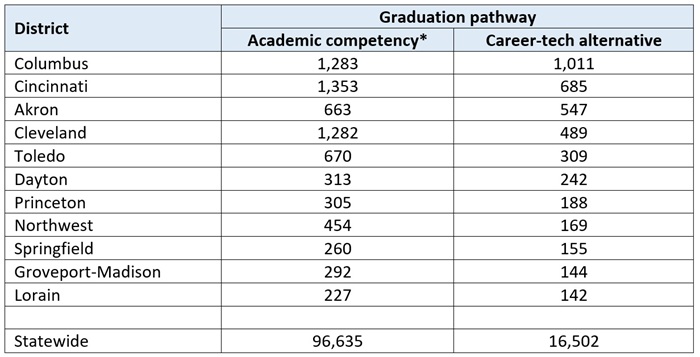
How often does this occur? Table 1 shows that 16,502 students in the class of 2024 received diplomas through the career-tech route (12 percent of the cohort). In districts such as Cincinnati, Cleveland, and Toledo, hundreds of students graduated this way. In Columbus and Akron, nearly as many students graduated via the career-tech option as met the state’s academic competency standard. Remember, such students did not demonstrate competency in English and math. Instead, as my recent report indicates, they often graduate by collecting credentials of questionable value, such as retail and public-safety certificates or generalist CPR certifications.

Table 1: Districts with the most students graduating via career-tech alternative

CTE and academics blog table 1
Source: Ohio Department of Education and Workforce. Notes. (*) This includes students who achieve the state’s competency score on the Algebra I and English II end-of-course exams, as well as a small number of students with disabilities who meet competency requirements via alternative exams. The total number of graduates in the class of 2024 were 117,979 and 15,678 non-graduates (total cohort = 133,657 students). Less than 100 students statewide graduated via the other alternatives of military enlistment, dual enrollment, or ACT/SAT scores.

When schools award diplomas to students who cannot read, write, and do math, it sets them up for a lifetime of failure and frustration. Young people with a customer service certificate might be able to find an entry-level job in retail. But what if they want to move up the corporate ladder into a better paying position—one that might allow them to provide for a family? Or what if they want to start their own business? Those positions require strong English and math skills. Consider also how many professions—even those not necessarily demanding college degrees—require candidates to pass a standardized exam just to get their foot in the door. In the area of public safety, police officers, firefighters, and paramedics have to pass exams that require academic skill. Jobs in healthcare, construction, and financial services also have exams.

Poor academic preparation doesn’t just restrict entry to professions and limit job promotion, but it also hurts workers’ ability to change careers. Some workers—perhaps tired of the same routine or backbreaking work—may simply desire a change of scenery. Others might need to reskill due to larger economic forces, including the AI revolution that could easily decimate thousands of jobs. But their chances of a successful transition are diminished when they struggle to read basic materials or solve math problems.

Career-technical education, done right, can be a game changer for students. It gives them practical skills and experiences that ready them for the workforce. But it shouldn’t be a substitute for reading, writing, and arithmetic. Ohio must insist that every student is competent in English and math before graduation, while also providing greater flexibility in its course requirements to allow for rigorous technical training for those preparing for the workforce. Academics plus strong career-connected learning is the best way to ensure that the next generation of Ohioans have what they need for long-term success.

Policy Priority:
Standards & Accountability
Topics:
Career & Technical Education
Jeff Murray
11.14.2025
Ohio charter news logo
Listen to this article
Loading the Elevenlabs Text to Speech AudioNative Player...

Stories featured in Ohio Charter News Weekly may require a paid subscription to read in full.

National recognition

Kudos to Akron’s Dreams Academy, an all-boys private school in its inaugural year of operation, for being named a finalist for the prestigious Yass Prize this year. Each year, the national organization aims to reward the most innovative and successful education models. Each of the 23 finalists will have the opportunity to make their pitch in person at an upcoming event, explaining why they should receive the $1 million prize. If the Dreams Team wins, they plan to expand their model to Cleveland, Columbus, and Youngstown. Fingers crossed for their success!

State recognition

This week we’re also celebrating all the charter schools across the state who were awarded Ohio STEM Learning Network grants for Fall 2025. The list is too long to include here, but you can see them all at this link. Overall, 194 projects across 68 counties were awarded a share of $900,000 in funding from Battelle. Great news!

School transportation must benefit all students

Fordham’s Aaron Churchill published an op-ed this week blasting Ohio’s “impractical to transport” rules that give districts every possible opportunity to deny busing to charter, private, open enrollment, and STEM school students. “Districts’ reluctance to provide reliable transportation — or any transportation at all,” he writes, “has caused unnecessary headaches for families choosing non-district options, and has even aggravated the chronic absenteeism crisis.” And he provides solutions as well.

The extent of Hope

We have been following the imminent expansion of the Schools of Hope program in Florida, which will allow charter schools to occupy space in any underenrolled district school building in the state starting in fall 2027. How many charters will take advantage of the new rules—which come with few restrictions and minimal costs—is just now starting to become clear, as is the staggering number of district buildings who fit the underenrollment criteria.  

Great new national data

As part of its Bright Spots initiative to draw out and highlight what’s working in education across the United States, The 74 published an analysis and data tool focusing on schools doing a great job in teaching students to read—especially those with high concentrations of low-income students. Even better news: Charter schools tended to be overrepresented in the list of exceptional schools, making up 7 percent of all schools in the sample, but 11 percent of those that are doing an exceptional job at the vital work of early literacy. Amazing! You can check out all the data and see if your school is on the list at the link above.

A new round?

Many pundits were sure that the constitutionality of a religiously-affiliated charter school would be tested again after the St. Isidore of Seville Catholic Virtual School v. Drummond case ended in a 4-4 decision at the U.S. Supreme Court earlier this year. All eyes are back on Oklahoma where the proposal to create Ben Gamla Jewish Virtual Charter School appears to be proving those predictions true.

*****

Did you know you can have every edition of the Ohio Charter News Weekly sent directly to your Inbox? Subscribe by clicking here.

Policy Priority:
School Choice
Topics:
Charter Schools
Jeff Murray
11.14.2025
Gadfly Bites logo
Listen to this article
Loading the Elevenlabs Text to Speech AudioNative Player...

News stories featured in Gadfly Bites may require a paid subscription to read in full. Just sayin’.

  1. First up for Friday, Fordham’s Aaron Churchill fires rhetorical shots against Ohio’s “impractical to transport” rules that give districts every possible opportunity to deny busing to charter, private, open enrollment, and STEM school students. He’s done the research—the data are clear, as are the solutions to end this problem forever more. (Columbus Dispatch, 11/13/25)

  2. Next is Aaron’s op-ed decrying Ohio’s habit of backtracking on stringent academic standards across the board. Heaven knows there are plenty of examples, but he focuses here on third grade retention and high school graduation requirements. “Enforceable state standards challenge Ohio schools to help all students reach their full potential,” he concludes. “But today’s lower expectations allow for mediocrity and shortchange students of the education they need and deserve. Ohio must set high standards — and ensure they are taken seriously.” (Cleveland.com, 11/14/25)

  3. Our final piece today is a news item, and an interesting one. The elected board members of Columbus City Schools—including a number of lame ducks at the top whose terms will end in December—this week proposed a framework for some hefty staff and service cuts that, if completed, would fully eliminate the district’s projected budget deficit with no other changes made. Even the highly-necessary closures of a dozen school buildings as previously proposed would only save a fraction of that amount (without factoring in the sales of those closed buildings, which is a whole other chestnut remaining to be roasted). Sadly, everyone knows we’ve been here before. “I feel like every four years I’m cutting $50 million and I’m having the same discussion about closing buildings,” said Ramona Reyes, the longest-serving member on the current board (and, also, one of those lame ducks). Ironically, the district would be in great shape if she and her colleagues ever actually did that right-sizing. But everyone already knows that “seeing the hurt of cutting staff or closing somebody’s building”, as Reyes puts it, has always been enough to stop all but the meagerest of such efforts cold. And I don’t see anything to indicate that the new board will be any different. (Columbus Dispatch, 11/13/25)

Did you know you can have every edition of Gadfly Bites sent directly to your Inbox? Subscribe by clicking here.

Policy Priority:
School Funding
Topics:
Governance

Pagination

  • First page « First
  • Previous page ‹ Previous
  • Page 69
  • Page 70
  • Page 71
  • Page 72
  • Current page 73
  • Page 74
  • Page 75
  • Page 76
  • Page 77
  • Next page Next ›
  • Last page Last »
Fordham Logo

© 2026 The Thomas B. Fordham Institute
Privacy Policy
Usage Agreement

National

P.O. Box 110
Burke, VA 22009

202.223.5452

[email protected]

Ohio

P.O. Box 82291
Columbus, OH 43202

614.223.1580

[email protected]

Sponsorship

130 West Second Street, Suite 410
Dayton, Ohio 45402

937.227.3368

[email protected]