
In September, the Ohio Department of Education and Workforce (DEW) released the latest round of school and district report cards, which cover the 2024–25 academic year. Here at Fordham, we’ve been digging through the data to provide some overarching analysis. Some of it, like disappointing early literacy results and Ohio’s persistent chronic absenteeism problem, are cause for concern. Other findings, like the comparative success of charter schools, provide reasons for optimism.
Nestled between these two extremes are Ohio’s math results. There are glimmers of good news, to be sure. But there’s also a lot of work to be done and no time to waste. Here are three big takeaways that will hopefully inspire state leaders to take action on policies that can boost math achievement.
1. Math proficiency improved incrementally since last year.
Chart 1 shows the number of students who scored proficient or above on the state’s math exams during the two most recent school years. In the final column, which identifies the difference between 2024 and 2025 results, green shading indicates improvement and red indicates a decline.
Chart 1. Percentage of students scoring at least proficient on math state tests in 2024 and 2025
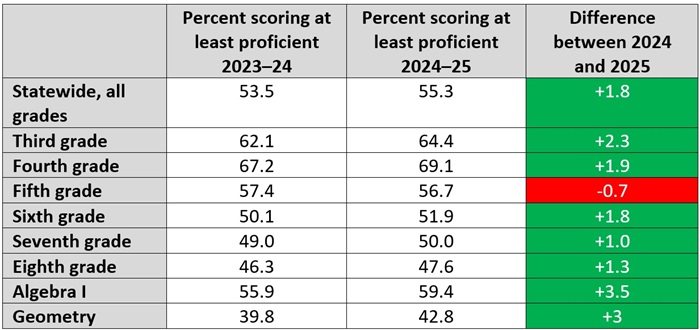
For the most part, the year-to-year differences are positive. The overall statewide proficiency rate went up by 1.8 percentage points, which is much better than the measly half a percentage point the state managed between 2023 and 2024. In elementary and middle school, third grade registered the largest improvement in proficiency, with a jump of 2.3 percentage points. But it was the high school exams of Algebra I and geometry that produced the largest gains overall (3.5 and 3 percentage points, respectively). Meanwhile, the only grade level to see a drop in proficiency was fifth, though it was by less than 1 percentage point.
Although the year-to-year differences are positive, it’s important to recognize that there are significant numbers of students who aren’t meeting grade level standards. On two tests, eighth grade math and geometry, proficiency was below 50 percent. Last year’s eighth grade results are especially worrisome, as these are students who are now in their first year of high school. In less than four years, they’ll be out in the world as adults—and less than half of them are currently proficient in math. Third and fourth grade results are encouraging, as proficiency is around or above 65 percent. But even in these areas, there are still tens of thousands of students who aren’t proficient.
2. Proficiency rates still haven’t returned to pre-pandemic levels.
Ohio’s state report card summary celebrates that we’ve seen “encouraging improvements” in statewide math proficiency over the past five years. And as outlined above, proficiency has improved in nearly every grade level. But limiting comparisons to the past five years means setting the 2020–21 school year as the baseline for improvement. That’s the same academic year that state test results cratered courtesy of the pandemic. In fact, in the majority of grades and subjects, 2021 test scores are the lowest on record over the last decade. When scores are that low during the baseline year, it’s not difficult to show improvement.
To get a complete picture of math achievement in Ohio—and to put improvements into the proper perspective—it’s crucial to compare recent results to pre-pandemic proficiency rates. Chart 2 shows the number of students who scored proficient or above on the state’s math exams during the 2018–19 and 2024–25 school years. The final column identifies the difference between the two, with red shading indicating that the proficiency rate hasn’t returned to pre-pandemic levels.
Chart 2. Percentage of students scoring at least proficient on math state tests pre- and post-pandemic
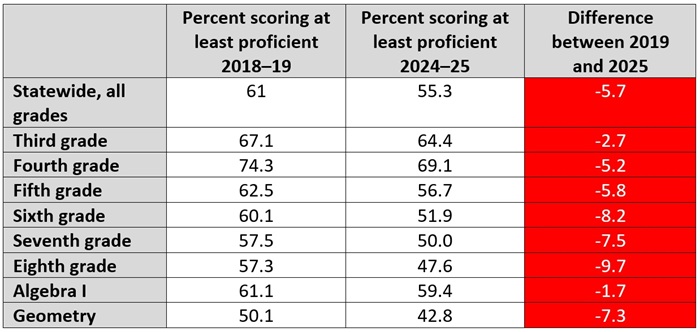
It should worry policymakers, advocates, and families that the entire final column is red. Statewide and in every grade level, math achievement has yet to bounce back to pre-pandemic levels. But it’s the size of these discrepancies that should shift the worry meter into overdrive. Fourth and fifth grade have a gap of more than 5 percentage points. Seventh grade and geometry have a gap of approximately 7 percentage points. Sixth grade clocks in at just over 8 percentage points. And eighth grade has a whopping 9.7 percentage point difference. Remember, the statewide proficiency rate jumped less than 2 percentage points this year. If Ohio doesn’t start improving at a more rapid pace, it will take another five years to close all of these gaps.
3. More than a fourth of students are scoring limited in most grades.
When students take Ohio’s state exams, their results fall into one of five performance levels: limited, basic, proficient, accomplished, and advanced. The top three levels (proficient, accomplished, and advanced) are considered passing scores, while the lowest (limited) is a red flag that students are far behind and at serious risk of falling further still.
Chart 3 shows the percentage of students who scored limited during the last two academic years. The good news is that the number declined in every grade except eighth. The bad news is that even with these declines, there are still significant numbers of students scoring limited. In elementary and middle school, the percentage ranges from 23 percent in fourth grade to an eye-popping 38.5 percent in eighth. Algebra I posted the smallest percentage, perhaps because the exam is part of Ohio’s graduation requirements and has higher stakes attached. Even so, a fifth of students are still scoring limited in a subject that’s critical for future success.
Chart 3. Percentage of students scoring limited on math state tests

***
Ohio has a math problem. Too many students aren’t meeting grade level standards. Achievement has yet to bounce back to pre-pandemic levels. Tens of thousands of kids are scoring in the lowest achievement category. And while proficiency rates did improve compared to last year, an average bump of less than 2 percentage points isn’t enough. It’s time for state leaders to buckle down and take the math crisis in Ohio seriously. Students are counting on it.