
If you follow education policy in the Buckeye State, the idea of an early literacy to-do list probably seems strange. It’s only been two years since Governor DeWine and the General Assembly established a statewide initiative focused on the science of reading. By focusing on effective instructional practices that have been proven to work for students of all reading levels, the initiative promises to raise literacy achievement across the board.
But a comprehensive literacy strategy, like the ones that have greatly benefitted students in Florida and Mississippi, also includes intensive interventions for students who are falling far behind. In this area, Ohio still has work to do. Let’s examine two ideas that Ohio lawmakers should consider in an effort to provide extra support to the students who need it most.
1. Reinstate the original third grade retention requirement
Lawmakers should be familiar with the concept of retaining struggling readers, as Ohio’s Third Grade Reading Guarantee has been the law of the land for more than a decade. The guarantee, a package of early literacy reforms passed during the Kasich era, aims to ensure that all children have the foundational reading skills they need to succeed. Its cornerstone is a requirement for schools to retain students who are still struggling to read fluently at the end of third grade and provide them with intensive interventions before promoting them to fourth.
Or at least that was the cornerstone. In response to political pressure from the education establishment, lawmakers gutted the retention requirement in 2023. Technically, struggling readers can still be retained. But state law now includes a significant loophole that allows schools to avoid retention if parents request promotion. Unsurprisingly, report card data indicate that, after the new policy went into effect, virtually every third grader in Ohio—regardless of their reading skill—was promoted.
Bowing to adult priorities rather than holding the line is a bad look for lawmakers, and it’s not good for kids. In a well-known 2011 study, the Annie E. Casey Foundation found that non-proficient readers in third grade are four times more likely to drop out of high school than their proficiently reading peers. This clearly demonstrated that failing to intervene early has serious long-term consequences for students and helped prompt Ohio’s guarantee in the first place. Meanwhile, rigorous studies published since that landmark report have evaluated states’ third grade retention policies. All of them—including one from Ohio, as well as Florida, Indiana, and Mississippi—have found that the policy significantly boosts the achievement of retained pupils. The upshot? If state lawmakers want to ensure that Ohio’s science of reading initiative reaches its full potential, they need to reinstate a firm retention policy to prevent students from falling through the cracks.
2. Expanding intervention to struggling readers in all grades
When students take Ohio’s state exams, their results fall into one of five performance levels: limited, basic, proficient, accomplished, and advanced. The top three levels (proficient, accomplished, and advanced) are considered passing scores. But data from the two most recent school years show that a sizable percentage of Ohio’s students are scoring at the limited level in reading.
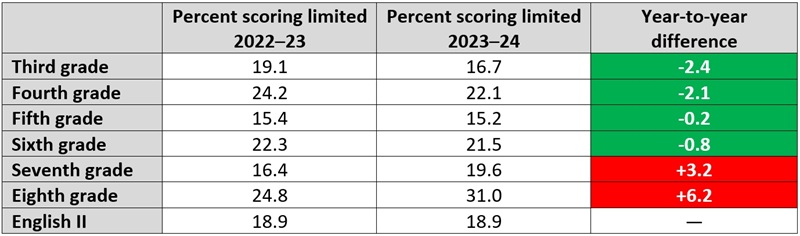
Chart 1 shows that the number of students in grades 3–8 who scored limited in the last two years ranges from 15 to 31 percent. Things aren’t much better in high school, where nearly 19 percent of students scored limited on the English II end-of-course exam. It’s good news that, in the earlier grades, the number of students scoring limited decreased between 2023 and 2024. But in seventh and eighth grades, the number is rising.
Chart 1. Percentage of students scoring limited on English language arts state tests
To their credit, lawmakers are considering ways to intervene with struggling students. Senate Bill 19 would require public schools to provide academic intervention services to students who score limited on reading or math state tests. Given the percentage of students who fall into this category—not only in reading, but also in math—lawmakers would be wise to get these provisions into law as soon as possible.
***
With Ohio’s science of reading initiative, state lawmakers established a solid foundation for reading improvement. Building on that foundation is the next step. Reinstating retention and ensuring low-scoring students are provided with intensive intervention could bolster the likelihood that Ohio’s early literacy efforts are successful for all students.