Mobile Navigation

  • National
    • Policy
      • High Expectations
      • Quality Choices
      • Personalized Pathways
    • Research
    • Commentary
      • Gadfly Newsletter
      • Flypaper Blog
    • Events
    • Scholars Program
  • Ohio
    • Policy
      • Priorities
      • Media & Testimony
    • Research
    • Commentary
      • Ohio Education Gadfly Biweekly
      • Ohio Gadfly Daily
  • Charter Authorizing
    • Application
    • Sponsored Schools
    • Resources
  • About
    • Mission
    • Board
    • Staff
    • Career
Home
Home
Advancing Educational Excellence

Main Navigation

  • National
  • Ohio
  • Charter Authorizing
  • About

District of Columbia‘s Teacher Union Strength Profile

This profile is one of 51 state profiles accompanying Fordham’s report, A Crowded Table: Teacher Union Strength in 2026, which updates Fordham’s 2012 rankings of state teacher union strength.

  • Read more about District of Columbia‘s Teacher Union Strength Profile

Nebraska’s Teacher Union Strength Profile

This profile is one of 51 state profiles accompanying Fordham’s report, A Crowded Table: Teacher Union Strength in 2026, which updates Fordham’s 2012 rankings of state teacher union strength.

  • Read more about Nebraska’s Teacher Union Strength Profile

Missouri’s Teacher Union Strength Profile

This profile is one of 51 state profiles accompanying Fordham’s report, A Crowded Table: Teacher Union Strength in 2026, which updates Fordham’s 2012 rankings of state teacher union strength.

  • Read more about Missouri’s Teacher Union Strength Profile

Minnesota’s Teacher Union Strength Profile

This profile is one of 51 state profiles accompanying Fordham’s report, A Crowded Table: Teacher Union Strength in 2026, which updates Fordham’s 2012 rankings of state teacher union strength.

  • Read more about Minnesota’s Teacher Union Strength Profile

Louisiana’s Teacher Union Strength Profile

This profile is one of 51 state profiles accompanying Fordham’s report, A Crowded Table: Teacher Union Strength in 2026, which updates Fordham’s 2012 rankings of state teacher union strength.

  • Read more about Louisiana’s Teacher Union Strength Profile
Aaron Churchill
7.9.2026
OH transportation workgroup blog image
Getty Images/stu99
Listen to this article
Loading the Elevenlabs Text to Speech AudioNative Player...

In 2025, the General Assembly created a workgroup tasked with reviewing pupil transportation and developing recommendations aimed at “better meet[ing] the transportation needs of Ohio students.” Consisting of four state lawmakers (two from each party) and 11 school officials (representing all education sectors), the workgroup was formed in response to persistent concerns about students being left without rides, particularly those attending public charter and private schools.

The workgroup’s final report was released earlier this month. It depicts districts’ growing use of an “impracticality” loophole that allows them to deny student transportation. The report offers a series of recommendations—some more realistic than others—that seek to address the problem. Let’s take a look at the findings and key recommendations.

“Impractical to transport”

For more than 50 years, Ohio has required districts to provide transportation to all resident students, whether they choose a district school or an alternative.[1] The law makes perfect sense. It promotes safety and efficiency, as a single entity is responsible for busing rather than hundreds of individual schools attempting the feat. It’s also fair to taxpayers: All parents receive a public service from the district to which they pay taxes. Finally, the law honors parents’ choices. They can rely on their local district for transportation even if they select another option. To support districts in this task, the state provided $830 million for transportation in FY26 (up from $603 million four years ago).

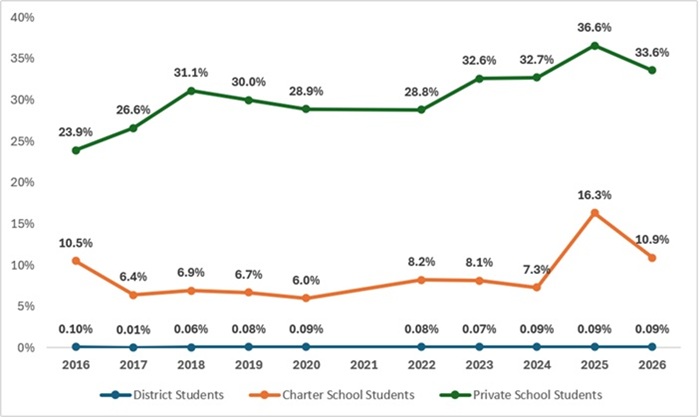
Unfortunately, as the workgroup report discusses, school districts declare tens of thousands of charter and private school students “impractical to transport.” This loophole—or “statutory opportunity,” as the report awkwardly phrases it—permits districts, through school board resolution, to deny tax-paying families the busing service they are otherwise entitled to. The latest numbers per the report: In 2025–26, districts rejected transportation for 19,153 private school and 2,723 charter school students (representing 34 and 11 percent of transported private and charter students, respectively). Instead, districts pay their families a nominal “payment in lieu of transportation” of about $600—half of what districts spend to bus a typical student and the equivalent of a meager three bucks and change per day.

As Figure 1 shows, districts have increasingly used this loophole to avoid busing. Impracticality rates over the past two years are the highest on record (these data have been tracked since 2015–16). And in 119 districts (roughly one in six statewide), the workgroup notes that every single private and charter school student was declared “impractical”—likely reflecting a blanket policy of rejecting parents’ requests rather than making case-by-case determinations. In stark contrast, only 618 district pupils statewide were denied transportation last year, representing less than one in every 1,000 transported district students overall. Likely, these are mainly students attending their home district but could consist of some open enrollees who are entitled to transportation if they make it to a bus stop within their district of attendance.

Figure 1. Percentage of district, charter, and private school students declared “impractical to transport,” 2015–16 to 2025–26
OH transportation workgroup blog figure 1
Source: Ohio Student Transportation Workgroup report. Note: Data for 2020–21 are omitted, as they likely reflected challenges related to the Covid-impacted year.

Workgroup recommendations

The workgroup report generally acknowledges that denying transportation en masse is wrong and recommends a policy framework that would “guarantee transportation for all eligible Ohio students to their school of choice.” This goal is spot-on and consistent with Ohio’s longstanding policy (save for districts’ “opportunity” to declare children “impractical”).

Given this, one might have expected a clear and forceful call to simply repeal the impracticality provisions, a move that lawmakers should seriously consider. But, alas, the workgroup—comprised of several district officials—did not go that route. Instead, the report argues for a “phasing out” of impracticality conditioned on a slew of other policies being adopted (e.g., lots more money, regional transportation consortia, increased data collections, statewide student registration systems, and more). Those are fine ideas, but also large and complicated proposals that would be tough to implement in the real world and thus unlikely to be enacted. In the meantime, thousands of Ohio families will continue to be denied transportation because of impracticality.

Fortunately, the workgroup shifts toward more realistic proposals near the end of the report. There, it suggests ways that lawmakers can at least curb districts’ abuse of the impracticality provision. Commendable recommendations include:

  • Require the Ohio Department of Education and Workforce (DEW) to audit districts with high rates of impracticality determinations.

  • Require DEW to issue rules regarding what standards districts must meet to declare a student impractical—e.g., what precise time or distance allows for impracticality. (Under current law, districts must “consider” six factors—e.g., time/distance and cost—to declare a student impractical to transport, but there are no guidelines about when a factor applies.)

  • Add statutory language that requires districts to “provide clear evidence” (not just “consider”) that each of the six factors applies for transportation to be deemed impractical.

Though not formally adopted by the workgroup, a report appendix contains two more critical policy recommendations:

  • Increase the payment in lieu of transportation to better support families bearing transportation responsibilities, while also acting as a stronger deterrent to impracticality declarations.

  • Codify an attorney general opinion and DEW guidance that ensures equal provision of transportation to private and charter high school students, if offered also to district high schoolers. (State law requires busing for K–8 students but not high school.)

***

School transportation should be a basic public service provided by local governments (districts) to all families in the community. Regrettably, the bus doesn’t come around to serve thousands of Ohio students due to a massive loophole in state law. Though not perfect, the workgroup report contains some recommendations that would help to curtail abuse and better ensure that every student gets a ride to school. 


[1] Certain commonsense exceptions do apply: Districts are not required to transport students who live less than two miles from their school or more than 30 minutes away. Providing busing for high school students (grades 9–12) is also optional for districts.


Policy Priority:
School Funding
Topics:
School Finance
Robert Pondiscio
7.9.2026
American and Texas flags
Getty Images/Amy Sparwasser
Listen to this article
Loading the Elevenlabs Text to Speech AudioNative Player...

This June, the Texas State Board of Education adopted new social studies standards and a required literature reading list for its public schools. These changes follow Texas’s 2024 release of its “Bluebonnet” curriculum, a package of instructional resources for elementary school, which sparked controversy over the inclusion of Bible stories in the reading materials.

Bible stories, canonical books, and “patriotic” social studies standards have each invited familiar charges of culture-war excess. Perhaps. But look again—and look at these three things together.

Taken together, these initiatives suggest something more consequential than conservative provocation. Texas appears to be developing a coherent theory of education: Knowledge is cumulative, literacy depends on background knowledge, and language proficiency has an unavoidable cultural valence, meaning that it reflects the knowledge a speech community shares and assumes its members possess. Furthermore, Texas’s theory of education assumes that public education is obligated to equip every child with the knowledge, language, habits, and skills needed for full and effective participation in America’s civic, cultural, and economic life.

Texas may not have gotten every curricular choice right. But it appears to know what it thinks education is for. That alone distinguishes it from much of American schooling.

Start with the state’s new social studies standards. Their most striking feature is not their ideological orientation but their specificity and architecture. In the early grades, children learn stories, people, places, events, and traditions. Beginning in third grade, the standards become broadly chronological, moving from ancient civilizations through Greece and Rome, the medieval world, the Renaissance and Reformation, the Scientific Revolution and Enlightenment, European colonization, the American Revolution, and the Constitution. The standards explicitly call for concepts to be embedded in stories and historical content in order to “create schema for understanding.”

This is a significant departure from the way American education often thinks about social studies—and education more broadly. For decades, schools have been encouraged to focus on skills: critical thinking, problem solving, analysis, collaboration, and, in literacy, comprehension strategies such as finding the main idea, making inferences, and identifying the author’s purpose. The tacit assumption is that the particular content used to practice these skills is negotiable and interchangeable.

Texas’s approach goes in the opposite direction: Knowledge builds on knowledge. What a child learns in second grade affects what she can understand in fifth grade, which affects what she can comprehend in eighth grade. A student who understands Greece and Rome, Hebrew Scriptures, medieval institutions, the Reformation, and the Enlightenment is better prepared to understand the American founding. The fifth-grade standards make those connections explicit.

This is not merely a theory of history or literacy instruction. It’s a theory of education itself.

If literacy depends on knowledge, and knowledge is cumulative, content cannot be endlessly interchangeable—a school’s entire curriculum is therefore a literacy curriculum. That helps explain why Texas’s social studies standards, Bluebonnet curriculum, and reading list should be viewed as parts of a whole. Coherence demands choices. A school system cannot be indifferent to whether one classroom studies ancient Egypt, another spends six weeks on a generic unit about “communities,” and a third pursues student-selected projects, and then assume all children will arrive at the next grade equally prepared.

Natalie Wexler, one of the nation’s most important advocates for knowledge-building curriculum, recently praised the ambition and specificity of the Texas social studies standards while worrying that their perceived ideological coloration could unnecessarily inflame the culture wars. That concern is worth taking seriously; Virginia, which she points to as an exemplar, shows that content-rich standards can be built through a more bipartisan process. But Texas is attempting something broader than writing better standards for a single subject: aligning literacy, curriculum, culture, and civics around a common theory of education.

To Wexler’s broader point about political provocation, conversations about curriculum are unavoidably complicated and uncomfortable, because background knowledge is not culturally neutral and does not always yield to preferred notions of inclusivity.

E. D. Hirsch Jr.’s deepest insight was not merely that reading comprehension depends upon knowing facts. He also understood that language is a cultural artifact. A speech community’s history, religion, literature, myths, symbols, idioms, and collective memories become embedded in the language its members speak and read. A “David and Goliath” struggle, a “Trojan horse,” an “Achilles’ heel,” and “Big Brother” are not mere decorative flourishes appended to English. They are part of English.

This raises an essential but uncomfortable curricular question: What does the language we want children to master assume they already know?

That question does not yield an immutable list of names, books, and events. Speech communities change, and America’s cultural inheritance has always expanded and evolved. Nor does it render representation irrelevant. America’s diversity and the contributions and experiences of its people must be taken seriously, treated respectfully, and taught truthfully.

But “representation” is not the purpose of public education. A curriculum is not principally a mirror in which every child must see a flattering reflection of himself. Its more important function is to give children access to a world they did not make but must learn to navigate—including the taken-for-granted cultural knowledge their more privileged peers are likely to encounter outside school. That is an equity argument. Affluent and highly educated families will always find ways to transmit sophisticated language, cultural knowledge, institutional know-how, and civic confidence to their children. Children who depend chiefly upon school for access to those things have the greatest need for an explicit, cumulative, coherent curriculum.

Critics have also charged that the new Texas standards and curricula are overly patriotic. But public schools are, if nothing else, public institutions. It should not be controversial for them to cultivate some measure of affection for the community, state, and country that created and sustains them. This need not require triumphalism, mythology, or silence about injustice. But it is simply incorrect to view critique as neutral but affirmation as ideological. A curriculum can estrange children from their country just as surely as it can teach uncritical reverence for it.

Moreover, it’s simply not accurate to say that the standards paper over American failures. They include slavery, the Civil War, Juneteenth, segregation, the civil rights movement, and figures such as Frederick Douglass, Harriet Tubman, Martin Luther King Jr., Claudette Colvin, Rosa Parks, Ruby Bridges, and Hector P. Garcia. The story the standards tell is not merely one of national greatness, but of ideals, failures to honor them, and struggles to extend them.

It’s also worth noting that civic education is not merely about attachment. Children need knowledge of American history and institutions so they can understand their rights, navigate government, make persuasive arguments, pursue opportunities, advance their interests, participate in self-government, and change institutions intelligently when necessary.

The Texas social studies standards are admirably explicit about this knowledge-building component of civics. They aim to develop responsible citizens who understand constitutional government, consent of the governed, civic virtue, individual rights, and the preservation of liberty.

In sum, literacy gives children access to the speech community, and civic knowledge gives them agency within the political community. The pursuit of both aims tends to spark political controversy and debate, but they are vital nonetheless.

None of Texas’s curricular reforms guarantee success. The state’s greatest challenge may be practical: Its new social studies standards are enormously ambitious, yet social studies is easily squeezed out by reading and math, and classroom practice is hard to change through state policy alone.

Texas appears to have grappled with this problem. Its ambitions extend beyond aligning standards and curriculum to creating coherence across the larger education system.

“What the State Board has done is significant because it has attempted to ensure coherence in the standards,” Texas Education Commissioner Mike Morath told me. “What broader laws in Texas do is ensure that coherence is supported by high-quality instructional materials, teacher preparation, in-service training, and, ultimately, assessment.”

Each of those levers matters, but not equally. Better teacher preparation and training can help change practice. Aligned assessment is more powerful still. Texas plans to align its reading assessments with its knowledge-building ambitions, drawing some passages from the literary works list and others from content students will have studied in science and social studies. If schools know that reading comprehension will be tested partly through material students are supposed to have encountered, the familiar dictum that “what gets tested gets taught” may finally be put to constructive purpose. Schools will have less incentive to sacrifice history and science for generic reading-skills practice if state reading tests reward the acquisition of specific domains of knowledge.

Whether all this is enough to change classroom practice remains to be seen. But Texas is at least attempting to align the major levers available to a state: what children are expected to know, the materials teachers use, how teachers are prepared and trained, and what the state measures. That is a far more serious theory of implementation than states typically bring to reform efforts.

This larger development—and the contrast to business as usual—is worth recognizing and praising. American education has spent decades fruitlessly pursuing skills without knowledge, literacy without content, diversity without commonality, and citizenship without grateful inheritance. Texas is attempting something different: a coherent approach to knowledge, language, literacy, and civic formation.

Whether it can execute that vision remains an open question. Some of its individual choices deserve debate, and others will surely require revision. But the fact that Texas’s emerging theory conflicts with several fashionable ideas about education is not the problem.

It is the point.

Policy Priority:
High Expectations
Topics:
Curriculum & Instruction
Governance
Arthur VanderVeen
7.9.2026
Students on laptops
Getty Images/SeventyFour
Listen to this article
Loading the Elevenlabs Text to Speech AudioNative Player...

Dale Chu’s recent critique of through-year assessment revisits a familiar concern: that state assessments cannot serve both accountability and instruction without compromising one purpose or the other. It is a concern worth taking seriously. Accountability requires comparable, defensible claims about student performance; instruction requires timely, actionable evidence that helps teachers respond to student learning. If poorly designed, through-year assessment can blur those purposes and satisfy neither.

But that is not an argument against through-year assessment. It is an argument for better design.

Nathan Dadey and his colleagues at the Center for Assessment have made the more careful version of this point. They define through-year assessments as systems intended to support both “the production and use of a summative determination” and at least one additional goal. The most commonly cited additional goal is instructional utility: providing information during the year that helps educators and students make better decisions while there is still time to act.

That is exactly the claim through-year assessment systems must be held accountable for.

So what is required for instructional utility? The Center has identified five essential features: coherence with the enacted curriculum, tasks that support deeper thinking, results at the right grain size, timely feedback, and results that inform instruction. The fifth is both the most important and the hardest to achieve. It is not enough to display data faster or more often. Assessment becomes instructionally useful only when it helps educators understand what students are thinking, where they are struggling, and what to do next.

That is the design problem we are working to solve with the Montana Office of Public Instruction.

In the Montana MAST through-year model, shorter assessment events are designed to align flexibly to local curriculum scope and sequence while still aggregating to a comparable statewide summative measure. The goal is not to make a single test “do everything.” It is trying to replace a fragmented assessment ecosystem—state summative tests over here, commercial interims over there, curriculum-embedded checks somewhere else, and disconnected remediation tools on top of all of it—with a more coherent system of instructional decision making.

This is not a “New Shimmer” problem—asking one product to do two incompatible things. Granted, the accountability concern is real. Because through-year testlets contribute to the final summative score, accountability pressure does not disappear; it is distributed across the year. That makes design especially important. These short testlets, administered in a class period every four to six weeks, are not intended to replace classroom formative assessment practices or curriculum-embedded assessments. They are intended to monitor students’ progress toward mastery in a way that applies accountability not simply to the final outcome, but in support of better instructional practice throughout the year: reinforcing the adopted curriculum rather than narrowing it, testing students on what they have had an opportunity to learn, returning instructionally useful feedback while it can still shape instruction, and supporting cycles of inquiry that help teachers adjust instruction before learning gaps harden.

We are seeing evidence that students and educators recognize the value of this approach as they become more familiar with it. In the most recent annual survey of Montana teachers and students, 79 percent of students and 59 percent of teachers surveyed agreed that students learn more when they take several smaller assessments during the year instead of one large test at the end. And teachers overwhelmingly value the misconceptions reporting because it gives them something specific and actionable they can address in the context of their taught curriculum. That’s something they just aren’t getting from the rest of the test pile.

Dale’s argument largely recycles an older debate as if the field has stood still. Innovative assessment leaders are moving beyond the false choice between instructional utility and comparability. A growing number of states—including Montana, Indiana, North Carolina, Missouri, Delaware, and now Texas and Oklahoma—are exploring ways to make state assessment more useful without abandoning comparability or rigor. The details differ, but the motivation is shared: State leaders recognize that the current model often produces information too late, too far from instruction, and too disconnected from the decisions educators need to make during the year.

That is why through-year assessment should be evaluated not as a new version of the traditional summative test, but as an effort to redesign the state assessment system around a clearer theory of action. The recent analysis of MAST published by the Montana Office of Public Instruction and Education First makes that point well:

Through-year assessments are best understood not as incremental modifications to existing summative models but as fundamentally different systems that require clarity of instructional vision, deeply contextualized theories of action, intentional incentive structures and a reimagined role for state education agencies. When these elements are misaligned, TYAs risk amplifying reactive or incoherent instructional responses. When they are thoughtfully aligned, however, TYAs have the potential to provide information that is genuinely value-added: supporting educators in making more informed, timely and productive decisions for their students.[1]

State assessments should not promise to be everything to everyone. But they can be better than the status quo. Through-year models should be judged by what they make possible in practice: teachers using more actionable evidence in planning conversations, districts using data to target professional learning and curriculum implementation supports, and states gaining clearer visibility into where investments are needed to help students meet rigorous expectations. The challenge is real, but it is one that state assessment systems are increasingly positioned to meet.


[1] Aneesha Badrinarayan, Cedar Rose, and Emma Fortier, Moving Toward Instructional Relevance: Recommendations for Through-Year Assessment Systems that Advance Teaching and Learning (Education First and Montana Office of Public Instruction, 2026), 32.

Jenn Vranek Khaled Ismail
7.9.2026
Bad grade
Getty Images/IcemanJ
Listen to this article
Loading the Elevenlabs Text to Speech AudioNative Player...

In a recent Flypaper post, Dale Chu argues that the promise of a single assessment system doing multiple things well is “too good to be true.” He says that through-year assessments (TYA)—tests administered periodically throughout the school year that culminate in a summative score—are trying to do too much. But his critique relies on theoretical exaggerations, ignores the glaring failures of our current testing landscape, and dismisses the very real potential of through-year assessments to reduce testing while actually helping teachers.

The foundation of his argument rests on a philosophical, rather than empirical, claim: that a test cannot simultaneously be instructionally useful for teachers and provide valid accountability data for policymakers. In reality, state assessment systems should serve two perfectly legitimate purposes: instructional improvement and system-level accountability. When state assessments are designed to serve instructional improvement, they can also serve system-level accountability. It’s the reverse that is not true. The dozen states redesigning their state end-of-year tests into through-year tests to support educators to improve learning also can help districts and states see whether all students are being served well, and where the system needs to act.

Dale also selectively points out the potential “unintended effects” of through-year assessments, while conveniently avoiding the massive unintended negative effects created by the current system. The modern assessment landscape is an incoherent pile of redundant, unhelpful tests. The average American student takes seven standardized tests a year, and in the highest-testing districts, students take 88 by the end of eighth grade.

Because state end-of-year tests fail to give teachers timely feedback, a market failure has emerged. Districts spend millions layering on commercial interim assessments (like NWEA or STAR) throughout the year. District leaders see these interim scores, assume students are on track, then learn otherwise from the state summative results.

This pile of expensive, unhelpful tests littering the school calendar surely isn’t what advocates for system accountability intend.

Perhaps most frustrating is Dale’s assumption that states adopting TYA will inevitably spend more money and “add to students’ total testing burden.” This assumes the worst case and ignores how TYA actually functions. If a state-coordinated through-year system replaces the disjointed commercial interims districts currently buy, total testing time goes down, not up. In fact, during Indiana’s first year of ILEARN implementation, more than 60 percent of surveyed districts reported they are eliminating commercial interims like MAP or STAR because ILEARN provides what they need. Texas soon will explicitly prohibit districts from administering locally mandated benchmark tests that are not aligned to what’s taught as it implements its new through-year assessment system. This should result in fewer tests overall.

Through-year assessments are not a magic bullet, but they hold the distinct promise of making summative tests far more meaningful to educators and families. By breaking up the end-of-year testing monolith and aligning assessments more closely with what is actually being taught, TYA provides timely, relevant feedback that lets teachers make real-time course corrections during the school year. Here are facts about leading models:

  • Montana’s MAST allows districts to choose when to administer “testlets” according to their own local scope-and-sequence, counts the testlets’ results toward the summative score, and includes student misconceptions on the math reports that educators are nearly universally praising as immediately actionable and helpful. MAST was designed first for instructional utility and is in federal peer review now to serve as the state’s accountability assessment. And the worry that this funnels every school onto a single course sequence does not hold up: The state built a configurator that lets each district match the testlets to its own curriculum and pacing. This year it ran more than 800 configurations across 52 curricula, built on the most commonly used high-quality instructional materials (HQIM). (See Arthur VanderVeen’s post for more about Montana’s model.)

  • Indiana’s ILEARN is a series of formative “checkpoints,” with “second chance opportunities” throughout the year that feed predictive modeling, though the summative score comes only from the end-of-year test. It uses an application programming interface (API) to sync state assessment data automatically with locally adopted HQIM and intervention platforms, which eliminates manual data tracking and generates personalized study and remediation plans in tools students already use. Indiana is also moving to require those vendors to align to the state’s Performance Level Descriptors, so the rigor bar holds no matter which materials a district adopts.

Dale also raises the specter of kids and teachers facing three high-stakes tests a year instead of one. We would frame the stakes differently. The stakes can be higher, but in a way, we should want them to be. When a test gives a teacher honest, specific information about what a student knows, where they are stuck, and why—and does so while that student is still in the room—it pushes adults to act on the results during the year instead of reading about them after the fact. That is the kind of accountability people have been asking for, when they complain that schools are judged on results they never had a real chance to do anything about.

We’re excited to see what Kansas, Texas, and Missouri will contribute to continued state innovation and learning. At last month’s National Conference on Student Assessment, Texas Education Agency Commissioner Mike Morath indicated the new state-developed beginning- and middle-of-year interim assessments will use “warm reads,” which are texts related to the concepts and vocabulary in students’ curriculum. Warm reads, described here by science of reading guru Natalie Wexler, help more accurately measure students’ reading comprehension. Texas is going a step further and barring districts from layering other non-instructionally relevant tests on top of its system and setting criteria for what qualifies. We are for it, on one condition: The bar for quality has to be high, and the state must face down the vendor lobby when their products cannot clear it.

Given all of this potential, we wish Dale and others would stop arguing against the theoretical versions of through-year assessment, rather than evaluating whether specific models actually outperform the broken status quo. We need more research, evaluation, and innovation to understand how well TYA measures provide support for both instruction and accountability and fewer theoretical critiques.

The question we should be asking is not “can one test do everything flawlessly?” (Because, duh, no.) The real question is whether a thoughtfully designed, state-coordinated through-year system can work better than the expensive, redundant, and instructionally useless status quo we have today.

Policy Priority:
High Expectations
Topics:
Accountability & Testing
Evidence-Based Learning
Curriculum & Instruction
Governance
Teachers & School Leaders
Amber M. Northern, Ph.D.
7.9.2026
School entrance
Getty Images/sangaku
Listen to this article
Loading the Elevenlabs Text to Speech AudioNative Player...

New York City’s Small Schools of Choice (SSC) program was one of a panoply of education reforms enacted in the early 2000s under then-mayor Michael Bloomberg and schools chief Joel Klein. The idea was to redesign students’ high school experiences and to increase graduation rates for students from low-income backgrounds by leveraging smaller school models emphasizing personalized academic instruction. A recent report from MDRC gives us a longer-term look at how SSC students have fared over time.

The SSC effort initially closed dozens of large, low-performing high schools in the city; created over 100 new small schools to serve students in the lowest-income areas of the city; and used a ranked-choice application system to assign all rising ninth-graders to specific high schools, with priority given to low-income students. Ultimately, about 90 percent of students attending SSCs were Black or Hispanic and 83 percent qualified for free or reduced-price lunch.

SSCs typically served around 100 students per grade and emphasized academic rigor and personalized relationships between teachers and their students. Building staff chose a school theme and a community partner to provide additional support, which ranged from helping to fund programs, to hiring staff, to providing students with work-based experiences.

Since 2010, MDRC researchers have used the lottery process embedded within New York City’s district-wide high school assignment process to study SSCs’ effects. In short, when a given school had more applicants than seats, the district’s admissions algorithm randomized which applicants received an offer. So far, they’ve found large, positive impacts on high school graduation. However, they haven’t been able to look at longer-term outcomes until now, as enough time has passed.

MDRC drew an evaluation sample comprising over 100 SSCs and more than 16,000 students, including those who won the lottery and enrolled in an SSC, and those who lost and enrolled instead in a non-SSC New York public school. Researchers followed students for six years who attended an SSC in the 2005–06 through 2008–09 school years and measured effects on enrollment in postsecondary education, degree attainment, future employment, and earnings.

Descriptive data show that, on average, 76 percent of SSC enrollees graduated from high school within four years, versus 68 percent of non-SSC enrollees. Their causal results show large, positive effects (nearly 10 percentage points) on students’ enrollment in postsecondary education immediately after graduating from high school. But there was no difference between the two groups in the selectivity of institutions in which they enrolled. And that big percentage-point difference in college enrollment translated into a more modest positive effect of 2.5 percentage points on four-year postsecondary degree attainment rates, suggesting that SSCs boosted college entrance more than degree completion (perhaps a by-product of the college-for-all ethos). Finally, SSCs do not have an impact on individuals’ employment rates or earnings six years after their expected high school graduation. Still, the researchers believe that may not be the last word because many sampled kids are still in college.

While most of the initial Small Schools of Choice schools are still around, that terminology is no longer used today. However, New York City Schools is still opening and operating small and themed schools. But it’s doing so with a more organized and curated push for career-connected learning in them, which befits the current focus on building varied and effective pathways from high school to postsecondary success, in all its forms. That’s all well and good.

Just as commendable is MDRC’s and the Gates Foundation’s 16-year commitment to following these schools. In education, patience and funding usually run out long before the evidence does. It’s worth applauding efforts to stay the course long enough to see where results do—and do not—materialize.

SOURCE: Rebecca Unterman and Miki Shih, “Effects of New York City’s small schools of choice on postsecondary degree attainment and employment,” MDRC (January 2026).

Policy Priority:
Quality Choices
Topics:
Evidence-Based Learning
Curriculum & Instruction
Governance
Teachers & School Leaders

Pagination

  • First page « First
  • Previous page ‹ Previous
  • Page 22
  • Page 23
  • Page 24
  • Page 25
  • Current page 26
  • Page 27
  • Page 28
  • Page 29
  • Page 30
  • Next page Next ›
  • Last page Last »
Fordham Logo

© 2026 The Thomas B. Fordham Institute
Privacy Policy
Usage Agreement

National

P.O. Box 110
Burke, VA 22009

202.223.5452

[email protected]

Ohio

P.O. Box 82291
Columbus, OH 43202

614.223.1580

[email protected]

Sponsorship

130 West Second Street, Suite 410
Dayton, Ohio 45402

937.227.3368

[email protected]